



Yes, you can donate Bitcoin to charity and skip the capital gains tax entirely. The trick is to send the Bitcoin itself, not sell it first and hand over the cash.
That one choice is worth real money. On a single Bitcoin bought for $10,000 and now worth about $64,300, donating directly saves $8,145 in tax and puts $8,145 more into the charity’s hands.

This guide covers donate bitcoin to charity tax basics for the three countries where most of our readers live: the United States, the United Kingdom and Canada. It uses today’s Bitcoin price, the real forms, and the rules as they stand in November 2026.
- Key Takeaways
- Why Donating Bitcoin Beats Selling It First
- The US Rules, in Plain English
- Only a 501(c)(3) Counts
- You Must Have Held It for Over a Year
- The 30% of AGI Cap
- The Paperwork: Form 8283 and Friends
- You Have to Itemize
- The UK Rules: No Tax on the Gift, but No Gift Aid Either
- The Canada Rules: A Credit, but the Gain Still Counts
- US vs UK vs Canada at a Glance
- What If You Live Somewhere Else?
- How to Donate Bitcoin to Charity in 7 Steps
- Where Your Bitcoin Can Go
- 5 Mistakes That Cost Donors Real Money
- The December 31 Deadline
- Frequently Asked Questions
- Is donating Bitcoin to charity tax deductible?
- Do I need an appraisal to donate Bitcoin?
- Can I donate Bitcoin I bought less than a year ago?
- Does the charity have to accept Bitcoin directly?
- Can I donate Bitcoin to a charity in another country?
- What happens if I donate Bitcoin and the price falls the next day?
- Sources
This guide is general information only, not tax advice. Tax rules depend on your own situation, so talk to a qualified tax adviser before you move serious money.
Key Takeaways
- Donate the Bitcoin itself to a qualified charity and you pay no capital gains tax on the gain in the US, while still deducting the full market value.
- In the US the charity must be a 501(c)(3), you must have held the Bitcoin for over a year, and the deduction is capped at 30% of your adjusted gross income.
- The UK treats a crypto gift to a registered charity as a no-gain, no-loss disposal, so no capital gains tax arises, but Gift Aid does not apply to crypto.
- Canada still treats the gift as a sale at fair market value, so the gain counts, but the donation tax credit usually offsets the tax.
- Gifts over $5,000 in the US need a qualified appraisal and Form 8283, and gifts over $250 need a written acknowledgment from the charity.
- A gift must reach the charity by December 31 to count for the 2026 tax year, so do not leave it to the last week.
Why Donating Bitcoin Beats Selling It First
Most people sell first because it feels simpler. You sell the Bitcoin, the cash lands in your bank, and you donate the cash.
The problem is that the sale is a taxable event, and the tax comes out before the charity sees a cent.
Donating the Bitcoin directly skips that step. The charity receives the coins, sells them tax-free because it is a charity, and you claim the full value as your deduction.

Everyone ends up better off except the tax office.
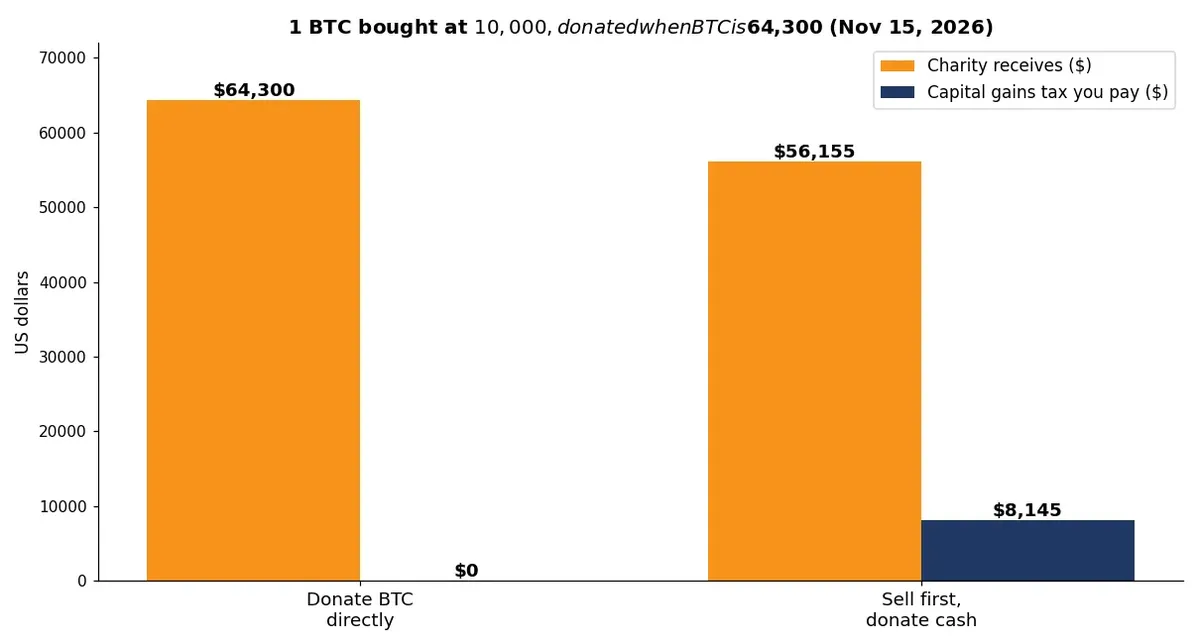
The chart above uses real numbers from this morning. Bitcoin traded at about $64,300 on November 15, 2026, after touching $62,006 overnight.
One coin bought for $10,000 is now worth $64,300, so the gain is $54,300.
| Donate 1 BTC directly | Sell 1 BTC, donate the cash | |
|---|---|---|
| Charity receives | $64,300 | $56,155 |
| Capital gains tax you pay | $0 | $8,145 |
| Your tax deduction | $64,300 | $56,155 |
| Extra benefit | Full value reaches the charity | You pay tax first, then give |
At the 15% long-term capital gains rate, the tax on that $54,300 gain is $8,145. Sell first and the charity gets $56,155.
Donate directly and the charity gets the full $64,300, while your deduction is $8,145 bigger too.
Bitcoin fell hard this week, dropping below $63,000 overnight and out of the world’s top 15 assets by market value. A lower price means a smaller deduction, so the exact saving moves with the market.
Read our report on Bitcoin falling out of the top 15 assets for the full picture.
The Math, Step by Step
Start with your cost basis, which is what you paid for the Bitcoin plus any fees. Subtract that from the market value on the day you donate, and you have your gain.
If you donate directly, that gain simply vanishes from your tax return. You never sold, so there is nothing to tax, and the deduction equals the full market value.
If you sell first, the gain is real income. You pay 0%, 15% or 20% on it depending on your income, then you donate what is left.
The deduction shrinks by exactly the tax you paid.
When Selling First Still Wins
Direct donation is not always the right move. If you bought the Bitcoin less than a year ago, the deduction drops to your cost basis, so selling first can work out better.
Small gifts are another case. If the gift is a few hundred dollars, the tax saving may not justify the extra paperwork.
And if the charity cannot accept crypto at all, selling first is your only option.
The US Rules, in Plain English
The United States gives crypto donors the best deal of the three countries, but it also has the most paperwork. Get the four rules below right and the rest is routine.
The IRS treats Bitcoin as property, not money. That single fact is what makes the whole strategy work, because donating property you have held for over a year is treated very differently from donating cash.
Our full Bitcoin tax guide explains how that property treatment shapes every crypto tax rule.
Only a 501(c)(3) Counts
Your deduction only exists if the charity is a qualified organization under section 501(c)(3). Most well-known nonprofits qualify, but a crowdfunding page, a political campaign or a foreign charity usually does not.
Check before you send anything. The IRS runs a free Tax Exempt Organization Search tool, and it takes about a minute to confirm a charity’s status.
You Must Have Held It for Over a Year
The full fair-market-value deduction only applies to Bitcoin you have held for more than one year. That is the long-term holding period, and it is the magic ingredient.
Donate coins you bought six months ago and the deduction shrinks to your cost basis. On our example that means deducting $10,000 instead of $64,300, which wipes out almost the whole benefit.
The 30% of AGI Cap
Donations of appreciated property to a public charity are capped at 30% of your adjusted gross income in the year you give. Cash gifts get a higher 60% cap, so property gifts hit the ceiling sooner.
Say your AGI is $200,000. Your cap is $60,000, so a $64,300 Bitcoin gift gives you a $60,000 deduction this year and the remaining $4,300 carries forward.
You can use that leftover for up to five years.
Big gifts need planning. If your gift is close to the cap, talk to your accountant before December, not after.
The Paperwork: Form 8283 and Friends
Noncash gifts over $500 go on Form 8283, which you attach to your return. That is the easy part, and most tax software handles it without drama.
Gifts over $5,000 need more. You need a qualified appraisal from an independent appraiser, you complete Section B of Form 8283, and the charity signs to confirm it received the coins.
Gifts over $250 need a written acknowledgment from the charity, dated before you file. Keep the transaction hash, the exchange rate at the time of the gift, and the charity’s receipt in one folder.
Audits love paperwork, and this folder is your defence.
You Have to Itemize
The deduction only helps if you itemize on Schedule A instead of taking the standard deduction. For 2026 the standard deduction is $16,100 for single filers, $32,200 for married couples filing jointly, and $24,150 for heads of household.
If your total itemized deductions are below those numbers, the charity deduction saves you nothing. Run the numbers first, or the gift is generous but not tax-smart.
The UK Rules: No Tax on the Gift, but No Gift Aid Either
The UK is simpler than the US and less generous in one specific way. You pay no tax on the gift, but you get no income tax relief for it either.
That split surprises people. The capital gains side is kind, while the income tax side gives you nothing, and mixing the two up is the most common UK mistake.
Germany has a similar one-year rule that makes long-held crypto tax-free, so the idea is not unique to Britain.
The No-Gain, No-Loss Rule
HMRC treats a gift of crypto to a UK, EU or EEA charity as a no-gain, no-loss disposal. The proceeds are deemed to equal your cost, so no gain arises and no capital gains tax is due.
The charity does not even have to receive it as an outright gift. It can pay you up to your original cost for the coins and the no-gain, no-loss treatment still holds.
Pay you more than your cost, though, and the excess becomes a taxable gain.
One warning: the relief disappears if the donation is “tainted”, which means it comes with strings attached or a side arrangement. A clean gift to a real charity is fine.
Why Gift Aid Does Not Apply
Gift Aid is the UK’s best-known charity perk, and it does not work with crypto. HMRC is clear that cryptoassets are not currency or money, so a crypto gift cannot be a Gift Aid donation.
That means the charity cannot reclaim 25p in the pound from HMRC on your gift. If you convert the crypto to pounds first and donate the cash under Gift Aid, the charity gets the top-up, but you pay capital gains tax on the sale.
There is no way to have both.
Higher-rate taxpayers should also note that gifts of listed shares to charity do get income tax relief in the UK. Crypto does not get the same treatment, and that gap is worth knowing before you plan a large gift.
The Canada Rules: A Credit, but the Gain Still Counts
Canada is the least generous of the three, and it catches donors by surprise. The gift earns you a donation tax credit, but the tax office still treats it as if you had sold the coins.
That is the opposite of the US rule, where the gain disappears. In Canada the gain stays, and the credit has to work hard enough to cover it.
The Deemed Disposition
The CRA treats a gift of crypto to a registered charity as a disposition at fair market value. If the coins have gone up since you bought them, you report a capital gain in the year of the gift.
Only half of the gain is taxable, because Canada’s inclusion rate is 50%. On our example, a $54,300 gain means $27,150 of taxable income.
Publicly listed shares donated to charity escape this entirely, but crypto does not get that exemption yet.
You report the gain on Schedule 3 and line 12700, the same as any other crypto sale.
The Donation Credit Offsets the Gain
The good news is the official receipt. A registered charity or other qualified donee can issue one for the fair market value of the gift, and you claim the charitable donation tax credit on Schedule 9 and line 34900.
The federal credit is 15% on the first $200 and 29% on the rest, plus a provincial credit on top. For most donors that credit is bigger than the tax on half the gain, so the gift still leaves you ahead.
Claims are generally limited to 75% of your net income, and unused amounts carry forward for up to five years. Keep the receipt, the wallet records and the valuation, because the CRA will want all three.
US vs UK vs Canada at a Glance
The three systems reward the same gift in three different ways. This table is the part no other guide puts in one place, so bookmark it if you give from more than one country.
| Country | Capital gains on the gift | Deduction or credit | Main limit | Key form |
|---|---|---|---|---|
| United States | None, if held over 1 year | Deduct full market value | 30% of AGI | Form 8283 |
| United Kingdom | None, no-gain, no-loss | No income tax relief, no Gift Aid | None on the gain | Self Assessment |
| Canada | Yes, deemed disposition at market value | Donation tax credit | 75% of net income | Schedule 9, line 34900 |
The US wins on pure tax saving, the UK wins on simplicity, and Canada wins on nothing except honesty. Where you live decides which column matters most to you.
What If You Live Somewhere Else?
The same idea travels, but the numbers change fast. Ireland cut its capital gains rate to 31% for disposals from October 7, 2026, so an Irish donor who sells first pays less tax than before.
Japan still taxes crypto gains as miscellaneous income at rates up to 55% until the planned 20% flat rate arrives in 2028.
The Netherlands does not tax your gain at all, it taxes your holdings under the Box 3 wealth tax, which changes the maths completely.
South Africa’s tax office now sees crypto clearly, and the UAE charges individuals 0% but hides a 9% corporate trap for businesses. Check the guide for your own country before you give.
How to Donate Bitcoin to Charity in 7 Steps
The process takes about an hour the first time and minutes after that. Follow the steps in order and you will have every document the tax office could ask for.
- Pick a qualified charity and confirm its status with the IRS search tool or your own country’s register.
- Check the charity accepts Bitcoin, or use a donor-advised fund that does.
- Choose coins you have held for over a year, so the full deduction applies.
- Record the fair market value at the moment of the gift, with a screenshot of the price.
- Send a small test amount first, then the full gift to the same address.
- Save the transaction hash, the receipt and the written acknowledgment in one folder.
- File the right forms with your return, and carry forward any unused deduction.
Where Your Bitcoin Can Go
Most large charities now accept crypto, either directly or through a processor. The Giving Block, now part of Shift4, handles crypto gifts for thousands of 501(c)(3) organizations, and it converts the coins to cash for the charity at no cost to you.
Donor-advised funds are the flexible option. Fidelity Charitable and Schwab Charitable both accept Bitcoin, give you the deduction in the year you fund the account, and let you recommend grants to charities later.
That split is handy when you want the 2026 deduction but have not picked the final charity yet.
Small charities may not have a wallet at all. If the one you love cannot take crypto, a donor-advised fund can bridge the gap, or you can sell first and donate cash instead.
5 Mistakes That Cost Donors Real Money
The rules are simple, but the mistakes are expensive. These five show up again and again in tax season.
- Donating coins held for less than a year, which cuts the US deduction to your cost basis.
- Giving to an organization that is not a qualified charity, which kills the deduction completely.
- Skipping the appraisal on gifts over $5,000, which the IRS can use to deny the whole deduction.
- Sending Bitcoin to the wrong address, which is final. Crypto has no undo button, so test first.
- Forgetting the written acknowledgment, which you need before you file, not after.
The December 31 Deadline
A gift counts for the 2026 tax year only if it reaches the charity by December 31, 2026. The date that matters is when the charity receives the coins, not when you click send.
Bitcoin moves fast, but charity finance teams do not. Wallets get checked on business days, and a gift sent on December 30 may not be receipted until January.
Send yours in early December and confirm the receipt before the year ends.
This deadline is also why the price matters. Bitcoin traded near $64,300 this morning after a sharp fall, so a gift made today is worth far less than the same gift a month ago.
The deduction follows the price on the day you give.
Frequently Asked Questions
The questions below come from the searches Bitcoin holders actually run when they plan a charitable gift. Each answer uses the same numbers and rules as the guide above.
Is donating Bitcoin to charity tax deductible?
Yes, in the US, if you give to a qualified 501(c)(3) charity and you itemize your deductions. You can deduct the full fair market value if you held the Bitcoin for over a year, and you pay no capital gains tax on the gain.
In the UK there is no capital gains tax on the gift, but there is no income tax relief either. In Canada you get a donation tax credit, but the gain is still taxable.
Do I need an appraisal to donate Bitcoin?
In the US, gifts over $5,000 need a qualified appraisal from an independent appraiser, plus Section B of Form 8283 signed by the charity. Gifts over $500 need Form 8283, and gifts over $250 need a written acknowledgment from the charity.
The appraisal is the step most donors miss, and the IRS can deny the whole deduction without it.
Can I donate Bitcoin I bought less than a year ago?
You can, but the US deduction drops to your cost basis instead of the full market value. On our example that means deducting $10,000 instead of $64,300.
If your coins are short-term, it is often better to wait until you pass the one-year mark, or to sell first and donate the cash.
Does the charity have to accept Bitcoin directly?
No. Many charities take crypto through a processor such as The Giving Block, which converts it to cash for them.
Donor-advised funds such as Fidelity Charitable also accept Bitcoin and let you recommend grants later.
If your chosen charity takes no crypto at all, sell first and donate the cash, and accept the capital gains tax as the cost.
Can I donate Bitcoin to a charity in another country?
Usually not if you want a US deduction. Foreign charities do not qualify under section 501(c)(3), with narrow exceptions for certain Canadian, Mexican and Israeli charities under tax treaties.
Check the charity’s status with the IRS search tool before you send anything, or the gift may be generous but not deductible.
What happens if I donate Bitcoin and the price falls the next day?
Nothing changes for you. Your deduction is fixed at the fair market value on the day the charity received the coins.
The charity bears the price risk after that, which is why most charities convert donated crypto to cash quickly.
Sources
- IRS Publication 526, Charitable Contributions (irs.gov)
- HMRC, Gift Aid guidance, Chapter 3 (hmrc.gov.uk)
- Canada Revenue Agency, Line 34900, Donations and gifts (canada.ca)
Tax rules change, and each tax authority updates its guidance without notice. Check the sources above before you file, and talk to a qualified tax adviser about your own situation, because that is the complete picture of donate bitcoin to charity tax basics in 2026.