


Here is the short answer to the Bitcoin fed rate cut prediction everyone is asking about this week: a Fed rate cut is still very unlikely in 2026, but Bitcoin is rallying anyway because the threat of more rate hikes just collapsed. Bitcoin trades near $86,000 on Monday, October 5, within striking distance of its eight-month high near $87,400. The September jobs report was so weak that traders who were pricing in an October rate hike last week are now staring at a coin flip.
So what actually happens to BTC in each scenario: cut, hold, or hike? I have been watching Bitcoin trade around Fed decisions for years, and the honest answer is more surprising than most people think. Rate cuts do not automatically mean higher Bitcoin prices. In 2025, the Fed cut rates three times, and Bitcoin fell after the announcement almost every single time.

This is my opinion, built on real data. Let me walk you through it.
- Where Bitcoin Stands Right Now
- Why the Question Flipped This Week
- Scenario 1: The Fed Actually Cuts Rates (The Surprise Case)
- Scenario 2: The Fed Holds for Longer (My Base Case)
- Scenario 3: The Fed Hikes Again (The Hawk Case)
- What History Actually Says About Fed Days
- Bitcoin Fed Rate Cut Prediction: My Honest Take
- Frequently Asked Questions
- Does a Fed rate cut make Bitcoin go up?
- What are the odds of a Fed rate cut in 2026?
- When is the next Fed meeting?
- What is the highest Bitcoin could go if the Fed cuts rates?
- Is now a good time to buy Bitcoin before the Fed decision?
- The Bottom Line
Key Takeaways
- Bitcoin trades near $86,000, about $1,300 below its eight-month high of $87,400. Support sits at $85,000-$85,500.
- The September jobs report was a shock: only 29,000 jobs added versus roughly 85,000 expected, with unemployment rising to 4.2%. October hike odds collapsed from above 70% to roughly a coin flip.
- A rate cut is priced near zero. Sixteen of nineteen Fed officials still expect another rate hike in 2026, not a cut.
- History is the contrarian signal: Bitcoin fell after 7 of the 8 FOMC meetings in 2025, including all three meetings where the Fed actually cut rates.
- My call: the Fed holds for longer, Bitcoin grinds between $80K and $90K, and a $90K-plus close to 2026 is realistic if October passes without a hike.
Where Bitcoin Stands Right Now
Bitcoin zoomed toward $87,000 early Monday, peaking just shy of $86,950 before pulling back to just under $86,000 in Asian morning hours. That is still up about 1.3% on the day, and it is the second push in a week to stall just below the late-September high near $87,400.
The fuel came from the weak September jobs report released on October 2. Payrolls grew by just 29,000 against expectations near 84,000 to 90,000, and the unemployment rate ticked up to 4.2%. Softer jobs data means less pressure on the Fed to keep raising rates, and that lifted risk assets across the board. The 10-year Treasury yield slipped to 5.25%, still close to its highest level since 2002, but the direction mattered more than the level.
Institutional demand is doing the heavy lifting underneath. Spot Bitcoin ETFs pulled in roughly $2.65 billion during September, and October opened with another $103 million in inflows. When big money keeps buying through macro fear, dips keep getting bought.
Why the Question Flipped This Week
Just three weeks ago, the mood was the opposite. On September 16, the Fed raised rates by 25 basis points to a range of 3.75% to 4.00%, its first increase since July 2023. The vote was unanimous, 12 to 0. The dot plot showed 16 of 19 officials expecting at least one more hike before year-end, with the average end-2026 projection around 4.1%. Prediction markets priced an October hike as high as 76%.

Then two things happened. First, New York Fed President John Williams, the second-ranking official on the rate-setting committee, told an audience at the University at Buffalo that the Fed has “no need for urgency” after the September move. Traders heard what they wanted to hear: the October hike is no longer a done deal.
Second, the jobs report landed like a bucket of cold water. A 29,000 print with unemployment at 4.2% is the kind of number that forces even hawkish officials to pause. Not everyone is convinced, though. Fed Governor Michael Barr said this month that further policy adjustments are “likely to be needed,” pointing to core inflation running hot and AI-related spending pushing chip prices higher. The October 28 meeting is genuinely close to a coin flip now, and the September jobs preview laid out exactly why this report was the make-or-break macro test for Bitcoin.
Scenario 1: The Fed Actually Cuts Rates (The Surprise Case)
Let me be blunt: a rate cut in 2026 is the least likely outcome on the board. Cut contracts on prediction markets trade near zero. The dot plot has every single official ruling out a cut this year. For a cut to happen, something would have to break in the data, like a shockingly weak inflation print on October 14 or a sudden jump in unemployment.
But that is exactly why the scenario is worth thinking through. If the Fed cut, it would mean the economic picture deteriorated fast, and markets would have to reprice everything at once.
What Bitcoin Would Likely Do After a Surprise Cut
The first move would almost certainly be up, and it could be violent. Short sellers would scramble to cover, momentum traders would pile in, and the $87,400 resistance would probably break within hours. In a genuine surprise-cut scenario, I think Bitcoin could run toward $92,000 to $100,000 as the liquidity story goes mainstream again.
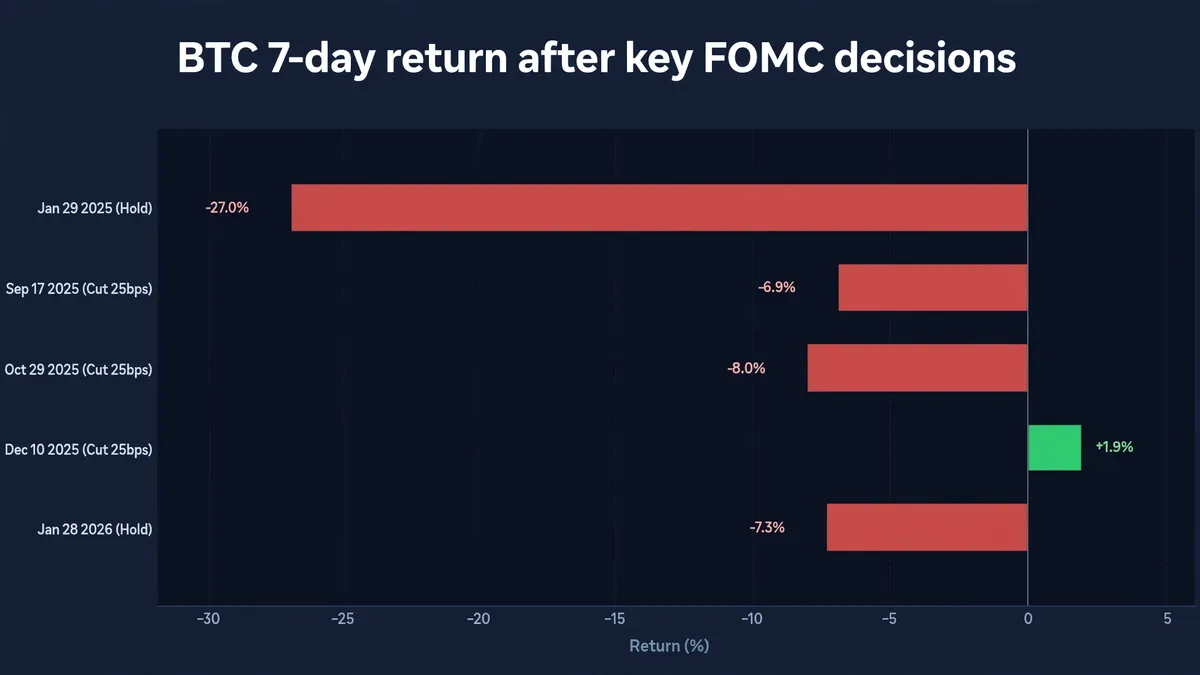
Here is the catch, and it is a big one. In 2025, the Fed cut rates three times, and Bitcoin fell in the week after every single one of them. The September 2025 cut was followed by a 6.9% drop. The October 2025 cut was followed by an 8.0% drop. Only the December 2025 cut saw a gain, a tiny 1.9%, and that came after Bitcoin had already fallen 24% from its all-time high.
Why does this happen? Because by the time the Fed announces, traders have already bought in anticipation. The confirmation gives them a reason to take profits. It is the classic “sell the news” pattern, and it has been remarkably consistent. So my honest read on a surprise cut: a sharp pop toward $95,000-plus, followed by a fade unless real liquidity, like sustained ETF inflows, follows through. Compare that with the long-term analyst forecasts if you want to see how the pros model multi-year scenarios.
Scenario 2: The Fed Holds for Longer (My Base Case)
This is where I think we actually are. Williams said the quiet part out loud: the Fed can afford to wait. Inflation is still running around 3.4% to 3.7%, well above the 2% target, which gives the hawks their argument. But the jobs data is softening, which gives the doves theirs. The result is a standstill, and standstills tend to last longer than markets expect.
A long hold is not exciting, but it is not bearish either. Bitcoin rallied about 23% in August 2026 even as September hike odds climbed above 50%. The market has learned to live with 4% rates. What it cannot stand is surprise.
The Bitcoin Playbook for an Extended Hold
In a hold scenario, Bitcoin probably grinds in a range between roughly $80,000 and $90,000 through the rest of the year. The $85,000 to $85,500 zone is the floor to watch, and $87,400 is the ceiling. A daily close above $87,000 would be the first real sign that buyers can break through, and analysts see $90,000 as the next magnet above that.
What breaks the range? Two things. First, the September CPI report on October 14. A cool print would reinforce the “no more hikes” story and likely send Bitcoin testing $90,000. A hot print would revive hike fears and push us back toward $80,000. Second, ETF flows. September’s $2.65 billion in inflows is the quiet bid under this market. As long as institutions keep buying, pullbacks stay shallow. The bull-versus-bear debate over $200K shows how wide the range of serious opinions still is.
Scenario 3: The Fed Hikes Again (The Hawk Case)
Do not write this one off. Barr is openly arguing for more tightening, four officials penciled in two more hikes this year back in September, and the 10-year yield at 5.25% shows the bond market still fears inflation more than recession. If the October 14 CPI comes in hot, the October 28 meeting could easily deliver another quarter-point hike.
A hike would be a genuine risk-off signal. Higher yields and a stronger dollar compete directly with Bitcoin for capital, and Bitcoin pays no yield just for holding it. Every extra month of “higher for longer” raises the opportunity cost of sitting in crypto instead of government debt.
Downside Targets If Hikes Continue
We already have a template. After the September 16 hike, Bitcoin dipped to about $75,400 before climbing back. A second hike would likely retest the $75,000 to $78,000 zone. Below that, the $73,000 area held as the range floor earlier this year, and $70,000 is the big psychological line.
Would it be the end of the rally? I doubt it. Bitcoin has bounced from every macro-driven dip this cycle, usually once yields stabilize. The pain would be real in the short term, but the ETF bid and the supply story do not disappear because the Fed hiked a quarter point. Still, anyone buying here should size positions for a possible 10% to 15% drawdown. Our 2026 year-end targets already map out this kind of floor-to-ceiling range, from a $74K floor to a $150K dream case.
What History Actually Says About Fed Days
This is the part most prediction articles skip, and it is the most useful data I have. CoinGecko and CoinTelegraph tracked Bitcoin’s 7-day performance after every 2025 FOMC meeting. The results should humble anyone who thinks rate decisions are simple for crypto:
| FOMC Meeting | Fed Decision | BTC 7-Day Return |
|---|---|---|
| Jan 29, 2025 | Hold | -27% |
| Mar 19, 2025 | Hold | Negative |
| May 7, 2025 | Hold | Negative |
| Jun 18, 2025 | Hold | Negative |
| Jul 30, 2025 | Hold | Negative |
| Sep 17, 2025 | Cut 25bps | -6.9% |
| Oct 29, 2025 | Cut 25bps | -8.0% |
| Dec 10, 2025 | Cut 25bps | +1.9% |
Data: CoinGecko/CoinTelegraph analysis of post-FOMC Bitcoin performance, 2025. “Negative” where only the direction was reported.
Bitcoin fell after 7 of the 8 meetings in 2025. That happened during a cutting cycle that was supposed to be bullish for risk assets. The one positive week, December 2025, came only because Bitcoin had already dropped about 24% beforehand and the selling pressure was spent.
The pattern held into 2026. On January 28, the Fed held rates exactly as expected, and Bitcoin still fell 7.3% within 48 hours. The lesson is consistent: the rate decision itself is rarely the trade. What moves the market is the surprise element, the dot plot, and the press conference tone. Knowing what to watch before a Fed decision matters more than guessing the decision itself.
A Common Mistake to Avoid
Do not buy Bitcoin into the FOMC announcement expecting a rally. The data says the announcement itself is usually the local top, not the launchpad. Patient buyers have historically gotten better entries in the 24 to 48 hours after the statement, when the post-announcement dip bottoms. Plan the trade around the pattern, not the headline.
Bitcoin Fed Rate Cut Prediction: My Honest Take
Here is where I put my opinion on the record. The Fed holds on October 28. Williams’ “no need for urgency” comment was the tell: the committee wants more data, and the weak jobs report gave the doves cover to wait. December is the real decision point, when a fresh dot plot arrives, and I expect the Fed to stay on hold there too unless inflation clearly breaks lower.
For Bitcoin, that means a grinding fourth quarter, not a vertical one. My base case: BTC trades $82,000 to $88,000 through October, then makes a run at $90,000 to $95,000 into year-end as the “no more hikes” narrative firms up and ETF inflows keep compounding. The upside surprise case is a cool October 14 CPI plus a skipped October hike, which could pull $95,000 forward into December.
The downside case is a hot CPI that reprices a December hike. That would likely send Bitcoin back to $72,000 to $75,000 before buyers step in. Either way, the cut question is really a liquidity question, and right now liquidity is saying: be patient, not fearful.
One more honest note. Predictions are educated guesses, not guarantees. The 2025 data proves that even the “obvious” bullish outcome, actual rate cuts, can coincide with falling prices. Size your positions for the scenario you do not expect, keep some dry powder for the post-FOMC dip, and never invest money you cannot afford to lose. This is my opinion, not financial advice.
Frequently Asked Questions
These are the questions I see most often about the Fed and Bitcoin. Short answers, no fluff.
Does a Fed rate cut make Bitcoin go up?
Not reliably. In 2025 the Fed cut rates three times, and Bitcoin fell in the seven days after two of those cuts (down 6.9% and 8.0%). Only the December cut saw a small 1.9% gain. Rate cuts help liquidity over months, but the announcement itself usually triggers profit-taking, the classic “sell the news” pattern.
What are the odds of a Fed rate cut in 2026?
Close to zero. Cut contracts on prediction markets trade near zero, and 16 of 19 Fed officials expect at least one more rate hike in 2026, with the average end-year projection around 4.1%. The realistic debate is hike versus hold, not cut versus hold.
When is the next Fed meeting?
The next FOMC meeting is on October 28, 2026, followed by December 9. The October meeting is close to a coin flip between a hold and a 25-basis-point hike after the weak September jobs report. December matters more for markets because it brings a fresh dot plot.
What is the highest Bitcoin could go if the Fed cuts rates?
In my opinion, a genuine surprise cut could spike Bitcoin toward $92,000 to $100,000 as shorts cover and momentum builds. But history warns the spike would likely fade: every 2025 cut was followed by a down week. A sustained rally needs follow-through liquidity, like continued ETF inflows, not just the headline.
Is now a good time to buy Bitcoin before the Fed decision?
That depends on your timeframe and risk tolerance, and this is not financial advice. The data shows buying into the announcement has historically been the worse entry, with dips bottoming 24 to 48 hours after the statement. Many investors prefer spreading purchases over time rather than betting on a single macro event.
The Bottom Line
The question “what happens if the Fed cuts rates” is really three questions: how likely is a cut (very unlikely), what happens if we get one (a spike, then probably a fade), and what actually matters (the dot plot, the press conference, CPI on October 14, and ETF flows). Bitcoin at $86,000 is not waiting for a cut. It is waiting for certainty that the hiking cycle is over.
My prediction stands: hold, grind, then $90,000-plus into year-end. The Fed does not need to cut for Bitcoin to win. It just needs to stop hiking. Watch the October 14 inflation data and the October 28 meeting, keep your position sizes sane, and remember that the announcement is usually the top, not the launchpad.