


Yes, you can spend Bitcoin on coffee, groceries, and bills. You do not need a special shop or a tech degree to do it.
The trick is picking the right method for each purchase. Lightning wins for small daily buys, a crypto debit card works almost everywhere, and gift cards unlock stores that take no crypto at all.

This guide shows you all four ways, then prices one real week of spending through each of them at today’s Bitcoin price of about $65,000.
- What you need before you spend Bitcoin
- One week of spending, priced four ways
- Method 1: Pay with Lightning
- Method 2: Pay on-chain
- Method 3: Use a crypto debit card
- Method 4: Buy gift cards with Bitcoin
- Where you can actually spend Bitcoin
- The tax part nobody tells you
- What to do when a payment fails
- Mistakes that cost real money
- How much Bitcoin should you keep for spending?
- Frequently asked questions
- Can I spend Bitcoin at a normal grocery store?
- Is spending Bitcoin taxable?
- What is the cheapest way to spend Bitcoin?
- Can I spend Bitcoin without a bank account?
- What happens if I send Bitcoin to the wrong address?
- Do I need to convert Bitcoin to cash first?
- Sources
- Start with one coffee
Key takeaways
- Lightning is the cheapest way to spend Bitcoin day to day. Three payments in our worked week cost about one cent in fees.
- On-chain payments work, but the fee can eat a small purchase. At today’s fee rate, a $5 coffee carries a $0.46 network fee.
- A crypto debit card works anywhere Visa or Mastercard works. The shop never knows Bitcoin was involved.
- Gift cards unlock Amazon, Walmart, and Target, which do not take Bitcoin directly.
- Every spend can be a taxable sale in the US and many other countries. Keep a record of each one.
What you need before you spend Bitcoin
You need a wallet with a small amount of Bitcoin in it. Keep your spending money separate from your long-term savings.
Most people keep a small “spending wallet” on their phone and the rest in cold storage. Our guide to getting a Bitcoin wallet walks through the setup step by step, and our guide to storing Bitcoin safely explains how to split savings from spending money.
Think in sats, not whole Bitcoin. One Bitcoin is 100 million sats, and at $65,000 per Bitcoin, one sat is worth $0.00065.
A $5 coffee costs about 7,692 sats, which looks strange at first and feels normal after a week.

One week of spending, priced four ways
Most guides list the four methods and stop there. That tells you nothing about what each one really costs, so we priced a normal week four times, once per method, using live numbers from November 16, 2026.
Bitcoin traded near $65,000 that morning. The standard on-chain fee rate was about 5 sats per virtual byte, and a normal SegWit payment is about 141 virtual bytes.
That makes one on-chain payment cost about 705 sats, or $0.46.
The week we priced
We picked three ordinary purchases. Five weekday coffees at $5 each, one grocery run at $120, and one utility bill at $250.
The week totals $395, or 607,692 sats at $65,000 per Bitcoin.
| Purchase | Price in dollars | Price in sats |
|---|---|---|
| Coffee, 5 x $5 | $25 | 38,462 |
| Groceries, one trip | $120 | 184,615 |
| Utility bill | $250 | 384,615 |
| Week total | $395 | 607,692 |
What each method costs for the same week
Lightning is almost free. On-chain costs $1.37 for the three payments, which sounds small until you see that $0.46 of it lands on a $5 coffee.
A debit card at a typical 1% conversion spread costs $3.95. Gift cards vary by brand, and a typical week lands near $2.50 of markup.
| Method | Fees for the week | Total paid | Best for |
|---|---|---|---|
| Lightning | about $0.01 | $395.01 | Small daily buys |
| On-chain | $1.37 | $396.37 | Larger single payments |
| Gift cards | about $2.50 (typical) | about $397.50 | Stores with no crypto checkout |
| Crypto debit card | about $3.95 | $398.95 | Anywhere cards work |
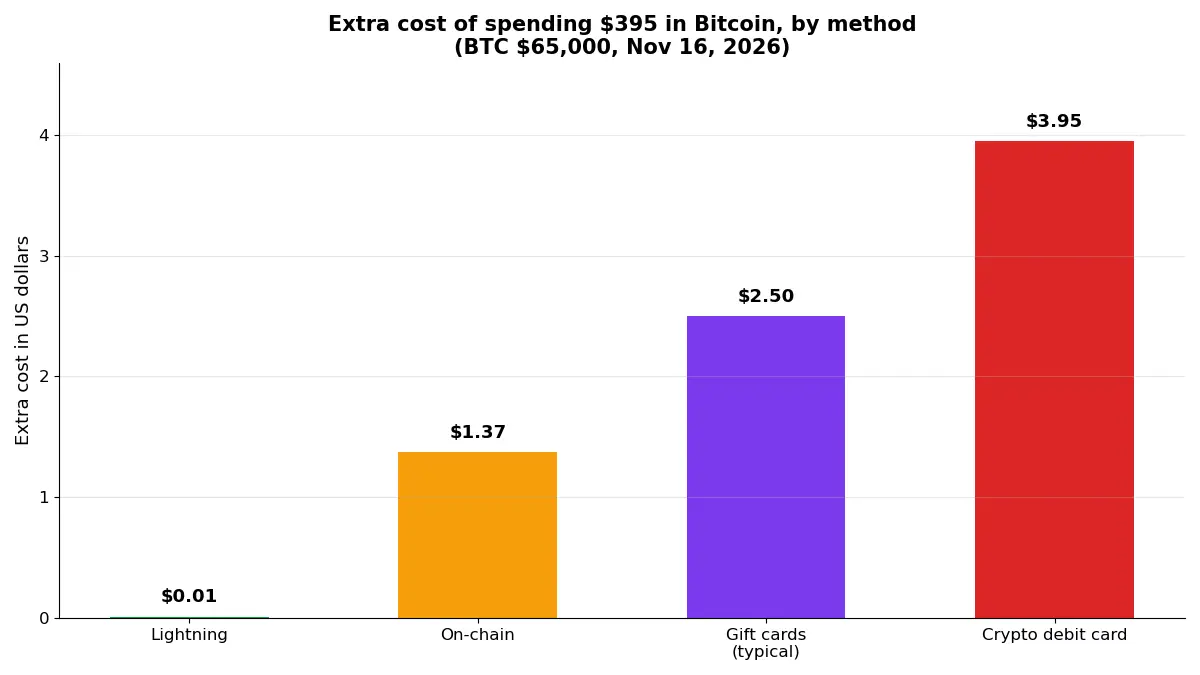
The chart makes the point in one glance. Lightning costs almost nothing, on-chain is fine for bigger payments, and the card is the most expensive route because you pay for convenience.
Gift-card markup sits in the middle and changes by brand, so check the price before you buy the card.
Method 1: Pay with Lightning
Lightning is a fast layer built on top of Bitcoin. It moves small payments in about a second for a fraction of a cent.
Here is how a payment works in real life. You open your Lightning wallet, scan the QR code at the till or on the checkout screen, check the amount, and tap confirm.
The payment clears before you put your phone away.
Lightning fits coffee, snacks, tips, and small online purchases. It is the only method where the fee stays tiny no matter how small the purchase is.
Our full guide to paying with Bitcoin Lightning covers wallets, channels, and the six ways a payment can fail.
Two limits matter. Your wallet needs a funded Lightning channel with enough outbound capacity, and the merchant has to accept Lightning invoices.
Both problems are shrinking fast, and the Steak ‘n Shake example below shows how far it has come.
Method 2: Pay on-chain
An on-chain payment is a normal Bitcoin transaction recorded on the blockchain. You send Bitcoin from your wallet to the merchant’s address, and the network confirms it in about 10 minutes.
The fee does not depend on the amount you send. It depends on how busy the network is and how much data your transaction carries.
A standard payment costs about $0.46 at today’s fee rate, and it can cost much more when the network is busy.
That flat fee shapes when on-chain makes sense. It is fine for a $250 bill, where $0.46 is a rounding error.
It is a bad deal for a $5 coffee, where the same fee adds 9.2% to the price. Use on-chain for bigger payments and Lightning for small ones.
Always check the fee your wallet shows before you confirm. If the network is busy, wait an hour or switch to Lightning.
Never pay an on-chain fee that costs more than the thing you are buying.
Method 3: Use a crypto debit card
A crypto debit card is the easiest way to spend Bitcoin in everyday life. It looks and works like a normal Visa or Mastercard debit card, and it works anywhere those cards work.
When you swipe, the card provider sells just enough of your Bitcoin to cover the purchase and pays the shop in dollars. The shop sees an ordinary card payment and never knows Bitcoin was involved.
Coinbase Card, Crypto.com Visa Card, BitPay Card, and Cash App Card all work this way, and Strike Card spends from a Lightning balance instead.
The cost is a conversion spread, usually around 0.5% to 2%, plus any monthly or top-up fee your card charges. On our $395 week, a 1% spread costs $3.95.
That is the price of spending anywhere without thinking about it.
One detail catches people out. Some cards convert your Bitcoin when you load the card, and some convert at the moment you swipe.
Either way, each swipe can count as a sale of Bitcoin for tax purposes, so keep the card for planned spending rather than everyday impulse buys.
Method 4: Buy gift cards with Bitcoin
Gift cards are the workaround for stores that do not take Bitcoin at all. You buy a gift card with Bitcoin, then spend the card like normal money.
Bitrefill sells gift cards for more than 5,000 brands across 170 countries, and you can pay with Bitcoin or Lightning. eGifter covers hundreds of US retailers the same way.
Amazon, Walmart, and Target gift cards all work through these services even though none of those stores takes Bitcoin directly.
The catch is the markup. Many cards sell at face value, and some carry a small premium that changes by brand.
Check the card price against its face value before you buy, and buy the card right before you need it so your money is not locked into one store.
Gift cards are hard to refund, so treat them like cash. Our guide to converting Bitcoin to gift cards walks through the safest services and the fees to watch for.
Where you can actually spend Bitcoin
Direct acceptance is smaller than the headlines suggest, and bigger than the skeptics claim. BTC Map lists about 26,914 merchants worldwide that accept Bitcoin, and the number grows every month.
Steak ‘n Shake is the most visible example. The chain switched on Lightning payments at all 393 of its US restaurants on May 16, 2025, and says the move cut its payment processing costs by about half.
Newegg and AT&T take Bitcoin through the BitPay payment processor, and thousands of independent Square sellers can switch Bitcoin payments on.
The honest picture is that most big stores still do not take Bitcoin at the till. Amazon, Walmart, Target, Starbucks, and Home Depot do not accept it directly.
That is where gift cards and debit cards do the heavy lifting, and they cover nearly every store you already shop at.
To find places near you, check BTC Map before you go out. If you run a shop yourself, our guide to accepting Bitcoin payments explains how merchants set it up, and our BTCPay Server setup guide covers the self-hosted route with no middleman.
The tax part nobody tells you
Spending Bitcoin is not like spending dollars. In the United States, the IRS treats digital assets as property, not currency, and swapping property for goods or services counts as a sale.
That means every coffee can create a capital gain or loss. If you bought Bitcoin at $40,000 and spend it at $65,000, you have a gain on the amount you spent.
You report those sales on Form 8949, and the IRS page on digital assets lists exactly what records you need: the date, the amount, and the fair market value in dollars at the time.
Most other countries follow the same idea. The UK, Canada, Australia, and much of Europe treat spending crypto as a disposal, and the gain counts even when the purchase is tiny.
A few countries have small exemptions for personal spending, so check your local rules before you build a habit around this.
Keep it simple and you will be fine. Use one wallet for spending, export its transaction history every month, and note the dollar value of each payment.
Our Bitcoin tax guide covers the full rules, and our guide to donating Bitcoin to charity shows the one common case where spending Bitcoin can actually save tax.
What to do when a payment fails
Payments fail sometimes, and a failed payment is rarely a lost payment. Walk through these checks before you try again.
First, check the invoice. Lightning invoices expire, usually after a few minutes, and an expired invoice will always fail.
Ask the merchant for a fresh one and scan it right away.
Second, check your balance and your channel. A Lightning payment fails if your channel lacks enough outbound capacity for the amount.
Top up the channel or split the payment, and try again.
Third, check the network and the address. An on-chain payment sent to the wrong address cannot be reversed, so copy the address or scan the QR code instead of typing it.
If you sent to the right address and it is just slow, wait for the next few blocks before you panic.
Fourth, send a small test payment first when the amount is large. A $1 test costs almost nothing on Lightning and proves the address works.
Then send the rest with confidence.
Mistakes that cost real money
The most expensive mistake is sending Bitcoin to the wrong address. Bitcoin payments cannot be reversed, and a wrong address usually means the money is gone for good.
Scan QR codes and double-check the first and last characters every time.
The second mistake is paying on-chain for tiny purchases. A $0.46 fee on a $5 coffee is a 9.2% surcharge, and the fee only grows when the network gets busy.
Save on-chain for bills and big purchases.
The third mistake is ignoring the tax record. A year of coffees is dozens of small sales, and reconstructing them from memory at tax time is miserable.
Export your history monthly and keep the dollar value next to each payment.
The fourth mistake is keeping your spending money on an exchange. Exchanges can freeze withdrawals, and they hold your keys.
Move a week’s spending money to your own wallet and leave the rest somewhere safe.
How much Bitcoin should you keep for spending?
Keep one or two weeks of spending money in your spending wallet, and nothing more. At our worked example of $395 a week, that means about 0.006 to 0.012 BTC at today’s price.
Top it up on a fixed day, like Sunday night, so spending stays a routine instead of a reaction to price moves. If Bitcoin jumps 10% in a week, your coffee does not get 10% cheaper in sats, because the shop still charges $5 and the wallet just converts fewer sats.
Never keep your whole stack in a hot wallet. A phone wallet is convenient and also the easiest thing to lose, so treat it like the cash in your pocket rather than the money in your bank.
Frequently asked questions
These are the questions readers ask most about using Bitcoin for daily purchases. The short answers are below, and the full detail sits in the sections above.
Can I spend Bitcoin at a normal grocery store?
Yes, but rarely with Bitcoin directly. Most grocery stores do not take it at the till, so the practical routes are a crypto debit card, which works anywhere Visa or Mastercard works, or a gift card bought with Bitcoin through a service like Bitrefill.
Is spending Bitcoin taxable?
In the United States, yes. The IRS treats Bitcoin as property, so spending it counts as selling it, and any gain is taxable.
The same idea applies in the UK, Canada, Australia, and many other countries, so keep a record of each payment and its dollar value.
What is the cheapest way to spend Bitcoin?
Lightning is the cheapest by far. Three payments in our worked week cost about one cent in fees, while the same week cost $1.37 on-chain and about $3.95 on a crypto debit card at a 1% spread.
Use Lightning for small buys and on-chain for larger ones.
Can I spend Bitcoin without a bank account?
Yes. Lightning and on-chain payments need only a wallet, not a bank account.
A crypto debit card usually needs an account with the card provider, but direct Bitcoin payments and gift cards do not.
What happens if I send Bitcoin to the wrong address?
The payment is almost certainly gone. Bitcoin transactions cannot be reversed, and there is no support line to call.
Always scan the QR code, check the address carefully, and send a small test payment first when the amount is large.
Do I need to convert Bitcoin to cash first?
No. A crypto debit card converts it for you at the moment you pay, and a gift card service converts it when you buy the card.
Direct Lightning and on-chain payments need no conversion at all, since the merchant takes Bitcoin itself.
Sources
- Internal Revenue Service, Digital assets
- mempool.space, Bitcoin fee rates and mempool data
- BTC Map, merchants accepting Bitcoin worldwide
Start with one coffee
Spending Bitcoin in everyday life is no longer an experiment. Lightning handles the small stuff for pennies, a debit card covers everywhere else, and gift cards fill the gaps.
Start small this week. Load a Lightning wallet with $20, buy one coffee, and watch the fee come in under a cent.
Once you know how to spend Bitcoin in everyday life for one coffee, the rest of the week is just the same move repeated.