



Binance founder Changpeng Zhao, known as CZ, has denied that Binance sold Bitcoin during the weekend crash. CZ denies Binance Bitcoin crash sales in a post on X from November 15, and he said he bought crypto himself in the days before prices fell.
Bitcoin dropped to $62,006 on Sunday, November 15, its lowest price since July. It then bounced back toward $65,360 on Monday morning, but the blame game started before the bounce did.

Key takeaways
- CZ said on X: “No, Binance did not sell crypto.” He added that he bought crypto in the past few days with stablecoins he recently received.
- Bitcoin hit $62,006 on November 15, its lowest since July, then recovered to about $65,360 on Monday morning, November 16.
- US spot Bitcoin ETFs lost $2.35 billion over two weeks, with $1.91 billion leaving in seven straight trading sessions through November 13.
- Crypto liquidations reached $2.02 billion in 24 hours, and $1.68 billion of that was long positions.
- Anchorage Digital researcher David Lawant said the sell pressure came mainly from the US, with heavy selling on Coinbase, not Binance.
- The Crypto Fear and Greed Index sits at 10, which means Extreme Fear.
What CZ Actually Said
CZ opened his post with a question: “Why are crypto prices down?” He answered it in the same breath, writing that no one knows for sure.
- What CZ Actually Said
- The Weekend in Numbers
- The Blame Test: Three Suspects, Three Checks
- Why US Sellers Look Like the Main Source
- The ETF Drain, Day by Day
- What CZ Listed as Possible Causes
- What the Rebound Does and Does Not Prove
- What to Watch Next
- Frequently Asked Questions
- Did Binance sell Bitcoin during the crash?
- Why did Bitcoin fall to $62,006?
- How much money left Bitcoin ETFs?
- How much was liquidated in the crash?
- Is the crypto market still in Extreme Fear?
- The Bottom Line
He added a warning that matters for the whole debate. Correlation does not prove causation, so his list of possible causes is a set of guesses, not proof.
Then came the denial that traders were waiting for. CZ wrote that Binance did not sell crypto, and he said he bought crypto in the past few days with stablecoins he recently received.
He even joked that his own buying might be the cause. The joke flips the rumour, since the market accused Binance of selling while CZ says he was buying.
He did not name which coins he bought. He also gave no amounts or wallet addresses, so the claim stands on his word, not on on-chain proof.

Binance co-CEOs Richard Teng and Yi He posted the same message on X on Sunday, about 70 minutes apart. Their post said short-term pressure is a normal reaction to tighter macro conditions, and it added that the long-term case for Bitcoin and crypto remains intact.
Why the Rumour Started
The rumour did not come from nowhere. Binance suffered a record hack on October 29, when attackers drained about $6.36 billion in mixed crypto assets from Binance wallets.
Traders then asked a fair question about whether the exchange sold crypto to cover the gap. Binance said it set aside more than $6.34 billion from its own corporate reserves to cover user balances in full.
Our Binance hack withdrawal status coverage tracked how that recovery played out day by day. The order book data backs the denial, at least on the spot market.
Binance spot cumulative volume delta stayed positive after October 31. Selling clustered on Coinbase between November 10 and November 14, which points away from Binance and toward US venues.
The Weekend in Numbers
The crash was fast, deep, and broad. Bitcoin fell from a November 8 close of $74,754 to a low of $62,006 on November 15, a drop of about 17.1 percent in one week.
The low also sits about 50.9 percent below the all-time high of $126,296, reached on October 6, 2025. The rebound to about $65,360 on Monday morning recovered only about 5.4 percent from the low.
| Number | Value | Source |
|---|---|---|
| Weekend low, November 15 | $62,006 | The Block, Binance data |
| Low on major US exchanges | About $61,950 | CryptoNews, Coinbase data |
| Monday morning price, November 16 | About $65,360 | KuCoin daily report |
| Weekly change | Down 14.2 percent | The Block |
| Drop from November 8 close | About 17.1 percent | BTCRepublic calculation |
| Drop from all-time high | About 50.9 percent | BTCRepublic calculation |
| 24-hour liquidations | $2.02 billion | CoinGlass |
| Long positions liquidated | $1.68 billion | CoinGlass |
| ETF outflows, two weeks | $2.35 billion | The Block, SoSoValue |
| Fear and Greed Index | 10, Extreme Fear | Alternative.me |
Ether fell harder than Bitcoin on the week, down about 13.7 percent, while Solana dropped about 19.7 percent. The whole market moved together, which points to a broad selloff rather than a single coin problem.
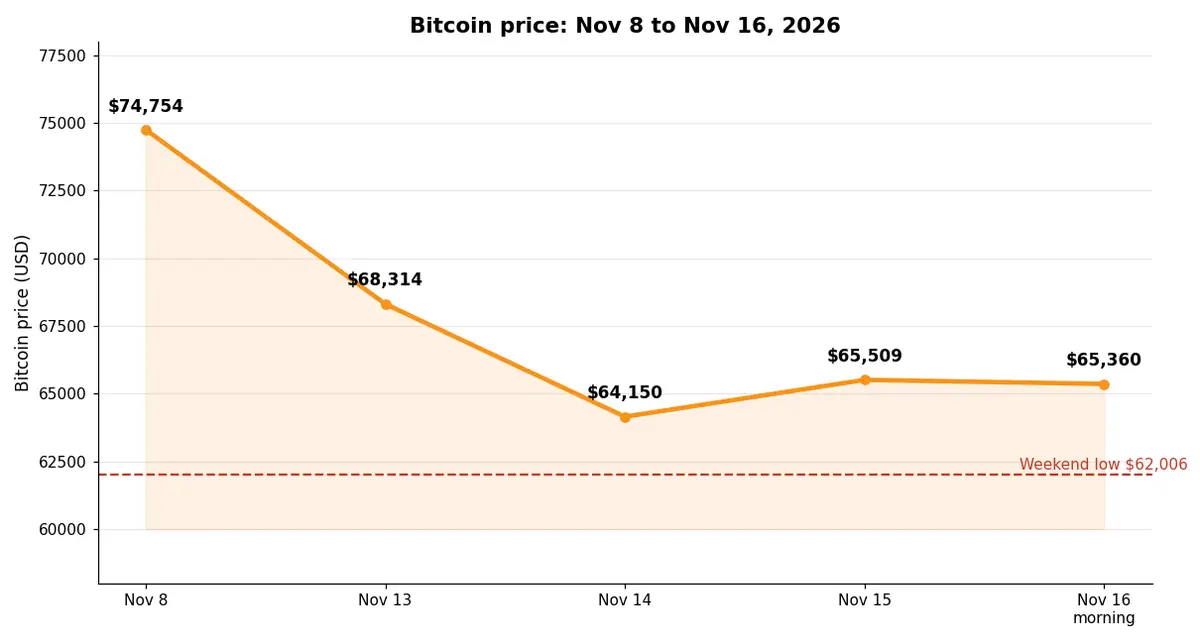
Bitcoin fell from $74,754 on November 8 to $62,006 on November 15, then recovered to about $65,360 on Monday morning. Prices from Finnhub Binance data and KuCoin.
The Blame Test: Three Suspects, Three Checks
Three suspects dominate the debate. Binance sold to cover the hack, US sellers drove the drop, or ETF redemptions drained the market.
Each suspect can be tested against the same three checks: order book flow, fund flows, and timing. This test is the original part of this article, and no other outlet framed the weekend as a verdict on three suspects using these three checks.
| Suspect | Order book flow | Fund flows | Timing | Verdict |
|---|---|---|---|---|
| Binance sold crypto | Binance spot flow stayed positive after October 31 | No evidence of Binance redemptions | Hack was October 29, crash was November 15 | Not supported |
| US sellers drove the drop | Heavy net taker selling on Coinbase, November 10 to 14 | US ETFs bled for seven straight sessions | Bitcoin fell in the hour before the US open on 13 of the past 15 days | Strongest case |
| ETF redemptions drained the market | Redemptions hit the spot market through authorised participants | $2.35 billion out in two weeks | Outflows ran November 5 to 13, crash followed | Strong case |
The verdict is clear on one point. The Binance theory fails all three checks, while the US seller theory and the ETF theory pass them.
Those two are really two sides of the same story. US investors sold, and US funds redeemed shares, but that does not prove US sellers caused every dollar of the drop.
Why US Sellers Look Like the Main Source
Anchorage Digital researcher David Lawant gave the clearest version of the US case. He said the sell pressure continues to come primarily from the US, adding that the call is coming from inside the house.
Lawant pointed to a chart that showed heavy net taker sell flow on Coinbase compared with overseas exchanges. Net taker flow measures aggressive selling by market takers, so when it clusters on one exchange, that exchange is where the selling lives.
The timing fits the same pattern. Influencer Axel Bitblaze noted that Bitcoin fell in the hour before the US open on all but two of the past fifteen days.
That is a US trading hours pattern, not an Asian hours pattern. Binance is a global exchange, so a Binance-led sale would not cluster around the US open.
Our earlier coverage of the crash gives the same picture from a different angle. Bitcoin dropped out of the world’s top 15 assets as its market value fell to about $1.30 trillion, and the fall tracked the US trading day.
The listed companies selling Bitcoin in 2026 story also showed US miners and firms cashing out to fund AI spending. That adds to the US supply story.
The ETF Drain, Day by Day
US spot Bitcoin ETFs lost $2.35 billion in net outflows over two weeks. That is the largest two-week total since the fortnight ending June 5, when $3.14 billion left the funds.
The latest week, November 9 to 13, took $1.07 billion. The week before took $1.28 billion, and the funds lost money on all five trading days last week.
| Trading day | Net outflow |
|---|---|
| Monday, November 9 | $201.1 million |
| Tuesday, November 10 | $95.0 million |
| Wednesday, November 11 | $299.9 million |
| Thursday, November 12 | $284.0 million |
| Friday, November 13 | $185.5 million |
| Week total | $1.07 billion |
BlackRock’s IBIT led the way out. It took $143.5 million of Friday’s $185.5 million in outflows, about 77 percent of the day.
Its losing streak reached 11 straight sessions since October 30. Its November outflows reached $2.12 billion, about 90 percent of the whole market’s net withdrawals.
ETF flows are not the same as price moves, and the funds do not set the Bitcoin price directly. Redemptions still matter, because authorised participants sell Bitcoin to meet them.
The longest streak of daily net outflows for US Bitcoin ETFs shows how rare a seven-day run like this is. November is already the weakest month for the funds since June, when $4.51 billion left.
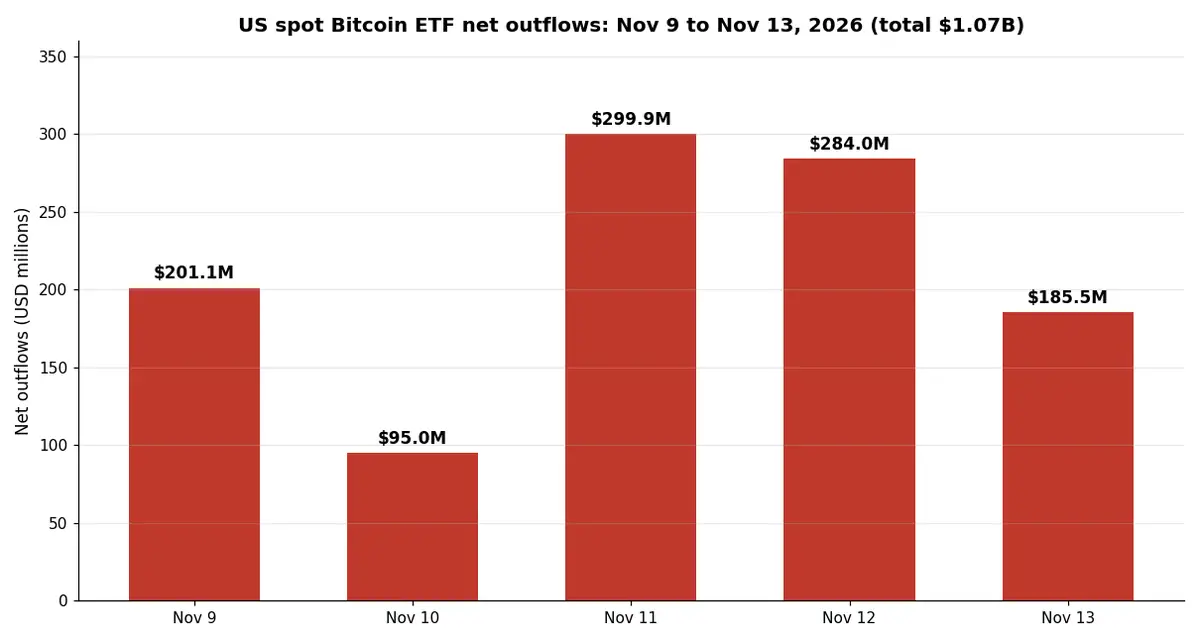
US spot Bitcoin ETFs lost $1.07 billion in the week ending November 13, after $1.28 billion the week before. Data from The Block analysis of SoSoValue figures.
Ether Funds Bled Too
Spot Ether ETFs lost $398.9 million last week. That was their seventh straight weekly outflow, one short of the record run of eight.
The Bitcoin story is the headline, but the outflow hit the whole crypto ETF complex. Only one of the 15 US spot crypto ETF categories tracked by SoSoValue saw net inflows last week, with Avalanche funds taking in a small $227,000.
What CZ Listed as Possible Causes
CZ named six possible causes for the drop. He stressed that none of them is proven, and he warned that correlation does not prove causation.
First, money rotating toward the Anthropic IPO, expected on November 19. CZ cited a comparison that showed Bitcoin fell 19 percent in the 50 days before the SpaceX listing on June 12.
The comparison is interesting, but it does not prove that IPO buyers sold Bitcoin to fund their orders. Second, ETF outflows, which have hard numbers behind them, as the $2.35 billion two-week total shows.
Third, security worries, including the Binance hack, iPhone-linked wallet thefts, a Chrome vulnerability, and a Microsoft outage. These events shook trust, but none of them directly sold Bitcoin.
Fear can still move a market even when the fear has no single seller. Fourth, expectations of another Federal Reserve rate hike, which pull money out of risk assets as markets price a high chance of a December hike.
This factor fits the timing, because rate fears built up through the same week as the ETF outflows. Fifth, the midterm elections, after which Bitcoin has bottomed in 2018 and 2022.
The pattern is real, but a pattern is not a cause. Sixth, doubts about how AI companies are funded, which Binance Research tied to the drop on November 15 as Bitcoin fell 15.6 percent over 11 days.
What the Rebound Does and Does Not Prove
Bitcoin bounced from $62,006 to about $65,360 by Monday morning. A bounce after a crash is normal, and it does not prove the worst is over.
It proves buyers stepped in near $62,000, nothing more. The Fear and Greed Index still reads 10, which means Extreme Fear.
It is unchanged from November 15 and down from 29 a week ago. Sentiment has now sat in extreme fear for four straight days, and markets can stay fearful for weeks.
The technical picture also stays weak. The 200-week average near $67,750 now sits above the price, and the 200-day average near $73,000 sits further above it.
Both levels act as resistance until Bitcoin closes above them. Below the price, the June low near $58,500 and the 2026 low of $57,718, set on July 1, are the next supports.
Our Binance hack liquidity recovery coverage showed order books stayed thin even as headline outflows eased. Thin books cut both ways, since they let a bounce run fast and they let the next selloff run fast too.
What to Watch Next
Monday is the first real test. US markets reopen, and the ETF flow data will show whether redemptions stop or stretch to an eighth straight session.
A single day of inflows would not end the story, but it would break the streak that fed the crash. Watch the $62,000 level next, since it held on Sunday.
A close below it would open the way toward the 2026 low of $57,718, about 12 percent below Monday morning’s price. Watch $67,750 above it, the 200-week average that now caps the bounce.
Watch Coinbase flow too. If net taker selling stays heavy on Coinbase while Binance flow stays positive, the US seller story gains more weight.
If the flow flips, the story changes. The Bitcoin crash to a two-month low near $73,700 after the midterm sweep showed how fast the same pattern can repeat.
Finally, watch what CZ does next. He said he bought crypto in the past few days, but he gave no amounts, no coins, and no wallet addresses.
His words moved the debate, but only verifiable flow data will settle it. The Binance review explains how the exchange works for beginners who want to check its markets for themselves.
Frequently Asked Questions
Readers asked the same five questions all weekend. Here are the short answers, with the numbers behind each one.
Did Binance sell Bitcoin during the crash?
No, according to Binance founder CZ. CZ denies Binance Bitcoin crash sales in his November 15 post on X, and order book data supports him, because Binance spot flow stayed positive after October 31 while selling clustered on Coinbase.
Why did Bitcoin fall to $62,006?
No single cause is proven. The strongest evidence points to US selling and ETF outflows, with US spot Bitcoin ETFs losing $2.35 billion in two weeks and heavy net taker selling showing up on Coinbase.
How much money left Bitcoin ETFs?
US spot Bitcoin ETFs lost $1.07 billion in the week ending November 13, after $1.28 billion the week before. The two-week total is $2.35 billion, the largest since the fortnight ending June 5.
How much was liquidated in the crash?
Crypto liquidations reached $2.02 billion in the 24 hours from 8am ET on Saturday to 8am ET on Sunday, according to CoinGlass. Long positions made up $1.68 billion of that total, and short positions made up $342.4 million.
Is the crypto market still in Extreme Fear?
Yes. The Crypto Fear and Greed Index reads 10 on November 16, which means Extreme Fear, unchanged from November 15 and down from 29 a week ago.
The Bottom Line
CZ denied the rumour in plain words, and the flow data backs him. Binance did not show up as the seller, while US sellers and ETF redemptions did.
That does not make the market safe. Bitcoin is still down 14.2 percent on the week, fear is extreme, and the next ETF flow print lands on Monday.
The bounce to $65,360 is a relief, not a recovery. Watch the flows, not the rumours, to see what comes next.