



The Philippines has no crypto tax law, and the Bureau of Internal Revenue (BIR) has issued no regulation that covers Bitcoin. Your gains are still taxed.
They fall under the ordinary income tax, at graduated rates from 0% to 35%, with the first PHP 250,000 of annual income tax-free. That gap between “no crypto law” and “still taxed” is where most of the confusion lives.

This guide explains bitcoin tax in the philippines explained in plain English, with the 2026 rates, a worked example that shows how the same PHP 2,000,000 gain can cost PHP 402,500 or PHP 152,500 depending on how long you held, and the 15% capital gains tax myth that many sites still repeat.
- Key Takeaways
- The Short Answer: No Crypto Tax Law, But the BIR Still Taxes Your Gains
- The 15% Capital Gains Tax Myth
- The 2026 Rates: What You Actually Pay on a Gain
- The Worked Example: One Gain, Three Tax Bills
- Path 1: She sells after 6 months, and the full gain counts
- Path 2: She sells after 18 months, and only half the gain counts
- Path 3: She is a registered trader and elects the 8% option
- What Counts as a Taxable Event, and What Does Not
- The 8% Option for Registered Traders
- How to Report: Forms, Deadlines, and Records
- CARF Is Coming: Your Foreign Exchange Will Report to the BIR
- The BSP Side: Why Your Exchange Needs a Licence
- Five Mistakes That Cost Filipino Bitcoin Holders Money
- Frequently Asked Questions
- Is Bitcoin taxed in the Philippines?
- Is there a 15% capital gains tax on crypto in the Philippines?
- How much tax do I pay if I sell Bitcoin at a profit?
- Do I pay tax if I only hold Bitcoin and never sell?
- Are crypto-to-crypto swaps taxed in the Philippines?
- How do I report Bitcoin income to the BIR?
- Will the BIR know about my foreign exchange account?
- Sources
This guide is general information only, not tax advice, and tax rules depend on your own situation, so talk to a qualified tax adviser or CPA in the Philippines before you file.
Key Takeaways
- The Philippines has no crypto-specific tax law, and the BIR has issued no regulation that classifies crypto for tax. Gains fall under the ordinary income tax rules.
- Bitcoin gains are taxed at graduated rates of 0% to 35%. The first PHP 250,000 of annual taxable income is tax-free.
- Hold a capital asset for more than 12 months and only 50% of the gain counts (NIRC Sec. 39(B)). On a PHP 2,000,000 gain, that one rule can save PHP 250,000 in tax.
- The 15% capital gains tax many sites quote does not apply to crypto. It covers shares of stock not traded through the local exchange, under RA 12214.
- Registered traders can elect an 8% rate on gross receipts above PHP 250,000, if total receipts stay at or below PHP 3,000,000 for the year.
- The Philippines committed to the OECD Crypto-Asset Reporting Framework (CARF) in June 2025, with first automatic exchanges of crypto account data targeted for 2028.
- Crypto-to-crypto swaps, spending Bitcoin, and receiving Bitcoin as pay are all taxable events. Simply holding Bitcoin is not.
The Short Answer: No Crypto Tax Law, But the BIR Still Taxes Your Gains
The Philippines has no law written for crypto tax. The National Internal Revenue Code (NIRC) has no crypto chapter, and the BIR has published no revenue regulation, memorandum circular, or ruling that sets crypto-specific rates or methods.
That does not mean your gains escape tax. Section 32(A) of the Tax Code defines gross income as “all income derived from whatever source”, and nothing in that phrase excludes crypto.
Section 23 sets out who pays tax on what. A resident citizen pays tax on income from sources inside and outside the Philippines, while a nonresident citizen, including a Filipino working abroad, pays tax only on Philippine-source income.

In practice, the BIR treats Bitcoin as property, and a disposal of that property can produce taxable income. The consensus among Philippine tax guides in 2026 is the same: with no special regime, the ordinary rules apply by analogy.
That consensus is not a BIR ruling, and nobody can tell you with certainty how the BIR will classify your specific activity until it issues guidance or rules on a case. The honest position is that the risk sits with you, and good records are your best protection.
Our full Bitcoin tax guide shows how other countries handle the same question. The Philippines is unusual because the answer starts with “there is no law”, and then the ordinary tax rules do the work anyway.
The 15% Capital Gains Tax Myth
Search for Philippine crypto tax and you will see “15% capital gains tax” quoted everywhere. It is wrong, and it is the single most repeated error in this topic.
The 15% rate is real, but it taxes something else. Section 24 of the Tax Code applies a 15% final tax to net capital gains on shares of stock in a domestic corporation that are not traded through the local stock exchange.
Crypto is not shares of stock. Bitcoin is not a share in a domestic corporation, and it is not traded through the Philippine Stock Exchange, so neither part of that rule reaches a Bitcoin sale.
The confusion got worse in 2025. The Capital Markets Efficiency Promotion Act (RA 12214), approved on 29 May 2025, rewrote the tax on shares, interest, and documentary stamps, and it set a uniform 15% capital gains tax on unlisted shares, domestic and foreign.
RA 12214 contains no provision on digital assets. It changed the share rules and left crypto exactly where it was: under the ordinary income tax.
The other final capital gains tax in the Code is 6% on certain real property. That does not reach a Bitcoin sale either.
There is no separate capital gains tax for crypto the way there is for shares or land.
If a site tells you to budget 15% on your Bitcoin profit, it has mixed up the share rule with the crypto rule. Your actual rate comes from the graduated scale below, and it can be higher or lower than 15% depending on your income.
The 2026 Rates: What You Actually Pay on a Gain
Individual income tax in the Philippines uses a graduated scale. Each rate applies only to the slice of your income inside that band, so nobody pays the top rate on the whole amount.
The first PHP 250,000 of annual taxable income is tax-free. This zero band is the most generous part of the system, and it means small gains often owe nothing at all.
Here are the rates that apply in 2026, from Section 24(A)(2)(a) of the Tax Code as amended by the TRAIN law (RA 10963).
| Annual taxable income | Tax rate | Tax on the band |
|---|---|---|
| Up to PHP 250,000 | 0% | PHP 0 |
| PHP 250,000 to 400,000 | 15% of the excess over PHP 250,000 | Up to PHP 22,500 |
| PHP 400,000 to 800,000 | PHP 22,500 + 20% of the excess over PHP 400,000 | Up to PHP 102,500 |
| PHP 800,000 to 2,000,000 | PHP 102,500 + 25% of the excess over PHP 800,000 | Up to PHP 402,500 |
| PHP 2,000,000 to 8,000,000 | PHP 402,500 + 30% of the excess over PHP 2,000,000 | Up to PHP 2,202,500 |
| Above PHP 8,000,000 | PHP 2,202,500 + 35% of the excess over PHP 8,000,000 | No ceiling |
Your Bitcoin gain joins your other taxable income for the year, and the scale applies to the total. A gain of PHP 100,000 costs nothing if you have no other income, because it sits inside the tax-free band.
The same gain costs much more if your salary already fills the lower bands. Your salary and your crypto gain share one scale, so the gain is taxed at your marginal rate, not in isolation.
That is why two people with the same Bitcoin profit can owe very different amounts. The rates are simple, but the result depends on everything else you earned that year.
For comparison, Spain taxes Bitcoin gains at 19 to 30 percent on a separate savings scale, so a Spanish holder’s salary never pushes the crypto rate up. The Philippine system works the other way round, and that difference matters more than the headline rates.
The Worked Example: One Gain, Three Tax Bills
Rates on a table are abstract. A worked example makes them concrete, and this one is the heart of the guide, because it shows how holding time changes the bill.
Meet Ana.
She bought 1 Bitcoin for PHP 3,000,000 in June 2024 and sold it for PHP 5,000,000 in December 2025. Her gain is PHP 2,000,000, and she has no other income that year, so the numbers below are clean.
The same gain produces three different tax bills, depending on how she held and how she is registered. Here they are.
Path 1: She sells after 6 months, and the full gain counts
If Ana sells within 12 months, the whole PHP 2,000,000 gain counts as taxable income. The 50% rule does not apply, because she held the coins for less than a year.
Her tax is PHP 402,500. The first PHP 250,000 is tax-free, the next PHP 150,000 pays 15% (PHP 22,500), the next PHP 400,000 pays 20% (PHP 80,000), and the last PHP 1,200,000 pays 25% (PHP 300,000).
That is an effective rate of 20.1% on her gain. She keeps PHP 1,597,500 of the PHP 2,000,000 profit after tax.
Path 2: She sells after 18 months, and only half the gain counts
Section 39(B) of the Tax Code holds a rule that rewards patience. For capital assets held for more than 12 months, only 50% of the gain is taken into account.
Ana held for 18 months, so only PHP 1,000,000 of her PHP 2,000,000 gain counts. Her tax falls to PHP 152,500: PHP 22,500 on the slice from PHP 250,000 to PHP 400,000, PHP 80,000 on the slice to PHP 800,000, and PHP 50,000 on the last PHP 200,000.
The 50% rule saves her PHP 250,000. Six extra months of holding cut her tax bill by more than 60%.
One honest warning belongs here. The 50% rule applies to capital assets, and no BIR ruling has confirmed that a casual crypto holder’s Bitcoin counts as a capital asset.
A frequent trader may find the BIR treats the same coins as ordinary business income instead, where the full gain counts. Keep this in mind before you plan around the rule, and ask a CPA if you trade often.
Path 3: She is a registered trader and elects the 8% option
Ana’s friend Bea trades Bitcoin as a registered self-employed business. In one year she sells PHP 2,400,000 worth of Bitcoin that cost her PHP 1,400,000, so her gain is PHP 1,000,000.
Under the graduated rates, her PHP 1,000,000 gain costs PHP 152,500, the same as Ana’s long-term path. But Bea can elect a different deal: a flat 8% on her gross receipts above PHP 250,000, instead of the graduated rates and the percentage tax.
Her 8% bill is PHP 172,000, which is 8% of PHP 2,150,000. She pays PHP 19,500 more than under the graduated rates, so why would anyone choose it?
The answer is simplicity.
The 8% option taxes gross receipts, not profit, so Bea skips detailed cost tracking and the 3% percentage tax. She trades a slightly higher bill for a much simpler return.
The catch is the ceiling.
The 8% option is only open while gross sales or receipts stay at or below PHP 3,000,000 for the year. Cross that line and the graduated rates apply instead, with no choice in the matter.
| Path | Gain counted | Tax due | Effective rate on the gain |
|---|---|---|---|
| Short-term holder, full gain | PHP 2,000,000 | PHP 402,500 | 20.1% |
| Long-term holder, 50% rule | PHP 1,000,000 | PHP 152,500 | 7.6% |
| Registered trader, 8% option | PHP 1,000,000 gain on PHP 2,400,000 receipts | PHP 172,000 | 17.2% of the gain |
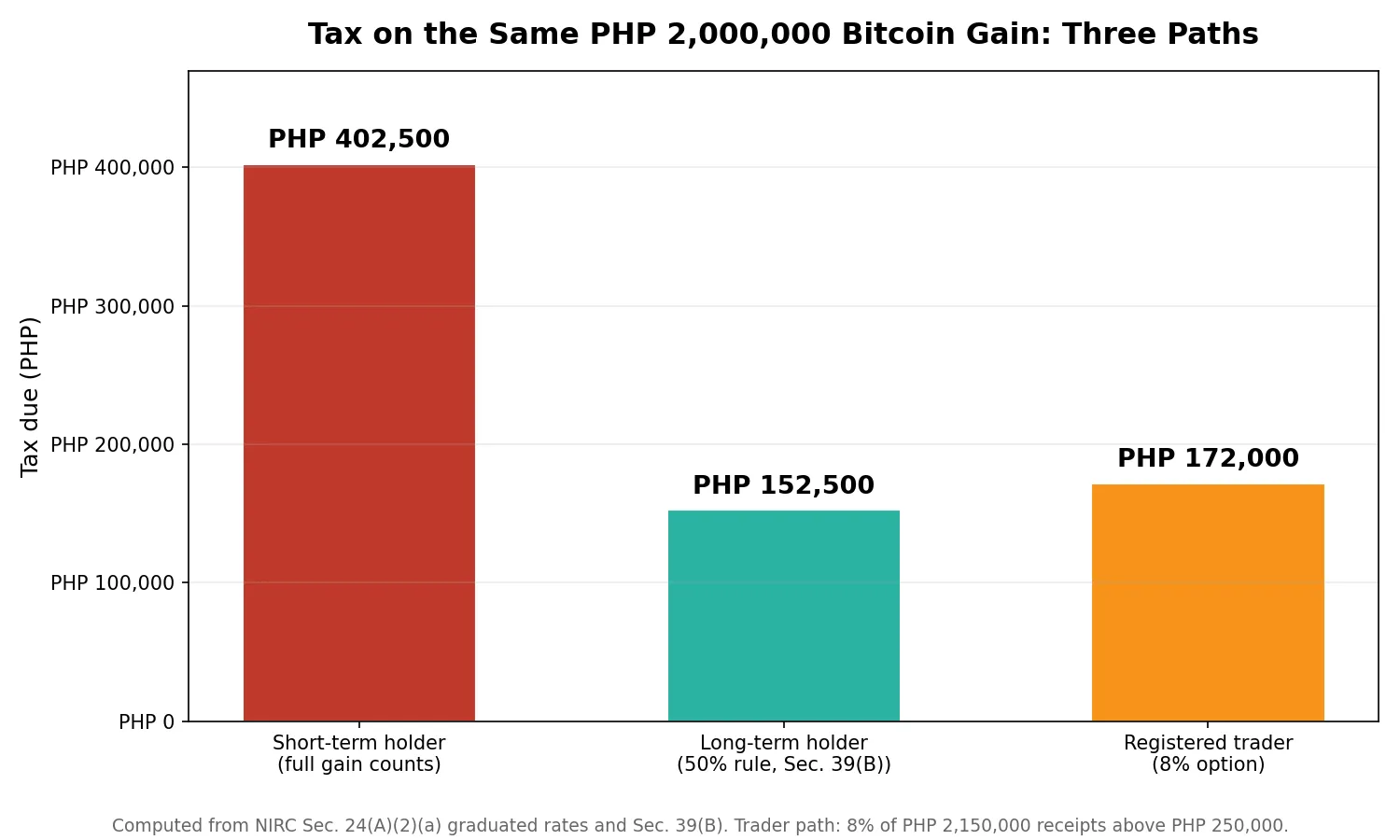
The lesson is simple.
Holding for more than a year is the biggest legal lever a Philippine holder has, and it is worth more than any rate argument. The 8% option is a convenience, not a discount, and it can cost more than the graduated rates when margins are thin.
What Counts as a Taxable Event, and What Does Not
The Philippines taxes disposals, not holdings. Buying Bitcoin and keeping it in your wallet creates no tax bill, no matter how much the price rises.
Tax arrives when you dispose of the coins. That word covers more than most people expect, so here is the full list.
| Event | Taxable? | Why |
|---|---|---|
| Sell Bitcoin for pesos | Yes | The gain is income when you realise it |
| Swap Bitcoin for another crypto | Yes | A swap is a disposal of the Bitcoin, valued in pesos on the swap day |
| Spend Bitcoin on goods or services | Yes | Paying with Bitcoin disposes of the coins you spent |
| Receive Bitcoin as salary or pay | Yes | It is compensation income at its peso value on the day you receive it |
| Staking or mining rewards | Yes | Rewards are income when received, at their peso value that day |
| Buy and hold, never sell | No | No disposal, no realised gain |
| Move coins between your own wallets | No | You still own the same coins |
Swaps are the trap. Many traders swap Bitcoin for altcoins all year, never touch pesos, and assume no tax is due.
The BIR would disagree. A swap disposes of the Bitcoin at its peso market price on that day, and the gain is taxable even though no pesos reached your bank account.
Receiving Bitcoin as pay works the same way in reverse. The peso value on the day you receive it is your income, and that value becomes your cost basis, so a later sale is only taxed on the gain above it.
Staking and mining rewards follow the same logic. They are income when you receive them, and their peso value that day becomes your cost basis for a later sale.
Mining as an organised activity may be treated as business income, which lands in the general base rather than the capital-asset bucket.
The 8% Option for Registered Traders
Self-employed individuals and professionals whose gross sales or receipts stay at or below the PHP 3,000,000 VAT threshold can elect a flat 8% rate on gross sales or receipts above PHP 250,000.
The option comes from Section 24(A)(2)(b) of the Tax Code, as amended by the TRAIN law. It replaces the graduated rates and the percentage tax, so you pay one flat rate and skip the band calculations entirely.
It applies to gross receipts, not profit.
That distinction decides whether it helps you or hurts you. A trader with thin margins can pay more under the 8% option than under the graduated rates, as Bea’s example above shows.
A trader with fat margins and little paperwork may come out ahead, because the 8% rate applies to the whole receipt while the graduated rates only reach the gain. Run both calculations before you elect, and remember the election is annual.
If your gross receipts cross PHP 3,000,000, the option closes. You fall back to the graduated rates, and you may also need to register for VAT, which brings its own filing duties.
Crypto tax software can track your cost basis and run both calculations for you, which is worth doing before you choose. The software does the arithmetic; the choice stays yours.
How to Report: Forms, Deadlines, and Records
Your Bitcoin gain goes on your annual income tax return. Which form you use depends on how you earn your money.
Self-employed individuals and mixed-income earners file BIR Form 1701. Employees with only compensation income file BIR Form 1700.
If you have both a salary and crypto gains, you are a mixed-income earner and Form 1701 is yours.
The annual return is due on 15 April of the year after the income year. Gains you made in 2026 go on the return you file by 15 April 2027.
You file through the BIR’s eBIRForms system or the eFPS online portal, and you pay through an accredited bank or payment channel. Keep the confirmation receipt, because it is your proof of filing.
Records decide whether your return survives a question from the BIR. Keep every exchange statement, the date and peso value of each buy and sell, the fees you paid, and the wallet addresses involved.
The accepted accounting method is FIFO, which means the first coins you bought are treated as the first coins you sold. Use one method and stick to it, because switching methods between years invites trouble.
Capital losses have a limit worth knowing.
Under Section 39(C) of the Tax Code, capital losses can only offset capital gains, not your salary or business income. A loss year still helps, but only against gains.
Tax loss harvesting explains how to use losses properly before 31 December. Selling at a loss to offset a gain is legal, but the loss only helps if you have gains to offset it against.
CARF Is Coming: Your Foreign Exchange Will Report to the BIR
Today, the BIR relies on your own return to learn about your crypto. That is about to change, and the change has a date.
In June 2025, the Department of Finance committed the Philippines to the OECD Crypto-Asset Reporting Framework, known as CARF. Undersecretary Charlito Martin Mendoza signified the commitment at the 8th Asia Initiative Meeting in Male, Maldives, and the target is first automatic exchanges of crypto account data by 2028.
CARF works like the bank reporting system that already exists. Crypto exchanges will collect their users’ identity and transaction data and report it to their home tax authority, which shares it with the tax authority where the user lives.
The Philippines joins 67 other jurisdictions already committed to CARF, including 10 in Asia. Malaysia, Singapore, and Thailand sit in the same group, with first exchanges in 2028.
What this means for you is plain.
If you hold Bitcoin on a foreign exchange, that exchange will eventually report your account to the BIR automatically. The era when foreign crypto sat outside the BIR’s view is ending.
The practical step is to start keeping clean records now, while the reporting is still voluntary in effect. When CARF data starts arriving in 2028, the BIR will be able to match it against your returns, and a mismatch is much harder to explain than a complete return.
Check the position again before you file for 2027, because the implementing rules and the exact start date can still move.
The BSP Side: Why Your Exchange Needs a Licence
Tax is only half the regulatory picture. The Bangko Sentral ng Pilipinas (BSP) licenses the businesses that exchange and transfer virtual assets, and your choice of exchange matters for your safety.
BSP Circular No. 1108, issued in 2021, requires virtual asset service providers (VASPs) to secure a Certificate of Authority to operate as money service businesses. A VASP without custodial services needs at least PHP 10,000,000 in paid-in capital, and one with custody needs at least PHP 50,000,000.
The BSP stopped accepting new VASP applications in 2022, and in August 2025 it extended that moratorium indefinitely. No new VASP licence can be obtained right now, so the list of licensed providers is short and changes only when a firm leaves it.
On the SEC side, the 2025 crypto-asset service provider rules require SEC-registered corporations with at least PHP 100,000,000 in paid-up capital. The two regulators split the job: the BSP covers money movement and fiat gateways, while the SEC covers investment products and trading venues.
For you, the rule is simple.
Use a BSP-licensed exchange such as Coins.ph, PDAX, or Maya, which is exactly where our guide on how to buy Bitcoin in the Philippines starts. Licensed exchanges keep proper records, which also makes your tax filing easier.
Two more facts belong here.
Virtual assets have no legal tender status in the Philippines, and the BSP does not issue or guarantee them. Your Bitcoin is your property, not Philippine money, and that is part of why the tax treatment is what it is.
Five Mistakes That Cost Filipino Bitcoin Holders Money
Most Philippine Bitcoin tax problems come from the same few errors. Here they are, so you can avoid them.
First, people budget 15% on their gain. They read the share rule, apply it to crypto, and file the wrong number.
The 15% rate covers unlisted shares, not Bitcoin. Your rate comes from the graduated scale, and it can be higher or lower.
Second, people hear “no crypto law” and assume “no tax”. They skip the return entirely, and then CARF data or a bank inquiry catches up with them.
No crypto-specific law does not mean no tax. The ordinary income tax already covers the gain.
Third, people forget that swaps are taxable. They trade Bitcoin for altcoins all year, never touch pesos, and assume nothing is due.
Each swap is a disposal at the peso price that day. A year of swaps can be a year of gains with no cash to pay them.
Fourth, people plan around the 50% rule without checking whether it applies to them. They hold for 13 months and assume half the gain vanishes from the return.
The rule covers capital assets, and no BIR ruling has confirmed it for casual crypto holders. Frequent traders may find the BIR treats their coins as business income instead.
Fifth, people keep no records. They rely on the exchange to remember everything, then the exchange closes, changes hands, or only keeps two years of history.
Your records are your defence, so keep them. Export your trade history every quarter and store it somewhere you control.
If you want the wider picture, Ireland cut its crypto capital gains rate to 31 percent in its 2027 budget, while the Philippines still taxes gains as ordinary income. Every country has its own trap, and the Philippine trap is assuming the missing law means a missing bill.
Frequently Asked Questions
Here are the questions readers ask most about Bitcoin tax in the Philippines.
Is Bitcoin taxed in the Philippines?
Yes. The Philippines has no crypto-specific tax law and the BIR has issued no crypto regulation, but Bitcoin gains fall under the ordinary income tax at graduated rates of 0% to 35%, with the first PHP 250,000 of annual taxable income tax-free.
Is there a 15% capital gains tax on crypto in the Philippines?
No. The 15% final tax applies to net capital gains on shares of stock not traded through the local stock exchange under RA 12214, and crypto is not shares of stock, so the 15% rate does not apply to a Bitcoin sale.
How much tax do I pay if I sell Bitcoin at a profit?
Your gain joins your other taxable income for the year and is taxed at the graduated rates from 0% to 35%. A PHP 2,000,000 gain with no other income costs PHP 402,500 if you held for 12 months or less, but only PHP 152,500 if you held for more than 12 months and the 50% rule applies.
Do I pay tax if I only hold Bitcoin and never sell?
Buying and holding Bitcoin is not a taxable event, and moving coins between your own wallets is not a disposal either. Tax applies when you sell, swap, spend, or receive Bitcoin as pay, though the 50% rule may reduce the gain if you held for more than 12 months.
Are crypto-to-crypto swaps taxed in the Philippines?
Swapping Bitcoin for another cryptocurrency counts as a disposal of the Bitcoin, and you calculate the gain at the peso market price on the day of the swap. No pesos need to reach your bank account for the gain to be taxable.
How do I report Bitcoin income to the BIR?
Report the gain on your annual income tax return, BIR Form 1701 for self-employed and mixed-income earners or Form 1700 for employees with only compensation income. The return is due on 15 April of the following year, and you should use the FIFO method for cost basis and keep every exchange statement.
Will the BIR know about my foreign exchange account?
Not yet through automatic reporting, but that is changing. The Philippines committed to the OECD Crypto-Asset Reporting Framework in June 2025, with first automatic exchanges of crypto account data targeted for 2028, so foreign exchanges will eventually report your account to the BIR.
Sources
- Bureau of Internal Revenue: official site, tax code, revenue regulations, and forms (NIRC Sec. 24, Sec. 32, Sec. 39; BIR Forms 1700 and 1701)
- Department of Finance: Philippines to implement a framework on crypto-assets (CARF commitment, June 2025)
- Bangko Sentral ng Pilipinas: official site, VASP licensing under Circular No. 1108