



Spain taxes your Bitcoin gains at 19% to 30%. The rate depends on the size of your gain, not on how long you held the coins.
That part is simple. The part that catches people out is the paperwork.

Spain has a crypto-specific form, Modelo 721, and a wealth tax that can apply to the same coins. And in 2026, the European reporting law everyone expected to close the loop hit a surprise delay.
- Key Takeaways
- The Short Answer: Spain Treats Bitcoin as Property, Not Money
- The 2026 Rates: What You Actually Pay on a Gain
- What Counts as a Taxable Event, and What Does Not
- Selling Bitcoin for euros
- Swapping Bitcoin for another crypto
- Spending Bitcoin on goods or services
- Holding, and moving coins between your own wallets
- Modelo 721: The Form That Catches People Out
- Modelo 721 vs Wealth Tax: Two Different Jobs
- DAC8: The Twist Nobody Expected in 2026
- Staking, Mining and Airdrops Land in Different Buckets
- How to Report Your Bitcoin Tax in Spain
- Five Mistakes That Cost Spanish Bitcoin Holders Money
- Frequently Asked Questions
- Is Bitcoin taxed in Spain?
- Do I pay tax if I only hold Bitcoin and never sell?
- What is Modelo 721 and who must file it?
- Does DAC8 mean my exchange reports me automatically?
- Are crypto-to-crypto swaps taxed in Spain?
- Is staking income taxed differently from a sale?
- Sources
This guide explains bitcoin tax in spain explained in plain English, with the 2026 rates, a worked example, the Modelo 721 rules, and the DAC8 twist you will not find in most guides.
This guide is general information only, not tax advice, and tax rules depend on your own situation, so talk to a qualified tax adviser in Spain before you file.
Key Takeaways
- Bitcoin gains are taxed as savings income in Spain at progressive rates of 19% to 30%. A 100,000 euro gain costs 21,880 euro in tax.
- Spain treats Bitcoin as property, not money. Selling, swapping, and spending Bitcoin are all taxable disposals, while simply holding it is not.
- Modelo 721 is an informational form for crypto held with foreign custodians above 50,000 euro at 31 December. It does not charge tax by itself, but missing it can bring penalties.
- Self-custody wallets where you control the private keys do not count toward Modelo 721. Only coins held by a foreign custodian count.
- Spain’s own DAC8 law lapsed when parliament was dissolved on 6 October 2026, but EU exchanges still collect your data from 2026, and Spanish exchanges already report under Modelo 172 and 173.
- Crypto also counts toward Spain’s wealth tax above a 700,000 euro exemption, at rates from 0.2% to 3.5% depending on your region.
- Staking rewards are taxed as capital income when you receive them. Mining as an organised activity is taxed as business income at general rates up to about 54%.
The Short Answer: Spain Treats Bitcoin as Property, Not Money
Spain does not treat Bitcoin as money. The tax authority, the Agencia Tributaria, treats it as a digital asset, and a sale counts as a disposal of that asset.
That one decision shapes everything else. Your gain lands in the savings base of personal income tax, known as IRPF, the same bucket as dividends and share gains.

The savings base uses its own lower progressive scale, separate from the general scale that covers salaries. Your region cannot change these savings rates, so they are the same in Madrid, Barcelona, and Seville.
Our full Bitcoin tax guide shows how other countries handle the same question, and Spain sits in the middle of the pack: tougher than countries with no capital gains tax, gentler than the top-rate countries.
The 2026 Rates: What You Actually Pay on a Gain
Spain taxes savings income in five bands. Each rate applies only to the slice of your gain inside that band, so nobody pays the top rate on the whole gain.
Here are the rates that apply in 2026.
| Gain in the band | Tax rate |
|---|---|
| Up to 6,000 euro | 19% |
| 6,000 to 50,000 euro | 21% |
| 50,000 to 200,000 euro | 23% |
| 200,000 to 300,000 euro | 27% |
| Above 300,000 euro | 30% |
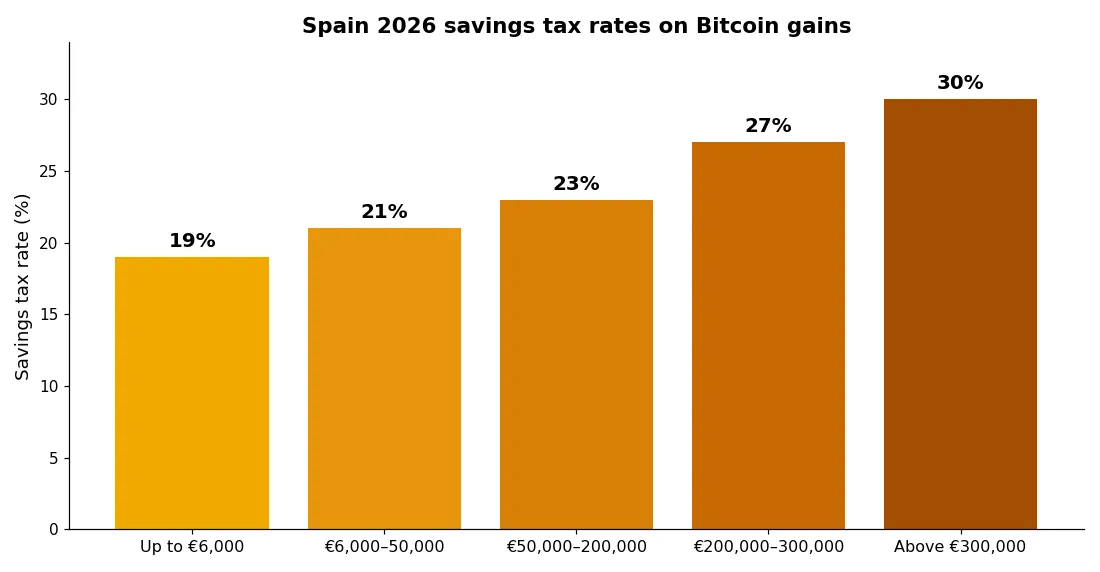
Now let us work a real example. Say you bought Bitcoin for 20,000 euro and sold it for 120,000 euro, so your gain is 100,000 euro.
The first 6,000 euro of the gain pays 19%, which is 1,140 euro. The next 44,000 euro pays 21%, which is 9,240 euro.
The last 50,000 euro pays 23%, which is 11,500 euro. Your total tax is 21,880 euro.
That is an effective rate of 21.9% on the gain, not 23%, because the lower bands pull the average down.
A smaller gain works the same way. A 10,000 euro gain costs 1,980 euro: 1,140 euro on the first 6,000 euro, plus 840 euro on the remaining 4,000 euro.
A very large gain climbs further up the ladder. A 350,000 euro gain costs 86,880 euro, an effective rate of 24.8%, because only the slice above 300,000 euro pays the 30% top rate.
For comparison, the same 100,000 euro gain in Ireland would cost 31,000 euro at Ireland’s flat 31% capital gains rate, as our Bitcoin tax in Ireland guide explains. Spain’s progressive scale saves you 9,120 euro on that gain.
One more point matters. The bands apply to your total savings income for the year, not to each sale separately.
Your Bitcoin gain sits in the same pot as your dividends and interest, and losses from other savings income can offset your crypto gains.
What Counts as a Taxable Event, and What Does Not
Spain taxes disposals, not holdings. Buying Bitcoin and keeping it in your wallet creates no tax bill, no matter how much the price rises.
Tax arrives when you dispose of the coins. That word covers more than most people expect, so here is the full list.
Selling Bitcoin for euros
This is the obvious one. You sell Bitcoin for euros, and the difference between your sale price and your purchase price is your gain.
Your cost basis is what you paid, including fees. Spain uses the FIFO method, which means the first coins you bought are treated as the first coins you sold.
Swapping Bitcoin for another crypto
This is the trap. Swapping Bitcoin for Ethereum counts as a disposal of the Bitcoin, even though no euros ever touch your bank account.
You calculate the gain at the euro market price of the Bitcoin on the day of the swap. Many traders only learn this when they sit down to file.
Spending Bitcoin on goods or services
Paying with Bitcoin is also a disposal. If you buy a laptop with Bitcoin that has doubled in value, the gain on the coins you spent is taxable.
Holding, and moving coins between your own wallets
Neither of these is taxable. Moving Bitcoin from an exchange to your own hardware wallet changes nothing for income tax, because you still own the same coins.
Gifts and inheritances follow separate rules, and they can trigger tax for the person who receives the coins. If you plan a large gift, get advice first.
Modelo 721: The Form That Catches People Out
Modelo 721 is the form most guides mention and few explain properly. It is an informational declaration, which means it does not charge tax by itself.
Its job is to tell the tax authority what crypto you hold abroad. Filing it costs you nothing in tax, but skipping it when you had to file can bring a penalty.
It replaced Modelo 720 for crypto. Modelo 720 still exists, but it now covers foreign bank accounts and other foreign assets, while crypto held abroad moved to Modelo 721.
Who must file Modelo 721
You must file if you are a Spanish tax resident and your crypto sits with a custodian outside Spain. The threshold is 50,000 euro, measured on the combined value of all your foreign-held crypto at 31 December.
Two conditions must both apply. First, a third party must safeguard your private keys for you, such as a foreign exchange holding your coins.
Second, that custodian must not be resident in Spain. If your total foreign-held crypto is 50,000 euro or less at 31 December, you do not file.
If it crosses the line, you report all of it, not just the amount above 50,000 euro.
What self-custody means for you
Coins in a wallet where you alone control the private keys do not count toward Modelo 721. The tax authority confirmed this in its own guidance, and the tax directorate backed it in binding ruling V2290-23.
This is the single most useful fact in this guide. Moving your coins to your own hardware wallet takes them out of the Modelo 721 calculation entirely.
It does not take them out of income tax or wealth tax. It only removes the reporting duty for those coins.
Deadlines and penalties
Modelo 721 is filed between 1 January and 31 March of the year after the reporting year. Balances at 31 December 2026 are reported between January and March 2027.
You file it online through the Agencia Tributaria website, using a digital certificate, electronic ID, or Cl@ve PIN. The form asks for the exchange, the type of coin, and the balance at 31 December.
Penalties for a missed filing can be steep, and the tax authority has the exchange data to check. File it if you are anywhere near the threshold, and keep a copy of what you submitted.
One related point: the euros sitting in your account at a foreign exchange are a different asset. That cash balance may still need reporting on Modelo 720 if your total foreign accounts cross 50,000 euro.
Modelo 721 vs Wealth Tax: Two Different Jobs
Readers mix these two up, because both involve a threshold and both involve crypto. They are different tools with different jobs, and it helps to see them side by side.
| Modelo 721 | Wealth tax | |
|---|---|---|
| What it is | An informational declaration | A real tax on net wealth |
| Threshold | 50,000 euro of foreign-held crypto | 700,000 euro of total net wealth |
| What counts | Only crypto held by foreign custodians | All wealth, including crypto in self-custody |
| Cost if you owe it | No tax, but penalties if you skip it | 0.2% to 3.5% a year on wealth above the threshold |
| Deadline | 1 January to 31 March | Filed with the annual wealth tax return, Modelo 714 |
Wealth tax is a regional tax, so the details change by region. The general exemption is 700,000 euro per person, plus 300,000 euro for your main home, though the home exemption does not apply to crypto.
Some regions give full relief, so Madrid, Andalucia, and Murcia effectively charge no wealth tax. Others apply the state scale of 0.2% to 3.5%.
Catalonia sets the exemption at 500,000 euro, while the Balearic Islands raised it to 3,000,000 euro.
Above that sits the national Solidarity Tax on Large Fortunes, which applies to net wealth above about 3 million euro. It exists partly to stop regional relief from wiping out the bill for the richest residents.
Crypto counts toward wealth tax at its market value on 31 December, whether it sits on an exchange or in your own wallet. A big holding can push you over the threshold even if you never sold a single coin.
DAC8: The Twist Nobody Expected in 2026
Most 2026 guides tell you that exchanges now report your data automatically under DAC8. That is only half true for Spain, and the missing half is the most interesting part of this story.
DAC8 is the European Union directive that forces crypto providers to collect user data and share it with tax authorities. Data collection started across the EU on 1 January 2026, and the first exchange of that data between countries is scheduled for 2027.
Spain was supposed to pass its own DAC8 law to make it work at home. The bill reached parliament, and then politics got in the way.
The Cortes Generales were dissolved on 6 October 2026, a general election was called for 29 November 2026, and the DAC8 bill lapsed with the dissolution.
So Spain has no DAC8 law on the books right now. That does not mean the tax authority is blind, and this is where readers get the wrong idea.
First, the EU rule still binds providers in other member states. If you use an exchange based in France or Germany, it collects your data under its own country’s DAC8 law and shares it with Spain in 2027.
Second, Spain built its own domestic reporting years ago. Exchanges established in Spain already report your 31 December balances on Modelo 172 and your purchases, sales, swaps, and transfers on Modelo 173.
Those forms have applied since 2024, and they never depended on DAC8.
The honest summary is this: the Spanish DAC8 law fell, but Hacienda still gets your exchange data from two directions. Do not plan your taxes around the idea that the lapsed bill created a gap.
The new parliament will need to reintroduce the DAC8 bill after the election. When it does, it may also add the seizure powers over crypto assets that the lapsed bill contained.
Check the position again before you file for 2026.
Staking, Mining and Airdrops Land in Different Buckets
Not all crypto income is treated the same way in Spain. How you earned it decides which tax bucket it lands in, and the buckets have very different rates.
Staking rewards are the gentlest case. The tax authority treats them as capital income, which lands in the savings base at 19% to 30%.
You pay tax on the euro value of the reward on the day you receive it.
That day also sets your cost basis. If you later sell the staked coins, you only pay tax on the gain above the value they had when you received them.
Mining is a different story. If you mine as an organised activity, the rewards count as business income in the general base.
That base runs up to about 45% to 54% depending on your region, and you must register as self-employed and join the RETA scheme.
Our guide on how Bitcoin miners are taxed explains the hobby versus business line in detail, and the same logic applies in Spain.
Airdrops land in the general base too, as gains not from a transfer, valued at the market price on the day you receive them. A large airdrop can be painful, because general-base rates reach far higher than the 30% savings cap.
One practical tip follows from all of this. Keep staking, mining, and airdrop income in separate records from your trading gains, because they go on different parts of your return.
How to Report Your Bitcoin Tax in Spain
Reporting starts with records. Spain expects you to know what you bought, when you bought it, what you paid, and what you sold it for.
Most exchanges give you a transaction history download. Pull it every year, and keep it.
If you traded on several exchanges, you need all of them to work out your FIFO cost basis correctly.
Your gains go on Modelo 100, the annual personal income tax return. You report the gain in the savings base section, and the tax is calculated with the rest of your savings income.
Modelo 100 is filed during the spring tax campaign, and the deadline is usually 30 June. Modelo 721, if you owe it, goes in earlier, between January and March.
Losses can offset gains in the same year, but Spain has an anti-avoidance rule. If you sell crypto at a loss and buy the same crypto back within two months, you cannot deduct that loss.
The rule can stretch to a year in some cases, so do not sell at a loss and rebuy the same coin straight away and expect the loss to count. Wait out the window, or buy a different asset.
If you live in Spain under the Beckham Law regime for incoming workers, different rules apply. Foreign crypto gains are generally exempt during the six-year regime, while Spanish-source gains still face tax at a flat 24% up to 600,000 euro.
For a sense of how different the answers get elsewhere in Europe, Germany’s one-year holding rule can make long-held Bitcoin tax-free, while Japan taxes crypto gains at up to 55% and plans a cut to 20% from 2028. Spain sits between the two.
For a comparison outside Europe, see how the Philippines taxes Bitcoin.
For the opposite end of the scale, see Bitcoin tax in the UAE, where individuals pay 0% on personal gains.
Five Mistakes That Cost Spanish Bitcoin Holders Money
Most Spanish Bitcoin tax problems come from the same few errors. Here they are, so you can avoid them.
First, people forget that swaps are taxable. They trade Bitcoin for altcoins all year, never touch euros, and assume no tax is due.
The tax authority disagrees.
Second, people miss Modelo 721. They know about income tax and forget the foreign-holdings form, even though the exchange data makes the omission easy to spot.
Third, people mix up Modelo 721 and wealth tax. They file one and assume the other is covered.
The two forms ask different questions and have different thresholds.
Fourth, people sell at a loss and rebuy within two months. The loss looks deductible on paper, but the anti-avoidance rule wipes it out.
Fifth, people keep no records. They rely on the exchange to remember everything, then the exchange closes, changes hands, or only keeps two years of history.
Your records are your defence, so keep them.
If you want the wider picture, our New Zealand guide shows a country with no capital gains tax that still taxes most crypto gains as income. Every country has its own trap, and Spain’s are the forms.
Frequently Asked Questions
Here are the questions readers ask most about Bitcoin tax in Spain.
Is Bitcoin taxed in Spain?
Yes. Spain treats Bitcoin as property, and gains from selling, swapping, or spending it are taxed as savings income at progressive rates of 19% to 30% in 2026.
Do I pay tax if I only hold Bitcoin and never sell?
Buying and holding Bitcoin is not a taxable event in Spain, and moving coins between your own wallets is not a disposal either. Tax applies when you sell, swap, spend, or gift the coins, though large holdings can still count toward wealth tax.
What is Modelo 721 and who must file it?
Modelo 721 is an informational declaration for crypto held with custodians outside Spain. Spanish tax residents must file it between 1 January and 31 March if their combined foreign-held crypto was worth more than 50,000 euro at 31 December, and coins in self-custody wallets where you control the private keys do not count.
Does DAC8 mean my exchange reports me automatically?
EU crypto providers collect your data from 1 January 2026 and share it with tax authorities from 2027, but Spain’s own DAC8 law lapsed when parliament was dissolved on 6 October 2026, so it must be reintroduced after the 29 November 2026 election. Spanish exchanges already report your balances and transactions under Modelo 172 and Modelo 173, so the tax authority still receives your data.
Are crypto-to-crypto swaps taxed in Spain?
Swapping Bitcoin for another cryptocurrency counts as a disposal of the Bitcoin, and you calculate the gain at the euro market price on the day of the swap. No euros need to reach your bank account for the gain to be taxable.
Is staking income taxed differently from a sale?
Staking rewards are taxed as capital income in the savings base at 19% to 30%, based on their euro value on the day you receive them. That value then becomes your cost basis, so a later sale is only taxed on the gain above it.