



A bitcoin debit card lets you pay for groceries, fuel, and online orders with the Bitcoin you already own. The shop never sees any crypto.
Behind that one tap, your card provider sells a small slice of your Bitcoin and hands the shop dollars. That sale is the answer to bitcoin debit cards how they work, and it explains both the real cost and the tax bill.

This guide answers the question people type into Google, bitcoin debit cards how they work, in plain language. It covers the two funding models, a worked $100 example at the live November 6, 2026 price of about $76,100, real 2026 fees from Coinbase, Crypto.com, and Bybit, and the tax rule most guides skip.
- Key Takeaways
- What a Bitcoin Debit Card Actually Is
- How a Bitcoin Debit Card Works, Step by Step
- The Cost Most Explainers Bury: Every Tap Is a Sale
- Three Cards Compared: Coinbase, Crypto.com, and Bybit
- Virtual vs Physical Cards
- The Tax Bill Nobody Mentions at Checkout
- When a Bitcoin Debit Card Is the Wrong Tool
- How to Get a Bitcoin Debit Card
- Common Mistakes Beginners Make
- Pros and Cons of Bitcoin Debit Cards
- Frequently Asked Questions
- The Bottom Line
- Sources
If you are still choosing how to get Bitcoin in the first place, our payment methods hub covers every route in one place.
Key Takeaways
- A bitcoin debit card sells a little of your Bitcoin at checkout and pays the shop in dollars.
- Most cards run on Visa or Mastercard, so they work anywhere those networks are accepted.
- The real cost sits in the conversion spread, about 0.9% to 2.49% on the cards we checked.
- A $100 shop can cost $102.55 in Bitcoin value on the priciest card we found.
- In the US, every tap is a taxable sale of property, and you report it on Form 8949.
- Spending a stablecoin such as USDC instead of Bitcoin keeps the tax bill near zero.
What a Bitcoin Debit Card Actually Is
A bitcoin debit card is a normal Visa or Mastercard debit card that draws on your crypto balance instead of a bank account. You tap it at the till exactly like any other card, and the shop receives dollars, euros, or your local currency.
The difference sits behind the scenes. A normal debit card moves money you already hold in dollars.
A bitcoin debit card sells a little of your Bitcoin at the moment you pay, converts it to fiat, and settles the bill through the card network.

Do not confuse spending with buying. Buying Bitcoin with a debit card means you pay dollars and receive Bitcoin.
A bitcoin debit card runs the other way: you spend Bitcoin and the shop receives dollars.
Most of these cards are custodial, which means the provider holds your funds. You trust the provider with your balance, your identity documents, and the exchange rate it applies at checkout.
How a Bitcoin Debit Card Works, Step by Step
The checkout feels instant because the card network does the heavy work. Four quick stages run between your tap and the shop’s payment, and each one matters for cost.
First, you fund the card. You either link an exchange balance that the card draws on, or you preload a balance in advance.
Second, you tap or swipe at any merchant that accepts Visa or Mastercard.
The Four Steps Behind One Tap
The provider does the rest in under a second. Here is the sequence in order:
- You tap or swipe the card at the till, and the terminal sends the amount in local currency to the card issuer.
- The issuer works out how much Bitcoin to sell at the live market rate, plus any conversion fee it charges.
- The provider sells that slice of Bitcoin, converts it to the shop’s currency, and sends the payment through Visa or Mastercard.
- The network clears the payment, and the merchant receives ordinary fiat money. The shop never touches crypto.
Your exchange account logs the sale as an auditable entry. That log is the record you need at tax time, so keep it.
Preloaded vs Auto-Conversion: The Two Funding Models
Preloaded cards convert your Bitcoin into fiat upfront, when you load the card. The conversion happens once, at the load rate, and each purchase then spends plain fiat from the card balance.
Auto-conversion cards keep your balance in Bitcoin and sell a slice at every purchase. This is the most common design in 2026.
It keeps you invested until the second you spend, but it creates a taxable sale on every single transaction.
| Feature | Preloaded card | Auto-conversion card |
|---|---|---|
| When Bitcoin converts | Once, when you load the card | At every purchase |
| Price risk after loading | None, the balance is fiat | Full, until the moment you pay |
| Taxable sales | One per load | One per purchase |
| Best for | Budgeting a fixed amount | Staying invested until you spend |
Preloaded cards give you one tax event per load instead of one per coffee. Auto-conversion cards give you flexibility and a longer tax list.
Pick the model that fits how often you plan to spend.
The Cost Most Explainers Bury: Every Tap Is a Sale
Most guides list the annual fee and stop there. The annual fee is usually zero, so the card looks free.
The real cost hides in the conversion spread, the gap between the market price of Bitcoin and the rate your provider gives you.
Bitcoin.com puts the typical conversion cost at about 1% to 1.5%, often hidden inside the exchange rate rather than shown as a line item, and some cards charge more.
The Coinbase Card applies a spread of about 2.49% when you spend crypto other than USDC, according to 2026 fee comparisons.
That spread is the price of convenience. You pay it on every purchase, on top of any ATM or foreign transaction fee.
A card that advertises no fees can still cost you more than a card with a visible fee, because the spread never appears on your receipt.
A $100 Grocery Shop, Worked Out at Today’s Price
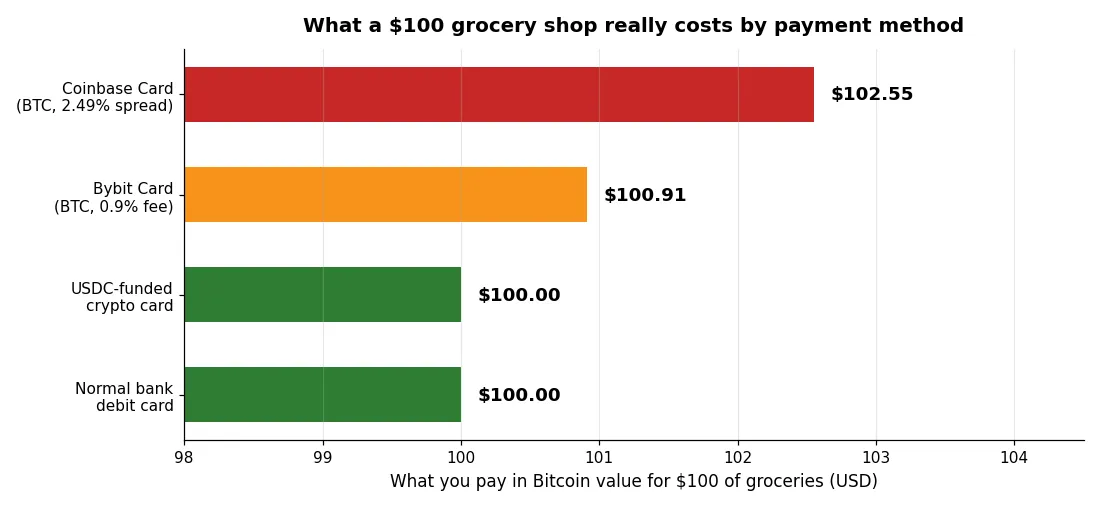
Bitcoin traded near $76,100 on November 6, 2026, down about 5.6% in 24 hours. The chart below uses that live price and the published 2026 fees to show what a $100 grocery shop really costs on each payment method.
| Payment method | Bitcoin you give up | Cost in Bitcoin value | Extra cost |
|---|---|---|---|
| Normal bank debit card | None | $100.00 | $0.00 |
| USDC-funded crypto card | 100 USDC | $100.00 | $0.00 |
| Bybit Card, Bitcoin funded | 0.001326 BTC | $100.91 | $0.91 |
| Coinbase Card, Bitcoin funded | 0.001348 BTC | $102.55 | $2.55 |
The math is simple. At $76,100 per Bitcoin, $100 of groceries needs 0.001314 BTC at the market rate.
On the Coinbase Card, the 2.49% spread drops the effective rate to about $74,205, so you need 0.001348 BTC instead. That slice is worth $102.55 at the market price, so the shop costs you $2.55 more than the price on the shelf.
The Bybit Card charges about 0.9% on crypto-funded spending, so the same shop costs $100.91 in Bitcoin value. A card funded with USDC costs $100.00, because a stablecoin barely moves against the dollar.
A normal bank debit card also costs $100.00, and it sells nothing.
Small amounts add up fast. A $2.55 extra charge looks trivial once, but fifty shops a month turn it into about $127.50 of hidden cost.
That is why the spread matters more than any cashback rate.
Why the Spread Hides in the Exchange Rate
Providers rarely show the spread as a fee. They show you a conversion rate, and the rate quietly sits below the market price.
You see the dollar total, not the Bitcoin you gave up.
The fix is to check the rate before you spend. Compare the provider’s Bitcoin price with the live market price on a site such as CoinGecko.
If the gap is wider than 1%, you are paying a premium for the tap.
Three Cards Compared: Coinbase, Crypto.com, and Bybit
Three cards cover most use cases in 2026, and they work in different places. The table below uses fees each issuer published or that 2026 comparisons verified against issuer pages in October.
| Card | Network | Annual fee | Conversion cost | Cashback | Where it works |
|---|---|---|---|---|---|
| Coinbase Card | Visa | $0 | About 2.49% spread on crypto, USDC free | Variable, shown in app | US, except Hawaii |
| Crypto.com Visa | Visa | $0 base tier | Variable spread | 0% base, 1.5% to 4.5% on paid tiers | US, UK, EEA, and more |
| Bybit Card | Mastercard | $0 | About 0.9% on crypto funding | 2% to 10% | Outside the EEA, not the US |
The Coinbase Card suits US users who already hold crypto on Coinbase. It charges no Coinbase fee for card spending, but the spread applies when you spend Bitcoin.
Spending USDC avoids the spread entirely.
Crypto.com changed its US product in 2026. Its US card is now a Visa Signature credit card, not a prepaid debit card.
The free Basic tier pays 0% cashback, and real rewards need a paid subscription or a CRO stake.
The Bybit Card suits users outside the US and the EEA. It charges about 0.9% on crypto-funded spending and pays 2% to 10% cashback, but rewards carry a monthly cap and the card does not serve US customers.
Binance shows how fast this market moves. It left the European Economic Area in late 2023 and relaunched its card as a Brazil-only product in October 2025.
Always check current availability in your country before you apply.
Virtual vs Physical Cards
A virtual card lives in your phone wallet, such as Apple Pay or Google Pay. You can use it online and in shops that accept contactless payments, and most providers issue it instantly.
A physical card takes one to three weeks to arrive, and it works everywhere, including old terminals and ATMs. It also lets you withdraw cash, which a virtual card cannot do.
ATM withdrawals carry their own fees. Crypto.com charges 2% above a free monthly allowance on its US card, and Bybit offers free withdrawals up to a monthly regional allowance.
Check the ATM terms before you travel.
The Tax Bill Nobody Mentions at Checkout
This is the part that surprises new users most. In the United States, the IRS treats Bitcoin as property, not currency.
Spending it is a sale of property, so every tap creates a capital gain or loss.
The gain is the difference between the Bitcoin’s cost basis, what you paid for it, and its fair market value when you spent it. If you bought Bitcoin at $50,000 and spent it at $76,100, the slice you sold gained value, and that gain is taxable.
Our worked example shows the scale. The Coinbase Card sale of 0.001348 BTC for a $100 shop had a cost basis of $67.38 if the Bitcoin was bought at $50,000.
The proceeds were $102.55, so the tap created a $35.17 capital gain on top of the $2.55 spread.
Hold time decides the rate. Bitcoin held for one year or less produces a short-term gain, taxed as ordinary income at rates up to 37%.
Bitcoin held for more than a year qualifies for long-term rates of 0%, 15%, or 20%.
There is no small-purchase exemption. The IRS provides no de minimis rule for spending crypto, so even a $4 coffee creates a reportable disposal.
You report each sale on Form 8949 and summarize on Schedule D.
Starting with the 2025 tax year, custodial exchanges and card providers must issue Form 1099-DA, which reports the gross proceeds of your disposals to the IRS. Cost basis reporting follows in 2026.
Your provider’s records will not stay private.
The Stablecoin Trick That Keeps the Bill Near Zero
Stablecoins such as USDC track the dollar, so spending them creates almost no gain or loss. The disposal is still reportable, but the numbers barely move.
This is why about 90% of what people run through crypto cards is now stablecoins, according to Bitcoin.com’s September 2026 snapshot. Most users treat volatile coins as savings and spend the steady ones instead.
If you want the convenience without the tax paperwork, fund the card with USDC and keep your Bitcoin untouched. You still pay any spread the provider charges, but the capital gains bill mostly disappears.
When a Bitcoin Debit Card Is the Wrong Tool
A bitcoin debit card is a spending tool, not a savings tool. It suits small, everyday purchases where convenience beats cost.
It fails in three common cases.
First, large purchases. A 2.49% spread on a $2,000 laptop costs about $51 in Bitcoin value.
A normal card plus a separate exchange buy costs far less.
Second, regular remittances. Sending money home is a transfer, not a purchase, and a card tap is the most expensive way to move it.
Our guide to buying Bitcoin with Western Union covers cheaper cross-border routes.
Third, holding Bitcoin you believe will rise. Every tap sells Bitcoin at today’s price.
If you expect the price to climb, spending your Bitcoin now locks in today’s value and creates a tax bill at the same time.
How to Get a Bitcoin Debit Card
Getting a card takes four steps, and identity verification is part of every licensed option. Genuine no-KYC cards have largely disappeared in regulated markets as identity rules tightened through 2025 and 2026.
- Pick a provider that serves your country and read its fee page first.
- Create an account and complete identity verification with a government ID and a selfie.
- Fund the card balance with Bitcoin or a stablecoin such as USDC.
- Add the virtual card to your phone wallet, and order a physical card if you want ATM access.
You can top up your exchange balance by wire transfer if you want to move a larger sum at once. The wire only moves dollars to the exchange, and you still buy the Bitcoin separately.
If a provider promises no ID checks, treat it as a warning sign. Licensed Visa and Mastercard issuers must verify identity, and a card that skips this step usually operates outside those rules.
Our guide to buying Bitcoin without ID explains the legal limits of anonymous options.
Common Mistakes Beginners Make
New cardholders repeat the same errors. Each one costs money or creates tax work, and each one is easy to avoid.
- Spending Bitcoin instead of stablecoins for daily shopping, which creates a capital gain on every purchase.
- Ignoring the spread and judging a card by its headline cashback rate alone.
- Forgetting the tax record. Keep the date, amount, cost basis, and fair market value of every tap.
- Assuming cashback erases the spread. A 2% cashback on a card with a 2.49% spread still leaves you behind.
- Using the card abroad without checking foreign transaction fees. Crypto.com US cardholders pay a 3% foreign transaction fee.
- Loading the card with Bitcoin you cannot afford to spend. The provider holds your funds, so a frozen account freezes your spending money.
Pros and Cons of Bitcoin Debit Cards
The card is useful, but only for the right job. Here is the honest balance.
| Pros | Cons |
|---|---|
| Spend Bitcoin anywhere Visa or Mastercard works | Every purchase is a taxable sale of property |
| No need to sell manually before you shop | Conversion spread of 0.9% to 2.49% on Bitcoin |
| Cashback in crypto on some cards | Provider holds your funds and your identity data |
| Virtual card ready instantly in your phone | KYC required, no licensed anonymous option |
| Useful where banks are slow or limited | Rewards often need staking or paid tiers |
| Stablecoin funding removes most tax friction | ATM and foreign transaction fees add up |
Frequently Asked Questions
How do bitcoin debit cards work?
A bitcoin debit card converts a small amount of your Bitcoin into dollars at the moment you pay. The shop receives ordinary money through Visa or Mastercard, and your exchange account records the sale.
The card never sends Bitcoin to the shop.
Is spending Bitcoin with a debit card taxable?
Yes, in the United States. The IRS treats Bitcoin as property, so each purchase is a sale that can create a capital gain or loss.
You report the sales on Form 8949 and Schedule D, and there is no minimum amount that escapes reporting.
How much does a bitcoin debit card cost to use?
Most cards have no annual fee. The main cost is the conversion spread, about 0.9% on the Bybit Card and about 2.49% on the Coinbase Card when you spend Bitcoin.
ATM and foreign transaction fees can add more, so read the fee page before you apply.
Can I use a bitcoin debit card anywhere?
You can use it anywhere Visa or Mastercard is accepted, which covers most shops and websites worldwide. Availability depends on your country, because each provider serves only certain regions.
Do I need ID to get a bitcoin debit card?
Yes. Licensed providers require identity verification with a government ID and a selfie.
Cards that promise no ID checks have largely disappeared from regulated markets.
Is it better to spend Bitcoin or stablecoins with a debit card?
Stablecoins are usually better for everyday spending. A stablecoin such as USDC barely moves against the dollar, so the capital gain on each purchase stays near zero.
Keep Bitcoin as savings and spend the steady coins instead.
The Bottom Line
Bitcoin debit cards work exactly as advertised: one tap turns your Bitcoin into a normal card payment. The catch is that the tap is also a sale, with a spread and a tax bill attached.
Now you know bitcoin debit cards how they work, and what each tap costs. Use the card for small everyday spending, fund it with stablecoins, and check the spread before you trust the headline rate.
Keep your Bitcoin for the long term, and let the card spend the coins that do not move.
If you need Bitcoin in a hurry to fund the card, our guide to buying Bitcoin instantly compares the quickest routes.