


A Bitaxe is a tiny, palm-sized Bitcoin miner you can run on your desk at home. It costs around $100 and uses about as much power as a phone charger.
It is also fully open-source, which means anyone can inspect or improve its design. Here is the catch: it is so small that it will almost certainly never earn you real money through normal mining. People buy it anyway, because it gives you a lottery ticket on the Bitcoin network.

If your little miner ever finds a block, you keep the whole reward of 3.125 BTC plus fees, worth hundreds of thousands of dollars.
- Key Takeaways
- What Is a Bitaxe Bitcoin Miner, Exactly?
- How a Bitaxe Mines Bitcoin
- Bitaxe Specs at a Glance
- The Honest Math: Your Real Odds of Winning
- What About Normal Pool Earnings?
- Bitaxe vs a Real ASIC Miner
- How to Set Up a Bitaxe in 5 Minutes
- Common Mistakes to Avoid
- Frequently Asked Questions
- Is a Bitaxe profitable?
- What are the odds of a Bitaxe finding a Bitcoin block?
- How much electricity does a Bitaxe use?
- Can I mine other coins with a Bitaxe?
- Do I need a computer running all the time?
- Where can I buy a Bitaxe?
- The Bottom Line
In this guide you will learn exactly what a Bitaxe Bitcoin miner is, how it works, what the specs really mean, the honest math behind the lottery odds, stories of real Bitaxe block wins, and how to set one up in about five minutes.
Key Takeaways
- A Bitaxe is an open-source, single-chip Bitcoin miner built for learning and fun, not for profit.
- The popular Bitaxe Gamma 601 runs at about 1.2 TH/s and sips only 17 watts of power.
- Most owners point it at solo mining, which is a lottery: find a block and you win the full 3.125 BTC reward.
- Your odds per block are roughly 1 in 728 million at today’s network size. Yes, it has happened. More than once.
- Setup takes minutes: plug it in, join its WiFi, open the AxeOS dashboard, enter your wallet address.
What Is a Bitaxe Bitcoin Miner, Exactly?
What is a Bitaxe Bitcoin miner? It is the smallest serious Bitcoin miner in the world. Instead of a loud industrial machine that fills a warehouse, a Bitaxe is a single circuit board about the size of your hand.
It holds one real ASIC chip, the same kind of chip used in professional mining hardware, plus a small screen, WiFi, and a fan.
The project started as an open experiment by a developer known as skot. He published the full hardware design and firmware on GitHub for free.

That means no company owns it. Small builders around the world, like Solo Satoshi, CryptoCloaks, and D-Central, manufacture and sell their own versions. You can even build one yourself if you can solder.
Why Open Source Matters Here
Almost every miner on the market is a black box. You cannot see what its software does. A Bitaxe is the opposite.
Every line of code and every circuit trace is public. That matters to Bitcoiners who care about trust, because mining hardware you cannot inspect could theoretically do sneaky things.
With a Bitaxe, there is nothing to hide, and the community improves the design in the open. If you want the basics first, read how Bitcoin mining actually works before going deeper.
How a Bitaxe Mines Bitcoin
A Bitaxe does the exact same job as a giant mining farm, just at a microscopic scale. Its ASIC chip, usually a Bitmain BM1370 from the Antminer S21 family, does nothing but guess numbers, trillions of times per second, trying to solve Bitcoin’s proof-of-work puzzle. An ESP32 microcontroller with WiFi connects the chip to the internet and serves the AxeOS dashboard, a simple web page where you watch your hashrate, temperature, and shares in real time.
You point the miner at either a normal mining pool or a solo pool. That choice changes everything, and it is the whole reason the Bitaxe exists.
Pool Mining vs Solo Mining on a Bitaxe
In pool mining, thousands of miners combine their power and split every reward. Your Bitaxe would earn a few cents a day this way. It is steady, but it will never pay for itself.
In solo mining, you keep 100% of any block you find, but your chance of finding one is astronomically small. Most Bitaxe owners choose solo mining and treat the device as a lottery ticket that runs 24/7 for pennies of electricity.
For the full picture on earnings, see the honest math on mining profitability in 2026.
Bitaxe Specs at a Glance
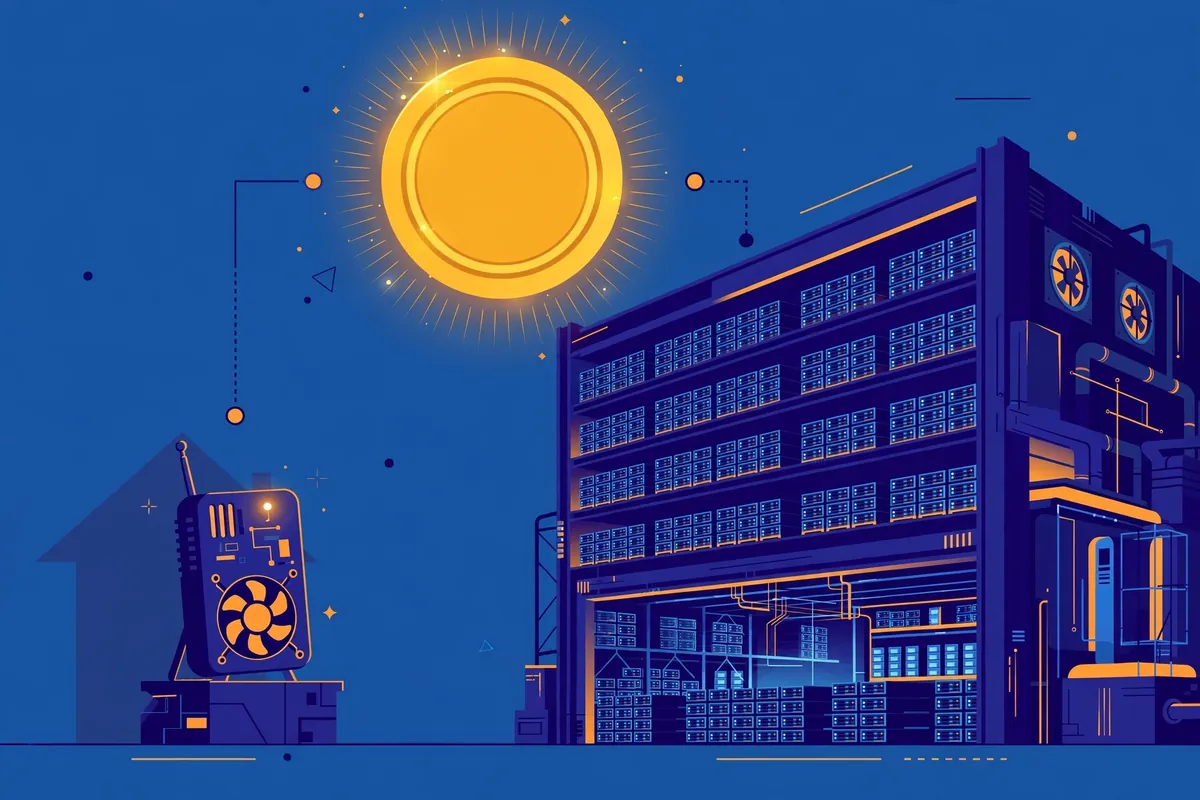
There are several Bitaxe models, but the Gamma 601 is the sweet spot most people buy today. Here are its real specs, pulled from vendor listings and community testing:
| Spec | Bitaxe Gamma 601 |
|---|---|
| Hashrate | ~1.2 TH/s (terahashes per second) |
| ASIC chip | Bitmain BM1370 (same chip family as the Antminer S21 Pro) |
| Power use | ~17 watts (about 15-20 J/TH efficiency) |
| Display | 0.96 inch OLED screen with live stats |
| Connectivity | WiFi with browser-based AxeOS dashboard |
| Cooling | 40mm fan with heatsink, around 35-40 dB |
| Power supply | 5V/6A supply included in the box |
| Design license | Fully open source (hardware and firmware) |
| Typical price | $69 to $105 depending on the vendor and extras |
Newer variants push further. The Bitaxe Turbo Touch packs two BM1370 chips for about 2.15 TH/s at $325, with a touchscreen that shows live price and block data. Older models like the Ultra and Supra used the BM1368 chip at lower hashrates and are cheaper secondhand.
The Honest Math: Your Real Odds of Winning
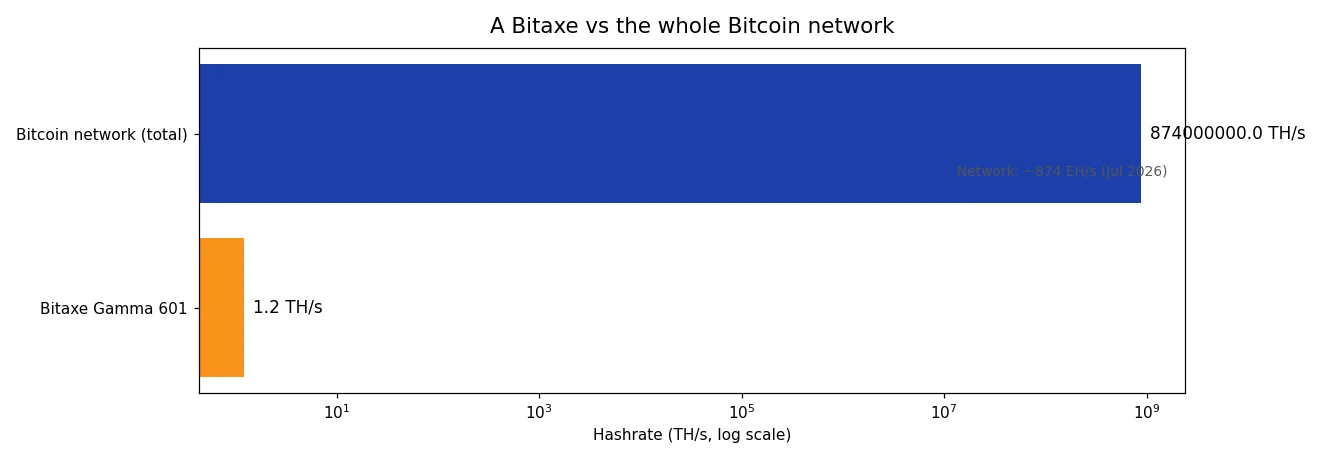
Let us do the math together, because this is where most articles get vague. The Bitcoin network currently runs at roughly 874 exahashes per second. Your Bitaxe Gamma runs at 1.2 terahashes per second.
Since one exahash equals one million terahashes, your share of the network is about 1.2 out of 874,000,000. That works out to roughly 1 chance in 728 million per block, or a statistically expected wait of about 14,000 years.
Sounds hopeless, right? But probability is weird. A coin that should land heads half the time can land tails ten times in a row.
Every block is a fresh lottery draw, and tiny miners keep winning against all logic.
The solo-mining win tracker at Solo Satoshi documents multiple confirmed Bitaxe block wins, and a public timeline of recent solo blocks keeps growing.
Real Bitaxe Block Wins
On July 24, 2024, a single Bitaxe mined block number 853,742 through Solo CKPool, the first Bitcoin block ever solved by a Bitaxe home miner. The reward was about 3.15 BTC, worth over $200,000 at the time, as reported by CryptoPotato.
In March 2025, a small cluster of Bitaxe devices with 3.3 TH/s combined found block 887,212, earning about $245,000. Then in July 2026, a solo Bitaxe running at roughly 1 TH/s found block 957,382 through Public Pool, worth around $200,000.
Each win made headlines precisely because the odds were so absurd.
What About Normal Pool Earnings?
If you point a Bitaxe at a regular pool instead of solo mining, the numbers are brutally honest. At current difficulty, a 1.2 TH/s device earns roughly $0.01 to $0.03 per day before electricity, according to live profitability trackers like MiningBoard.
After power costs, you might clear a few dollars per year. Nobody buys a Bitaxe to get rich slowly. They buy it for the lottery, the learning, and the fun of watching real proof-of-work happen on their desk.
Bitaxe vs a Real ASIC Miner
To feel the scale, compare the little Gamma 601 with an industrial Antminer S21:
| Bitaxe Gamma 601 | Antminer S21 | |
|---|---|---|
| Hashrate | 1.2 TH/s | 200 TH/s |
| Power | 17 W | 3,550 W |
| Noise | Whisper quiet | Vacuum cleaner loud |
| Price | ~$100 | ~$2,000+ |
| At home? | Yes, on your desk | No, needs special wiring |
| Open source? | Fully | No |
The Antminer is about 165 times more powerful. But it also costs 20 times more, uses 200 times more electricity, and sounds like a jet engine. The Bitaxe wins on everything except raw power, which was never the point.
How to Set Up a Bitaxe in 5 Minutes
Setting one up is genuinely easy. No technical background needed.
- Plug in the power supply. Connect the included 5V supply and power the board on. The little OLED screen lights up.
- Join its WiFi. The Bitaxe broadcasts its own network on first boot. Connect your phone or laptop to it.
- Open the dashboard. A setup page appears. Enter your home WiFi name and password so the miner can reach the internet.
- Open AxeOS. Find the miner’s address on your network (your router’s device list shows it) and open it in a browser. This is your control panel.
- Enter your pool and wallet. For the lottery, use a solo pool address and paste your Bitcoin wallet address as the username. Save, and watch the shares roll in.
Pair it with running your own Bitcoin node at home and you have a tiny sovereignty corner: your node verifies the chain, your miner contributes real proof-of-work to it. This short walkthrough shows a real unit being unboxed and configured:
Common Mistakes to Avoid
Expecting profit. The number one mistake is treating a Bitaxe like an investment. At pool rates it earns cents a day.
Buy the lottery ticket mindset, not the income mindset.
Using a weak power supply. Cheap 5V adapters cause crashes and overheating. Use the supply that came in the box or a known-good equivalent.
Blocking the fan. The little fan needs airflow. Do not bury the board under papers or run it inside a closed drawer.
Forgetting the wallet address. In solo mining, the pool pays the block reward to whatever address you entered. Triple-check it, because a typo means the win goes nowhere.
And remember, every halving cuts the prize. Read about the next Bitcoin halving to see how the reward schedule shrinks over time.
Frequently Asked Questions
Still curious? Here are the questions I hear most about the Bitaxe, answered straight.
If you are just starting out, read the beginner’s mining guide first, then come back to the answers below.
Is a Bitaxe profitable?
Not as an income source. Pool mining earns roughly $0.01 to $0.03 per day at current difficulty, which barely covers electricity. Its real value is education, fun, and a lottery shot at a full block reward.
What are the odds of a Bitaxe finding a Bitcoin block?
With 1.2 TH/s against a network of about 874 EH/s, your chance is roughly 1 in 728 million per block, or one expected win every 14,000 years. Improbable, but real wins have happened several times.
How much electricity does a Bitaxe use?
About 17 watts, similar to a phone charger or LED bulb. At average US electricity prices that costs roughly $1 to $2 per month to run nonstop.
Can I mine other coins with a Bitaxe?
It only mines SHA-256 coins, which in practice means Bitcoin and a few tiny forks. It cannot mine anything else, and it has no use for AI workloads or general computing.
Do I need a computer running all the time?
No. Once configured through the AxeOS web dashboard, the Bitaxe runs on its own. You only open the dashboard when you want to check stats or change settings.
Where can I buy a Bitaxe?
From small specialist builders like Solo Satoshi, CryptoCloaks, and D-Central, typically $69 to $105 for a Gamma 601. Because it is open source, many vendors sell versions with different coolers, stands, and screens.
The Bottom Line
A Bitaxe is the most fun you can have in Bitcoin for $100. It will teach you more about mining in a weekend than months of reading. It sips electricity, it looks great on a desk, and it holds a real, if microscopic, chance of winning a life-changing block reward.
Just go in with honest expectations: it is a lottery ticket and a learning tool, not a money printer. If you want to explore other ways to stack small amounts of Bitcoin, check out these free ways to earn small amounts of Bitcoin and phone-based mining apps that pay in BTC.