



The latest US government bitcoin moves are much bigger than the first reports suggested. On-chain trackers now put the total at about 17,795 BTC moved in three days, worth roughly $1.5 billion at recent prices. Of that, about 9,261 BTC, worth near $770 million, reached Coinbase Prime on October 6 and 7.
That sounds like a sale. It is not proof of one. No agency has confirmed any liquidation, and Coinbase Prime is also the custody provider the US Marshals Service uses for seized crypto. This guide walks through what actually moved, where it came from, and what traders should watch next.

Key takeaways
- US government bitcoin moves totalled about 17,795 BTC, near $1.5 billion, over three days.
- Galaxy Research tracked 9,261 BTC, about $770 million, into Coinbase Prime on October 6 and 7.
- Roughly half of that Coinbase Prime batch links to the 2016 Bitfinex hack recovery. Another 2,456 BTC came from wallets with no prior government label.
- No sale has been confirmed. A deposit to Coinbase Prime can mean custody, restitution, or administration, not just selling.
- Galaxy estimates government-linked wallets still hold about 319,086 BTC.
- Bitcoin fell to about $81,711 on October 8 and traded near $81,800 to $82,500 on October 9. Traders watch the $81,500 to $82,000 zone.
What exactly moved in the last three days?
The numbers grew in layers, which is why early headlines looked smaller. The first tranche covered on October 7 was about 833.6 BTC plus 40,285 BNB, together near $103 million. We covered that first step in our report on the $103M seized Bitcoin move to Coinbase Prime.
- What exactly moved in the last three days?
- Does a Coinbase Prime deposit mean the government is selling?
- How much Bitcoin does the US government still hold?
- How the market reacted, and the levels to watch
- Common mistakes traders make with this story
- FAQs
- Did the US government sell its Bitcoin?
- How much Bitcoin did the US government move in three days?
- Why does a Coinbase Prime deposit not prove a sale?
- How much Bitcoin does the US government still hold?
- Conclusion
Then the picture widened. Galaxy Research found 9,261 BTC reaching Coinbase Prime across October 6 and 7. Later reporting added another large transfer of more than 12,267 BTC, worth over $1 billion, linked to the Bitfinex recovery wallet. Added together, trackers put the three day total at about 17,795 BTC.
Where did the Coinbase Prime coins come from?
About half of the 9,261 BTC batch traces back to Bitcoin recovered after the 2016 Bitfinex hack. The rest came from other seizure wallets. The most interesting part is the 2,456 BTC that came from wallets nobody had labelled as government wallets before.
Galaxy thinks those coins are likely new seizures, because they followed the same route into the same federal Coinbase Prime deposit address. That is a sensible guess, not a confirmed fact. The Justice Department and the Marshals Service have not announced a new seizure for those coins.
Why the batches matter more than the headline total
Large holders rarely move everything in one transaction. They split coins into batches, test addresses, and move funds in steps. So a rising total over three days usually means an organised custody operation, not a panicked dump.

It also means the story can keep growing. If more batches appear today, the total will change again. Treat any single number as a snapshot, not a final count.

Does a Coinbase Prime deposit mean the government is selling?
No, not by itself. This is the step most headlines skip, so it is worth going slowly.
Coinbase Prime is the institutional side of Coinbase. In 2024, the US Marshals Service picked Coinbase Prime to provide custody and advanced trading services for large seized digital assets. That one contract explains why seized coins keep arriving there, whether the plan is storage, restitution, or a later sale.
Three reasons coins go to Coinbase Prime
First, custody. The government needs a safe, regulated place to hold seized coins while cases run. Second, restitution. A court ordered 94,643 BTC from the Bitfinex recovery to be returned to Bitfinex, and returning coins means moving them first. Third, administration. Cases close, wallets get consolidated, and old addresses get retired.
A sale is a fourth possibility, but it needs extra proof. Look for an official disposition notice, or coins moving onward in a pattern that matches an actual execution. Neither has appeared for this batch. Our earlier coverage of a previous US government Bitcoin transfer to Coinbase Prime followed the same pattern, and no sale was announced after that move either.
What the Strategic Bitcoin Reserve order says
In March 2025, an executive order set up a Strategic Bitcoin Reserve and said Bitcoin placed in that reserve should not be sold. There are narrow exceptions, such as victim compensation and certain legal uses.
Here is the catch. Not every seized coin is reserve Bitcoin. Some coins are still tied to court cases, forfeiture fights, or victims who may get them back. Those coins can legally move even while reserve coins stay locked. That legal split is why a big transfer and a no-sale policy can both be true at the same time.
How much Bitcoin does the US government still hold?
Galaxy now estimates government-linked wallets hold about 319,086 BTC, worth roughly $26.5 billion to $27 billion at recent prices. That still makes the United States the largest known sovereign holder.
Two cases dominate the total. About 127,271 BTC links to the Prince Group and LuBian case. About 94,643 BTC links to the Bitfinex recovery. Together they make up about 71 percent of the tracked balance, based on Galaxy figures reported this week.
Moved in three days
To Coinbase Prime, Oct 6 to 7
Still in government-linked wallets
Put the move in context and it shrinks. The 9,261 BTC sent to Coinbase Prime is under 3 percent of the tracked government total. Even the full 17,795 BTC is a small share. A move can be large in dollars and still be routine in share terms.
Ownership is the other wrinkle. Coins in government custody are not always government property. Some may go back to victims or exchanges once courts finish. Counting all 319,086 BTC as permanent reserve holdings would overstate the case.
How the market reacted, and the levels to watch
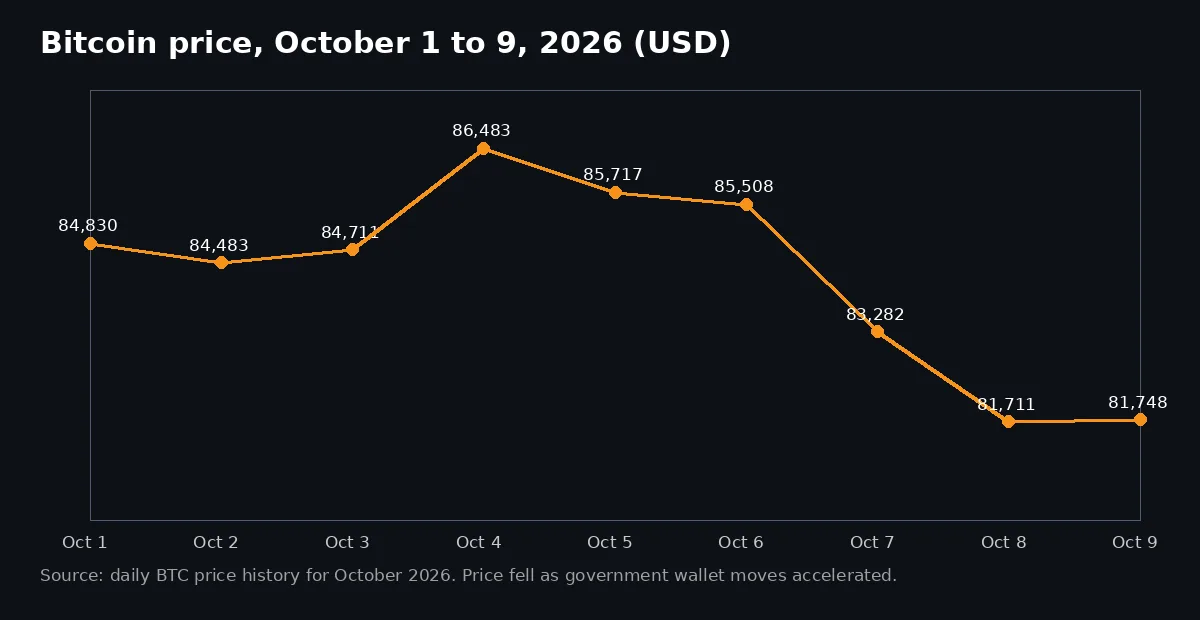
Bitcoin was already sliding before the biggest transfers landed. Price fell from about $86,483 on October 4 to about $83,282 on October 7, then to about $81,711 on October 8. On October 9 it traded near $81,800 to $82,500, with an intraday low near $80,394 in one live feed.
The chart below shows that daily slide from October 1 to October 9. The drop steepened as the wallet moves hit the news, but the downtrend started days earlier. Macro pressure and profit taking were already in play, a theme we saw in the Fed minutes reaction earlier this week.
The $81,500 to $82,000 support zone
Traders are watching $81,500 to $82,000 because Bitcoin is testing that band right now. Hold it, and the government story fades into background noise. Lose it with a daily close below, and the next debate is how deep this pullback runs.
That debate connects to two of our recent pieces. One mapped how low Bitcoin could go in a bear market drawdown. The other tracked Bitcoin being rejected at $87,000 for a third time, which marked the top of this short slide.
Step by step: how to check the next government move yourself
You do not need to trust any headline, including this one. Follow these steps when the next alert pops up.
Step 1: check the source tracker. Arkham labels US government wallets as one entity, so open that entity page and look at the actual transactions, amounts, and times.
Step 2: check the destination. A Coinbase Prime deposit address is a custody clue, not a sale receipt. Note whether coins stay there, move back out, or split toward exchanges.
Step 3: look for an official statement. The Justice Department publishes forfeiture and restitution actions. Silence after 48 hours usually means routine handling.
Step 4: compare the size with total holdings. A 1,000 BTC move sounds huge until you set it against roughly 319,000 BTC still held.
Step 5: watch price last. If Bitcoin holds its support zone while coins move, the market is treating the transfer as paperwork, not supply.
Common mistakes traders make with this story
The first mistake is reading every exchange deposit as a sale. Custody contracts changed that logic years ago. The second is adding every reported batch together twice. Some totals overlap, because different trackers count the same coins at different hops.
The third mistake is ignoring the Bitfinex restitution order. Coins a court told the government to return are not coins the government chose to sell. Mixing those two flows leads to exactly the wrong conclusion. For the longer view on where returned and reserve coins fit, see our Bitcoin price prediction for 2030 and the models behind it.
FAQs
Short answers to the questions readers keep asking about this week of transfers.
Did the US government sell its Bitcoin?
No sale has been confirmed. On-chain data shows transfers to Coinbase Prime, and Coinbase Prime also provides custody for the US Marshals Service, so a deposit alone does not prove a sale.
How much Bitcoin did the US government move in three days?
On-chain trackers put the total at about 17,795 BTC, worth roughly $1.5 billion, including 9,261 BTC that reached Coinbase Prime on October 6 and 7.
Why does a Coinbase Prime deposit not prove a sale?
Coinbase Prime provides custody and trading services for the US Marshals Service. Seized coins can enter Coinbase Prime for custody, restitution, or administration without reaching the open market.
How much Bitcoin does the US government still hold?
Galaxy Research estimates government-linked wallets hold about 319,086 BTC. Much of it links to the Prince Group case and the Bitfinex recovery, and some is still subject to court orders or restitution.
Conclusion
These US government bitcoin moves are real, large, and worth watching. They are not, on current evidence, a confirmed sale. About half the Coinbase Prime batch is Bitfinex recovery money with a court ordered destination, the reserve order limits selling reserve coins, and the moved total is a small slice of roughly 319,086 BTC still held.
Your next step is simple. Watch the $81,500 to $82,000 zone and watch whether the Coinbase Prime coins stay put or move onward. If an agency publishes a disposition notice, the story changes. Until then, treat this as a custody operation first and a sale signal only if harder proof arrives.