


Here is the short version: HANetf just launched the world’s first euro-hedged bitcoin etc. It is called the Arrow Bitcoin EUR Hedged ETC, it trades under the ticker EBTC, and it lets European investors buy Bitcoin without betting on the U.S. dollar at the same time.

EBTC started trading on Euronext Paris on September 29 and lists on Xetra in Frankfurt from September 30. The currency hedge is handled by HSBC, and the product carries a 0.49% total expense ratio. A pound-hedged sibling, the Arrow Bitcoin GBP Hedged ETC (GBTC), launched on the London Stock Exchange on the same day.
- Why a Euro-Hedged Bitcoin ETC Actually Matters
- Inside the EBTC Product
- Why Now: Europe’s $12B Crypto ETP Market
- Who This Fits (and Who Should Skip It)
- The Honest Risks Nobody Should Ignore
- Frequently Asked Questions
- What is a euro-hedged bitcoin ETC?
- How is EBTC different from a regular bitcoin ETC?
- What does EBTC cost?
- Where can I buy EBTC?
- Does the hedge remove Bitcoin’s price risk?
- The Bottom Line
Key Takeaways
- EBTC is the first crypto ETC in the world with a built-in euro currency hedge.
- It trades on Euronext Paris (from Sept 29) and Xetra (from Sept 30) under ISIN XS3438606090.
- HSBC supplies the daily FX hedge; the fee is 0.49% per year plus a separate daily hedging cost.
- A pound-hedged sibling, GBTC, launched on the London Stock Exchange at the same time.
- The hedge removes dollar swings, not Bitcoin’s own price risk.
Why a Euro-Hedged Bitcoin ETC Actually Matters
If you live in Europe and buy a regular bitcoin ETC, you are not making one bet. You are making two. Bitcoin is priced in U.S. dollars everywhere in the world, so your returns depend on Bitcoin’s price and the EUR/USD exchange rate. That is easy to forget when Bitcoin just pushed back above $85,000 on softer US inflation data and the dollar charts look exciting.
Say Bitcoin rises 10% in dollars, but the dollar falls 8% against the euro over the same stretch. Your gain in euros ends up far smaller than the dollar chart suggests. HANetf co-founder and co-CEO Hector McNeil puts it plainly: many investors want exposure to bitcoin without taking an extra view on the dollar.
Bitcoin’s Hidden Second Bet: the U.S. Dollar
This is the part most first-time buyers miss. When you buy an unhedged bitcoin product, currency moves quietly add to or subtract from your return every single day. A strong euro can eat your gains. A weak euro can inflate them. Either way, you never asked for that trade.
EBTC’s hedge is built to cancel that out. HSBC runs daily currency hedging, so the product tracks Bitcoin’s own performance and strips out most of the EUR/USD noise.

Gold Already Proved This Playbook
None of this is new in finance. Gold is priced in dollars too, and European investors faced the same headache for years. The fix was currency-hedged gold ETCs, which today hold about $23 billion, roughly 13% of Europe’s gold ETC market. If you want the full picture, here is how Bitcoin stacks up against gold as a store of value in 2026.
McNeil’s pitch is simple: bring that proven logic to crypto. “With this launch, we are bringing the established logic of Euro-hedged ETFs to the crypto market,” he said.
Inside the EBTC Product
So what exactly are you buying? An ETC is an exchange-traded commodity. In Europe, ETFs must hold a diversified basket of assets, so single-asset products like this one are structured as ETCs instead. In the U.S., the same idea would usually be called an ETF, which is why BlackRock’s blockbuster Bitcoin ETF made such waves across the Atlantic.
The structure uses physical replication, which means the product is backed by actual bitcoin, not just paper contracts. It is domiciled in Jersey, Interactive Brokers LLC acts as custodian, and the issuer is HANetf Multi-Asset ETC Issuer Plc.
How the Currency Hedge Works
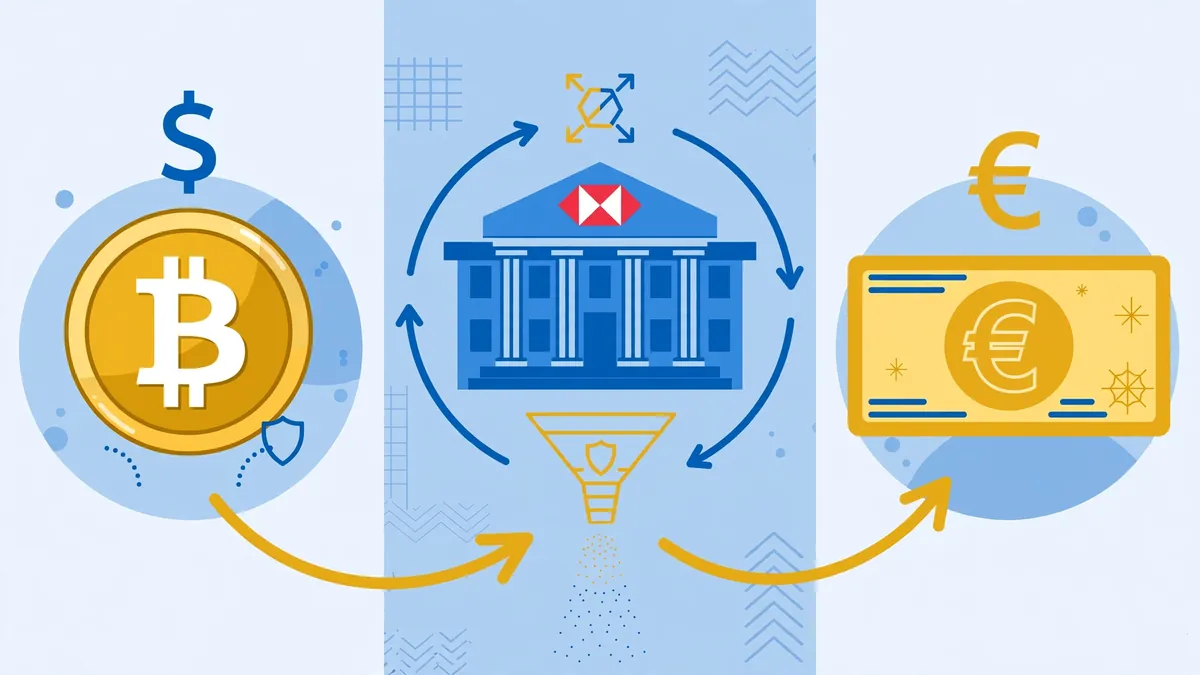
Think of it as a filter. Bitcoin’s dollar price goes in one side, the hedge strips out the EUR/USD movement using forward contracts, and what comes out the other side is Bitcoin’s performance measured in euros.
HSBC refreshes this hedge daily. That matters because currency markets never sleep, and a hedge set once a month would drift off target fast.
EBTC Fact Sheet: the Numbers That Matter
| Product | Arrow Bitcoin EUR Hedged ETC |
| Ticker | EBTC |
| ISIN | XS3438606090 |
| Exchanges | Euronext Paris, Xetra |
| Trading start | Sept 29 (Paris), Sept 30 (Xetra), 2026 |
| Hedge provider | HSBC (daily hedging) |
| Total expense ratio | 0.49% per year + daily FX hedging cost |
| Replication | Physical (backed by actual bitcoin) |
| Custodian | Interactive Brokers LLC |
| Domicile | Jersey |
Why Now: Europe’s $12B Crypto ETP Market
The timing is no accident. European crypto-tracking ETC assets reached roughly $12 billion by the end of June 2026, according to ETFBook data. In the U.S., the figure sits near $100 billion. The product shelves are filling fast, and new institutional crypto ETPs keep landing in Europe almost every month.
Big money keeps rotating toward Bitcoin too. One sovereign wealth fund even sold gold to buy Bitcoin, according to a Bitwise report. HANetf itself helped launch the Bitwise Physical Bitcoin ETP back in June 2020, the world’s first centrally cleared bitcoin ETP. Now it is adding currency-hedged versions aimed squarely at investors worried about dollar weakness.
The launch also lands at a busy moment for the market. Bitcoin is holding near $83,000 after an eighth straight session of spot ETF inflows, with traders watching the core PCE inflation report and a stalled U.S. Clarity Act for direction. Here is where analysts see Bitcoin heading this October.
Who This Fits (and Who Should Skip It)
EBTC makes the most sense for long-term European holders who want pure Bitcoin exposure and do not want currency swings muddying their returns. If you believe the dollar could weaken over the next few years, the hedge does the worrying for you. You also skip the hassle of managing custody yourself, since the ETC structure handles that.
It is less useful if you actively want dollar exposure, or if you trade short term and can manage currency risk on your own. And if you sit outside the eurozone or the UK, this specific product was not built for you. The pound-hedged sibling GBTC on the London Stock Exchange covers sterling investors instead.
The Honest Risks Nobody Should Ignore
A currency hedge is not magic, so here is what it does not do.
The Hedge Costs Money Every Day
The 0.49% annual fee is only the headline number. There is also a separate daily FX hedging cost, and hedging is never perfect, so small tracking differences can appear between EBTC and Bitcoin’s actual price. Over long holding periods, those little drags add up, so compare the all-in cost against a plain unhedged bitcoin ETC.
What the Hedge Does Not Fix
Bitcoin itself can still fall 20% in a week, and no currency hedge will save you from that. You also carry the usual product risks: the issuer, the custodian, and the fact that a brand-new listing can have wider spreads until trading volume builds up. A hedge removes the dollar from your Bitcoin bet. It does not remove the Bitcoin from your Bitcoin bet.
Frequently Asked Questions
A currency-hedged product raises a lot of questions, even for experienced investors. Here are the ones readers ask most, answered in plain language.
What is a euro-hedged bitcoin ETC?
It is an exchange-traded commodity that tracks Bitcoin’s price while using currency forwards to cancel out most EUR/USD exchange-rate moves, so your return in euros reflects Bitcoin’s performance, not the dollar’s.
How is EBTC different from a regular bitcoin ETC?
A regular bitcoin ETC leaves you exposed to both Bitcoin’s price and the dollar. EBTC adds a daily currency hedge, provided by HSBC, that strips out the dollar effect.
What does EBTC cost?
The total expense ratio is 0.49% per year, plus a separate daily currency-hedging cost.
Where can I buy EBTC?
It trades on Euronext Paris and on Xetra in Frankfurt under the ticker EBTC, with ISIN XS3438606090.
Does the hedge remove Bitcoin’s price risk?
No. The hedge only targets currency risk. Bitcoin’s own volatility, plus issuer, custodian, and liquidity risks, all remain.
The Bottom Line
HANetf’s EBTC is a small product with a big idea: let Europeans buy Bitcoin without accidentally buying the dollar too. The gold market proved the model works at scale, and with $12 billion already sitting in European crypto ETCs, the audience is clearly there.
Whether it takes off will come down to costs, spreads, and how many investors actually care about currency risk. But for the long-term holder who wants Bitcoin and only Bitcoin, this euro-hedged bitcoin etc is now the cleanest ticket in Europe.
Next step: watch the first weeks of trading volume and spreads on Euronext Paris and Xetra before jumping in, and compare the all-in cost with an unhedged bitcoin ETC if you do not mind dollar exposure.