



Yes, Brazil taxes your crypto. If you sell Bitcoin at a profit, the Receita Federal expects its share, and the rules are simpler than most guides make them sound.
The hard part is that half the guides on the internet get the rate wrong. This guide fixes that first, then walks you through the two tax systems, the R$35,000 exemption, and the new DeCripto reporting rule in plain English.

This is crypto tax in brazil for beginners, written for someone who bought Bitcoin on a Brazilian exchange and now wonders what the tax office wants. It covers the 2026 rules, the deadlines, and the mistakes that cost beginners money.
- Key Takeaways
- The Big Correction: There Is No 17.5% Flat Rate in Brazil
- Two Tax Systems, One Decision: Where Your Crypto Sits
- The Domestic Regime: The R$35,000 Rule and the Progressive Rates
- Same Gain, Two Tax Bills: A Worked Example
- The Offshore Regime: Law 14.754/2023 and the Flat 15%
- What Counts as a Taxable Event
- Mining, Staking and Getting Paid in Crypto
- How to Pay: GCAP and DARF, Step by Step
- DeCripto: The New Reporting Rule From July 1, 2026
- CARF: Why the Tax Office Will See Your Foreign Exchange Anyway
- Declaring Your Holdings in the Annual Return
- Common Mistakes Beginners Make
- Frequently Asked Questions
- Is crypto taxed in Brazil?
- What is the crypto tax rate in Brazil in 2026?
- Is there a tax-free allowance for crypto in Brazil?
- Do I pay tax when I swap Bitcoin for another crypto in Brazil?
- What is DeCripto and do I need to file it?
- Does Brazil share crypto data with other countries?
- Sources
This guide is general information only, not tax advice. Tax rules depend on your own situation, so talk to a Brazilian accountant (contador) before you file.
Key Takeaways
- There is no 17.5% flat rate. MP 1.303/2025 expired on October 8, 2025 without a vote, so the old rules still apply.
- Domestic crypto (Brazilian exchanges and self-custody) uses progressive rates of 15% to 22.5%, and months with total sales of R$35,000 or less are exempt.
- Crypto on foreign exchanges pays a flat 15% once a year under Law 14.754/2023, with no R$35,000 exemption.
- Calculate domestic gains in GCAP and pay with a DARF by the last business day of the following month.
- DeCripto reporting became mandatory on July 1, 2026, and Brazil starts swapping crypto data with other countries under CARF in 2027.
- Declare holdings worth R$5,000 or more in your annual return, and keep your records for five years.
The Big Correction: There Is No 17.5% Flat Rate in Brazil
Search for crypto tax in brazil for beginners and you will find two different answers. Some guides say every gain pays a flat 17.5%, while others say the rate is progressive and starts at 15%.
Only one side is right. The flat rate was a proposal that died in Congress, and the guides that still print it are out of date.
This is the single most expensive mistake a Brazilian crypto holder can make in 2026. Believing the flat rate means paying tax you do not owe, or skipping an exemption that would have saved you money.

What MP 1.303 Actually Was
In June 2025 the government published Provisional Measure 1.303/2025. It proposed a flat 17.5% tax on all crypto gains and the end of the R$35,000 monthly exemption.
A provisional measure is not a law. It takes effect at once, but Congress must vote it into law within 120 days, or it dies.
Congress never voted, so the measure expired on October 8, 2025 and the old rules came back in full. The table below lays out the timeline.
| Date | What happened | Status for 2026 |
|---|---|---|
| June 11, 2025 | Government publishes MP 1.303/2025, proposing a flat 17.5% rate and no exemption | Proposal only |
| June 2025 | The measure takes effect provisionally, and many guides rewrite their pages around the 17.5% rate | Temporary |
| October 8, 2025 | Congress lets the measure expire without a vote | Expired |
| 2026 tax year | Progressive rates of 15% to 22.5% and the R$35,000 exemption still apply | In force |
The 17.5% rate lived for less than four months and never became law. Any guide that still presents it as the 2026 rule was written during that window and never corrected.
Which Guides Still Get It Wrong
MEXC still publishes a Brazil crypto tax guide that states a flat 17.5% rate on all capital gains. Its page was updated in May 2026, months after the measure expired, and it never mentions the expiry.
Several smaller guides repeat the same figure, and some even claim the R$35,000 exemption is gone. They all share one flaw: they copied the provisional measure and never checked what Congress did with it.
By contrast, TokenTax, GetDtax and Rue all confirm the progressive rates and the exemption. The Receita Federal itself never adopted the flat rate, because it had no law to adopt.
Before you trust any guide, check three things. First, does it mention that MP 1.303 expired on October 8, 2025?
Second, does it say the R$35,000 exemption still applies? Third, does it cite a source dated after October 2025?
If the answer to the first question is no, the guide is stale. Close it and use a source that follows the Receita Federal instead.
Two Tax Systems, One Decision: Where Your Crypto Sits
Brazil runs two different tax systems for crypto, and the one that applies to you depends on where your coins sit. This split is the most important idea in this guide, so get it right before you calculate anything.
Coins on a Brazilian exchange, or in a wallet you control yourself, fall under the domestic regime. Coins held through a foreign exchange fall under the offshore regime, which has its own law and its own rate.
The table below compares the two side by side. Keep it open while you read the rest of this guide.
| Feature | Domestic regime | Offshore regime |
|---|---|---|
| Governing rule | General capital gains rules | Law 14.754/2023 |
| Where it applies | Brazilian exchanges and self-custody | Foreign exchanges and foreign custodians |
| Tax rate | Progressive: 15% to 22.5% | Flat: 15% |
| R$35,000 monthly exemption | Yes | No |
| When you pay | Monthly, via GCAP and DARF | Annually, in your tax return |
| Losses | Cannot offset other gains or carry forward | Can offset foreign gains and carry forward |
The split creates a strange result. A small seller can owe nothing at home and still owe tax abroad, while a big seller can owe more at home than abroad.
The worked example later in this guide shows both cases with real numbers. First, here is how each regime works on its own.
The Domestic Regime: The R$35,000 Rule and the Progressive Rates
The domestic regime covers crypto you hold on a Brazilian exchange, such as Mercado Bitcoin or Foxbit, and crypto you hold in your own wallet. The Receita Federal treats self-custody as domestic, because the coins belong to a Brazilian resident even though the blockchain is global.
Two numbers decide your bill: your total sales in the month, and the size of your gain. The first number decides whether you owe anything at all.
The R$35,000 Test Counts Sales, Not Profit
If your total crypto sales in a month stay at or below R$35,000, your gain is exempt. You owe nothing, and you file no GCAP and no DARF for that month.
Notice the test counts sales, not profit. Sell R$40,000 of Bitcoin in a month and make only a R$5,000 gain, and the exemption is gone, because R$40,000 is above the line.
Sell R$30,000 in a month and make a R$20,000 gain, and the whole gain is exempt, because R$30,000 is below the line. The test looks at what you sold, not what you earned.
Add up every disposal in the month, including crypto-to-crypto swaps and spending crypto on goods. Each one counts toward the R$35,000 total.
The Progressive Rate Bands
Once your monthly sales pass R$35,000, the gain is taxed on a progressive scale. The rate rises with the size of your annual gain, and most beginners pay only the lowest rate.
| Annual gain | Tax rate |
|---|---|
| Up to R$5 million | 15% |
| R$5 million to R$10 million | 17.5% |
| R$10 million to R$30 million | 20% |
| Above R$30 million | 22.5% |
The bands apply to the gain, not to your sales. A R$100,000 gain is taxed at 15% even if you sold R$1 million of crypto to realise it.
Only the part of the gain inside each band pays that band’s rate. A R$6 million gain pays 15% on the first R$5 million and 17.5% on the remaining R$1 million, which works out to an effective rate of 15.42%.
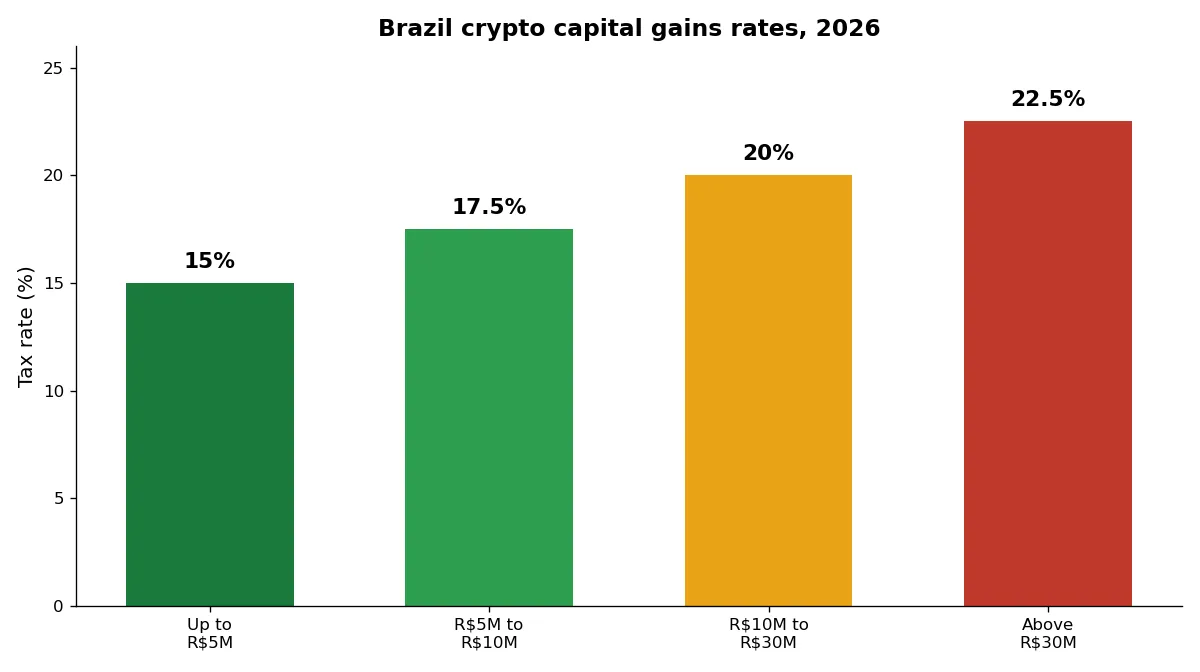
For most readers, the practical rate is 15%. The higher bands exist for large sellers, and they are the reason the flat 17.5% myth matters: it overcharges small sellers and undercharges very large ones.
Same Gain, Two Tax Bills: A Worked Example
Here is the comparison no other guide publishes. Take the same three gains and run each one through both regimes, so you can see exactly where the money goes.
Every figure below comes from the rates in this guide, and you can check the maths yourself. No guide publishes this side-by-side view, because most of them still use the wrong flat rate.
| Scenario | Domestic tax | Offshore tax |
|---|---|---|
| Small: R$10,000 gain, R$30,000 sold in the month | R$0 (sales under R$35,000) | R$1,500 (15% of the gain) |
| Medium: R$100,000 gain, R$200,000 sold in the month | R$15,000 (15% of the gain) | R$15,000 (15% of the gain) |
| Large: R$6,000,000 gain | R$925,000 (15% of R$5M plus 17.5% of R$1M) | R$900,000 (15% of the gain) |
The small seller is where the regimes diverge most. At home, the R$35,000 exemption wipes the bill to zero, while abroad the same R$10,000 gain costs R$1,500.
The medium seller pays the same R$15,000 either way, but the timing differs. At home, the tax is due by the last business day of the next month, while abroad it waits for the annual return.
The large seller pays R$25,000 more at home than abroad. That gap is the price of the progressive scale, and it is the only case where the offshore regime wins on the rate alone.
None of this is a reason to move your coins abroad for tax reasons. The offshore regime has no exemption, stricter reporting, and the annual calculation leaves no room for monthly planning.
Use the table to see which regime fits your own numbers, then follow the payment steps for that regime. The next two sections explain both.
The Offshore Regime: Law 14.754/2023 and the Flat 15%
Since January 1, 2024, crypto held through institutions abroad falls under Law 14.754/2023. The law treats it as a foreign financial investment, and the tax works very differently from the domestic regime.
The rate is a flat 15% on your realised gains for the year. There is no R$35,000 exemption, so even a R$100 gain on a foreign exchange is taxable.
You calculate the tax once a year, inside your annual tax return, instead of paying monthly. Gains and losses from all your foreign investments are netted together, and unused foreign losses carry forward to later years.
That netting is the one real advantage of the offshore regime. A loss on a foreign exchange can cut the tax on a gain from the same year, which the domestic regime never allows.
Self-Custody Is Not Offshore
Many beginners get this wrong. Moving your Bitcoin from a Brazilian exchange to your own hardware wallet does not make it offshore.
The Receita Federal has said self-custodied crypto held directly by a Brazilian resident is not treated as located abroad. The blockchain is international, but the owner is Brazilian, so the domestic regime applies.
What matters is the institution that holds your coins. If a foreign company custodies them, the offshore regime applies, and if a Brazilian company does, the domestic regime applies.
If you are unsure where your coins sit, check your exchange. A Brazilian CNPJ on the platform means domestic, while a foreign entity means offshore, and our guide on how to buy Bitcoin in Brazil explains which platforms operate locally.
What Counts as a Taxable Event
Brazil taxes the gain when you dispose of crypto, not when you buy it. The table below lists the common triggers, so you can spot them before they surprise you.
| Action | Taxable disposal? | What it means |
|---|---|---|
| Sell Bitcoin for reais | Yes | Compare the sale price with your acquisition cost |
| Swap Bitcoin for another crypto | Yes | A crypto-to-crypto swap is a disposal, even with no cash involved |
| Spend Bitcoin on goods or services | Yes | Paying with Bitcoin is treated like selling it |
| Receive Bitcoin as salary or payment | Yes, as income | Taxed at its value in reais on the day you receive it |
| Move Bitcoin between your own wallets | No | No change of ownership, so no taxable event |
| Simply hold Bitcoin while the price rises | No | Paper gains are not taxed until you dispose of the asset |
Many beginners get caught by the second row. Swapping Bitcoin for Ethereum on an exchange feels like one trade, but the Receita Federal sees it as selling Bitcoin and buying Ethereum in the same moment.
Every disposal needs a value in reais on the day it happened. That value decides your gain, so record it at the time, not months later when the price has moved.
Mining, Staking and Getting Paid in Crypto
Not every crypto gain is a capital gain. Rewards you receive for mining or staking are usually income when you receive them, valued in reais on that day.
Income from mining, staking and salary follows the progressive income tax table, which runs from 0% to 27.5%. The rate depends on your total income for the year, not on the crypto alone.
When you later sell those reward coins at a higher price, that second step is a separate capital gain. The cost base is the value you already declared as income, so you are not taxed twice on the same rise.
Mining works the same way for hobbyists and professionals, with one split. A hobby miner reports the rewards as income, while a commercial miner reports them as business income and can deduct electricity, hosting and other costs.
Our guide on how Bitcoin miners are taxed explains the hobby versus business split in full.
Airdrops are a grey area. The Receita Federal has not published one rule that covers every airdrop, so keep the receipt date, the number of tokens and the value in reais, and treat a later sale as a separate disposal.
If you receive crypto as salary or freelance payment, the same logic applies. Declare the value in reais as income on receipt, then treat any later sale as a capital gain against that value.
How to Pay: GCAP and DARF, Step by Step
Domestic gains are paid monthly, and the process has four steps. It looks bureaucratic the first time, then becomes routine.
Step one: add up all your crypto sales for the month. If the total is R$35,000 or less, stop here, because no tax is due and no form is needed.
Step two: work out the gain on each disposal in GCAP, the official capital gains program. Enter the acquisition cost and the sale value for each coin you sold, and GCAP calculates the tax.
Step three: generate a DARF payment slip from GCAP and pay it by the last business day of the following month. A June sale means a DARF due by the last business day of July.
Step four: import your GCAP totals into your annual tax return. The monthly payments and the annual return must agree, so keep the DARF receipts with your records.
Offshore gains skip this monthly cycle. They go straight into your annual return, where the flat 15% applies to the net result for the year.
To keep the maths straight, use crypto tax software that supports Brazilian rules and the GCAP workflow. Most global tools default to other countries’ methods, so check the method before you trust the output.

DeCripto: The New Reporting Rule From July 1, 2026
On July 1, 2026, Brazil replaced its old crypto reporting system with a new one called DeCripto. It is a reporting duty, not a new tax, but it changes what the Receita Federal knows about you.
Under the old rule, IN RFB 1.888/2019, you reported foreign exchange activity yourself when your monthly operations passed R$30,000. The new rule, IN RFB 2.291/2025, raises that self-reporting threshold to R$35,000 a month and widens what must be reported.
Brazilian exchanges file DeCripto for their own customers, so their users do nothing extra. You file it yourself only for activity the exchanges cannot see: foreign exchanges, decentralised platforms and peer-to-peer trades above R$35,000 in a month.
DeCripto covers purchases, sales, swaps and transfers, including airdrops, staking income and mining income. It is due by the last business day of the month after the operations, through the e-CAC portal.
The Scale of What Brazil Already Sees
The Receita Federal published its own numbers in June 2026, and they show how much data already flows in. Between August 2019 and December 2025, Brazilians declared about R$1.58 trillion in crypto purchase and sale operations.
Stablecoins dominate that total. About R$1.13 trillion, or 71.7% of the declared volume, was stablecoins, and their share of monthly volume stayed above 80% in recent years.
One coin dominates the stablecoins. Tether (USDT) accounts for 88.7% of all declared stablecoin volume, which makes it the single most reported crypto asset in Brazil.
These are the Receita Federal’s own figures, not an exchange estimate. They explain why the tax office built DeCripto: the volume was already there, and the old system could not keep up with it.
What Happens If You Skip DeCripto
Missing a DeCripto filing carries its own penalties, separate from any tax you owe. A late filing costs R$100 per month or part of a month, and the fine is halved if you file before the Receita opens an audit.
Omitted or wrong information costs 1.5% of the operation value. Ignoring a Receita notice about your filing costs R$500 per month.
These fines stack on top of the tax and interest for any gain you failed to report. File on time, even in a month when you owe no tax, because the filing and the payment are two different duties.
CARF: Why the Tax Office Will See Your Foreign Exchange Anyway
Brazil is also joining the global system that shares crypto data between countries. It is called the Crypto-Asset Reporting Framework, or CARF, and it is run by the OECD.
Under CARF, crypto platforms collect identity and tax-residence information and report user transactions to their own tax authority each year. That authority then swaps the data automatically with the tax authorities of other participating countries.
Brazil began collecting CARF-aligned information in 2026, and the OECD lists Brazil among the 46 jurisdictions that will make their first exchanges in 2027. The first swap will cover data from 2026.
One thing CARF does not change is your own reporting duty. You must report your crypto gains and income whether or not a platform reports them, and that duty exists today.
The Receita Federal already receives data from Brazilian exchanges and can request account information from foreign ones. CARF widens that visibility, it does not create it from scratch.
For a wider view of how other countries handle the same questions, see our Bitcoin tax guide, which covers the rules around the world, and our Bitcoin tax in Canada for beginners guide for a comparison with the CRA system.
Declaring Your Holdings in the Annual Return
Paying the monthly tax is only half the job. Your annual return must also list what you own, even in a year when you sold nothing.
Declare each type of crypto you hold under “Bens e Direitos”, Group 08 (Criptoativos), at its acquisition cost, not its current market value. The threshold is an acquisition cost of R$5,000 or more for that type of crypto.
The tax year runs from January 1 to December 31. For 2025 income, the annual return window ran from March 23 to May 29, 2026, and the Receita sets a fresh window each year.
Keep your records for at least five years after filing. Save your exchange CSVs, wallet histories, transaction hashes, DeCripto submissions and DARF payment proofs, because they are what prove your cost base if the Receita asks.
Exchanges close and apps disappear, but your tax obligation does not. A clean transaction history turns a stressful audit letter into a short exchange of documents.
If you want the full calculation from cost base to return, our guide on how to calculate your Bitcoin capital gains tax shows the steps in order.
Common Mistakes Beginners Make
The first mistake is trusting a stale guide. If a page still claims the 17.5% flat rate applies in 2026, every number on it is suspect, so verify the rate against a Receita Federal source first.
The second mistake is testing the R$35,000 exemption against your profit. The test counts your total sales in the month, so a small gain on a large sale is still taxable.
The third mistake is forgetting crypto-to-crypto swaps. Swapping Bitcoin for Ethereum is a disposal, even though no reais reached your bank account.
The fourth mistake is mixing the two regimes. Domestic and offshore gains are calculated separately, and a loss on a foreign exchange cannot cut a gain on a Brazilian one.
The fifth mistake is skipping DeCripto. The filing is due even in months when you owe no tax, and the fines for a missed filing are separate from the tax.
The sixth mistake is keeping no records. Without dates and values in reais, you cannot prove your cost base, and the Receita will not guess in your favour.
Compare the rules with other countries before you assume Brazil is unusual. Our India crypto tax guide shows a system with a 30% flat rate and no exemptions at all, which makes Brazil’s R$35,000 exemption look generous by comparison.
Frequently Asked Questions
The questions below come from the searches Brazilian beginners actually run. Each answer uses the same numbers and rules as the guide above.
Is crypto taxed in Brazil?
Yes. Brazil taxes crypto gains as capital gains and crypto received as income as ordinary income.
Buying and holding crypto is not taxable, and moving it between wallets you own is not taxable either.
What is the crypto tax rate in Brazil in 2026?
There is no single rate. Domestic gains pay progressive rates of 15% to 22.5%, and gains on foreign exchanges pay a flat 15% a year.
The flat 17.5% rate that some guides quote was a proposal in MP 1.303/2025, which expired on October 8, 2025 without a vote and never became law.
Is there a tax-free allowance for crypto in Brazil?
Yes, under the domestic regime. If your total crypto sales in a month are R$35,000 or less, your gain for that month is exempt.
The test counts your total sales, not your profit, and it does not apply to crypto held on foreign exchanges.
Do I pay tax when I swap Bitcoin for another crypto in Brazil?
Yes. A crypto-to-crypto swap is a disposal of the Bitcoin you gave up, valued in reais on the day of the swap.
You compare that value with your acquisition cost to work out the gain, even though no cash changed hands.
What is DeCripto and do I need to file it?
DeCripto is Brazil’s crypto reporting declaration, created by IN RFB 2.291/2025 and mandatory for transactions from July 1, 2026.
You file it yourself for foreign exchange, decentralised platform or peer-to-peer activity above R$35,000 in a month, by the last business day of the following month.
Does Brazil share crypto data with other countries?
Yes. Brazil began collecting CARF-aligned information in 2026, and the OECD lists it among the jurisdictions making their first automatic exchanges in 2027.
Your own reporting duty exists today, whether or not a platform reports your activity.
Sources
- Diario Oficial da Uniao: Instrucao Normativa RFB No. 2.291/2025, creating DeCripto (in.gov.br)
- Receita Federal: Stablecoins account for about 80% of declared crypto volume in Brazil (gov.br)
- OECD Global Forum: Jurisdictions committed to CARF, with Brazil among the first exchanges in 2027 (oecd.org)
Tax rules change, and the Receita Federal updates its guidance without notice. Check the sources above before you file, and talk to a Brazilian accountant about your own situation, because that is the complete picture of crypto tax in brazil for beginners in 2026.