



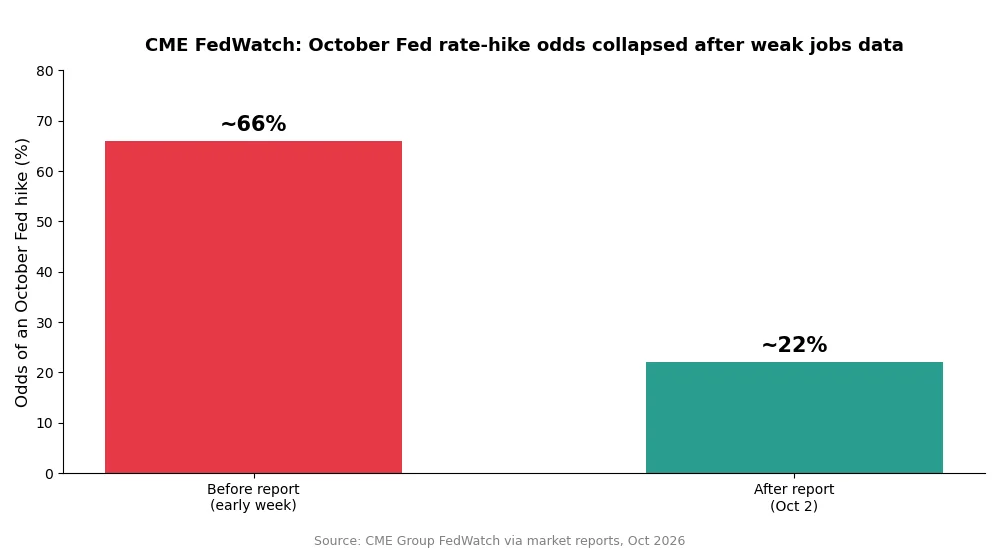
On Friday, October 2, the US economy added just 29,000 jobs in September. Economists had expected roughly 84,000. Within hours, Bitcoin punched above $87,000, and the market’s bet on another Federal Reserve rate hike this month collapsed from around 66% to near 22%.
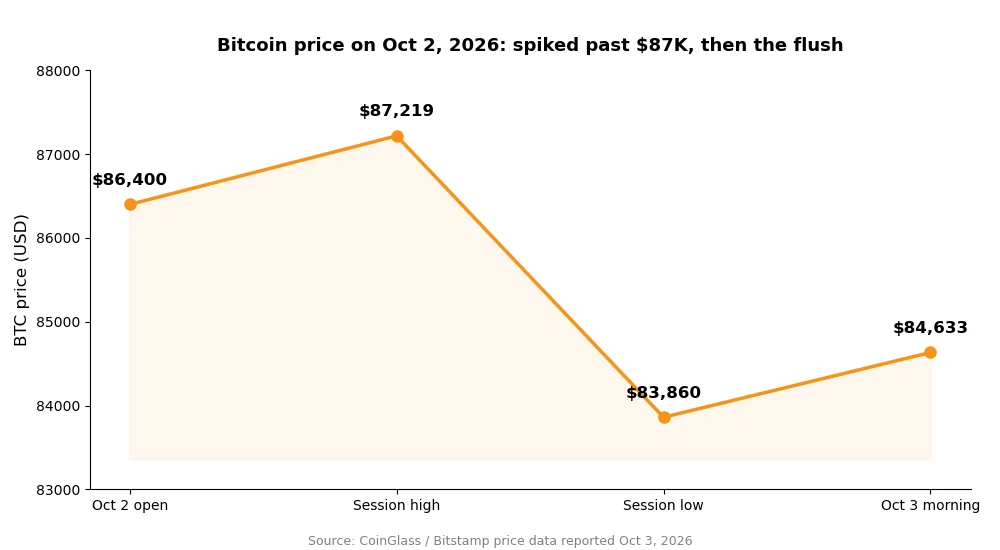
This is what a classic bitcoin jobs report trade looks like: weak labor data means less pressure for higher rates, and less rate pressure is fuel for Bitcoin. But the rally did not hold. A $433.6 million liquidation wave flushed late longs, and Bitcoin traded near $86,700 on Monday morning, still stuck under its 2026 ceiling.

- September nonfarm payrolls came in at +29K vs ~84-90K expected; unemployment rose to 4.2%; July and August were revised down by a combined 60K.
- Bitcoin hit $87,219 on October 2, then a $433.6M liquidation wave dragged it to $83,860; it trades near $86,700 Monday morning.
- CME FedWatch odds of an October rate hike fell from ~66% to ~22%; the next catalysts are September CPI on October 14 and the FOMC meeting on October 27-28.
What the September Jobs Report Actually Showed
The Bureau of Labor Statistics released the September numbers at 8:30 a.m. ET on Friday. Hiring, the agency said, “changed little” in every major industry. For traders betting on another Fed hike, the details were grim.
- What the September Jobs Report Actually Showed
- Why the Weak Jobs Report Sent Bitcoin Past $87K
- Why Bitcoin Could Not Hold $87K
- What Comes Next: CPI and the October Fed Meeting
- Mistakes Traders Are Making Right Now
- Frequently Asked Questions
- Why did a weak jobs report push Bitcoin higher?
- What are the current odds of an October Fed rate hike?
- Did Bitcoin set a new 2026 high?
- What is the next big event for Bitcoin?
- The Bottom Line
Headline: 29,000 new jobs versus roughly 84,000 to 90,000 expected. The unemployment rate ticked up to 4.2%, above the 4.1% forecast. Trading resource The Kobeissi Letter called it the third weakest jobs report of 2026.
The revisions were just as ugly. August was cut from 162,000 down to 133,000, and July swung from a 21,000 gain to a 10,000 loss. Combined, that erased 60,000 jobs from the record. Wage growth held at 3% year over year, with average hourly earnings at $37.81 and the average workweek at 34.4 hours. Health care led gains with 17,000 jobs; financial activities lost 7,000. If you want the full setup the market went in with, read our preview of the September jobs report.
Why the Weak Jobs Report Sent Bitcoin Past $87K
To understand the spike, look at the Fed. The central bank raised its benchmark rate to a 3.75% to 4.00% range in mid-September, and traders were openly debating whether a second hike could land at the October 27-28 meeting. A strong jobs number would have made that hike likely.
The miss flipped the bet. CME FedWatch data showed the odds of an October hike collapsing from about 66% early in the week to roughly 22% after the report, with some intraday readings even lower. December odds still sit above 75%, so the market is pricing a delay, not a full pivot. For context on the last move, see how Bitcoin reacted to the last Fed rate hike.

A softer inflation backdrop
The jobs report was not the only tailwind. A softer-than-expected August PCE reading, 3.4% versus the 3.7% forecast, had already cooled rate fears earlier in the week. Bitcoin broke $85K on that softer PCE inflation print, and the jobs miss added fuel to the same fire.
Put the two together and the message is clear: price pressure is cooling while hiring is fading. That combination gives the Fed room to wait, and waiting is exactly what risk assets like.
The $87K ceiling everyone is watching
Bitcoin’s Friday high of $87,219 stopped just short of the roughly $87,354 to $87,395 September peak that has capped every rally this year. That zone has become the 2026 ceiling, rejecting price several times.
This time, buyers first punched through a heavy sell wall near $85,000, which fed the momentum. But thick supply from positions built up during 2026 is stacked above $87K, and the wall held again. Spot demand helped too: Bitcoin ETFs opened October with $103 million in inflows as Fed hike odds collapsed.
Why Bitcoin Could Not Hold $87K
The answer is leverage. Open interest rose about 4.3% into the report, from roughly 626,000 BTC to 653,000 BTC, and the annualized funding rate climbed from around 3% to 10%. Longs were paying more and more to stay in the trade.
When price stalled at the ceiling, the flush came fast. CoinGlass data shows $433.57 million in total crypto liquidations over 24 hours, with $321.77 million of those, about 74%, from long positions. Bitcoin fell from $87,219 to a session low of $83,860 before steadying near $84,633 on Saturday morning. The ETF streak also broke on October 1 with about $149 million in net outflows, thinning the spot bid right at resistance. For the bigger flow picture, Bitcoin ETF inflows hit a 2026 record just days earlier.
“Weak is not automatically bullish”
That warning came from Fabian Dori, chief investment officer at Sygnum Bank. His point: a soft-but-orderly slowdown supports the liquidity trade, but a real growth scare would drag risk assets, Bitcoin included, lower with it. Liquidity stays the driver either way.
It is a useful lens for what happened. The market got the orderly kind of weak, so Bitcoin rose. But without a real break of the $87K ceiling, the move stayed a relief rally, not a trend change.
JUST IN: Bitcoin broke through the $85,000 sell wall today as the U.S. jobs report came in lower-than expected. The longer this trend continues, $90K is looking more and more like a magnet.
Bitcoin Magazine (@BitcoinMagazine), October 2, 2026
What Comes Next: CPI and the October Fed Meeting
The next macro test arrives fast. September CPI drops on October 14, and the FOMC meets October 27-28. If inflation cools again, the case for holding rates strengthens. If it runs hot, December hike expectations can bleed back into October. This is the pattern we keep seeing in crypto prices ahead of CPI data and FOMC rate decisions.
Before CPI lands, there is one more Fed signal to read today. Our preview of the Fed FOMC minutes Bitcoin traders are watching today breaks down the five clues that could settle the fight at the $87K ceiling.
On Monday morning, Bitcoin traded near $86,700, back inside the range. CoinGlass liquidation heatmaps show heavy clusters below at $83,500 and above near $87,700, which means both sides face real pain if price breaks out. Gold joined the move too, jumping from about $4,178 to $4,227 an ounce within minutes of the report. For a full walk-through of the cut, hold, and hike scenarios with real price targets, read our Bitcoin fed rate cut prediction.
21shares strategist Matt Mena argues that $87,000 is the barrier to clear, with the path above it opening toward $90K and then $97K.
Mistakes Traders Are Making Right Now
The jobs report created real opportunity, but it also created traps. Here are the ones catching people out this weekend.
Chasing the breakout candle
Buying the spike above $87,000 without a plan was exactly what fed the $433.6 million flush. News candles move fast, and they retrace just as fast. Wait for confirmation, not excitement.
Overleveraging a macro event
Funding hit 10% and longs were wiped out in hours. If you trade the news, small size is the only sane size. The liquidation wave is the lesson.
Reading one report as a full Fed pivot
December hike odds remain above 75%. The market faded October, not the whole tightening cycle. Betting on endless rate cuts this early is premature.
Frequently Asked Questions
These are the questions readers are asking most about the jobs report, the Fed, and what it all means for Bitcoin this month.
Why did a weak jobs report push Bitcoin higher?
Weak hiring makes another Fed rate hike less likely. Lower rate expectations ease borrowing costs and lift risk assets, from stocks to Bitcoin. Gold jumped for the same reason within minutes of the release.
What are the current odds of an October Fed rate hike?
CME FedWatch put the odds near 22% after the report, down from roughly 66% earlier in the week. December hike odds remain above 75%, so traders see the hike as delayed rather than cancelled.
Did Bitcoin set a new 2026 high?
No. The $87,219 high on October 2 fell just short of the roughly $87,354 to $87,395 September peak. That zone remains the 2026 ceiling Bitcoin has to clear.
What is the next big event for Bitcoin?
September CPI arrives on October 14, followed by the FOMC meeting on October 27-28. Another soft inflation print would strengthen the case for the Fed to hold rates steady.
The Bottom Line
The bitcoin jobs report story is simple: terrible labor data took another October rate hike off the table, Bitcoin tested its 2026 ceiling at $87K, and leverage did the rest, flushing $433.6 million of positions in a day. The market survived the week, but the ceiling survived too.
What comes next depends on inflation, not jobs alone. Watch the October 14 CPI print: another cool reading keeps October safe for risk assets, while a hot one puts the hike right back on the table.
The jobs data also helps explain what falling Fed hike odds mean before the CPI report for Bitcoin’s next move.