



Bitcoin tax in the UK starts with one simple fact. HMRC treats Bitcoin as property, not money, so selling it can trigger Capital Gains Tax.
For the 2026/27 tax year you pay 18% on gains inside your basic rate band and 24% above it, after a £3,000 tax-free allowance.

This guide walks through the rules in plain English. It also covers what changed in 2026, because three big changes now shape how HMRC finds unreported gains.
- Key Takeaways
- What Changed for UK Bitcoin Tax in 2026
- How HMRC Sees Your Bitcoin
- Capital Gains Tax Rates for 2026/27
- Section 104 Pooling and the 30-Day Rule
- When Bitcoin Counts as Income, Not a Gain
- Crypto ETNs and ISAs: The Rule Most Guides Get Wrong
- How to Report Bitcoin Tax
- HMRC Nudge Letters: 81,172 and Rising
- Common Mistakes Beginners Make
- Frequently Asked Questions
- Do I pay tax on Bitcoin in the UK if I only hold it?
- What is the Bitcoin tax rate in the UK for 2026/27?
- Do I need to report crypto if my gains are below £3,000?
- Are crypto-to-crypto swaps taxed in the UK?
- Can I hold Bitcoin in an ISA?
- Sources
Australia takes a different approach, with a 50% discount for long-term gains that ends on 1 July 2027. Our guide to Bitcoin tax in Australia for beginners explains theATO rules in full.
Canada also includes only half of a capital gain in taxable income, through a 50% inclusion rate. Our guide to Bitcoin tax in Canada for beginners explains the CRA rules in full.
Japan taxes Bitcoin gains as miscellaneous income at up to about 55.9%. Our guide to Bitcoin tax in Japan explained covers the NTA rules in full.
Key Takeaways
- HMRC treats Bitcoin as property. Selling, swapping or spending it counts as a disposal for Capital Gains Tax.
- 2026/27 rates are 18% for basic rate taxpayers and 24% for higher and additional rate taxpayers, after a £3,000 annual exempt amount.
- From 1 January 2026 UK exchanges must collect and report customer data to HMRC under CARF, with first reports due by 31 May 2027.
- HMRC sent 81,172 crypto nudge letters in 2025/26, up from 65,000 the year before.
- Section 104 pooling sets your cost basis, and the 30-day rule stops quick sell-and-rebuy tricks.
- Crypto ETNs left stocks and shares ISAs on 6 April 2026. New ISA investments go through Innovative Finance ISAs only.
- The 2025/26 Self Assessment deadline is 31 January 2027.
What Changed for UK Bitcoin Tax in 2026
Most UK crypto tax guides still describe the world as it was in 2024. Four changes in 2026 moved the ground under them, and this section gives you the current picture first.

Read this table before you read anything else. It holds the dates that matter most for beginners.
| Date | What changed | Why it matters |
|---|---|---|
| 1 January 2026 | CARF starts. UK exchanges must collect your identity and transaction data. | HMRC receives your 2026 activity automatically. First reports land by 31 May 2027. |
| 6 April 2026 | Crypto ETNs leave stocks and shares ISAs. | New ISA buys go through Innovative Finance ISAs only. Older holdings stay put. |
| July 2026 to March 2027 | HMRC runs its latest nudge letter campaign. | 81,172 letters went out in 2025/26, nearly triple the 2023/24 figure. |
| 28 October 2026 | Autumn Budget 2026 keeps CGT rates and the £3,000 allowance for 2027/28. | The trading allowance rises from £1,000 to £3,000 from 6 April 2027. Stablecoin disposals become CGT exempt from 2027/28. |
| 31 January 2027 | Online Self Assessment deadline for 2025/26. | Report 2025/26 gains and pay the tax by this date. |
Two of these changes do the heavy lifting. CARF ends the era when exchange data stayed private, and the nudge letter surge shows HMRC already uses the data it holds.
The rest of this guide explains the rules themselves, so you can work out what you owe under the new reality.
How HMRC Sees Your Bitcoin
HMRC calls Bitcoin a cryptoasset, and it taxes cryptoassets as property. That single choice drives everything else in this guide.
You do not owe tax just for owning Bitcoin. Tax starts when you dispose of it, and HMRC defines disposal more widely than most beginners expect.
What Counts as a Disposal
A disposal happens whenever you part with Bitcoin in a way that realises value. The table below lists the common cases.
| Action | Disposal? | Notes |
|---|---|---|
| Sell Bitcoin for pounds | Yes | The classic case. Your gain equals the sale price minus your pooled cost. |
| Swap Bitcoin for another crypto | Yes | HMRC treats the swap as a sale at the market value that day, even though no pounds change hands. |
| Spend Bitcoin on goods or services | Yes | Paying with Bitcoin counts as selling it at its sterling value. |
| Gift Bitcoin to someone other than your spouse | Yes | HMRC uses the market value on the day of the gift. |
| Transfer Bitcoin to your spouse or civil partner | No | Spouse transfers are exempt, and no gain arises at the time. |
| Move Bitcoin between your own wallets | No | Moving coins you still own changes nothing for tax. |
The swap row surprises most beginners. Trading Bitcoin for Ethereum feels like staying invested, but HMRC sees a sale of Bitcoin and a purchase of Ethereum.
Each swap creates its own gain or loss, and each one needs its own sterling value on the day it happened. If you sell peer to peer instead, our guide to selling Bitcoin on P2P platforms safely explains how to do it without getting scammed.
For the worldwide picture, our full Bitcoin tax guide compares how different countries tax Bitcoin, from the UK to the United States and India.
Capital Gains Tax Rates for 2026/27
Your gain is the sterling value you received minus the allowable cost of the coins you sold, minus fees. Add up every gain and loss across the tax year, then subtract the £3,000 annual exempt amount.
What remains is taxable, and the rate depends on your income tax band. The table below shows the 2026/27 rates.
| Your position | CGT rate | When it applies |
|---|---|---|
| Basic rate taxpayer | 18% | Gains that fall inside your remaining basic rate band, up to £50,270 of total income plus gains |
| Higher rate taxpayer | 24% | Gains above the basic rate band, on income from £50,271 to £125,140 |
| Additional rate taxpayer | 24% | Gains above £125,140 of income |
| Gains that straddle the band | 18% then 24% | Part of the gain fills the leftover basic rate space at 18%, the rest pays 24% |
The £3,000 allowance covers your total gains across all assets, not just crypto. You cannot carry it forward, so an unused allowance dies at the end of the tax year.
You must still report if your total disposal proceeds pass £50,000 in the year, even when your gains sit below £3,000. That £50,000 trigger catches many beginners who sell large amounts at a small profit.
The UK approach sits in the middle of the global range. India taxes crypto gains at a flat 30%, which our India crypto tax guide covers in full, while several US states add their own layer on top of federal tax.
A Worked Example With Real Numbers
Numbers make the rules click, so here is one investor’s year. All figures include fees, and every value is in pounds.
Sara buys 0.5 BTC for £25,000 in January 2026. She buys another 0.3 BTC for £18,000 in March 2026.
Her pool now holds 0.8 BTC at a total cost of £43,000, which works out to an average of £53,750 per BTC. In June 2026 she sells 0.4 BTC for £28,000.
Her allowable cost for the sale is 0.4 times £53,750, which equals £21,500. Her gain is £28,000 minus £21,500, which equals £6,500.
She subtracts the £3,000 annual exempt amount, which leaves £3,500 of taxable gain. As a higher rate taxpayer she pays 24% of £3,500, which equals £840.
As a basic rate taxpayer she would pay 18% of £3,500, which equals £630. The same trade costs £210 more at the higher rate, which shows why your income band matters.
Section 104 Pooling and the 30-Day Rule
HMRC does not let you pick which coins you sold. Every unit of the same token you own sits in one Section 104 pool, with a single average cost.
The pool spans every exchange and wallet you use. Buying Bitcoin on two exchanges still leaves you with one Bitcoin pool, not two.
Two matching rules apply before the pool. HMRC applies them in a fixed order, and they exist to stop a simple trick.
The Same-Day Rule
Coins you buy on the same day as a sale match that sale first. Their cost replaces the pool cost for that part of the sale.
This rule matters most for active traders, because same-day buys and sells happen often. Check the dates on every trade before you reach for the pool average.
The 30-Day Bed and Breakfast Rule
Coins you buy within 30 days after a sale also match the sale first. This rule blocks the old trick of selling at a loss on Monday and buying the same coins back on Tuesday to bank the loss.
Say you sell 0.2 BTC on 1 May and buy 0.2 BTC back on 20 May. The May purchase matches the sale, so the pool average does not apply to that part.
Only coins left unmatched after those two rules draw their cost from the pool. For a full walkthrough of the maths, see our guide on how to calculate Bitcoin capital gains tax.
When Bitcoin Counts as Income, Not a Gain
Capital Gains Tax covers most investors, but some Bitcoin arrives as income. HMRC taxes that income at your marginal Income Tax rate of 20%, 40% or 45%.
Staking rewards and mining rewards count as income on the day you receive them, valued in pounds at that moment. The same rule covers crypto you receive as pay for work, and airdrops you receive for doing something.
Airdrops you receive for doing nothing usually escape Income Tax, though a later sale still triggers Capital Gains Tax. The line turns on whether you did something to earn the tokens.
The first £1,000 of miscellaneous income each year escapes tax under the trading allowance. The Autumn Budget 2026 raises that allowance to £3,000 from 6 April 2027, which helps small stakers and miners.
Keep one more point in mind. Income tax on receipt sets your cost basis for the later sale, so the same coins can face tax twice on different amounts, once as income and once as a gain.
Crypto ETNs and ISAs: The Rule Most Guides Get Wrong
Many guides still say crypto ETNs belong in stocks and shares ISAs. That was true for six months, and it stopped being true on 6 April 2026.
The FCA lifted its retail ban on crypto ETNs on 8 October 2025. For a short window those notes qualified for stocks and shares ISAs, then the Individual Savings Account (Amendment) Regulations 2026, SI 2026/248, moved them out again.
From 6 April 2026, new crypto ETN investments inside an ISA must go through an Innovative Finance ISA. Holdings bought before that date can stay where they are, which is called grandfathering.
Three limits still apply. You cannot hold Bitcoin itself in any ISA, only the ETN.
SIPPs have been able to hold crypto ETNs since 8 October 2025. Crypto ETNs carry no FSCS cover, and the FCA still bans retail crypto derivatives.
If a guide tells you to buy Bitcoin ETNs in a stocks and shares ISA today, that guide is out of date. Check the date on any ISA advice before you act on it.
How to Report Bitcoin Tax
You report capital gains on the capital gains summary pages, SA108, of your Self Assessment return. Crypto income goes on the main SA100 return.
The online deadline for the 2025/26 tax year is 31 January 2027. Register for Self Assessment by 5 October in the year you first need to file, which means 5 October 2027 for the 2026/27 tax year.
Follow these steps, and do them in order.
- Gather every trade, swap, spend and gift from every exchange and wallet for the tax year.
- Convert each value to pounds using the sterling price on the day it happened.
- Apply the same-day rule, then the 30-day rule, then the Section 104 pool to work out each gain or loss.
- Add up all gains and losses, subtract the £3,000 annual exempt amount, and apply your 18% or 24% rate.
- Enter the figures on SA108, file online by 31 January, and pay the tax by the same date.
Software can do the heavy lifting, and our roundup of crypto tax software for reporting Bitcoin taxes compares the tools that handle HMRC pooling rules.
Records HMRC Expects You to Keep
HMRC can ask for records years after the event, so keep them from day one. Save the date, the type of transaction, the number of coins, the sterling value, the fees, and the wallet or exchange involved.
Export your exchange history at least once a year, and keep it somewhere safe. Exchanges close accounts and lose old data, but your duty to report survives.
HMRC Nudge Letters: 81,172 and Rising
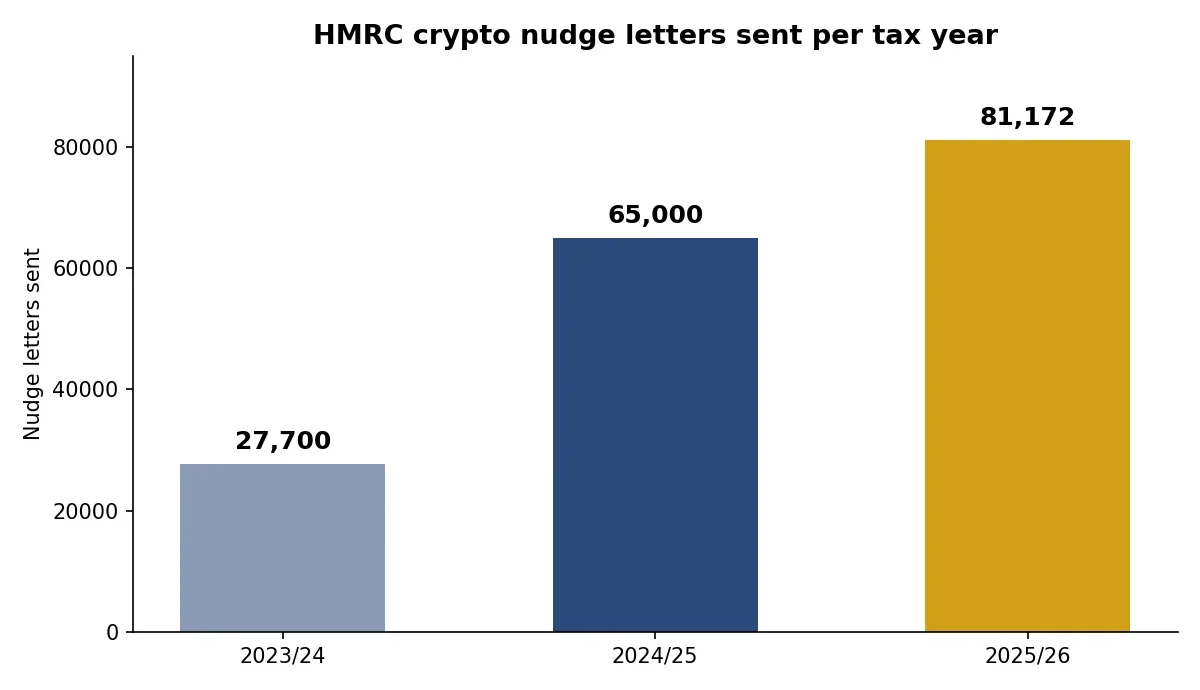
HMRC has sent crypto nudge letters for years, and the campaign keeps growing. Figures obtained under the Freedom of Information Act by UHY Hacker Young show 81,172 letters went out in 2025/26.
That figure is up 25% on the 65,000 sent in 2024/25, which was itself more than double the 27,700 of the year before. The chart below shows the climb.
A nudge letter is not a tax bill and not an accusation. HMRC writes to say it holds information that suggests you disposed of cryptoassets, and it asks you to check your own records.
The current campaign runs from July 2026 to March 2027. If you owe tax, HMRC points you to its cryptoasset disclosure service, and you normally pay the tax, interest and any penalty within 30 days of disclosing.
Ignore the letter and the matter does not close. HMRC can open a compliance check, and penalties run from 4 years back for honest mistakes to 6 years for carelessness and 20 years for deliberate concealment.
One warning matters here. Scammers copy HMRC letters and emails, so check the contact details against HMRC’s own list of genuine contacts before you act.
Never pay through a link or phone number that appears only in the message.
Common Mistakes Beginners Make
Most UK Bitcoin tax errors come from the same few traps. Dodge these and you dodge most of the trouble.
- Treating a crypto-to-crypto swap as tax free. Every swap is a disposal, and HMRC taxes the Bitcoin you gave up at its market value that day.
- Forgetting the £50,000 proceeds trigger. You must report even when your gains sit below £3,000, if you disposed of more than £50,000 worth in the year.
- Using the wrong cost basis. HMRC uses Section 104 pooling, not first in first out, and the 30-day rule applies before the pool.
- Ignoring staking and mining income. Rewards count as income when you receive them, and the later sale can trigger a second tax event.
- Letting losses die. Losses only help if you report them, and a reported loss can offset gains in the same year or carry forward to later years. Our guide to Bitcoin tax loss harvesting shows how to use losses before 31 December.
- Assuming HMRC cannot see your trades. CARF reporting from 2026 and the nudge letter surge mean exchange data now reaches HMRC as a matter of routine.
- Filing late. The 31 January deadline carries automatic penalties, and interest runs from 1 February.
Frequently Asked Questions
Do I pay tax on Bitcoin in the UK if I only hold it?
No. Buying and holding Bitcoin is not a disposal, so no Capital Gains Tax arises.
Tax starts only when you sell, swap, spend or gift the coins.
What is the Bitcoin tax rate in the UK for 2026/27?
Gains above the £3,000 annual exempt amount pay 18% inside your basic rate band and 24% above it. The rates match the rates for shares and other non-residential assets.
Do I need to report crypto if my gains are below £3,000?
You still need to report if your total disposal proceeds pass £50,000 in the tax year, even when your gains sit below the allowance. You should also report losses, because only reported losses can offset future gains.
Are crypto-to-crypto swaps taxed in the UK?
Yes. HMRC treats swapping Bitcoin for another crypto as a disposal of the Bitcoin at its sterling market value on the day of the swap, even though no pounds change hands.
Can I hold Bitcoin in an ISA?
No, you cannot hold Bitcoin itself in any ISA. Crypto ETNs became available to retail investors in October 2025, but from 6 April 2026 new ISA investments in them must go through an Innovative Finance ISA, and holdings bought before that date stay grandfathered in place.
Sources
- GOV.UK, Check if you need to pay tax when you sell cryptoassets
- HMRC Cryptoassets Manual, Cryptoassets for individuals: which taxes apply (CRYPTO20050)
This article explains the rules in general terms. It is not tax advice, and your own situation may change the answer.
Speak to a qualified UK tax adviser before you file.