



Yes, you pay tax on Bitcoin in Australia. The Australian Taxation Office (ATO) treats Bitcoin as property, not money, so selling, swapping, spending or gifting it can trigger capital gains tax (CGT).
That one fact shapes everything else in this guide. If you bought Bitcoin as an investment and later sold it for more than you paid, the profit is a capital gain.

If you earned Bitcoin from staking or mining, that is usually ordinary income instead.
- Key Takeaways
- Bitcoin Tax in Australia for Beginners: The Rules in Plain English
- How Much Tax Will You Actually Pay?
- The Big 2026 Change: The 50% Discount Ends on 1 July 2027
- Staking, Mining and Airdrops Are Income, Not Capital Gains
- The $10,000 Personal Use Exemption (and Why It Rarely Helps)
- Investor or Trader? The ATO Draws a Line
- The ATO Already Knows: Data Matching and Exchanges
- How to Report Bitcoin on Your Tax Return
- Common Mistakes That Cost Australians Money
- Frequently Asked Questions
- Do I pay tax on Bitcoin in Australia if I never sell it?
- How long do I need to hold Bitcoin to get the 50% CGT discount?
- Does the ATO know if I trade crypto?
- Are staking rewards taxed in Australia?
- What happens to the 50% discount after 1 July 2027?
- Do I need to report small amounts of Bitcoin, or only big gains?
- Sources
This guide explains bitcoin tax in Australia for beginners in plain English. It covers the 2026-27 rates, the 50% CGT discount, the $10,000 personal use rule, staking and airdrops, the ATO data-matching program, and the big change coming on 1 July 2027.
This guide is general information only. It is not tax advice.
Tax rules depend on your own situation, so talk to a registered tax agent before you lodge.
Key Takeaways
- The ATO treats Bitcoin as a CGT asset. Every disposal can trigger CGT.
- Hold for 12 months or more and you may halve your gain with the 50% CGT discount.
- From 1 July 2027, the 50% discount ends. Cost-base indexation plus a 30% minimum tax replaces it.
- Staking rewards, mining income and most airdrops are ordinary income when you receive them.
- The ATO receives transaction data from Australian exchanges, so unreported disposals are easy to spot.
- Keep records for at least 5 years after you dispose of any crypto.
Bitcoin Tax in Australia for Beginners: The Rules in Plain English
The ATO updated its official crypto guidance on 19 August 2026. Its position has stayed consistent for years: crypto assets are not a form of money for tax purposes.

That means Bitcoin sits in the same tax box as shares or an investment property. You do not pay tax just for owning it.
You pay tax when something happens to it.
Bitcoin Is Property, Not Money
The ATO says crypto assets are a digital representation of value. You can transfer, store or trade them electronically, but the tax law does not treat them as currency.
This matters because it decides which tax rules apply. A payment in dollars is not a CGT event.
A payment in Bitcoin usually is.
What Counts as a Disposal
A disposal happens whenever you give up ownership of your Bitcoin. The table below lists the common triggers.
| Action | CGT event? | What it means |
|---|---|---|
| Sell Bitcoin for Australian dollars | Yes | Compare the sale price with your cost base |
| Swap Bitcoin for another crypto | Yes | A crypto-to-crypto swap is a disposal, even with no cash involved |
| Spend Bitcoin on goods or services | Yes | Paying with Bitcoin is treated like selling it |
| Gift Bitcoin to someone | Yes | Gifting is a disposal at market value |
| Move Bitcoin between your own wallets | No | No change of ownership, so no CGT event |
| Simply hold Bitcoin while the price rises | No | Paper gains are not taxed until you dispose of the asset |
Many beginners get caught by the second row. Swapping Bitcoin for Ethereum on an exchange feels like one trade, but the ATO sees it as selling Bitcoin and buying Ethereum in the same moment.
How Much Tax Will You Actually Pay?
Australia has no separate CGT rate. Your net capital gain is added to your other taxable income and taxed at your marginal rate.
This is the part of bitcoin tax in Australia for beginners that surprises people most. There is no flat crypto rate, so your salary decides how much of the gain you keep.
That makes your tax bracket the key number. The table below shows the 2026-27 resident rates, and the chart under it makes the steps easy to see.
| Taxable income (AUD) | Tax rate |
|---|---|
| $0 to $18,200 | 0% (tax-free threshold) |
| $18,201 to $45,000 | 15% |
| $45,001 to $135,000 | 30% |
| $135,001 to $190,000 | 37% |
| Over $190,000 | 45% |
Most residents also pay the 2% Medicare levy on top of these rates. The 15% rate in the second row is new: it fell from 16% on 1 July 2026.
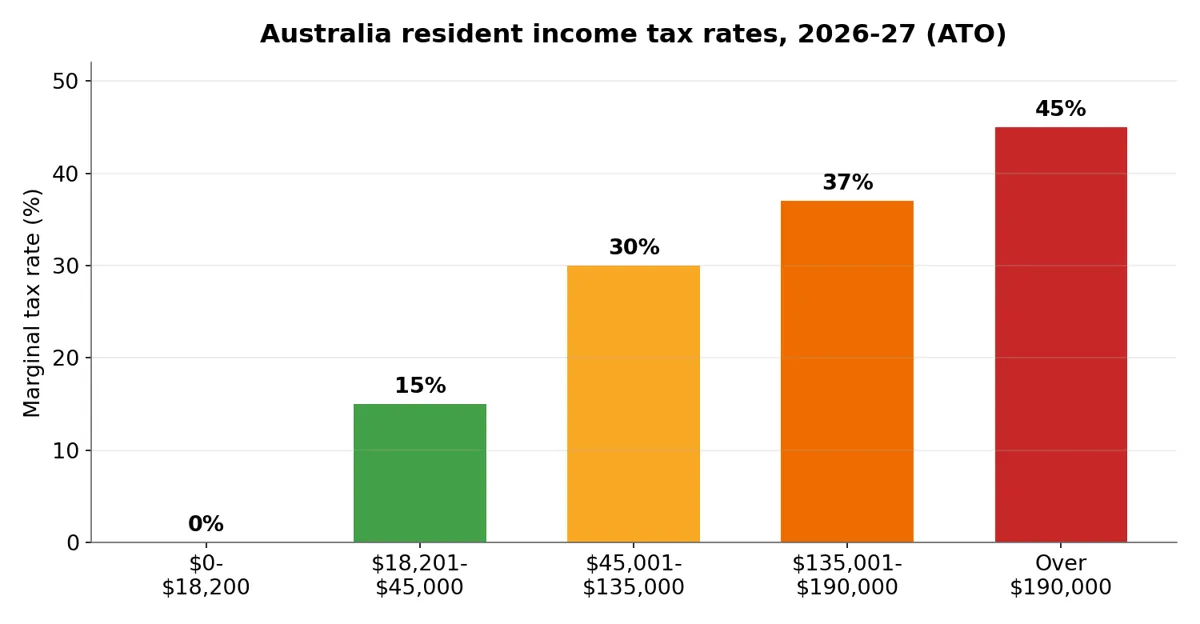
Australia resident marginal tax rates, 2026-27 (ATO). The 2% Medicare levy applies on top for most residents.
Your capital gain stacks on top of your salary. If you earn $80,000 a year and make a $30,000 assessable gain, that gain is taxed at the rates that apply above $80,000.
The 50% Discount, Explained With Numbers
Hold a Bitcoin parcel for 12 months or more and you may qualify for the 50% CGT discount. Only half of the gain counts as assessable income.
The 12 months are counted carefully. The day you buy and the day you sell do not count toward the 12 months, so selling on the exact anniversary can cost you the discount.
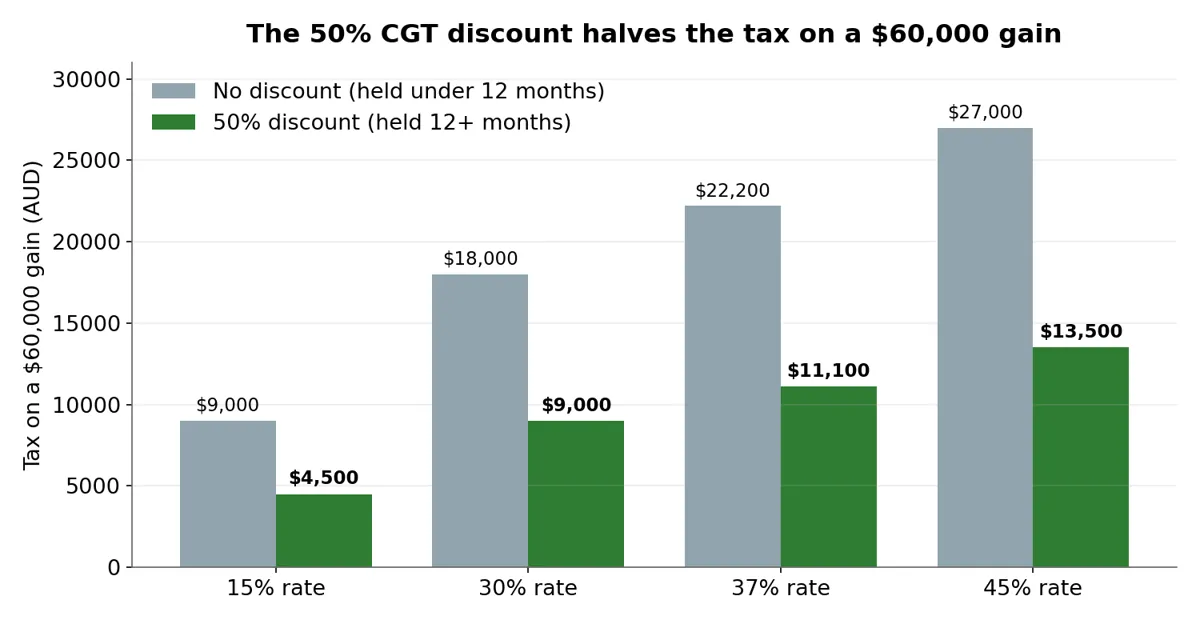
Tax on a $60,000 Bitcoin gain at four marginal rates, with and without the 50% discount. Figures are illustrative and exclude the Medicare levy.
The chart shows why holding matters. At a 37% marginal rate, the same $60,000 gain costs $22,200 in tax without the discount and $11,100 with it.
A Worked Example From Buy to Sale
Emma buys 0.5 BTC for $40,000 in March 2025. She sells it for $100,000 in September 2026, after holding it for 18 months.
Her capital gain is $60,000. The 50% discount cuts the assessable gain to $30,000.
At her 37% marginal rate, the tax on that gain is $11,100, plus the Medicare levy if it applies to her.
Fees belong in the maths too. Brokerage and exchange fees add to your cost base, which shrinks the gain.
Keep every fee receipt, because each one lowers the tax you owe. Our guide to how to calculate your Bitcoin capital gains walks through the cost-base rules step by step.
The Big 2026 Change: The 50% Discount Ends on 1 July 2027
Here is the change that makes this guide different from every older Australian crypto tax article. The 50% CGT discount is being abolished for gains that build up from 1 July 2027.
The 2026-27 Federal Budget, delivered by Treasurer Jim Chalmers on 12 May 2026, announced the change. Parliament passed it as the Treasury Laws Amendment (Tax Reform No. 1) Act 2026 (Act No. 49 of 2026), which received Royal Assent on 26 June 2026.
| Old rules (until 30 June 2027) | New rules (from 1 July 2027) | |
|---|---|---|
| Long-term gain relief | 50% CGT discount after 12 months | Cost-base indexation by CPI instead |
| What gets taxed | Half of the nominal gain | Only the real gain above inflation |
| Minimum tax on gains | None | 30% minimum tax on real gains |
| Who it covers | Individuals, trusts, partnerships | Individuals, trusts, partnerships |
| Super funds | 33.33% discount | 33.33% discount stays |
| Companies | No discount | No discount, no change |
Indexation works like this: your cost base rises with inflation, so only the gain above inflation is taxed. The 30% minimum tax then acts as a floor, so the tax on post-2027 gains is at least 30% of the real gain, even if your marginal rate is lower.
What Happens to Coins You Already Hold
Gains built up before 1 July 2027 keep the old treatment. Crypto you still hold on 30 June 2027 is deemed sold and reacquired at market value just before 1 July 2027.
No tax is payable on 1 July 2027 itself. The deemed value is only used later, when you actually sell, to split your total gain into a pre-2027 part and a post-2027 part.
Take a simple example. You bought 1 BTC for $50,000 in 2024.
It is worth $150,000 on 30 June 2027, and you sell it for $250,000 in 2030. The first $100,000 of gain keeps the 50% discount, so $50,000 is assessable.
The second $100,000 falls under the new rules: indexation lifts your cost base with inflation, and the 30% minimum tax sets the floor.
What to Do Before 30 June 2027
The deadline gives Australian holders a clear window to act. This checklist is the single most useful thing in this guide, so work through it before the 2026-27 year ends.
- Record a 30 June 2027 valuation for every holding. Screenshot each exchange balance and price, or export a portfolio statement dated 30 June 2027. This is the number that protects your pre-2027 gain.
- Check your holding periods. Coins bought before 30 June 2026 will have passed 12 months by the deadline, so their discount is locked in for pre-2027 gain.
- Think about gains you planned to realise anyway. Selling before 30 June 2027 means the whole gain gets the 50% discount. Selling after means part of it falls under the new rules.
- Use losses wisely. Capital losses offset gains in the same year, and unused losses carry forward. Our explainer on tax loss harvesting shows how to time this before 31 December.
- Tidy your records now. Every exchange, wallet and DeFi transaction needs a date and an Australian dollar value. Good records are what make the 30 June 2027 split possible.
- Talk to a registered tax agent. The transition rules are new, and the ATO is still finalising how the gain split is calculated. A short consultation beats a wrong return.
Do not rush to sell just because the rules change. A forced sale can cost more in tax than holding, so run your own numbers first.
Staking, Mining and Airdrops Are Income, Not Capital Gains
Not all crypto tax is CGT. Rewards you receive for staking, mining or airdrops are usually ordinary income in the year you receive them, and this income side of bitcoin tax in Australia for beginners is where most mistakes happen.
The amount is the fair market value in Australian dollars on the day you receive the reward. That value becomes your cost base if you later sell the reward coins, so a second CGT event can follow when you dispose of them.
The ATO published draft guidance on airdrops in August 2026, and it is still working through the details. Staking rewards are clearer: the ATO states plainly that they are ordinary income.
If you stake through an exchange, your reward history is part of the data the exchange already reports.
Mining works the same way. Coins you mine are income at their value when you receive them.
Hobby miners and business miners are treated differently, and how Bitcoin is taxed around the world explains why that distinction matters in other countries too.
The $10,000 Personal Use Exemption (and Why It Rarely Helps)
You may have heard that spending small amounts of Bitcoin is tax-free. The rule is real, but the ATO reads it very narrowly.
A capital gain is disregarded when the crypto was a personal use asset and you acquired it for less than $10,000. A personal use asset is one you keep or use mainly to buy things for personal use, soon after you buy it.
Buying $300 of Bitcoin on a Tuesday to pay for concert tickets on Wednesday can qualify. Buying Bitcoin, holding it for two years hoping the price rises, then spending some on a holiday does not.
The ATO has said it is unlikely most crypto holders satisfy the exemption. If you bought Bitcoin as an investment, it stays an investment even when you later spend some of it.
Losses on personal use assets are also disregarded, so you cannot claim them against other gains.
Investor or Trader? The ATO Draws a Line
Most Australians who buy Bitcoin are investors. Every disposal is a CGT event, and the 50% discount is available after 12 months.
A smaller group are traders carrying on a business. For them, crypto is trading stock, gains are ordinary income, losses are deductible, and the 50% discount does not apply.
The ATO looks at how often you trade, how organised the activity is, and whether you trade like a business.
Day trading every week with a written plan and a dedicated setup points toward business. Buying monthly and holding for years points toward investment.
If you are unsure which side you fall on, ask a tax agent, because the answer changes your whole return.
Self-managed super funds sit in their own lane. Complying SMSFs pay 15% tax and keep a one-third CGT discount, which the 2026 reform leaves untouched.
The ATO Already Knows: Data Matching and Exchanges
The ATO runs a crypto data-matching program that collects transaction data from Australian exchanges and designated service providers. The program has run since 2014 and extends through the 2025-26 financial year.
Over one million taxpayers now see a reminder message when they prepare their tax return, warning them they may have crypto gains or losses to declare. The ATO matches exchange data against returns and follows up on gaps.
The exchange side is tightening too. Australia passed the Corporations Amendment (Digital Assets Framework) Act 2026 on 1 April 2026, with Royal Assent on 8 April 2026.
It brings digital asset platforms and tokenised custody platforms into the AFSL licensing system run by ASIC, and it comes into force in April 2027.
Until then, exchanges must already register with AUSTRAC as virtual asset service providers. Check that any exchange you use is AUSTRAC-registered before you trust it with your money.
Our beginner guide to buying Bitcoin in Australia lists what to look for in a local exchange.
How to Report Bitcoin on Your Tax Return
Reporting is simpler than most beginners fear. The steps below cover the full reporting side of bitcoin tax in Australia for beginners, from records to lodgement.
- Gather your records. Every buy, sell, swap, gift, staking reward and fee, with the date, the amount and the Australian dollar value at the time.
- Work out each capital gain or loss. Subtract the cost base (what you paid, plus fees) from the proceeds (what you received, minus selling fees).
- Apply capital losses first. Losses offset gains in the same year. Any leftover loss carries forward to future years, but it can never offset salary or wages.
- Apply the 50% discount to long-term gains. Only gains on assets held 12 months or more qualify, and only until the 1 July 2027 change.
- Enter the totals in your return. Report capital gains at the CGT labels in myTax or your agent’s software. If your total capital gain is over $10,000, you also complete a CGT schedule.
- Report income separately. Staking, mining and airdrop income goes at “Other income” in your return, not in the CGT section.
Crypto tax software can pull your exchange and wallet history and do the first four steps for you. Check its figures against your own records before you lodge, because the software only knows what it can see.
The self-lodger deadline for the 2025-26 return was 31 October 2026, a Saturday, so it fell on Monday 2 November 2026. If you missed it, lodge as soon as you can and talk to a tax agent about late lodgement.
Common Mistakes That Cost Australians Money
Most crypto tax problems come from a handful of avoidable errors. Watch for these.
Forgetting crypto-to-crypto swaps. Swapping Bitcoin for another coin is a disposal.
People who report only cash sales understate their gains.
Reporting only the profit, not the gain. The gain is proceeds minus cost base, and the cost base includes fees.
Skipping fees overstates your tax.
Claiming the discount too early. Selling one day short of 12 months loses the whole 50% discount.
Count the days, and remember the buy and sell days do not count.
Claiming the personal use exemption on investments. The ATO watches this closely.
An investment you later spend is still an investment.
Ignoring staking rewards. Rewards are income when received, even if you never sell them.
Unreported staking income is one of the easiest things for data matching to catch.
Losing records. The ATO requires records for at least 5 years after disposal.
Old exchange accounts close, and CSV exports disappear.
Download your history every year.
The UK takes a different approach to the same problems, and our guide to how the UK taxes Bitcoin shows how pooling and allowances differ across the two systems.
Frequently Asked Questions
These are the questions beginners ask most about bitcoin tax in Australia for beginners. Each answer uses the ATO rules covered above.
Do I pay tax on Bitcoin in Australia if I never sell it?
No. Holding Bitcoin is not taxed, even if the price rises.
Tax only arises when you dispose of it or earn income from it, such as staking rewards.
How long do I need to hold Bitcoin to get the 50% CGT discount?
You need to hold it for 12 months or more. The day you buy and the day you sell do not count, so wait until the day after the anniversary to be safe.
The discount applies to gains that build up before 1 July 2027.
Does the ATO know if I trade crypto?
In most cases, yes. The ATO collects transaction data from Australian exchanges through its data-matching program, and over one million taxpayers receive a reminder about crypto when they prepare their return.
Are staking rewards taxed in Australia?
Yes. Staking rewards are ordinary income at their Australian dollar value on the day you receive them.
If you later sell those reward coins, a CGT event can follow as well.
What happens to the 50% discount after 1 July 2027?
It is replaced by cost-base indexation plus a 30% minimum tax on real gains. Gains built up before 1 July 2027 keep the discount, and holdings at 30 June 2027 are deemed sold and reacquired at market value to split the gain.
Do I need to report small amounts of Bitcoin, or only big gains?
You need to report all disposals, however small. There is no minimum threshold for reporting, and you should report losses too, because they can offset future gains.
Sources
- Australian Taxation Office, “What are crypto assets?” (updated 19 August 2026)
- Australian Taxation Office, “Taking the cryptic out of crypto this tax time” (updated 9 September 2026)
- Australian Taxation Office, “Tax and crypto asset investments” (NAT 75362)
Not tax advice. This guide is general information based on ATO guidance and legislation as at 10 November 2026.
Tax law changes often, so confirm the current rules with a registered tax agent before you act.