



Dollar cost averaging bitcoin means buying a fixed dollar amount of Bitcoin on a fixed schedule, whatever the price. When the price falls, your money buys more bitcoin, and when it rises, it buys less. Over time this smooths your average cost and removes the fear of buying at the wrong moment.
Key Takeaways
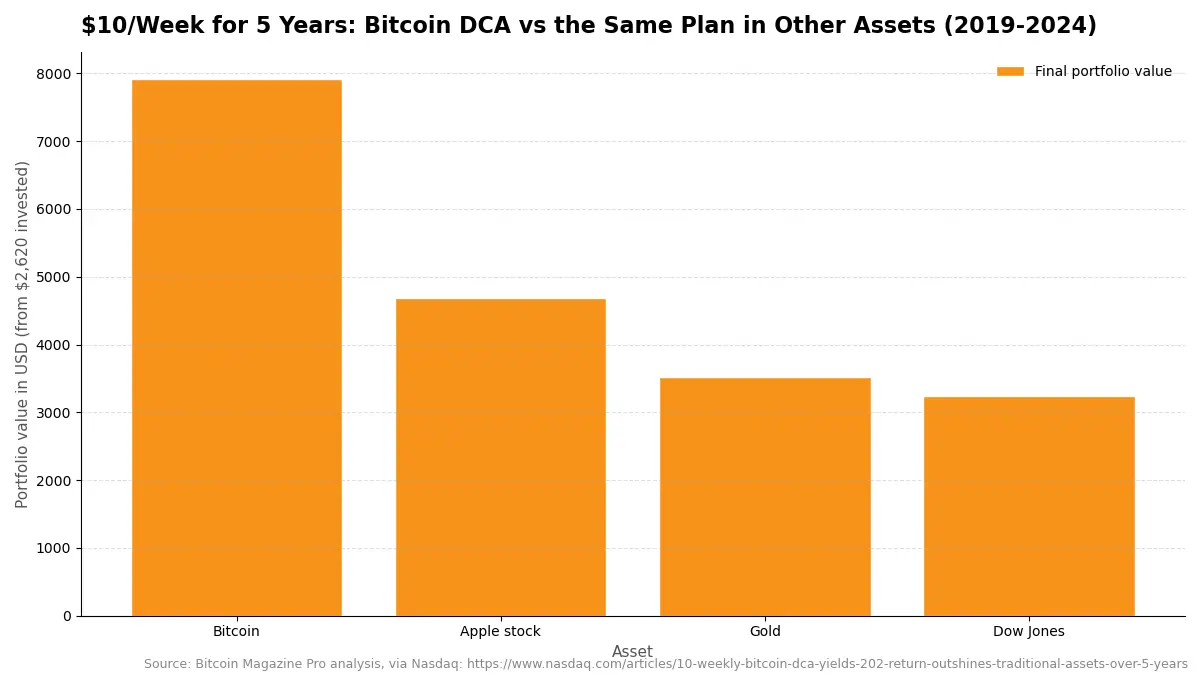
- The headline proof: $10 a week into Bitcoin from 2019 to 2024 turned $2,620 into about $7,913, a 202.03% return (Bitcoin Magazine Pro backtest).
- The honest caveat: lump-sum investing beats DCA about 68% of the time (Vanguard research). DCA wins for beginners by killing timing mistakes and panic selling, not by maximizing returns.
- Your outcome from this article: enough understanding and a concrete plan to set up your first recurring Bitcoin buy with confidence.
The 30-Second Answer: Is Dollar Cost Averaging Good for Bitcoin?
Yes, for most beginners. Bitcoin can move 10% in a week and 50% in a few months, and that volatility turns smart people into emotional buyers. A fixed schedule removes the decision: you buy on red days and green days alike.

This is the case for dollar cost averaging bitcoin as a beginner strategy. It trades a small expected return for a huge reduction in mistakes.
- The 30-Second Answer: Is Dollar Cost Averaging Good for Bitcoin?
- What Is Dollar-Cost Averaging in Bitcoin?
- How Dollar Cost Averaging Bitcoin Works: A $25/Week Walkthrough With Fees Included
- How Your Average Price Forms Over Time
- Worked Example: $25/Week for 12 Months With a 1.5% Fee
- How to Calculate Your Average Bitcoin Purchase Price
- Why DCA Fits Bitcoin Better Than Timing the Market
- Bitcoin’s Volatility Is the Whole Problem
- Missing the Best Days Destroys Returns
- Emotion Is the Real Enemy
- The Proof: What the Numbers Actually Say
- The dcaBTC Backtest: $10/Week, 2019 to 2024
- Longer Windows: A $100/Month Plan Since 2015
- Real-World DCA at Scale: Strategy and El Salvador
- The Honest Downside: When DCA Loses
- Lump-Sum Investing Wins About 68% of the Time
- DCA Trails in Steady Rallies and Bull Markets
- Even Machine Learning Barely Beat Plain DCA
- DCA vs. Lump-Sum Investing: Which Is Better for Bitcoin?
- How Much Should You Invest, and How Often?
- How Much: The 1-5% Rule and the Sleep Test
- Weekly vs. Monthly: What the Data Says
- The Best Day of the Week to Buy
- Fees: The Hidden Cost of Small Recurring Buys
- How a 1-2% Fee Compounds Against a $10/Week Plan
- Fixed Minimums Hurt Small Buys More Than Percentages Do
- Three Ways to Cut Fee Drag
- Taxes and Recordkeeping: What 200 Buys Means for Your Tax Return
- Every Buy Is a Separate Tax Lot
- Why You Must Start Tracking From Buy Number One
- Crypto Tax Software That Handles DCA Lots
- Self-Custody: When to Move Your Stack Off the Exchange
- Why Leaving DCA Buys on the Exchange Forever Is a Risk
- The Simple Rule: Sweep on a Schedule
- Hardware Wallet Basics for DCA Stackers
- Your 5-Step Dollar Cost Averaging Bitcoin Setup Plan for 2026
- Step 1: Pick Your Amount (Fixed, Affordable, Automatic)
- Step 2: Pick Your Frequency and Day (Weekly Recommended)
- Step 3: Choose Where to Buy and Set the Recurring Order
- Step 4: Set Up Tax Tracking Before Your First Buy
- Step 5: Schedule Your Self-Custody Sweeps
- Common Mistakes That Break the Strategy
- Stopping DCA in a Bear Market
- Pausing Because “It Feels Expensive”
- Trying to “Improve” DCA With Market Timing
- When Should You Actually Stop?
- Dollar Cost Averaging Bitcoin: Frequently Asked Questions
- Final Takeaway: Start the Schedule, Forget the Price
Look at the current market. Bitcoin trades around $83,000 to $86,000 as of late September 2026, roughly a third below its all-time high of $126,198 set on October 6, 2025.
Sentiment has whiplashed from record fear in February 2026 to greed by September. That is exactly the kind of market DCA is built for: no one knows whether the next 20% move is up or down, so you stop guessing and start accumulating.
One house rule before we continue: this article is educational content, not financial advice. Bitcoin is volatile and you can lose money. Only invest money you can afford to lose, and consider speaking with a licensed financial advisor before you start.
The one limit to know up front: in a steady, rising market, putting all your money in at once beats DCA about two times out of three. We show the numbers behind that later, because an honest strategy guide should tell you where its own advice loses.

202.03%
Return on $10/week into BTC, 2019-2024 ($2,620 became $7,913.20)
68%
Share of periods where lump-sum investing beat DCA (Vanguard research)
~34%
How far BTC sits below its October 2025 all-time high (late Sept 2026)
What Is Dollar-Cost Averaging in Bitcoin?
Start with the plain version. You pick an amount, say $25. You pick a schedule, say every Monday.
Then you buy $25 of Bitcoin every Monday, rain or shine, whether the news is good or terrible. That is the whole strategy. Everything else is detail.
If you are brand new and want the ground floor first, read our guide on what Bitcoin actually is before continuing. The rest of this article assumes you know that Bitcoin is a digital asset with a fixed supply of 21 million coins and a price that swings hard.
The Plain-English Definition
Dollar-cost averaging (DCA) is the practice of investing a fixed sum at fixed intervals, regardless of the price. The US Securities and Exchange Commission describes it the same way: investing your money in equal portions at regular intervals helps manage risk by adding new money in a consistent pattern over a long period.
With Bitcoin, the “fixed interval” is usually weekly or monthly, and the “fixed sum” is whatever you can afford to part with on that schedule.
In practice, dollar cost averaging bitcoin looks like this: $25 leaves your account every Monday and becomes bitcoin at whatever Monday’s price happens to be. Some Mondays you get a lot of sats. Some Mondays you get a few.
You never have to decide whether Monday is a good day to buy.
The Two Rules That Define DCA
Two rules, no exceptions, or it is not DCA.
Rule one: the amount is fixed. Not “around $25” and not “$25, or $100 if it dips.” The discipline comes from the amount never changing with your mood or the headlines.
Rule two: the schedule is fixed. Weekly, biweekly, or monthly, picked in advance and followed for years. The best DCA plans are automated recurring buys, because automation deletes the moment where you get to talk yourself out of buying.
What DCA Is Not
DCA is not trading. You are not reading charts, setting stop losses, or trying to sell the top. It is not timing the market either.
In fact it is the deliberate refusal to time the market. And it is not a trick that guarantees profit. If Bitcoin’s price fell for ten straight years, DCA would lose money more slowly than a lump sum bought at the top, but it would still lose.
The strategy only works on an asset you believe will be worth more years from now.
How Dollar Cost Averaging Bitcoin Works: A $25/Week Walkthrough With Fees Included
Time for the math. Most guides show DCA with round numbers and no fees, which flatters the strategy. This walkthrough includes a 1.5% fee on every buy, the way a real exchange charges you.
The prices below are a simplified teaching example, not real market history. The arithmetic, though, is exactly how your exchange will compute it.
How Your Average Price Forms Over Time
The mechanism is pure arithmetic. Your dollar amount stays fixed while the price moves, so the quantity of bitcoin you receive moves in the opposite direction. Cheap bitcoin gives you more sats per dollar.
Expensive bitcoin gives you fewer. Across dozens or hundreds of purchases, the cheap months automatically carry more weight. Your average cost per coin lands below the simple average of the prices you paid.
That is the cost average effect. It does not protect you from a falling market, and it does not create returns out of nothing. What it does is give you a better entry price than a single lucky or unlucky buying day, as long as prices fluctuate instead of marching straight up.
Worked Example: $25/Week for 12 Months With a 1.5% Fee
Assume you buy $25 of Bitcoin every week for 12 months. To keep the table readable, each row below groups four weekly buys into one month: $100 spent per month, $1.50 of that lost to fees, so $98.50 actually becomes bitcoin.
Total spent over the year: $1,200. Total fees: $18.
| Month | BTC price | Net invested | BTC bought | Cumulative BTC |
|---|---|---|---|---|
| 1 | $100,000 | $98.50 | 0.0009850 | 0.0009850 |
| 2 | $92,000 | $98.50 | 0.0010707 | 0.0020557 |
| 3 | $84,000 | $98.50 | 0.0011726 | 0.0032283 |
| 4 | $78,000 | $98.50 | 0.0012628 | 0.0044911 |
| 5 | $88,000 | $98.50 | 0.0011193 | 0.0056104 |
| 6 | $95,000 | $98.50 | 0.0010368 | 0.0066472 |
| 7 | $106,000 | $98.50 | 0.0009292 | 0.0075764 |
| 8 | $98,000 | $98.50 | 0.0010051 | 0.0085815 |
| 9 | $90,000 | $98.50 | 0.0010944 | 0.0096759 |
| 10 | $102,000 | $98.50 | 0.0009657 | 0.0106416 |
| 11 | $115,000 | $98.50 | 0.0008565 | 0.0114981 |
| 12 | $110,000 | $98.50 | 0.0008955 | 0.0123936 |
Three numbers tell the story. The simple average of the 12 monthly prices is $96,500. Your average price before fees is $95,369, which is lower, exactly as the theory promises: you bought more when it was cheap.
But your true all-in average cost is $96,823 per BTC, because the $18 in fees pushed it back up above the simple average. The DCA effect beat the average, and fees ate the difference. That is the most important lesson in this table: fees are part of the strategy, not a footnote.
At the final price of $110,000, your 0.0123936 BTC is worth about $1,363. Against $1,200 spent, that is a gain of roughly $163, about 13.6 percent.
A nice outcome, but notice how much of it the dips in months 3 and 4 contributed. Without them, the result would look very different.
How to Calculate Your Average Bitcoin Purchase Price
Your exchange usually shows this, but knowing the formula keeps you honest. Take every dollar you have ever spent on Bitcoin, fees included, and divide it by the total amount of BTC you received. That is your average purchase price, also called your cost basis.
Using the example above: $1,200 total spent divided by 0.0123936 BTC equals $96,823 per BTC. If you later buy more, add the new spend to the numerator and the new BTC to the denominator. That is all there is to it.
When Bitcoin’s price sits above your average, you are in profit. When it sits below, you are underwater, and the size of the gap tells you exactly how far price must recover.
Why DCA Fits Bitcoin Better Than Timing the Market
Bitcoin rewards patience and punishes prediction. Three facts explain why a boring schedule beats a clever forecast for most people.
Bitcoin’s Volatility Is the Whole Problem
Bitcoin regularly drops 20 to 30% and then recovers it within weeks. In 2026 alone, it fell more than 50% from its October 2025 high to around $60,000 in February, then climbed back above $86,000 by late September. A lump-sum buyer must pick one moment in that storm.
A DCA buyer picks them all and averages the weather.
This is the core reason dollar cost averaging bitcoin beats market timing for beginners. You do not need to know where the bottom is. The schedule buys the bottom for you automatically, because some of your buys are mathematically guaranteed to land near the lows.
Missing the Best Days Destroys Returns
Bitcoin’s gains arrive in violent bursts. Miss a handful of the best days and your returns collapse. One analysis of 2026 found that simply excluding the top 5 performing days would have turned a mild 9% decline into a 36% loss.
The best days tend to cluster right after the scariest drops, which is precisely when most people stop buying.
DCA keeps you in the market on the days you would rather look away. That is not a motivational slogan. It is arithmetic: you cannot capture the best days if your money is sitting in cash waiting for “a better entry.”
Emotion Is the Real Enemy
The data on investor behavior is brutal. People buy after rallies, when confidence is high, and sell after crashes, when fear peaks. The exact opposite of what works.
You will sometimes see precise claims about how much DCA reduces panic selling. Treat any such number with suspicion unless it comes attached to a named study, because we could not verify one. What is certain: a schedule you are not managing cannot be panic-sold.
Automation is the point. A recurring buy set up once, then ignored, does what willpower cannot. You will still feel the fear.
You just will not act on it.
Note: nothing in this article is financial advice. Past performance, including every backtest below, does not guarantee future results. Bitcoin can fall 50% or more and stay down for years.
The Proof: What the Numbers Actually Say
Slogans are cheap. Here are the verified figures, starting with the headline number for dollar cost averaging bitcoin: the famous dcaBTC backtest.
The dcaBTC Backtest: $10/Week, 2019 to 2024
A Bitcoin Magazine Pro analysis tracked a simple plan: $10 into Bitcoin every week for five years, 2019 through 2024. Total invested: $2,620.
Final value: $7,913.20, a 202.03 percent return.
The same $10 a week put into gold over the same period returned 34.47%, into Apple stock 79.13%, and into the Dow Jones 23.43 percent. Bitcoin’s volatility, the thing that scares beginners, was the engine of that outperformance: the dips let the fixed dollars buy far more.
The takeaway is narrower than it looks. This proves that a fixed schedule captured Bitcoin’s growth over one specific five-year window. It does not prove the next five years will repeat it.
Longer Windows: A $100/Month Plan Since 2015
A 2026 analysis by Coinbird ran a longer experiment: $100 into Bitcoin every month starting January 2015, through May 2026. That is 137 monthly purchases, $13,700 invested, worth about $632,315 at the end, a 4,515% total return.
The average acquisition cost was roughly $1,667 per BTC, because the early buys, made when Bitcoin cost hundreds of dollars, did the heavy lifting.
The same analysis is refreshingly honest about the ride. The investor would have endured a 76.72% drawdown along the way.
And in a later window, May 2021 to May 2026, the same $100-a-month plan turned $6,100 into about $11,244, a gain of 84.34 percent. Over that exact period, a lump sum invested upfront returned only about 43%, because DCA automatically bought more during the 2022 bear market.
In shorter windows, the analysis found, DCA underperformed lump-sum investing. The pattern holds: DCA shines when markets fall and trails when they rise smoothly.
Real-World DCA at Scale: Strategy and El Salvador
Institutions run DCA too, at sizes that make $25 a week look like a rounding error. Strategy, the company led by Michael Saylor, has bought Bitcoin on a near-weekly schedule since 2020, regardless of price.
As of September 27, 2026, Strategy held 847,666 BTC at an average cost of about $75,437 per coin, per its September 28, 2026 8-K filing. Its most recent weekly buy that week added 1,665 BTC at $85,681 per coin.
Saylor’s ritual is famous: a Sunday post of the company’s Bitcoin tracker with the caption “Stay Humble. Stack Sats.,” followed by another purchase announcement.
That ritual dates back years. One such post, on July 20, 2025, preceded a 6,220 BTC buy at an average price of $118,940.
“Stay Humble. Stack Sats.”
(Michael Saylor (@saylor), July 20, 2025, posted with Strategy’s Bitcoin tracker ahead of another weekly purchase (reported by Moneycheck)
Then there is the most literal DCA program in history. On November 17, 2022, in the depths of the bear market, El Salvador’s president announced his country would buy one bitcoin every single day.
“We are buying one #Bitcoin every day starting tomorrow.”
(Nayib Bukele (@nayibbukele), November 17, 2022 (reported by CoinDesk)
A head of state running daily DCA through a crash is the strategy in its purest form: a schedule, not a prediction. For more on the long arc that makes this patience rational, see our complete guide to what Bitcoin is and how it began.
The Honest Downside: When DCA Loses
Here is the section most beginner guides skip. The first honest truth about dollar cost averaging bitcoin is that it is a risk and emotion management strategy, not a return maximization strategy. Sometimes the calmer path costs you money, as our pros and cons of Bitcoin in 2026 lay out in full.
Lump-Sum Investing Wins About 68% of the Time
Vanguard’s 2023 research paper on this exact question, by Megan Finlay and Josef Zorn, compared lump-sum investing against 12-month DCA schedules across US, UK, and Australian markets. The paper used 1976-2022 global market data (its famous long US series stretching back to 1926 comes from Vanguard’s earlier 2012 study).
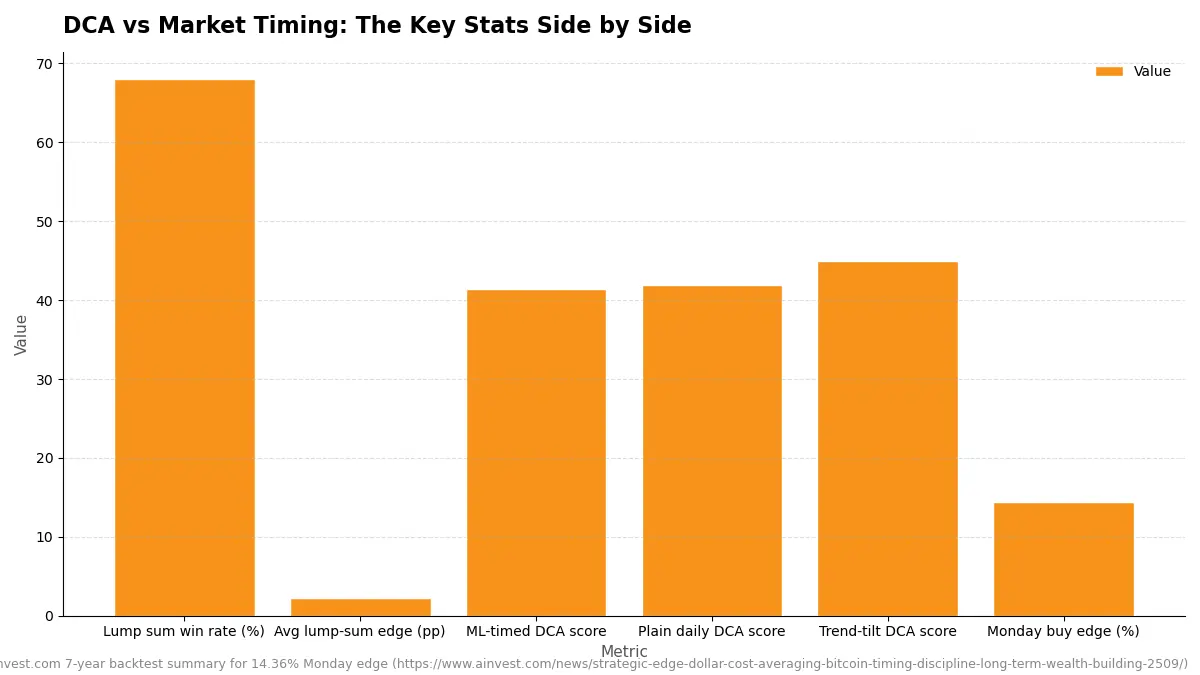
The result was consistent everywhere: lump sums outperformed DCA roughly 68% of the time in the United States, with an average edge of about 2.3 percentage points over the deployment year.
The logic is simple and hard to argue with. Markets rise more often than they fall. Every dollar sitting in cash waiting for its scheduled buy is a dollar missing the market’s upward drift.
Vanguard’s own summary is blunt: DCA mostly means taking the same risk later. DCA still makes sense for many people, but for the reason the researchers themselves note: the best strategy is the one you will actually follow.
And nervous investors who would otherwise keep cash on the sidelines do better with a schedule than with paralysis.
DCA Trails in Steady Rallies and Bull Markets
Does DCA work in a bull market? Yes, it still accumulates bitcoin and still removes emotion. But it leaves money on the table compared to buying upfront.
When prices climb steadily, each scheduled buy happens at a higher price than the last, and your average cost keeps rising behind the market.
A vivid illustration comes from a 2021 Bitcoin Magazine analysis. Five years of $10 daily buys turned $18,260 into almost $260,000, a 1,300% return that any investor would celebrate.
But a lump sum of $18,260 invested at the start of that window, when bitcoin traded near $568, would have grown past $1,500,000. The DCA investor did wonderfully. The lump-sum investor did roughly six times better.
In a relentless uptrend, averaging in is just a slower way of getting fully invested.
Pros
- Removes timing decisions and the fear of buying at the wrong moment
- Automatically buys more bitcoin when prices fall
- Prevents panic selling by replacing willpower with a schedule
- Works with small amounts; $10 a week is enough to start
- Outperforms lump sums in falling and choppy markets
Cons
- Loses to lump-sum investing about 68% of the time in rising markets
- Cash waiting for its scheduled buy misses market gains (cash drag)
- Fees on small recurring buys compound over years
- Every buy creates a separate tax lot to track
- Guarantees nothing; a long decline still loses money, just more slowly
Even Machine Learning Barely Beat Plain DCA
In 2026, a Georgia Tech analytics graduate named Bob Katz ran the experiment every skeptic dreams of: could a trained model time daily Bitcoin buys better than a dumb fixed schedule?
He trained a neural network on candlestick chart images to tilt daily purchases, then tested it across 3,076 rolling windows from 2016 to 2025. The machine-learning-timed plan scored 41.43 percent, while plain daily DCA, buying the same amount every day, scored 41.94 percent.
The model was indistinguishable from a coin flip.
Only a much simpler trick helped: slightly reducing buys when the 60-day trend looked unusually strong and increasing them when it looked weak. That “trend-tilt” DCA scored 44.95%, about three percentage points better than plain DCA.
The lesson is humbling for anyone tempted to outsmart the schedule. Even a trained model with years of data barely improved on buying the same amount every day.
DCA vs. Lump-Sum Investing: Which Is Better for Bitcoin?
“Is DCA better than lump-sum investing for Bitcoin?” is one of the most searched questions on this topic, and the honest answer is: it depends on your situation, not on the asset. Use the table below, then read the reasoning.
| Your situation | Better choice | Why |
|---|---|---|
| A lump sum is sitting in cash and you can stomach a 30% drop | Lump sum | Wins ~68% of the time; gets all your money working immediately |
| You invest from each paycheck as it arrives | DCA | This is not really a choice; it is the only way paycheck investing works |
| Markets are fearful or falling and you are nervous | DCA | Beat an upfront lump sum in the 2021-2026 window containing the 2022 bear market (84% vs 43%); the schedule prevents panic |
| The trend is steadily up and you have the cash now | Lump sum | Cash drag punishes DCA in smooth rallies |
| You are torn and losing sleep over the decision | Split it | Hybrid: invest half now, DCA the rest over 3 to 6 months |
When Lump Sum Wins
Lump sum wins when three things are true at once: the cash is already in your hand, you have a long horizon, and the market is more likely to rise than fall over your deployment window.
Since markets rise in roughly two-thirds of all 12-month periods, those conditions describe most calm, ordinary markets. Vanguard’s research even found that the lump-sum advantage grows the longer you stretch the DCA schedule: splitting cash over 36 months lets the lump sum win about 90% of the time in some analyses.
If you have the money and the nerve, history says put it to work.
When DCA Wins
DCA wins when the enemy is you, or when the market is falling. If the money arrives over time, as with a salary, dollar cost averaging bitcoin is simply how investing works; there is no lump sum to debate.
If fear is high, DCA’s scheduled buys capture the lows your emotions would make you skip. The Coinbird backtest covering the 2022 bear market makes the point: from May 2021 to May 2026, the $100-a-month DCA plan gained about 84% while an upfront lump sum gained about 43%.
If you want the broader framework for sizing any Bitcoin position, read our guide on how to invest in Bitcoin safely in 2026.
The Hybrid Option
Cannot decide? Do both. Invest half your cash immediately and DCA the other half over the next three to six months.
You capture most of the lump-sum advantage if markets rise, and you keep dry powder buying the dips if they fall. It is the strategy for people who are honest about being uncertain, which is most of us.
How Much Should You Invest, and How Often?
Two practical questions, answered with numbers instead of vibes.
How Much: The 1-5% Rule and the Sleep Test
How much should you invest in Bitcoin using DCA? Start with the rule used by cautious planners: 1 to 5% of your investable money, an amount whose total loss would annoy you but not hurt you. Then apply the sleep test.
If Bitcoin dropping 50% tomorrow would keep you up at night, your amount is too big. Shrink it until the number feels boring.
Two prerequisites, no exceptions. First, only money you can afford to lose goes into Bitcoin. Second, build a basic emergency fund first.
DCA fails the moment you must sell at the bottom because rent is due. The money you invest should be money you will not need for at least three to five years.
Weekly vs. Monthly: What the Data Says
Should you DCA weekly or monthly? Weekly buys smooth your average cost slightly more, because you sample the price four times as often. Monthly buys cost less in fees on exchanges that charge per transaction, and they mean less admin.
Either choice beats sporadic buying by a wide margin, and the difference between weekly and monthly is small next to the difference between having a schedule and not having one. Pick the frequency you will actually maintain.
For most beginners, weekly is the sweet spot: smooth enough, cheap enough, easy to automate.
The Best Day of the Week to Buy
Here is a fun wrinkle from the data. A seven-year backtest found that Monday buys accumulated 14.36% more bitcoin than buys on other weekdays, because Bitcoin often dips over the weekend when traditional markets are closed and liquidity is thin. Buying on the 1st or 2nd of the month showed a similar small edge over end-of-month buys.
Treat this as a tiebreaker, not a strategy. A 14% edge over seven years is real but small, and it can vanish as more traders exploit it. Consistency beats day-picking every time.
If Monday works for your payday schedule, take the bonus. If it does not, buy on Friday and never think about it again. For help deciding whether the current moment favors starting at all, see our breakdown of whether now is a good time to buy Bitcoin.
Fees: The Hidden Cost of Small Recurring Buys
Fees are where small DCA plans quietly bleed. A 1.5% fee sounds trivial. Over five years of weekly buys, it is not.
How a 1-2% Fee Compounds Against a $10/Week Plan
Run the numbers on the classic starter plan: $10 every week, 52 weeks a year.
- Year 1: $520 invested, $7.80 lost to a 1.5% fee.
- Year 3: $1,560 invested, $23.40 lost to fees.
- Year 5: $2,600 invested, $39.00 lost to fees.
At a 2% fee, the five-year toll rises to $52. That is 2% of everything you ever invested, gone before Bitcoin moves at all.
Worse, the fee also shrinks every future gain, because fees buy you less bitcoin and there is less bitcoin to appreciate. Always compute returns on fee-inclusive cost, the way our $25-a-week walkthrough did.
Fixed Minimums Hurt Small Buys More Than Percentages Do
The biggest fee trap in dollar cost averaging bitcoin is not the percentage fee. It is the minimum fee per transaction, which some platforms charge.
Imagine a $0.50 minimum fee per buy. Over five years of weekly buys, that is 260 buys times $0.50, or $130, a full 5% of your $2,600 invested.
Switch the same plan to monthly buys and the toll drops to 60 buys times $0.50, or $30, barely over 1%. Same dollars invested, same bitcoin target, four times less fee drag. This is the strongest argument for monthly over weekly on fee-heavy platforms.
(These are illustrative figures to show the mechanism; always check the live fee page before you commit.)
Three Ways to Cut Fee Drag
First, batch small buys into larger, less frequent ones where minimum fees apply. Monthly beats weekly when each transaction carries a fixed cost.
Second, compare before you commit. Recurring-buy fees differ wildly between platforms, sometimes by a factor of three or more, and they change often. Check the current fee schedule of two or three major exchanges before setting up your plan.
Third, use advanced or limit orders where supported instead of one-tap instant buys. Instant-buy convenience is usually the most expensive way to purchase. The few extra clicks of an advanced order can cut your per-buy cost substantially.
| Fee structure | $10/week for 5 years | Total fee drag |
|---|---|---|
| 1.5% per buy, no minimum | $2,600 invested | ~$39 (1.5%) |
| 2% per buy, no minimum | $2,600 invested | ~$52 (2%) |
| $0.50 minimum per buy, weekly | $2,600 invested | ~$30 (1.2%) |
Taxes and Recordkeeping: What 200 Buys Means for Your Tax Return
This is general information, not tax advice. Crypto tax rules differ by country and change often. Talk to a tax professional about your situation.
Every Buy Is a Separate Tax Lot
Here is what surprises every beginner who starts dollar cost averaging bitcoin. Each of your recurring buys is its own tax lot, with its own purchase date, cost basis, and holding period.
Buy weekly for four years and you own 208 separate lots. When you eventually sell, the tax calculation asks which specific lots you sold and what each one cost.
Most jurisdictions use FIFO, first in, first out, meaning your oldest buys are treated as sold first, but the recordkeeping burden is yours either way.
Holding periods matter too. In many countries, selling bitcoin held longer than a year is taxed at a lower long-term rate than a quick flip. With DCA, your lots age at different speeds: January’s buy may qualify for the long-term rate while November’s does not.
Why You Must Start Tracking From Buy Number One
Reconstructing 200 buys from exchange emails and CSV exports during tax season is a special kind of misery. Exchange records get messy, exports go missing, and transfers between wallets break the paper trail.
Start tracking from your very first buy. Log the date, amount, price, and fee of every purchase in a spreadsheet, or connect a tool that does it automatically. Future you will be grateful.
Crypto Tax Software That Handles DCA Lots
This is what crypto tax software exists for. Tools like Koinly, CoinLedger, and TaxBit connect to your exchange accounts, import every recurring buy, compute cost basis across hundreds of lots, and generate the reports your accountant needs.
Set one up before your first buy, not after your fiftieth. The free tiers of these tools usually cover small portfolios, so there is no excuse to start without one.
Self-Custody: When to Move Your Stack Off the Exchange
Your dollar cost averaging bitcoin plan lives on an exchange. Your bitcoin should not live there forever.
Why Leaving DCA Buys on the Exchange Forever Is a Risk
Exchanges get hacked, freeze withdrawals, and go bankrupt. It has happened to household names.
When your coins sit on an exchange, you hold an IOU, not bitcoin. The exchange holds the private keys, which means the exchange controls the coins.
Every week you add another buy to that IOU pile, the pile becomes a more attractive target and a bigger single point of failure.
The Simple Rule: Sweep on a Schedule
Do not move every $25 buy to your own wallet. That creates dozens of tiny outputs, called UTXOs, and each one costs a network fee to spend later.
A dust pile of 200 tiny outputs is expensive and annoying to consolidate. Instead, sweep on a schedule: move your coins to your own wallet after every 8 to 10 buys, or whenever your exchange balance passes a threshold you choose, like $500 or $1,000.
This keeps your UTXO count manageable and your fees low while limiting how long any meaningful amount sits on the exchange.
Hardware Wallet Basics for DCA Stackers
When your stack grows past an amount you would hate to lose, get a hardware wallet. Buy the device directly from the manufacturer, never secondhand.
Write the recovery seed phrase on paper, store it somewhere safe and separate from the device, and never photograph it or type it into a phone or computer. Enable two-factor authentication on your exchange account from day one.
For the full walkthrough of buying safely and locking down your accounts, see how to buy Bitcoin and our Bitcoin security tips that actually stop scammers.
Your 5-Step Dollar Cost Averaging Bitcoin Setup Plan for 2026
This is the payoff. Everything above was theory. These are the five things to do this week.
Each step takes minutes, and by Friday your dollar cost averaging bitcoin plan can be running on autopilot.
Pick your amount
A fixed sum that passes the sleep test. Start small; you can raise it later.
Pick your frequency and day
Weekly is the sweet spot for most beginners. Monday has a small historical edge.
Choose where to buy and automate it
Compare recurring-buy fees, enable 2FA, set the recurring order once.
Set up tax tracking before the first buy
Connect tax software or start a simple log. Two hundred untracked buys is a tax-season nightmare.
Schedule your self-custody sweeps
Pick a threshold and a calendar reminder. Move coins to your own wallet on a schedule.
Step 1: Pick Your Amount (Fixed, Affordable, Automatic)
Choose one number you can sustain for years without thinking about it. For most beginners that is $10 to $50 a week. Apply the 1 to 5% rule and the sleep test from the section above.
Write the number down. This number does not change with the news.
Step 2: Pick Your Frequency and Day (Weekly Recommended)
Weekly is the default recommendation: smooth averaging, low admin, easy to automate. If your exchange charges a meaningful minimum fee per transaction, consider monthly instead. Pick a day and stick to it.
Monday carries a small historical edge, but the edge is a bonus, not a rule. The schedule you keep beats the schedule you optimize.
Step 3: Choose Where to Buy and Set the Recurring Order
Compare the recurring-buy fees of two or three major exchanges available in your country. Look for the total cost per buy, including the spread, not just the advertised fee.
Create your account, complete identity verification, and enable two-factor authentication immediately. Then find the recurring buy feature, enter your amount and schedule, and turn it on.
Do a small manual test buy first if the platform allows it, so you see the real fee before automating.
Step 4: Set Up Tax Tracking Before Your First Buy
Before the first automated purchase lands, connect a crypto tax tool like Koinly, CoinLedger, or TaxBit to your exchange account, or open a simple spreadsheet with columns for date, amount, price, and fee.
Every buy from this point forward gets logged. This five-minute job now saves a five-hour job later.
Step 5: Schedule Your Self-Custody Sweeps
Decide your sweep rule today: every 10 buys, or whenever the balance passes $500, whichever comes first. Put a repeating calendar reminder on it.
When the time comes, withdraw to a wallet you control. Bitcoin’s long history rewards the patient; our guide to what Bitcoin is covers that history, and shows how every previous generation of steady accumulators was tested by drawdowns like the current one.
Common Mistakes That Break the Strategy
The strategy is simple. Keeping it simple is the hard part. These are the mistakes that most often break a dollar cost averaging bitcoin plan.
Stopping DCA in a Bear Market
Should you stop DCA during a Bitcoin bear market? No. Bear markets are when DCA buys the most sats per dollar.
The 2022 buyers who kept their schedules running accumulated at prices that look like gifts in hindsight. Stopping during a crash locks in the worst possible timing: you miss the cheap sats and resume buying only after prices recover.
The schedule exists precisely for the moments you want to cancel it.
Pausing Because “It Feels Expensive”
The bull-market version of the same mistake. Price doubles, your fixed dollars buy half as much bitcoin, and it feels pointless to continue.
But pausing means your money sits in cash while the asset you believe in keeps rising. If the amount still passes the sleep test, keep buying.
The schedule does not care about your feelings, and that is its job.
Trying to “Improve” DCA With Market Timing
Skipping buys when the chart looks scary, doubling buys when a YouTuber says the bottom is in, pausing for elections or halvings. Every tweak reintroduces the timing decisions DCA was built to eliminate.
Remember the Georgia Tech experiment: a trained machine-learning model could not beat the plain schedule. Your gut feeling will not do better.
When Should You Actually Stop?
When should you stop dollar-cost averaging? Only when your plan says so: you reached your target amount, your financial situation changed, or your investment thesis changed.
Never stop because of a price chart. Price-based stopping turns DCA back into market timing with extra steps.
Dollar Cost Averaging Bitcoin: Frequently Asked Questions
Short answers to the ten questions people ask most. The full reasoning lives in the sections above.
What is dollar cost averaging in Bitcoin?
It is buying a fixed dollar amount of Bitcoin on a fixed schedule, regardless of price. When bitcoin is cheap, your dollars buy more. When it is expensive, they buy less.
Over time your average cost smooths out, and you never have to guess the right moment to buy.
Is dollar cost averaging good for Bitcoin?
For beginners, yes, with one caveat. It is the best defense against the two things that destroy most new investors: buying at the wrong time and panic selling.
But it is not the highest-returning approach. In steady bull markets, lump-sum investing wins about 68% of the time. DCA is the safer path, not the richest one.
How much should I invest in Bitcoin using DCA?
Start with 1 to 5% of your investable money, only money you can afford to lose, and only after you have an emergency fund. Then use the sleep test: if a 50% drop would keep you awake, the amount is too big.
Most beginners land between $10 and $50 a week. You can always increase later.
How often should I DCA into Bitcoin, weekly or monthly?
Weekly for most people. It samples the price more often, which smooths your average cost, and it is easy to automate.
Go monthly if your exchange charges a fixed minimum fee per transaction, because weekly minimums compound into real money. Both beat irregular buying by a wide margin.
Is DCA better than lump-sum investing for Bitcoin?
It depends on your situation. Lump sum wins about two-thirds of the time when the cash is already available and markets are calm or rising.
DCA wins for paycheck investing, fearful markets, and anyone who might panic. If you cannot decide, split the difference: invest half now and DCA the rest over three to six months.
Does DCA work in a bull market?
It works, but it underperforms lump sums in a smooth rally. Each scheduled buy lands at a higher price than the last, so your average cost chases the market upward.
You still accumulate bitcoin and still avoid emotional mistakes. You just leave some return on the table versus having invested everything upfront.
When should I stop dollar-cost averaging?
Stop when your plan says so: you hit your target, your finances changed, or your thesis on Bitcoin changed. Never stop because the price scares you or excites you.
Price-based stopping is market timing wearing a DCA costume.
Should I stop DCA during a Bitcoin bear market?
No. Bear markets are when DCA does its best work, buying the most sats per dollar.
The 2022 bear market is the proof: from May 2021 to May 2026, steady $100-a-month buyers gained about 84% while an upfront lump sum gained about 43%. If anything, a bear market is the reason the schedule exists.
How do I calculate my average Bitcoin purchase price?
Divide everything you have ever spent on Bitcoin, fees included, by the total BTC you received. Example: $1,200 spent for 0.0123936 BTC gives an average cost of $96,823 per BTC.
Add new buys to both sides of the fraction as you go. Most exchanges show this number for you, but the formula keeps you honest.
Can I dollar-cost average out of Bitcoin?
Yes, it is called reverse DCA. Instead of buying on a schedule, you sell a fixed dollar amount on a fixed schedule, for example $200 on the first of every month.
It smooths your exit price the same way DCA smooths your entry price, and it prevents the classic mistake of selling everything in a panic at the bottom. It is less common than buying DCA, but the logic is identical.
Final Takeaway: Start the Schedule, Forget the Price
Dollar cost averaging bitcoin will not make you a genius, and it will not beat a well-timed lump sum in a smooth rally. What it does is simpler: it converts small, regular money into serious long-term exposure, as every backtest in this article shows, from $10 a week over five years to $100 a month since 2015.
Second, the honest limits: lump sums win two-thirds of the time in rising markets, fees eat small buys, and no schedule protects you if Bitcoin itself fails. Third, the plan: a fixed amount, a weekly schedule, an automated recurring buy, tax tracking from day one, and self-custody sweeps on a calendar.
The market will not wait for you to feel ready. As of late September 2026, Bitcoin sits about a third below its all-time high, sentiment has swung from record fear to greed in seven months, and nobody knows what the next 20% move looks like.
That uncertainty is not a reason to wait. It is the reason the schedule exists.
Your next step is concrete. Open our how to buy Bitcoin walkthrough, pick your exchange, and set up one recurring buy this week. Start small.
Automate it, then forget the price and let the schedule do the work. And remember: this is educational content, not financial advice. Only invest what you can afford to lose.
Mood matters too, even on a fixed schedule: learn how the Fear and Greed Index works so you can read market sentiment without letting it change your plan.