



Direct answer: Analyst forecasts for a bitcoin price prediction 2028 land anywhere from $57,000 to $644,000. The most grounded range clusters between $200,000 and $300,000, built on halving-cycle math and institutional demand. The April 2028 halving, which cuts new Bitcoin supply in half, is the engine behind almost every bullish forecast.
Bitcoin trades near $84,600 today, roughly 33% below its $126,210 all-time high from October 2025. That gap is exactly why the 2028 conversation matters so much. With the next halving about 18 months away, analysts are already doing the math on where BTC could be heading.

Key Takeaways
- Forecasts for Bitcoin in 2028 range from $57K (bear) to $644K (VanEck bull case).
- Analyst Jesse Myers puts a $232,000 price mark on the April 2028 halving, based on repeating the 4x pre-halving move of the 2024 cycle.
- Standard Chartered pushed its $500K target from 2028 back to 2030 in December 2025, citing weaker corporate buying.
- The 2028 halving (block 1,050,000, expected mid-April) cuts the block reward from 3.125 to 1.5625 BTC.
- Post-halving gains are shrinking each cycle: ~100x, then ~30x, then ~8x, then ~2x.
Where Bitcoin Stands Right Now
Before any serious bitcoin price prediction 2028 analysis, you need the starting line. Bitcoin changes hands around $84,600 as of October 3, 2026. That is down about 1.9% on the day but up roughly 9% over the past month, a quiet recovery from weaker territory earlier this year.
- Key Takeaways
- Where Bitcoin Stands Right Now
- Every Major 2028 Forecast, Compared
- The Halving Math That Drives Every Bull Case
- Bull, Base, and Bear Cases for 2028
- What Could Break Every Forecast
- How To Read These Predictions Like an Analyst
- What This Means For You
- FAQs
- What is the most realistic Bitcoin price prediction for 2028?
- When is the Bitcoin halving in 2028?
- Can Bitcoin reach $500,000 by 2028?
- What was the highest Bitcoin price prediction for 2028?
- Do halvings guarantee Bitcoin price increases?
- The Bottom Line
The bigger picture tells a mixed story. U.S. spot Bitcoin ETFs pulled in a record $2.65 billion in September, the second-largest monthly haul on record, showing that institutional demand is very much alive. BlackRock’s IBIT alone now holds over 782,000 BTC. Citi just raised its Bitcoin target to $113,000, turning bullish again for the final quarter of 2026.
Yet Bitcoin sits about a third below its October 2025 peak of $126,210. Circulating supply has passed 20 million BTC, more than 95% of the 21 million hard cap. Only about 4.4% of all Bitcoin that will ever exist remains to be mined. That scarcity is the foundation every 2028 forecast builds on.
Every Major 2028 Forecast, Compared
Here is what the serious forecasters are actually saying, with their numbers and the logic behind them. No cherry-picking, no hype.
| Forecaster | 2028 Target | Core Logic |
|---|---|---|
| Jesse Myers (analyst) | $232,000 by April 2028 halving; $464,000 by late 2029 | Repeats the 2024 cycle’s 4x pre-halving move from a $58K base |
| Motley Fool | $250,000 at the 2028 halving | Diminishing cycle returns: each halving delivers a smaller multiple |
| Swyftx (Pav Hundal) | ~$120,000 by 2028 | At least 100% rise; conservative cycle-deceleration read |
| Cole Kennelly (Volmex Labs) | $500,000 by 2028 | Volatility-market math; 540%+ rally from current levels |
| Timothy Peterson (economist) | $500,000+ by the halving; ~$1M after | Adoption-curve math and Metcalfe’s Law; ~70% annualized returns |
| VanEck | $644,000 by the 2028 halving | Bitcoin captures 50% of gold’s store-of-value market cap |
| Standard Chartered | $500,000 (pushed to 2030) | Originally 2028; delayed in Dec 2025 on weaker corporate buying |
| Changelly (algorithmic) | ~$100,000 avg; ~$57,000 min | Model-based; the conservative end of the spectrum |
The most interesting forecast may be Jesse Myers’, published September 9, 2026. His math is simple and worth understanding. Bitcoin bottomed near $58,000, then ran roughly 4x in the 18 months before the April 2024 halving. If that 4x pre-halving move repeats, you get $232,000 by the April 2028 halving. Apply the 2024 cycle’s roughly 2x post-halving gain on top, and you land near $464,000 in the second half of 2029.

Myers himself flags the key insight: the 2024 cycle broke the old pattern. Bitcoin hit a new all-time high before the April 2024 halving, not after it. Investors now try to front-run the halving because the event is completely predictable. That means the most intense price discovery may happen in the months before April 2028, not after.
The Halving Math That Drives Every Bull Case
The fifth Bitcoin halving arrives at block 1,050,000, currently projected for mid-April 2028. The block subsidy falls from 3.125 BTC to 1.5625 BTC. Daily new issuance drops from about 450 BTC to roughly 225 BTC.
Put that in dollar terms. At current prices, miners currently sell up to $46 million of new Bitcoin per day. After the halving, that falls to about $23 million. Against a market where ETFs alone absorbed $2.65 billion in a single month this September, the new supply becomes a rounding error.
That is the supply-shock argument, and it has never been stronger. Institutional demand already dwarfs new issuance before the halving. After it, the imbalance gets more extreme. This is the single biggest reason serious analysts keep their 2028 targets high even when the current price looks soft.

Why Halvings Matter Less (In Percentage Terms) Each Time
Here is the uncomfortable counterpoint every bull case has to answer. Post-halving gains are shrinking dramatically each cycle. Myers’ own numbers tell the story: roughly 100x after 2012, 30x after 2016, 8x after 2020, and about 2x after 2024.
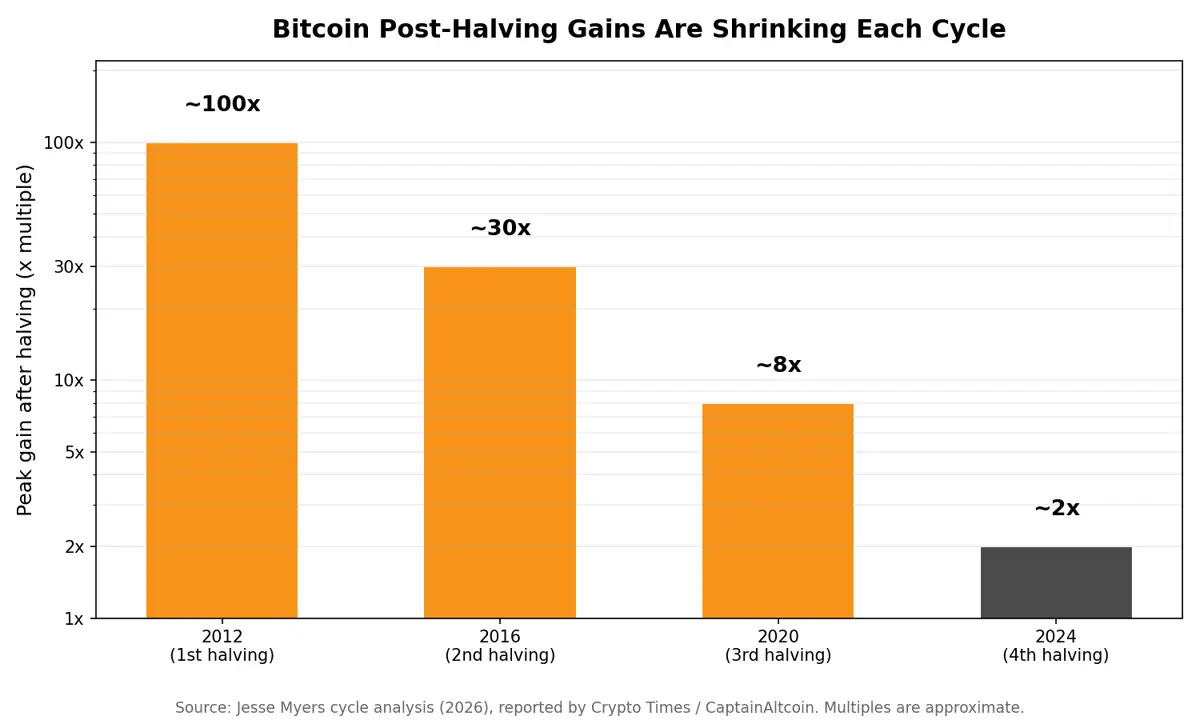
Cointelegraph ran the diminishing-returns math back in 2024: if the decay rate holds, the next cycle delivers about a 360% rally, putting BTC near $303,600 at the 2028 halving. That is a serious number, but it is a world away from the 100x days.
The reason is simple arithmetic. A smaller supply reduction now cuts new issuance from an already tiny base. With 95%+ of all Bitcoin mined, each halving removes less relative supply than the last. Demand has to do more of the work. If ETF and corporate demand keep growing, the math still works. If demand stalls, the halving alone cannot carry the price.
Bull, Base, and Bear Cases for 2028
Strip away the noise and three scenarios emerge for any honest bitcoin price prediction 2028.
Bull Case: $400K to $644K
ETF demand accelerates, the Fed cuts rates, and the halving supply shock lands on already-strong demand. VanEck’s $644K assumes Bitcoin takes half of gold’s store-of-value role. Peterson’s models reach $1M within 450 days after the halving.
Base Case: $200K to $300K
Diminishing returns continue their steady decay. Myers’ $232K pre-halving scenario plays out, followed by a muted post-halving rally toward $300K to $464K into 2029. This is where the serious math converges.
Bear Case: $57K to $100K
The four-year cycle breaks down. Macro turns hostile, ETF flows reverse, and demand fails to show up for the halving. Changelly’s models bottom near $57K. Bitcoin simply grinds sideways through the halving year.
What Could Break Every Forecast
Honest predictions come with failure modes. Here are the ones that matter.
Demand could fail to show up. The halving cuts supply, but price needs buyers. Standard Chartered already pushed its $500K call to 2030 because corporate buying came in weaker than expected. If September’s record $2.65 billion ETF inflow was a peak rather than a new normal, the supply-shock math falls apart.
The cycle could already be priced in. Myers’ own observation cuts both ways. If everyone front-runs the halving, the pre-halving run may have already happened in disguise, leaving 2028 itself flat. The 2024 cycle’s pre-halving all-time high is the warning.
Macro could turn hostile. Fed policy, a global recession, or a serious regulatory crackdown in a major market would compress every target. Bitcoin still trades like a risk asset in a crisis, halving or no halving.
AI is eating the capital. As the Motley Fool noted, enormous capital is flowing into AI infrastructure and trillion-dollar IPOs. If that continues, Bitcoin competes for attention with the hottest trade in markets. On the flip side, AI-driven productivity could eventually drive demand for scarce digital money. Both paths are live.
How To Read These Predictions Like an Analyst
Most price predictions are entertainment. Here is how to separate the useful ones from the noise when you see the next bitcoin price prediction 2028 headline.
First, check the mechanism. Myers shows his math: 4x pre-halving, 2x post-halving, with cited cycle history. Peterson cites adoption-curve models. VanEck cites gold’s market cap. A prediction without a mechanism is a guess wearing a suit.
Second, check the track record. Standard Chartered’s original $500K-by-2028 call was quietly pushed to 2030. Robert Kiyosaki’s $500K-by-2025 call failed outright. Forecasters who revise honestly deserve more weight than those who move goalposts silently.
Third, check the timing. A $232K target “by the April 2028 halving” is a very different claim from $232K “sometime in 2028.” Halving cycles peak 12 to 18 months after the event historically, so a forecaster’s exact window tells you how much cycle history they actually respect.
For context on the nearer term, our comparison of 2027 expert forecasts covers what analysts expect next year, and our $200K bull-vs-bear breakdown tests the milestone every 2028 forecast has to pass through first.
What This Means For You
If you are holding Bitcoin through 2028, the analyst consensus gives you a working range: $200K to $300K as the central expectation, $400K+ if everything breaks right, and sub-$100K if demand disappoints. None of this is financial advice, and no forecaster has a crystal ball.
The practical takeaway is about the calendar, not the price target. The halving arrives around mid-April 2028, and the 2024 cycle showed that front-running is now the dominant market behavior. If you believe the cycle structure holds, the 12 to 18 months before the halving may matter more than the 12 to 18 months after. That is the genuinely new insight from this cycle, and it changes how patient investors should think about timing.
Watch three things into 2028: monthly ETF flows (September’s $2.65 billion record set the bar), Fed policy direction, and whether institutional voices like Citi keep raising targets. Those three inputs will decide which scenario wins long before the halving arrives.
FAQs
Quick answers to the questions readers ask most about where Bitcoin could be heading in 2028.
What is the most realistic Bitcoin price prediction for 2028?
The most defensible range is $200,000 to $300,000, based on halving-cycle math with diminishing returns. Jesse Myers’ $232,000 pre-halving scenario and Cointelegraph’s $303,600 diminishing-returns calculation both land in this zone.
When is the Bitcoin halving in 2028?
The fifth halving is expected around mid-April 2028 at block 1,050,000. The block reward drops from 3.125 BTC to 1.5625 BTC. Read our full explainer on when the 2028 halving happens and what it changes.
Can Bitcoin reach $500,000 by 2028?
Several analysts say yes, including VanEck ($644K by the halving), Volmex Labs’ Cole Kennelly ($500K), and economist Timothy Peterson ($500K+). But Standard Chartered pushed its own $500K target back to 2030, so even Wall Street bulls are hedging the timeline.
What was the highest Bitcoin price prediction for 2028?
VanEck’s $644,000 target is the highest from a major institution, based on Bitcoin capturing half of gold’s store-of-value market. Adam Back has argued for $1 million before the 2028 halving, and ARK Invest’s models extend toward $1.5 million by 2030.
Do halvings guarantee Bitcoin price increases?
No. Every past halving was followed by a major rally, but gains are shrinking (100x, 30x, 8x, 2x), and the 2024 cycle peaked before the halving rather than after. A halving cuts new supply, but price still needs demand. Past performance does not guarantee future results.
The Bottom Line
A bitcoin price prediction 2028 worth trusting starts with the halving math and ends with honest uncertainty. The supply shock is real: 225 new BTC per day against billions in monthly ETF demand. The diminishing returns are equally real: each cycle’s multiple is a fraction of the last.
The base case, $200K to $300K around the April 2028 halving, is where the careful math converges. The bull case needs institutional demand to keep accelerating. The bear case needs it to stall. Watch the ETF flows, watch the Fed, and revisit this forecast as 2028 gets closer. Our 2026 year-end targets will tell you first whether the cycle is still on track.
Fidelity’s Timmer $300K by 2029 forecast gives a longer-dated Wall Street view beyond 2028. For the full decade horizon, read our full Bitcoin price prediction for 2030.
Looking further out, read our analysis of whether Bitcoin can reach $1 million.