



U.S. spot bitcoin ETFs pulled in $2.65 billion in fresh money in September, their second-best month since October 2025. The total came in below August’s blockbuster $3.52 billion, but it still shows that institutional demand for bitcoin is very much alive as we head into the final quarter of the year.
If you have been wondering whether the big money was quietly leaving bitcoin, this month’s numbers give you a clear answer: it is not. Let’s look at what actually happened, why August was bigger, and what to watch in October.

Key Takeaways
- $2.65B net inflows in September, the second-largest monthly total since October 2025 (SoSoValue data).
- August drew $3.52B, so September cooled about 25%, yet still beat almost every month of the past year.
- Q3 brought in $6.34B total, reversing roughly $5B in Q2 outflows, while bitcoin jumped 42.7%, its best third quarter since 2017.
- Ether ETFs added $832.43M, and October opened with $102.7M of bitcoin ETF inflows on day one.
- Next catalysts: daily flow trends, the October 8 jobless claims report, inflation data, and Fed commentary.
The Numbers Behind September’s $2.65B
The data comes from SoSoValue and was first reported by The Block. U.S. spot bitcoin ETFs recorded $2.65 billion in net inflows across September, making it their second-largest monthly intake since October 2025. Only August’s $3.52 billion was bigger. To put that in perspective, the funds had bled roughly $5 billion in outflows during the second quarter of this year, so the third-quarter rebound is a sharp change of mood.
- The Numbers Behind September’s $2.65B
- Why August Was Bigger (And Why It Barely Matters)
- Ether ETFs Had a Decent Month Too
- What It All Means for October
- FAQs
- How much money flowed into U.S. spot bitcoin ETFs in September 2026?
- Was September better than August for bitcoin ETF demand?
- Do ETF inflows push bitcoin’s price up?
- Which bitcoin ETF is the biggest?
- What should I watch in October?
- The Bottom Line
- The Numbers Behind September’s $2.65B
- Why August Was Bigger (And Why It Barely Matters)
- Ether ETFs Had a Decent Month Too
- What It All Means for October
- FAQs
- How much money flowed into U.S. spot bitcoin ETFs in September 2026?
- Was September better than August for bitcoin ETF demand?
- Do ETF inflows push bitcoin’s price up?
- Which bitcoin ETF is the biggest?
- What should I watch in October?
- The Bottom Line
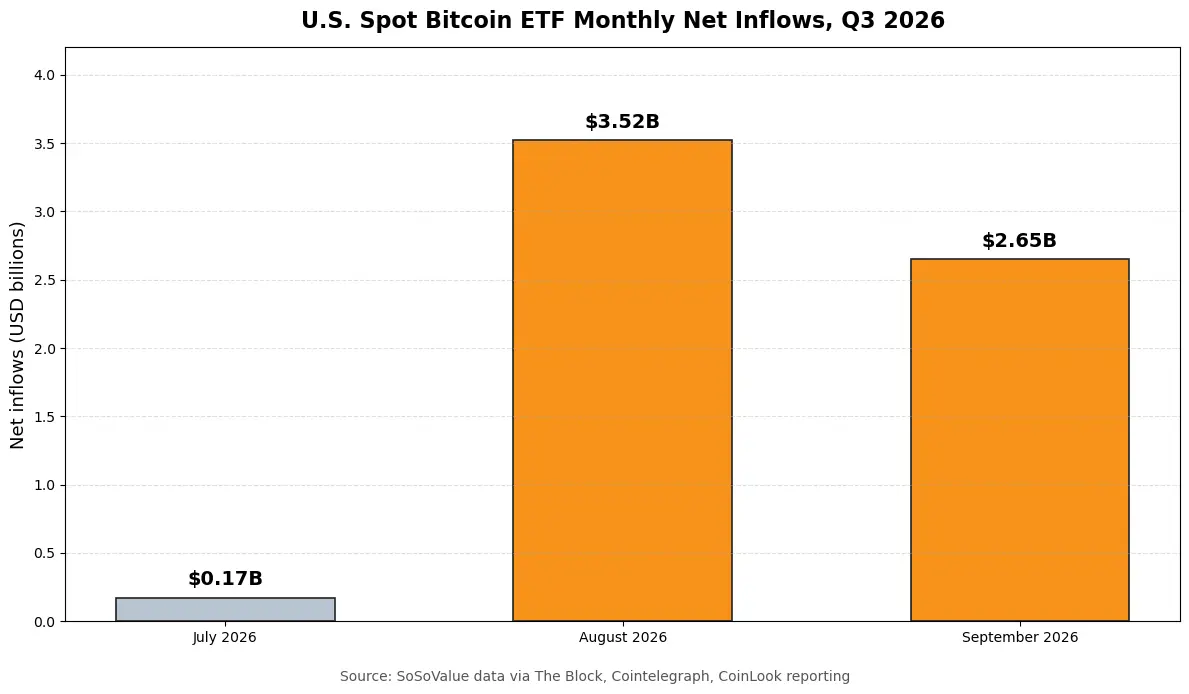
Zoom out a little and the quarterly picture is even more striking. July brought just $172 million, August exploded with $3.52 billion, and September added $2.65 billion. That is $6.34 billion for the full quarter, the strongest quarter of 2026 so far. Bitcoin’s price did its part, climbing 42.7% in Q3, its best third-quarter performance since 2017.
One Fund Still Rules the Roost
BlackRock’s iShares Bitcoin Trust, or IBIT, remains the giant of this market. It held about $67.07 billion in net assets on September 25 and carries a 0.25% sponsor fee. The concentration is wild: IBIT has taken in $61.16 billion since launch, while the entire U.S. spot bitcoin ETF complex sits at $57.6 billion in cumulative net inflows. That means every other fund combined is actually a net seller of about $8.4 billion over two and a half years. When people talk about ETF demand for bitcoin, they are mostly talking about IBIT.
Why August Was Bigger (And Why It Barely Matters)
August’s $3.52 billion set a very high bar, and September’s 25% slowdown is worth understanding. A big part of August’s surge was momentum: bitcoin rose nearly 25% in August alone, and rising prices attract buyers while letting advisers add allocations without the fear of instant losses. Those ETF inflows then soak up real bitcoin supply, which supports the price further. It is a feedback loop, and in August it spun hard.
September had its own hot streaks. At one point the funds ran a nine-day inflow streak that pulled in roughly $3.1 billion. The final trading day of the quarter then saw about $148.7 million in outflows, which cooled the monthly total but did not change the story. The momentum carried into the new month: October opened with $103M in fresh inflows on October 1. Remember, these same products set a record $2.39B weekly inflow earlier in the year, and hedge funds have been adding bitcoin ETF exposure around election-driven opportunities. Demand is no longer a one-month wonder.


Ether ETFs Had a Decent Month Too
Bitcoin was not the only story. U.S. spot ether ETFs drew $832.43 million in September, their second-largest monthly inflow since August 2025. For the full quarter, ether ETFs took in about $3.05 billion, reversing roughly $714 million in Q2 outflows, while ether itself gained about 71%.
October started differently for the two cousins, though. On the first trading day, bitcoin ETFs added $102.7 million in net inflows while ether ETFs saw $55.4 million in outflows, their third straight session of redemptions totaling about $118 million. If you are new to these products, our explainer on what the first spot bitcoin ETF approvals actually changed for ordinary investors is a good place to start.
What It All Means for October
Here is where we stand: total net assets across U.S. spot bitcoin ETFs have climbed to $109.3 billion, and cumulative net inflows since the January 2024 launch reached $57.6 billion. Dominick John, an analyst at Zeus Research, told The Block that the flows show institutional demand “has not faded” and that continued inflows “signal improving market sentiment and a potentially more bullish setup heading into the final quarter.” The Crypto Fear and Greed Index sits around 69 to 72, in greed territory, which suggests confidence without going overboard.
That said, ETF demand is only one piece of the puzzle. John also noted that traders will watch upcoming U.S. economic data closely: the October 8 jobless claims report, fresh inflation readings, and Fed commentary could all shift rate expectations and move flows. Macro is the wild card, as our September jobs report preview explained. For price levels to watch this month, see our October 2026 bitcoin price prediction. And if you are thinking bigger picture, Citi just raised its bitcoin price target while our 2026 year-end price targets roundup lays out the full bull-to-bear range.
FAQs
Quick answers to the questions readers keep asking about this month’s ETF numbers.
How much money flowed into U.S. spot bitcoin ETFs in September 2026?
They recorded $2.65 billion in net inflows for the month, according to SoSoValue data. That was the second-largest monthly total since October 2025, behind only August’s $3.52 billion.
Was September better than August for bitcoin ETF demand?
No. August’s $3.52 billion was the stronger month, so September cooled by about 25%. But September still beat almost every other month of the past year, and the $6.34 billion third quarter was the strongest quarter of 2026, so the trend remains firmly positive.
Do ETF inflows push bitcoin’s price up?
They create real buying pressure, because ETF issuers buy actual bitcoin to back new shares, which absorbs supply. But price is also driven by macro forces like rate expectations and sentiment, so inflows alone do not guarantee higher prices.
Which bitcoin ETF is the biggest?
BlackRock’s IBIT, by a huge margin. It held about $67.07 billion in net assets on September 25 and has taken in $61.16 billion since launch, more than the entire U.S. spot bitcoin ETF complex combined.
What should I watch in October?
Three things: whether daily ETF flows stay positive, the October 8 U.S. jobless claims report, and any fresh inflation data or Fed commentary that could shift rate expectations.
The Bottom Line
September’s $2.65 billion may not have beaten August, but it confirmed something more important: institutional demand for bitcoin has not faded. After a rough first half of 2026 that saw billions in outflows, three straight months of inflows, a 42.7% quarterly price rally, and $109.3 billion in ETF assets tell a recovery story that is hard to argue with.
If you want to follow this story as it develops, keep an eye on daily ETF flow data alongside bitcoin’s price action. Flows are the closest thing we have to a live read on what the big money is doing, and right now, the big money is still buying.
U.S. spot bitcoin ETFs pulled in $2.65 billion in fresh money in September, their second-best month since October 2025. The total came in below August’s blockbuster $3.52 billion, but it still shows that institutional demand for bitcoin is very much alive as we head into the final quarter of the year.
U.S. spot bitcoin ETFs pulled in $2.65 billion in fresh money in September, their second- best month since October 2025. The total came in below August’s blockbuster $3.52 billion, but it still shows that institutional demand for bitcoin is very much alive as we head into the final quarter of the year.
If you have been wondering whether the big money was quietly leaving bitcoin, this month’s numbers give you a clear answer: it is not. Let’s look at what actually happened, why August was bigger, and what to watch in October.
If you have been wondering whether the big money was quietly leaving bitcoin, this month’s numbers give you a clear answer: it is not. Let’s look at what actually happened, why August was bigger, and what to watch in October.
Key Takeaways
- $2.65B net inflows in September, the second-largest monthly total since October 2025 (SoSoValue data).
- August drew $3.52B, so September cooled about 25%, yet still beat almost every month of the past year.
- Q3 brought in $6.34B total, reversing roughly $5B in Q2 outflows, while bitcoin jumped 42.7%, its best third quarter since 2017.
- Ether ETFs added $832.43M, and October opened with $102.7M of bitcoin ETF inflows on day one.
- Next catalysts: daily flow trends, the October 8 jobless claims report, inflation data, and Fed commentary.
Key Takeaways
- $2.65B net inflows in September, the second-largest monthly total since October 2025 (SoSoValue data).
- August drew $3.52B, so September cooled about 25%, yet still beat almost every month of the past year.
- Q3 brought in $6.34B total, reversing roughly $5B in Q2 outflows, while bitcoin jumped 42.7%, its best third quarter since 2017.
- Ether ETFs added $832.43M, and October opened with $102.7M of bitcoin ETF inflows on day one.
- Next catalysts: daily flow trends, the October 8 jobless claims report, inflation data, and Fed commentary.
The Numbers Behind September’s $2.65B
The data comes from SoSoValue and was first reported by The Block. U.S. spot bitcoin ETFs recorded $2.65 billion in net inflows across September, making it their second-largest monthly intake since October 2025. Only August’s $3.52 billion was bigger. To put that in perspective, the funds had bled roughly $5 billion in outflows during the second quarter of this year, so the third-quarter rebound is a sharp change of mood.
The data comes from SoSoValue and was first reported by The Block. U.S. spot bitcoin ETFs recorded $2.65 billion in net inflows across September, making it their second-largest monthly intake since October 2025. Only August’s $3.52 billion was bigger. To put that in perspective, the funds had bled roughly $5 billion in outflows during the second quarter of this year, so the third-quarter rebound is a sharp change of mood.
Zoom out a little and the quarterly picture is even more striking. July brought just $172 million, August exploded with $3.52 billion, and September added $2.65 billion. That is $6.34 billion for the full quarter, the strongest quarter of 2026 so far. Bitcoin’s price did its part, climbing 42.7% in Q3, its best third-quarter performance since 2017.
Zoom out a little and the quarterly picture is even more striking. July brought just $172 million, August exploded with $3.52 billion, and September added $2.65 billion. That is $6.34 billion for the full quarter, the strongest quarter of 2026 so far. Bitcoin’s price did its part, climbing 42.7% in Q3, its best third-quarter performance since 2017.

One Fund Still Rules the Roost
BlackRock’s iShares Bitcoin Trust, or IBIT, remains the giant of this market. It held about $67.07 billion in net assets on September 25 and carries a 0.25% sponsor fee. The concentration is wild: IBIT has taken in $61.16 billion since launch, while the entire U.S. spot bitcoin ETF complex sits at $57.6 billion in cumulative net inflows. That means every other fund combined is actually a net seller of about $8.4 billion over two and a half years. When people talk about ETF demand for bitcoin, they are mostly talking about IBIT.
BlackRock’s iShares Bitcoin Trust, or IBIT, remains the giant of this market. It held about $67.07 billion in net assets on September 25 and carries a 0.25% sponsor fee. The concentration is wild: IBIT has taken in $61.16 billion since launch, while the entire U.S. spot bitcoin ETF complex sits at $57.6 billion in cumulative net inflows. That means every other fund combined is actually a net seller of about $8.4 billion over two and a half years. When people talk about ETF demand for bitcoin, they are mostly talking about IBIT.
Why August Was Bigger (And Why It Barely Matters)
August’s $3.52 billion set a very high bar, and September’s 25% slowdown is worth understanding. A big part of August’s surge was momentum: bitcoin rose nearly 25% in August alone, and rising prices attract buyers while letting advisers add allocations without the fear of instant losses. Those ETF inflows then soak up real bitcoin supply, which supports the price further. It is a feedback loop, and in August it spun hard.
August’s $3.52 billion set a very high bar, and September’s 25% slowdown is worth understanding. A big part of August’s surge was momentum: bitcoin rose nearly 25% in August alone, and rising prices attract buyers while letting advisers add allocations without the fear of instant losses. Those ETF inflows then soak up real bitcoin supply, which supports the price further. It is a feedback loop, and in August it spun hard.
September had its own hot streaks. At one point the funds ran a nine-day inflow streak that pulled in roughly $3.1 billion. The final trading day of the quarter then saw about $148.7 million in outflows, which cooled the monthly total but did not change the story. Remember, these same products set a record $2.39B weekly inflow earlier in the year, and hedge funds have been adding bitcoin ETF exposure around election-driven opportunities. Demand is no longer a one-month wonder.
September had its own hot streaks. At one point the funds ran a nine-day inflow streak that pulled in roughly $3.1 billion. The final trading day of the quarter then saw about $148.7 million in outflows, which cooled the monthly total but did not change the story. Remember, these same products set a record $2.39B weekly inflow earlier in the year, and hedge funds have been adding bitcoin ETF exposure around election-driven opportunities. Demand is no longer a one-month wonder.

Ether ETFs Had a Decent Month Too
Bitcoin was not the only story. U.S. spot ether ETFs drew $832.43 million in September, their second-largest monthly inflow since August 2025. For the full quarter, ether ETFs took in about $3.05 billion, reversing roughly $714 million in Q2 outflows, while ether itself gained about 71%.
Bitcoin was not the only story. U.S. spot ether ETFs drew $832.43 million in September, their second- largest monthly inflow since August 2025. For the full quarter, ether ETFs took in about $3.05 billion, reversing roughly $714 million in Q2 outflows, while ether itself gained about 71%.
October started differently for the two cousins, though. On the first trading day, bitcoin ETFs added $102.7 million in net inflows while ether ETFs saw $55.4 million in outflows, their third straight session of redemptions totaling about $118 million. If you are new to these products, our explainer on what the first spot bitcoin ETF approvals actually changed for ordinary investors is a good place to start.
October started differently for the two cousins, though. On the first trading day, bitcoin ETFs added $102.7 million in net inflows while ether ETFs saw $55.4 million in outflows, their third straight session of redemptions totaling about $118 million. If you are new to these products, our explainer on what the first spot bitcoin ETF approvals actually changed for ordinary investors is a good place to start.
What It All Means for October
Here is where we stand: total net assets across U.S. spot bitcoin ETFs have climbed to $109.3 billion, and cumulative net inflows since the January 2024 launch reached $57.6 billion. Dominick John, an analyst at Zeus Research, told The Block that the flows show institutional demand “has not faded” and that continued inflows “signal improving market sentiment and a potentially more bullish setup heading into the final quarter.” The Crypto Fear and Greed Index sits around 69 to 72, in greed territory, which suggests confidence without going overboard.
Here is where we stand: total net assets across U.S. spot bitcoin ETFs have climbed to $109.3 billion, and cumulative net inflows since the January 2024 launch reached $57.6 billion. Dominick John, an analyst at Zeus Research, told The Block that the flows show institutional demand “has not faded” and that continued inflows “signal improving market sentiment and a potentially more bullish setup heading into the final quarter.” The Crypto Fear and Greed Index sits around 69 to 72, in greed territory, which suggests confidence without going overboard.
That said, ETF demand is only one piece of the puzzle. John also noted that traders will watch upcoming U.S. economic data closely: the October 8 jobless claims report, fresh inflation readings, and Fed commentary could all shift rate expectations and move flows. Macro is the wild card, as our September jobs report preview explained. For price levels to watch this month, see our October 2026 bitcoin price prediction. And if you are thinking bigger picture, Citi just raised its bitcoin price target while our 2026 year-end price targets roundup lays out the full bull-to-bear range.
That said, ETF demand is only one piece of the puzzle. John also noted that traders will watch upcoming U.S. economic data closely: the October 8 jobless claims report, fresh inflation readings, and Fed commentary could all shift rate expectations and move flows. Macro is the wild card, as our September jobs report preview explained. For price levels to watch this month, see our October 2026 bitcoin price prediction. And if you are thinking bigger picture, Citi just raised its bitcoin price target while our 2026 year-end price targets roundup lays out the full bull-to-bear range.
FAQs
Quick answers to the questions readers keep asking about this month’s ETF numbers.
How much money flowed into U.S. spot bitcoin ETFs in September 2026?
They recorded $2.65 billion in net inflows for the month, according to SoSoValue data. That was the second-largest monthly total since October 2025, behind only August’s $3.52 billion.
They recorded $2.65 billion in net inflows for the month, according to SoSoValue data. That was the second-largest monthly total since October 2025, behind only August’s $3.52 billion.
Was September better than August for bitcoin ETF demand?
No. August’s $3.52 billion was the stronger month, so September cooled by about 25%. But September still beat almost every other month of the past year, and the $6.34 billion third quarter was the strongest quarter of 2026, so the trend remains firmly positive.
No. August’s $3.52 billion was the stronger month, so September cooled by about 25%. But September still beat almost every other month of the past year, and the $6.34 billion third quarter was the strongest quarter of 2026, so the trend remains firmly positive.
Do ETF inflows push bitcoin’s price up?
They create real buying pressure, because ETF issuers buy actual bitcoin to back new shares, which absorbs supply. But price is also driven by macro forces like rate expectations and sentiment, so inflows alone do not guarantee higher prices.
They create real buying pressure, because ETF issuers buy actual bitcoin to back new shares, which absorbs supply. But price is also driven by macro forces like rate expectations and sentiment, so inflows alone do not guarantee higher prices.
Which bitcoin ETF is the biggest?
BlackRock’s IBIT, by a huge margin. It held about $67.07 billion in net assets on September 25 and has taken in $61.16 billion since launch, more than the entire U.S. spot bitcoin ETF complex combined.
BlackRock’s IBIT, by a huge margin. It held about $67.07 billion in net assets on September 25 and has taken in $61.16 billion since launch, more than the entire U.S. spot bitcoin ETF complex combined.
What should I watch in October?
Three things: whether daily ETF flows stay positive, the October 8 U.S. jobless claims report, and any fresh inflation data or Fed commentary that could shift rate expectations.
Three things: whether daily ETF flows stay positive, the October 8 U.S. jobless claims report, and any fresh inflation data or Fed commentary that could shift rate expectations.
The Bottom Line
September’s $2.65 billion may not have beaten August, but it confirmed something more important: institutional demand for bitcoin has not faded. After a rough first half of 2026 that saw billions in outflows, three straight months of inflows, a 42.7% quarterly price rally, and $109.3 billion in ETF assets tell a recovery story that is hard to argue with.
September’s $2.65 billion may not have beaten August, but it confirmed something more important: institutional demand for bitcoin has not faded. After a rough first half of 2026 that saw billions in outflows, three straight months of inflows, a 42.7% quarterly price rally, and $109.3 billion in ETF assets tell a recovery story that is hard to argue with.
If you want to follow this story as it develops, keep an eye on daily ETF flow data alongside bitcoin’s price action. Flows are the closest thing we have to a live read on what the big money is doing, and right now, the big money is still buying.
If you want to follow this story as it develops, keep an eye on daily ETF flow data alongside bitcoin’s price action, and right now, the big money is still buying.
Spot demand keeps growing, and now regulators have also cleared leveraged products, including the newly approved 3x Bitcoin ETF.
MARA bitcoin galaxy digital transfer is a useful October follow-up to September’s inflow story: the $81 million move landed in a week of ETF outflows, showing how fast flow sentiment can flip.
Sponsors do not always keep pushing a filing forward either, as VanEck’s quiet Lido staking ETF withdrawal shows how a product can be pulled after a long wait.