



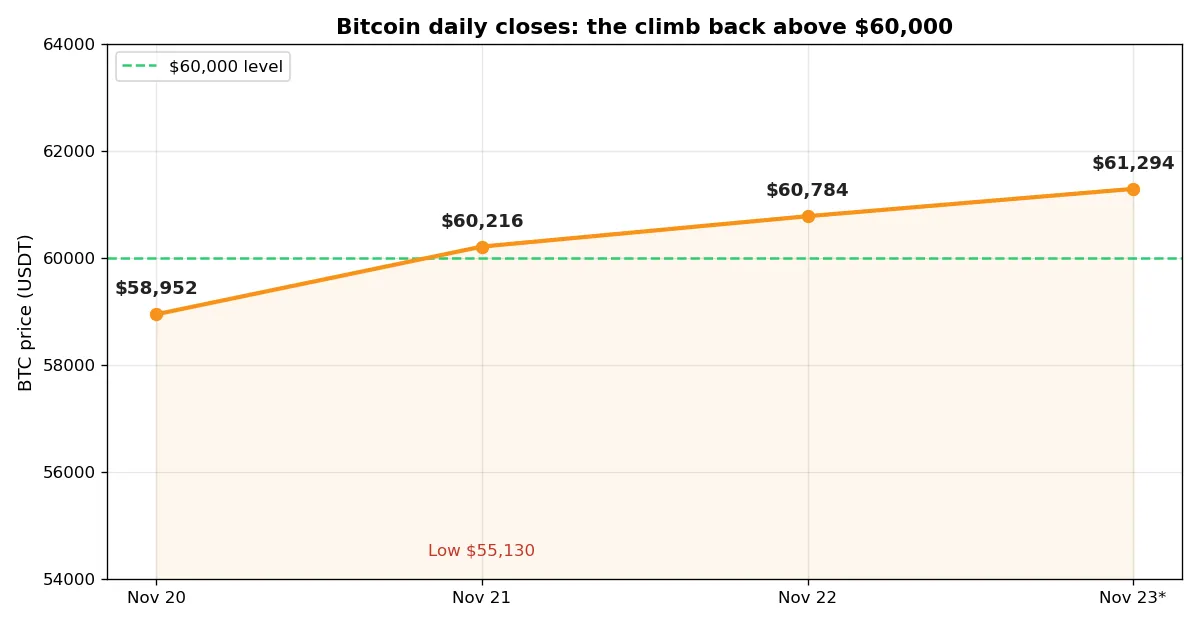
Bitcoin held $60,000 through one of the strangest weekends of the year. Missiles hit Bahrain, Kraken printed a $17,000 Bitcoin price, and Ledger confirmed tampered wallets in two more cities, yet Bitcoin still closed Sunday at $60,784.
That close matters because it was the first daily close above $60,000 since the crash. Monday now has to deliver a second one, and that second close is what turns a round number back into support.

Key takeaways
- Bitcoin closed Sunday at $60,784, up about 11% from Saturday’s $55,130 low.
- An Iranian missile and drone attack hit a civilian facility in Bahrain on Saturday, and Bitcoin still gained about 2% that day.
- Kraken’s Canadian dollar market printed Bitcoin at C$24,250, about $16,900, for roughly 14 hours. Kraken said the trades stand.
- Ledger confirmed tampered wallets in Berlin and is probing two more in Dubai, where two users lost a combined $604,000.
- US spot Bitcoin ETFs lost $1.25 billion in the week to November 20, and November outflows now total $3.59 billion.
The weekend in numbers
Saturday opened in panic. Bitcoin had already lost more than half its value from the $126,080 record set on October 6, 2025, and sellers drove it to $55,130, its lowest print since September 2024.
- Key takeaways
- The weekend in numbers
- Missiles over Bahrain, and Bitcoin barely blinked
- Kraken printed $17,000 Bitcoin, and the trades stand
- Tampered Ledgers reached Berlin and Dubai
- Chainflip lost $12 million, and the clock runs out today
- The money that left, and the money that did not come back
- What Monday has to prove
- Frequently Asked Questions
- Did Bitcoin really hold $60,000 over the weekend?
- What happened on Kraken’s Canadian dollar market?
- Are Ledger wallets still safe to use?
- What did Chainflip lose in the hack?
- When is the next PCE inflation report?
- Why did Bitcoin ETFs lose $1.25 billion last week?
- The bottom line
Buyers stepped in fast. Short sellers had to buy back in a hurry, and that forced buying pushed Bitcoin through $60,000 before Saturday ended, as we covered in our report on how Bitcoin crashed to a two-year low near $55,130 on Saturday and bounced back within hours.
Sunday did the quiet work. Bitcoin traded between $58,769 and $61,670 and closed at $60,784, which gave the market its first daily close above $60,000 since the crash.
Early Monday, Bitcoin traded near $61,294. That left it down about 12.5% on the week and about 22% in November, so the bounce repaired the chart without repairing the month.
| When | What happened | What Bitcoin did |
|---|---|---|
| Saturday, Nov 21, early | Bitcoin hit its lowest price since September 2024 | Low of $55,130, then an 8% bounce in hours |
| Saturday, Nov 21 | Iranian missile and drone attack hit a civilian facility in Bahrain | Gained about 2% over 24 hours |
| Saturday, Nov 21, 08:00 UTC | Kraken’s BTC/CAD pair printed C$24,250 | US dollar price stayed near $57,775 |
| Saturday, Nov 21 | Chainflip disclosed a hack worth about $12 million | FLIP token fell about 34% |
| Sunday, Nov 22 | First daily close above $60,000 since the crash | Closed at $60,784 |
| Monday, Nov 23, early | Bitcoin held above $61,000 in Asia trading | Traded near $61,294 |
Missiles over Bahrain, and Bitcoin barely blinked
Late Saturday, Iran launched a combined missile and drone attack on Bahrain. The strike hit a civilian industrial facility and set off a large fire, and Bahrain’s Interior Ministry said the fire caused no injuries at the site.

Two people were hurt in the wider attacks that day, one of them critically. Iran’s Revolutionary Guards said they had also targeted US military positions at the Al-Riffa and Awali bases, and Bahrain’s air defenses intercepted most of the incoming projectiles.
Bitcoin gained about 2% over the same 24 hours. That response says something about how traders read the news now, because a missile strike on a Gulf state used to mean an instant rush to cash.
The calm had limits. Bitcoin still sits more than 52% below its October 2025 record, and traders know the next headline can land at any hour.
Kraken printed $17,000 Bitcoin, and the trades stand
Kraken’s Canadian dollar market spent about 14 hours in its own reality. Heavy selling hit its CAD pairs from around 20:00 UTC on Friday, and by 08:00 UTC on Saturday the BTC/CAD pair had printed C$24,250.
Converted at the Bank of Canada’s rate of C$1.4325 per US dollar, that fill worked out to about $16,928. Bitcoin’s US dollar market never left the $55,000 to $58,000 range during the same window, so the gap was a local liquidity failure, not a market crash.
Kraken ruled out a hack and said every order processed correctly. Its statement ran to three words on the outcome: “Executed trades stand.”
The winners were small in number but large in profit. About 20.8 BTC changed hands in two sales near the low, and those buyers saved roughly $832,000 against prevailing prices.
Blockstream CEO Adam Back suggested a market maker on Kraken’s USDCAD market may have run out of funds, and arbitrage then carried the distortion into every CAD pair. Kraken has not named the seller, and the pair snapped back above C$80,000 by Saturday afternoon.
The lesson is simple and worth remembering. Thin fiat order books can print absurd prices, and a price on one exchange is not the price of Bitcoin.
Tampered Ledgers reached Berlin and Dubai
Ledger confirmed on November 18 that tampered hardware wallets had turned up in Berlin. The company is also probing two suspected devices in Dubai, and it calls the new cases the same incident that started in Southeast Asia in October.
A criminal group buys genuine Ledger devices, opens them, fits a hidden implant, and puts them back into circulation through resellers. The implant reads the 24-word recovery phrase off the screen during setup and sends it out over a mobile network.
The chip itself is not the problem. Ledger says its secure chip and operating system hold no flaw, and its Genuine Check cannot spot a physical implant because the implant never touches the chip.
The losses are real. Two Dubai customers lost a combined $604,000 from devices bought at Virgin Megastore, about 1,300 SOL from a Ledger Flex and 507,000 USDT from a Ledger Stax.
One Berlin user lost more than $320,000. Blockchain firm Bitquery traced about $1.68 million taken from 16 wallets in Dubai and Berlin.
Ledger asks anyone who bought a device in Berlin since January 2026 to contact support. It offers limited-time X-ray inspections at its factory in Vierzon, France, and it says no device bought directly on ledger.com has a confirmed case.
The rule for buyers has not changed, but the stakes have. Our guide to the best cold wallets for 2026 still ranks hardware wallets as the safest way to hold Bitcoin, yet only a device bought from the maker earns that trust.
Anyone setting one up should follow the steps to set up a hardware wallet safely and never enter a recovery phrase anywhere except the device screen.

Chainflip lost $12 million, and the clock runs out today
Cross-chain exchange Chainflip paused its protocol on Saturday after an attacker drained its vaults. The first reports put the loss at $4.86 million in ETH and stablecoins, then Chainflip disclosed 122.86 BTC stolen from its Bitcoin vault as well.
The full list reads 122.86137042 BTC, 520.22 ETH, 3.25 million USDC and 758,141 USDT. At prices near the incident, the total came to about $12 million, and the stolen crypto was worth almost half of FLIP’s market value.
Chainflip offered the attacker a deal. Return 90% of the funds by 18:38 UTC on Monday, November 23, and keep the other 10% as a bounty.
The deadline lands today, and Chainflip says it will publish a full incident report on Monday. Its founder says the team has contacted law enforcement, identified the vulnerability, and traced clues about the attacker, including the server used to register a validator account.
FLIP fell about 34% after the attack. The token drop matters less than the message, because a suspected signing-key compromise at a cross-chain bridge shakes trust across the whole sector.
The money that left, and the money that did not come back
US spot Bitcoin ETFs lost $1.25 billion in the week of November 16 to 20. BlackRock’s IBIT accounted for most of it, including a record $541.1 million outflow in a single session on November 19.
November outflows now total $3.59 billion, with only two positive days all month. Ether funds lost another $221.7 million in the same week, which took the combined total to $1.47 billion.
Bitcoin has rebounded on weak ETF flows before. Earlier in November, ETF flows told a different story from the price even as Bitcoin reclaimed $80,000, and the same split is visible again this weekend.
Retail traders are drifting away too. Bloomberg reported that retail traders are leaving crypto for AI stocks and prediction markets, and the price action fits that story.
Sentiment data backs it up. Santiment’s bullish-to-bearish comment ratio fell to 0.59 as Bitcoin broke below $60,000, then recovered only to about 0.77.
Bears still hold the majority in that reading. That fits a market where fear gripped the market and has not fully let go.
None of this stopped the weekend bounce. It only capped it, because every rally now runs into sellers who want out, not buyers who want in.
What Monday has to prove
Monday gives the market three tests, and each one has a clock on it.
First, the close. A second daily close above $60,000 turns the level back into support, and a close below it hands the bears their argument back.
The $55,130 low from Saturday is the line that matters if support fails.
Second, the Chainflip deadline. The 10% bounty offer expires at 18:38 UTC today, and the incident report due Monday will show whether a signing key really failed.
Third, the calendar. October PCE inflation lands on Wednesday, November 25, at 8:30 a.m. ET, and the consensus puts core PCE at 3.2% year on year against 3.1% before.
The Fed meets on December 8 and 9, so this is the last inflation print before that decision.
Bitcoin held $60,000 through missiles, a glitch and tampered wallets. Holding it through a quiet Monday would say more than holding it through a loud weekend.
That is the honest read, and it rests on Bitcoin’s fixed supply of 21 million coins, which no headline can change.
Frequently Asked Questions
Readers asked the same questions all weekend. Here are the short answers, with the numbers behind them.
Did Bitcoin really hold $60,000 over the weekend?
Yes. Bitcoin closed Sunday at $60,784, its first daily close above $60,000 since the crash, and Monday’s close is the second test.
Two closes above the level would turn $60,000 back into support.
What happened on Kraken’s Canadian dollar market?
Kraken’s BTC/CAD pair fell to C$24,250, about $16,900, during a roughly 14-hour liquidity failure that started on Friday evening. Kraken said its systems processed every order correctly, found no breach, and let the trades stand.
Are Ledger wallets still safe to use?
Devices bought directly on ledger.com have no confirmed cases in this incident. The risk sits with third-party sellers, so Ledger asks Berlin buyers since January 2026 to contact support and offers X-ray inspections for suspected devices.
What did Chainflip lose in the hack?
About $12 million in total, including 122.86 BTC, 520.22 ETH, 3.25 million USDC and 758,141 USDT. Chainflip offered the attacker a 10% bounty to return the other 90% by 18:38 UTC on Monday, November 23.
When is the next PCE inflation report?
Wednesday, November 25, at 8:30 a.m. ET, from the Bureau of Economic Analysis. The consensus expects core PCE at 3.2% year on year, up from 3.1%, ahead of the Fed meeting on December 8 and 9.
Why did Bitcoin ETFs lose $1.25 billion last week?
US spot Bitcoin ETFs recorded $1.25 billion in net outflows in the week of November 16 to 20, led by a record $541.1 million single-day outflow from BlackRock’s IBIT on November 19. November outflows now total $3.59 billion, with only two positive days all month.
The bottom line
Bitcoin survived a weekend that threw almost everything at it. War headlines, a broken exchange price, tampered wallets and a $12 million hack could not push it back under $60,000.
Survival is not a recovery. ETF money is still leaving, retail traders are looking elsewhere, and Bitcoin still sits about 22% lower in November.
Watch Monday’s close, the Chainflip deadline at 18:38 UTC, and Wednesday’s PCE report. Those three prints will say more about the next month than the whole weekend did.
This article is not investment advice. Bitcoin stays volatile, and nobody can promise what the next headline will do to the price.