



No. Moving Bitcoin between wallets you own is not a taxable event in the United States, the United Kingdom, or Canada.
You still own the same coins after the move, so nothing has been sold.

That answer is simple. The part that trips people up is what happens to your records when the coins move.
- Key Takeaways
- The Short Answer: No, But Your Records Still Matter
- Why Moving Your Own Bitcoin Is Not a Sale
- The Cost-Basis Trail: The Part Beginners Get Wrong
- Is Transferring Bitcoin Between Wallets Taxable in the US?
- The Per-Wallet Basis Rule Since 2025
- Form 1099-DA and the Missing Basis Problem
- The Digital Asset Question on Your Return
- Is Transferring Bitcoin Between Wallets Taxable in the UK?
- Canada and the Rest of the World
- Five Traps That Turn a Free Transfer Into a Tax Bill
- Trap 1: Paying the Network Fee in Bitcoin
- Trap 2: Sending Coins to Someone Else’s Wallet
- Trap 3: A Transfer Tied to a Trade
- Trap 4: Staking Rewards Received in Transit
- Trap 5: Software That Misreads the Move
- How to Record a Transfer in Five Minutes
- Common Mistakes to Avoid
- Frequently Asked Questions
- Is transferring Bitcoin between your own wallets taxable?
- Do I need to report a wallet transfer on my tax return?
- What happens to my cost basis when I move Bitcoin?
- Is the network fee taxable when I transfer Bitcoin?
- What if my exchange reports the transfer as a sale?
- Is moving Bitcoin to a wallet owned by someone else taxable?
- Sources
If the cost basis does not travel with the coins, your tax software can mistake a harmless transfer for a sale, and you can end up paying tax a year early on money you never received.
This guide answers the question of whether transferring bitcoin between wallets is taxable, then walks through the cost-basis trail that keeps your records straight. It covers the US, UK and Canadian rules, the five traps that turn a free transfer into a tax bill, and a five-minute routine for recording every move.
This guide is general information only, not tax advice. Tax rules depend on your own situation, so talk to a qualified tax adviser before you move serious money.
Key Takeaways
- Transferring Bitcoin between wallets you own is not a taxable event in the US, UK or Canada, because beneficial ownership does not change.
- Your original purchase price and purchase date travel with the coins. A transfer does not reset either one.
- In the US, cost basis has been tracked per wallet since January 1, 2025, so your records must show which coins moved where.
- In the UK, the coins stay in your Section 104 pool, and a transfer between your own wallets is not a disposal under HMRC rules.
- The network fee is the one taxable piece. Paying it in Bitcoin counts as a small disposal of the coins used to pay it.
- Tax software often misreads a transfer as a sale. Link the two sides of every move so it is not reported as a disposal.
The Short Answer: No, But Your Records Still Matter
Tax is charged on disposals, not on movement. A disposal means you sold, swapped, spent or gave away an asset.

Moving Bitcoin from an exchange to your own hardware wallet is none of those things.
The US Internal Revenue Service says this directly in its digital asset FAQs. A transfer from a wallet, address or account that belongs to you to another wallet, address or account that also belongs to you is not a taxable event.
HMRC says the same thing in its Cryptoassets Manual. A transfer between your own wallets is not a disposal, because beneficial ownership has not changed.
The Canada Revenue Agency applies the same idea: a disposition needs the property to leave your hands, and moving it between your own accounts does not do that.
So the transfer itself costs you nothing in tax. What costs people money is a broken paper trail.
When the coins arrive in a new wallet with no record of what you paid for them, your exchange or your software may treat the next sale as if you bought the coins for nothing.
Why Moving Your Own Bitcoin Is Not a Sale
Think of it like moving cash from your pocket to your safe. You own the same money before and after the move.
Nobody would call that a sale, and no tax office does either.
Bitcoin works the same way for tax purposes. The tax authorities in the US, UK and Canada all treat crypto as property.
Property tax is charged when ownership changes, and a transfer between your own wallets does not change the owner.
This is why the price of Bitcoin on the day of the transfer does not matter for the transfer itself. Your coins can double in value while they sit in transit, and you still owe nothing on the move.
The gain only becomes taxable when you actually dispose of the coins later.
What Counts as a Disposal
A disposal is any event where you give up ownership. Selling Bitcoin for dollars is a disposal.
Swapping it for another coin is a disposal. Spending it on goods is a disposal.
Giving it to another person is a disposal.
Moving it between your own wallets is not on that list. The IRS, HMRC and the CRA all draw the same line: if the same person owns the coins before and after, there was no disposal.
What Counts as a Transfer
A transfer is any move where you stay the owner. Exchange to hardware wallet, hardware wallet to a new phone wallet, one exchange account to another exchange account in your name, and wallet to wallet on the same chain all count as transfers.
The test is ownership, not the type of wallet. If the receiving address belongs to you, it is a transfer.
If it belongs to someone else, it is a gift, and gifts are disposals in most countries.
The Cost-Basis Trail: The Part Beginners Get Wrong
Here is the part most guides skip, and it is the part that actually costs people money. Every Bitcoin you own carries two facts with it: what you paid for it, and when you bought it.
Tax people call the first fact your cost basis and the second your holding period.
Those two facts decide how much tax you pay when you eventually sell. If you bought 1 BTC for $28,000 and sell it for $64,000, your gain is $36,000.
If you held it for more than a year, the US taxes that gain at the lower long-term rate, often 15%.
A transfer does not change either fact. The basis and the date travel with the coins to the new wallet.
The trouble starts when nothing in your records shows that the coins in the new wallet are the same coins you bought years ago.
A Worked Example With Real Numbers
Take a simple example. You bought 1 BTC for $28,000 in early 2023.
In 2024 you moved it to a hardware wallet when it was worth about $60,000. In November 2026 you moved it to a new exchange and sold it for $64,000, close to the price Bitcoin traded at this week.
Done right, the tax story is boring. Two transfers, zero tax on either move.
One sale in 2026, with a gain of $36,000 and a holding period of more than three years. At a 15% long-term rate, the tax is $5,400.
Done wrong, the story gets expensive. If your software sees the 2024 move as a sale, it reports a $32,000 gain in 2024, tax you owe on money you never received.
Then the 2026 sale shows only a $4,000 gain, because the software thinks you bought the coins at $60,000. The total gain is still $36,000, but you paid tax a year early and your records now contradict themselves.
| Step | What happened | Cost basis | Tax due |
|---|---|---|---|
| Early 2023 | Bought 1 BTC for $28,000 | $28,000 | $0 |
| 2024 | Moved 1 BTC to a hardware wallet | $28,000 (unchanged) | $0 |
| November 2026 | Moved 1 BTC to a new exchange | $28,000 (unchanged) | $0 |
| November 2026 | Sold 1 BTC for $64,000 | $28,000 | $5,400 at 15% |
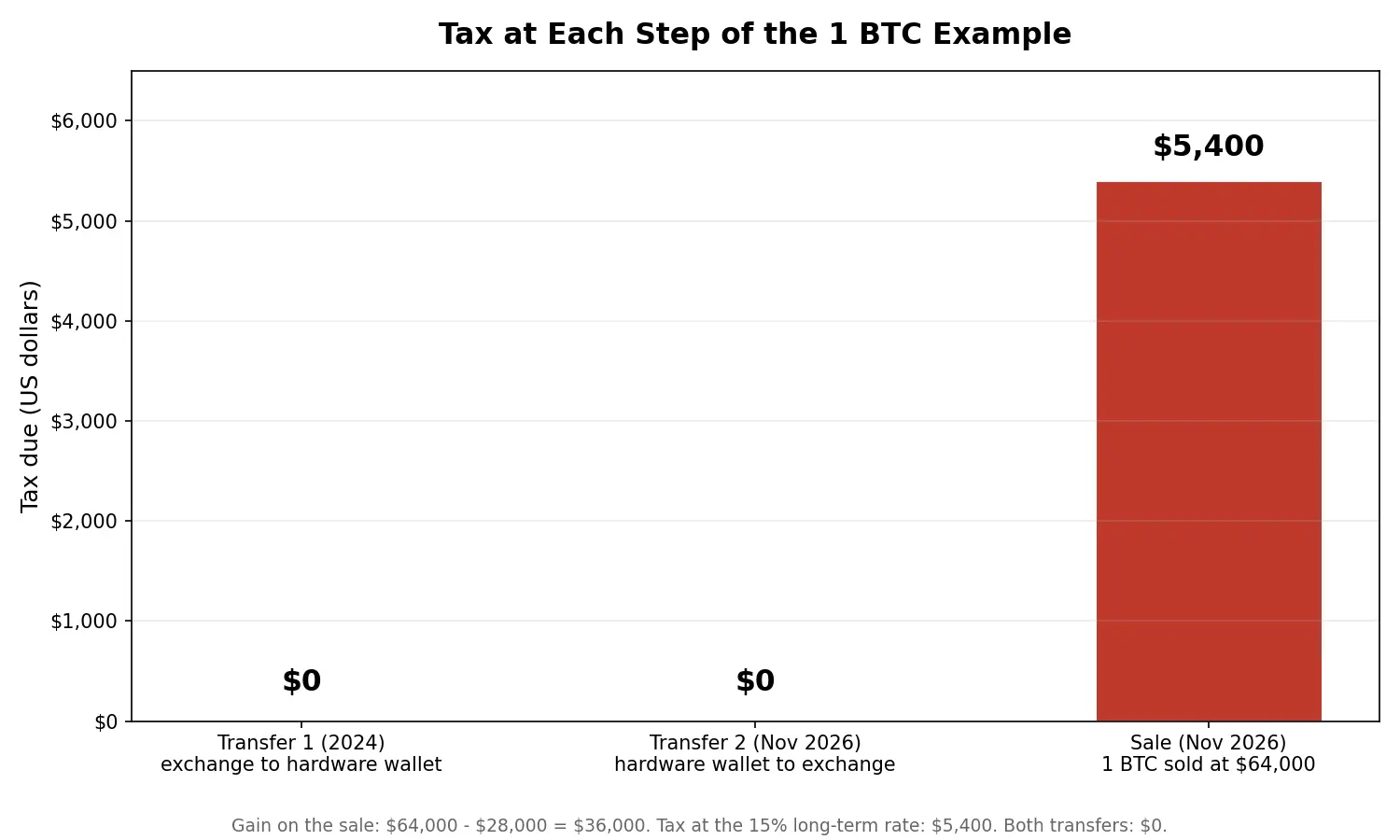
The table above is the whole idea in one picture. The basis column never changes until the sale, and the tax column stays at zero until the sale.
If your records show anything else, they are wrong.
Why the Trail Breaks
The trail breaks in three common ways. First, the receiving wallet has no record of where the coins came from.
Second, the sending exchange reports the move as a withdrawal with no destination. Third, the software on the receiving side treats an incoming transfer as a fresh purchase at the current price.
Any one of those breaks can turn a free transfer into a phantom sale. The fix is simple, and it takes five minutes.
Record both sides of every move, with the date, the amount, and the wallet on each end.
Is Transferring Bitcoin Between Wallets Taxable in the US?
No. The IRS treats a transfer between your own wallets as a non-taxable event.
Your cost basis and holding period carry over unchanged, and you report nothing on the move itself.
There are two US details that catch people out. The first is the per-wallet basis rule.
The second is Form 1099-DA, the new broker reporting form. Both are record-keeping problems, not taxes on the transfer.
Our Bitcoin tax guide covers the full US picture, including rates and the forms, if you want the wider view.
The Per-Wallet Basis Rule Since 2025
Since January 1, 2025, the IRS requires cost basis to be tracked separately for each wallet or account, under Revenue Procedure 2024-28. Before that rule, many investors pooled all their coins together.
Now each wallet has its own lots.
This matters when you move coins. The specific units you send keep their own cost basis and acquisition date, and those facts must land in the receiving wallet’s records.
If you sell from the new wallet later, the basis has to come from the lots that actually sit in that wallet.
Good tax software handles this if you link the transfer properly. It needs a transfer out on the sending wallet and a matching transfer in on the receiving wallet, with the source wallet named.
Without that link, the lots never arrive in the software’s eyes.
Form 1099-DA and the Missing Basis Problem
Brokers now report digital asset sales on Form 1099-DA. A transfer between your own wallets is not a sale, so it is not reported as a disposal on that form.
The catch comes later. Coins you transfer into a broker are treated as noncovered, which means the broker is not required to report your cost basis for them.
When you sell those coins, the 1099-DA can show your proceeds with the basis left blank.
You still have to report the correct basis yourself on Form 8949. Keep your own records, because the form the broker sends you will not do it for you.
The Digital Asset Question on Your Return
Every US federal return asks whether you received or disposed of digital assets during the year. Holding crypto, or transferring it between your own wallets, on its own lets you answer no, according to the IRS instructions.
Selling, trading or spending it means yes.
Answer the question honestly either way. A transfer alone does not make you a yes, but a sale in the same year does.
Is Transferring Bitcoin Between Wallets Taxable in the UK?
No. HMRC treats a transfer between wallets you own as a non-disposal.
The coins stay in your Section 104 pool for that token, with the same pooled cost as before.
HMRC lists four events as disposals: selling crypto, swapping it for another cryptoasset, spending it on goods or services, and giving it away to another person. Moving your own coins between your own wallets is none of those four.
Our guide to Bitcoin tax in the UK for beginners covers the 2026/27 rates and the annual exempt amount in full. The short version is that UK capital gains tax runs at 18% for basic-rate taxpayers and 24% for higher-rate taxpayers, with a £3,000 annual exempt amount.
Section 104 Pooling, in Plain Words
The UK does not track each coin separately. Instead, all your units of one token sit in a single pool with one average cost.
When you move coins between wallets, the pool does not change. The units simply sit at a different address with the same pooled cost.
This makes the UK simpler than the US on transfers. There is no per-wallet rule to satisfy.
You only need records that link the two sides of the move, so a transfer is not mistaken for a sale when you file.
The Network Fee Is a Small Disposal
The transfer itself is free of tax, but the fee is not. If you pay a network fee in Bitcoin, the coins used to pay it have been spent, and that counts as a disposal of those coins at their sterling value on the day.
The amount is usually tiny. A fee of 0.0002 BTC at a $64,000 price is about $12.80 of Bitcoin, and the gain on that sliver is the difference between its value when you bought it and its value when you spent it.
HMRC also says transfer fees are not an allowable cost, because there is no acquisition or disposal for them to attach to.
Canada and the Rest of the World
Canada follows the same principle. The Canada Revenue Agency treats a disposition as the moment property leaves your ownership, and moving crypto between accounts you control is not a disposition.
Your cost basis and acquisition date carry over.
Canada does differ in one respect worth knowing. If you give crypto away, the CRA treats it as a deemed disposition at fair market value, so the gain still counts.
A transfer to your own wallet is not a gift, but a transfer to a family member’s wallet is.
Most other countries follow the same ownership test. Ireland cut its CGT rate to 31% for disposals from October 2026, and a transfer between your own wallets is still not a disposal there.
Spain taxes Bitcoin at 19% to 30% on disposals, and again a self-transfer is not one. Germany exempts gains on crypto held for more than a year, and moving coins between your own wallets does not restart that clock.
| Country | Self-transfer taxable? | Basis rule | Fee taxable? |
|---|---|---|---|
| United States | No | Per wallet since 2025 | Yes, small disposal |
| United Kingdom | No | Section 104 pool | Yes, small disposal |
| Canada | No | Adjusted cost base carries over | Yes, small disposal |
| Ireland | No | Original basis carries over | Yes, small disposal |
| Spain | No | Original basis carries over | Yes, small disposal |
| Germany | No | Original basis carries over | Yes, small disposal |
The pattern is the same everywhere in the table. Ownership is the test, not the wallet.
If you still own the coins, you have not disposed of them.
Five Traps That Turn a Free Transfer Into a Tax Bill
A transfer between your own wallets is free. The five situations below look like transfers, but the tax office sees them differently.
Each one is easy to avoid once you know it exists.
Trap 1: Paying the Network Fee in Bitcoin
Every on-chain move charges a fee, and most wallets pay it in Bitcoin. The coins used for the fee are spent, so they count as a disposal.
The gain is usually a few dollars, but it still belongs on your return.
There is no way to avoid this one, and no need to fear it. Just know the fee is taxable, and let your software record it.
The fee itself cannot be added to your cost basis to cut a future gain.
Trap 2: Sending Coins to Someone Else’s Wallet
A transfer to a wallet that belongs to another person is a gift, not a transfer. In the US and UK, gifts of crypto count as disposals at market value, even if no money changed hands.
Double-check the address before you send. One wrong character can turn a free move into a taxable gift to a stranger.
If you want to give Bitcoin away on purpose, our guide to donating Bitcoin to charity shows the tax-smart way to do it. If you meant to send coins to a family member, that is a different decision, and it deserves its own tax check first.
Trap 3: A Transfer Tied to a Trade
Moving coins to an exchange is free. Selling them the moment they arrive is not.
The sale is the taxable event, and the transfer just before it does not change that.
The same applies to swaps. Moving Bitcoin to a decentralised exchange and swapping it for another token is a disposal of the Bitcoin, even though the coins never touched your bank.
The transfer and the trade are two separate steps, and only the trade is taxed.
Trap 4: Staking Rewards Received in Transit
Some wallets pay staking or interest rewards while your coins sit in them. Those rewards are income when you receive them, in the US and the UK alike, even if you never asked for them.
A transfer does not create the income, but a reward that lands during a move still counts as income. How Bitcoin miners are taxed covers the same income-versus-gains line for mining rewards, and the principle is identical here.
Trap 5: Software That Misreads the Move
This is the most common trap, and it is the one this guide exists to prevent. Exchange exports do not know who owns the receiving address, so a self-transfer looks exactly like a sale in a CSV file.
When your software sees a withdrawal with no matching deposit, it often records a sale at the market price on that day. Link the two sides of the move in your software, and the phantom sale disappears.
Check the linked transfer before you file, not after.
How to Record a Transfer in Five Minutes
You do not need special software to keep a clean trail. A simple note, made at the time of the move, beats a perfect spreadsheet built a year later from memory.
- Write down the date and time of the transfer.
- Note the amount moved and the coin, for example 0.5 BTC.
- Record the sending wallet and the receiving wallet by name, for example exchange to Ledger.
- Save the transaction ID or hash from the block explorer.
- In your tax software, link the withdrawal to the deposit as a transfer, not a sale.
Do this for every move, even small ones. The five minutes you spend now save hours of detective work at filing time, and they protect your cost basis when you eventually sell.
Common Mistakes to Avoid
The first mistake is treating a transfer as a sale on your return. You owe nothing on the move, so reporting it as a sale means paying tax you do not owe.
The second mistake is the opposite: forgetting the fee. The network fee is a small disposal, and leaving it out is a small error that adds up across many moves.
The third mistake is losing the purchase record. If you cannot prove what you paid for the coins, your software may assume a zero basis, and the whole sale becomes taxable gain.
Keep the original purchase receipt with the wallet that holds the coins.
The fourth mistake is mixing wallets in one pool. In the US, basis is tracked per wallet since 2025.
Selling from a wallet whose lots were never recorded there can produce the wrong gain.
Frequently Asked Questions
Is transferring bitcoin between wallets taxable? That is the question this section answers in six short answers.
Each one covers a different corner of the same rule.
Is transferring Bitcoin between your own wallets taxable?
No. Moving Bitcoin between wallets you own is not a taxable event in the US, UK or Canada, because you still own the same coins and beneficial ownership has not changed.
Your cost basis and holding period carry over unchanged.
Do I need to report a wallet transfer on my tax return?
Not as a sale. In the US, holding crypto or moving it between your own wallets on its own lets you answer no to the digital asset question.
In the UK, there is no disposal to report. Keep a record of the move either way, so it is not mistaken for a sale later.
What happens to my cost basis when I move Bitcoin?
It travels with the coins. If you bought 1 BTC for 28,000 dollars and move it to a new wallet, the basis in the new wallet is still 28,000 dollars and the purchase date is still the original date.
In the US, the lots must be recorded in the receiving wallet under the per-wallet rule that started in 2025.
Is the network fee taxable when I transfer Bitcoin?
Yes, in a small way. The Bitcoin used to pay the fee counts as a disposal of those coins, so any gain on that small amount is taxable.
The fee cannot be added to your cost basis, and it is not an allowable cost in the UK.
What if my exchange reports the transfer as a sale?
Reconcile it yourself. A transfer between your own wallets is not a sale, so it does not belong on Form 1099-DA as a disposal.
Coins moved into a broker are noncovered, so the broker may show proceeds without your basis when you sell. Report the correct basis on Form 8949 from your own records.
Is moving Bitcoin to a wallet owned by someone else taxable?
Yes. Sending Bitcoin to a wallet that belongs to another person is a gift, and in the US, UK and Canada a gift counts as a disposal at market value.
Check the address carefully before you send, because a wrong address can turn a free transfer into a taxable gift.
Sources
- IRS: Frequently Asked Questions on Virtual Currency Transactions
- IRS: Revenue Procedure 2024-28, per-wallet cost basis rules
- HMRC: Cryptoassets Manual, including CRYPTO22050 on disposals
This guide is general information only, not tax advice. If your situation involves large amounts, gifts, or a move tied to a trade, talk to a qualified tax adviser before you act.