



Filecoin price prediction 2026-2030 starts with a coin that just changed its own economics. FIL trades near $0.76 on November 10, 2026, and less than a month ago the network ended six years of vesting and rewired its block rewards to pay for real customers instead of empty storage.
Our short answer is this. Our base case puts FIL near $3.00 by 2030, with a bull case near $10.00 and a bear case near $0.80.

Nobody knows the real outcome. The published forecasts for 2030 run from about $1.19 to about $10.82, and that spread tells you more about this coin than any single number does.
- Key Takeaways
- Filecoin (FIL) Price Today: Where It Stands on November 10, 2026
- What Is Filecoin, in Plain English
- What Changed in October 2026: Solstice and the End of Vesting
- The vesting end cut new supply by about 75 percent
- Solstice pays for customers, not empty drives
- The demand numbers are still small
- Filecoin Price Prediction 2026: The Rest of the Year
- Filecoin Price Prediction 2027: The Solstice Test Year
- Filecoin Price Prediction 2028-2029: Slow Climb or Slow Fade
- Filecoin Price Prediction 2030: What $10 Would Actually Take
- Our Filecoin Price Prediction Table 2026-2030
- What Could Push FIL Higher
- What Could Hold FIL Back
- Filecoin vs Render and Injective: The Storage Coin Against the AI and Finance Picks
- Is Filecoin a Good Investment?
- Common Mistakes When Buying FIL
- Frequently Asked Questions
- What is the Filecoin price prediction for 2026?
- What is the Filecoin price prediction for 2030?
- Can Filecoin reach $10?
- Can Filecoin reach $100?
- What is the Filecoin Solstice upgrade?
- Is Filecoin a good investment in 2026?
- Conclusion: A Better Coin at a Worse Price
FIL trades near $0.76 on November 10, 2026, based on live price pages that put it between about $0.76 and about $0.77 during the morning. Its market value sits near $643 million, with about 846 million coins in circulation, and it ranks around 90 among all cryptocurrencies.
That puts Filecoin about 99.7 percent below its April 2021 peak near $236.84, and it is down about 32 percent in the last 30 days alone. The supply story just got much better, but the price has not cared yet, and that gap is what this article is really about.
Key Takeaways
- FIL trades near $0.76 on November 10, 2026, with a market value near $643 million, rank 90, and about 846 million coins in circulation.
- FIL is down about 12 percent in the last 7 days and about 32 percent in the last 30 days, and it closed November 9 at $0.78 after touching $0.79 on November 7.
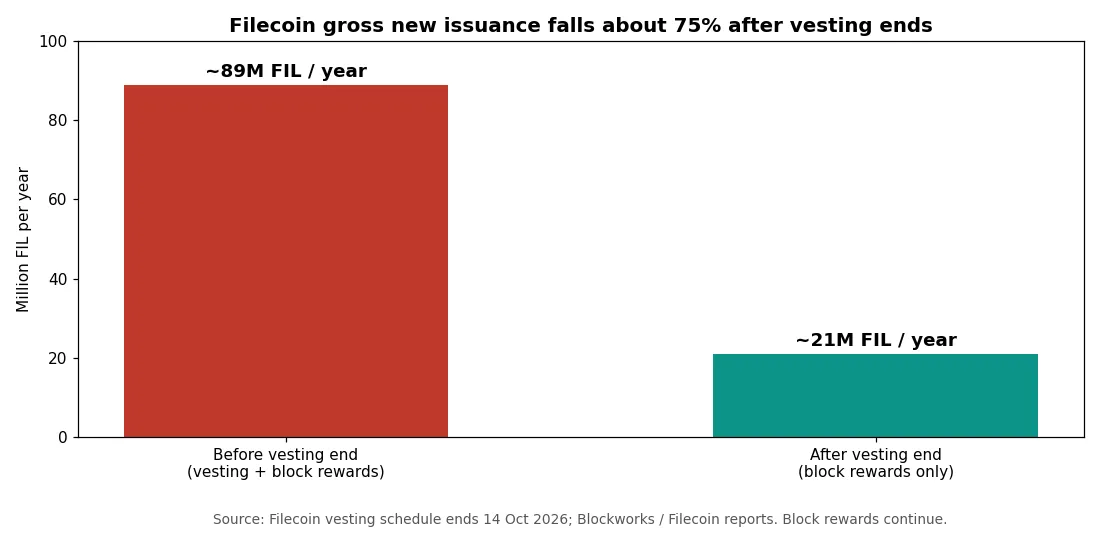
- Genesis vesting ended on October 14, 2026, and the Solstice upgrade activated on October 19, 2026, cutting gross new FIL issuance by about 75 percent, from roughly 89 million to roughly 21 million coins a year.
- Published 2030 forecasts disagree by about nine times, from a $1.19 average at DappRadar to a $10.82 average at Ventureburn.
- This article translates every published 2030 forecast into market value, so you can see what each target would actually require. A $10 FIL needs a $10 billion market value at 1 billion coins in circulation, or about 15 times the market value today.
- Our 2030 scenario bands run from $0.80 in the bear case to $10.00 in the bull case, with $3.00 as the base case. None of this is investment advice.
Filecoin (FIL) Price Today: Where It Stands on November 10, 2026
FIL woke up to a quiet session on November 10, 2026. It trades near $0.76, up a little in 24 hours, after a rough month that carried it from about $1.12 in early October down to about $0.74.
Bitcoin sets the mood for the whole market, and it sits near $74,800 after falling to about $73,700 on November 8, its lowest level since August. FIL fell harder than Bitcoin over the last month, which tells you buyers have not stepped in yet even after the supply news.

| FIL snapshot | November 10, 2026 |
|---|---|
| Price | About $0.76 to $0.77 |
| 24-hour range | $0.74 to $0.79 |
| Market value | About $625 million to $644 million |
| Market rank | About 90 |
| Circulating supply | About 846 million FIL |
| Total supply | About 1.96 billion FIL |
| 24-hour trading volume | About $61 million |
| Change, last 7 days | Down about 12 percent |
| Change, last 30 days | Down about 32 percent |
| Change, year to date | Down about 47 percent |
| Change, last 12 months | Down about 69 percent |
| All-time high | About $236.84 in April 2021 |
| 2026 low | About $0.61 in mid-2026 |
The last three daily closes tell the short-term story. FIL closed November 7 at $0.79, slipped to $0.74 on November 8, and bounced back to $0.78 on November 9.
Traders watch $0.74 as the nearest support and $0.79 as the nearest resistance. A clean break above $0.79 opens the path toward the $1.00 level, while a loss of $0.74 would put the 2026 low near $0.61 back in play.
The $1.00 level matters more than most round numbers. FIL has spent most of 2026 below it, and every published forecast for the rest of the year treats holding $1.00 as the first real test.
What Is Filecoin, in Plain English
Filecoin is a decentralised storage network. People with spare hard drive space rent it out, and people who need storage pay for it, with FIL as the currency that ties the two sides together.
Think of it like Airbnb for hard drives. Storage providers lock up FIL as a pledge, store other people’s data, and earn FIL rewards for proving the data is still there.
The network launched its mainnet on October 15, 2020, so it turned six years old last month. Its maximum supply is 2 billion FIL, and about 846 million coins circulate today.
Filecoin never promised to be fast money. It promised to be useful infrastructure, and for years the market rewarded the promise more than the usage.
That is the honest starting point for any price prediction. FIL is a storage coin in a market that currently pays far more attention to AI and finance tokens, and the price shows it.
If you want the comparison, our Render price prediction covers an AI infrastructure coin that ran the other way this year, while our Injective price prediction covers a finance chain that just got its first staked ETF.
What Changed in October 2026: Solstice and the End of Vesting
October 2026 gave Filecoin the biggest tokenomics change since launch. Two events landed five days apart, and both cut the flow of new coins hitting the market.
The first event ended vesting. The six-year vesting schedule for Protocol Labs and the Filecoin Foundation finished on October 14, 2026, after running in a straight line since mainnet launch.
The second event rewired rewards. The Solstice upgrade, network version 29, activated on October 19, 2026, and it now ties a growing share of block rewards to paying customers instead of raw storage capacity.
Together they change the supply math in a way no forecast can ignore. The question is whether demand grows fast enough to notice.
The vesting end cut new supply by about 75 percent
In the three months before the cutoff, vesting released 17.1 million FIL while block rewards minted only 5.4 million. Vesting supplied about three of every four new coins.
That flow has now stopped. Annualised new issuance from vesting plus block rewards falls from roughly 89 million FIL to roughly 21 million FIL a year.
Block rewards are now the only new issuance, at about 58,000 FIL a day, or a little over 2 percent of circulating supply a year. Mining does not stop, and Filecoin has no hard cap event coming, but the dilution pressure drops sharply.
Do not overread this. A supply cut helps only if buyers show up, and FIL fell about 32 percent in the 30 days after the news, so the market has not rewarded it yet.
Solstice pays for customers, not empty drives
Solstice implements FIP-0118, and it makes two changes that matter. Every new storage sector now gets 10 times quality-adjusted power automatically, with no review step.
Before Solstice, a sector earned that 10 times multiplier only if it stored data approved through Filecoin Plus, a human review program. That program ends at the upgrade, and no new datacap gets minted.
The block reward itself stays the same size, about 4.09 FIL per block, but the split changes. The miner share starts at 95 percent and steps down toward 50 percent over about nine quarters, or roughly 2.25 years.
The service share starts at 5 percent and can grow to 50 percent, but only when on-chain Filecoin Pay volume clears fixed dollar targets. Any service share the network fails to earn gets burned instead of handed out.
That burn is the sharp edge of the design. If paying demand stays tiny, coins burn and supply tightens, but the network also earns less for growth.
The demand numbers are still small
Filecoin Pay carried an annualised run rate of about $138,000 across 149 active payers as of October 17, 2026. That is up from $663 and 73 payers in January, so growth is real, but the base is tiny.
Filecoin Onchain Cloud, the set of smart contracts for buying storage on-chain, reached mainnet in the first quarter of 2026. Fil One, a storage product built on top of it, followed in the second quarter.
The first measured gate check lands around April 29, 2027. That date is the first real test of whether the demand story is working, and it sits squarely inside our 2027 forecast window.
Watch that date more than any price chart. If Filecoin Pay volume clears its targets, the service share grows and the burn stops.
If it misses, the burn continues and the market gets a clear signal.
Filecoin Price Prediction 2026: The Rest of the Year
The rest of 2026 is a test of whether FIL can hold the $1.00 level. Every published forecast agrees on that, even though the numbers differ.
CoinStats puts the rest of 2026 between $0.80 and $1.30, with $1.00 as the average. CoinLore is gloomier, with a base case near $0.61 by year end and a range from $0.37 to $3.01.
DappRadar sits in the middle with about $0.80 for 2026. BTCC gives a range of $0.90 to $1.50, and Ventureburn expects about $1.46 in the fourth quarter.
Our 2026 scenario runs from $0.70 in the bear case to $1.30 in the bull case, with $0.90 as the base case. The wide spread is honest, because FIL starts this window 24 percent below $1.00 and the market is in a fear mood.
Bitcoin drives the short term. BTC trades near $74,800 today, and the October US inflation report lands later today, so the whole market could move before FIL finds its own direction.
Our Bitcoin price prediction for 2026 maps five year-end targets for BTC, and FIL needs the top of that range to have any real shot at $1.30.
| Source | 2026 forecast | What it assumes |
|---|---|---|
| CoinStats | $0.80 to $1.30, average $1.00 | FIL holds $1.00, vesting cut supports the base |
| CoinLore | Base $0.61, range $0.37 to $3.01 | Model-based, bearish base case |
| DappRadar | About $0.80 | Algorithmic trend and momentum |
| BTCC | $0.90 to $1.50 | Market absorbs the vesting change |
| Ventureburn | About $1.46 in Q4 | Technical breakout from current floors |
| BTCRepublic base case | About $0.90 | Slow grind, $1.00 reclaimed late or not at all |
The lesson from past forecasts is humility. A widely cited 2024 projection called for $6.19 to $7.34 by 2025, while the actual 2025 low came in near $0.63.
Forecasts miss, and FIL misses by more than most coins. Treat every number in this article as a scenario, not a target.
Filecoin Price Prediction 2027: The Solstice Test Year
2027 is the year Solstice gets judged. The first gate check lands around April 29, 2027, and the service share of block rewards either grows or burns based on real payment volume.
CoinStats puts 2027 between $0.70 and $3.00, with $1.50 as the average. That range assumes the reduced issuance feeds into a better supply picture and FIL holds above $1.00 for much of the year.
CoinLore gives a 2027 base case near $0.73, with a bull case near $3.46. DappRadar is more cautious at about $0.94, and BTCC sketches a conservative $0.80 to $1.50 band against a base band of $1.50 to $3.00.
Our 2027 scenario runs from $0.70 in the bear case to $3.00 in the bull case, with $1.50 as the base case. The bull case needs two things at once: paid storage demand that clears the Solstice gates, and a broader altcoin rally.
The supply math helps here. With vesting gone, block rewards add only about 21 million FIL in 2027, so any demand growth hits a thinner stream of new coins.
The risk is just as clear. If Filecoin Pay volume stalls near its current $138,000 annualised run rate, the service share keeps burning and the market reads the upgrade as a story without customers.
Watch the April 2027 gate check before you trust any 2027 number. It is the one date in this article that can move the forecast by itself.
Filecoin Price Prediction 2028-2029: Slow Climb or Slow Fade
By 2028 and 2029, the Solstice transition is mostly done. The miner share of block rewards reaches its 50 percent floor around the start of 2029, and the network either runs on paying customers or it does not.
CoinStats groups these two years together, with a range of $0.90 to $5.00 and $2.00 as the average. DappRadar is far more modest, at about $1.06 for 2028 and about $1.13 for 2029.
CoinLore gives a 2028 base near $1.01 with a bull case near $9.61, and a 2029 base near $1.06 with a bull case near $12.18. Those bull cases assume a market mania that the base cases do not.
BTCC sketches a base band of $2.00 to $4.00 for 2028 to 2029, against a conservative $0.70 to $1.50. The gap between its own bands is the whole story: the outcome depends on adoption numbers that nobody can measure yet.
Our 2028 scenario runs from $0.90 to $3.50, with $2.00 as the base case. Our 2029 scenario runs from $0.90 to $4.00, with $2.50 as the base case.
Two forces decide these years. The first is whether AI workloads buy decentralised storage at scale, which is the bull case every forecaster leans on.
The second is Bitcoin’s cycle. Our Bitcoin price prediction for 2030 compares the big BTC models, and FIL has never rallied hard while Bitcoin was flat, so a weak BTC cycle caps FIL no matter what Filecoin builds.
The honest read is that 2028 to 2029 is a grind, not a moonshot. A FIL that doubles from $1.00 to $2.00 over two years would already beat what the cautious models expect.
Filecoin Price Prediction 2030: What $10 Would Actually Take
2030 is where the forecasts split widest, and that split is the most useful part of this article. The published 2030 averages run from $1.19 to $10.82, a gap of about nine times.
CoinStats gives 2030 a range of $0.80 to $10.00, with $3.00 as the average. CoinLore gives a base near $1.55, a bear case near $0.93, and a bull case near $8.22.
DappRadar gives the lowest 2030 average at about $1.19. BTCC gives a base band of $3.00 to $6.00 and a bull band of $6.00 to $12.00, while Ventureburn gives the highest single average at $10.82.
Our 2030 scenario runs from $0.80 in the bear case to $10.00 in the bull case, with $3.00 as the base case. That matches CoinStats, which is the most transparent of the published models about its assumptions.
Now the reality check, which is the exclusive element of this article. Every price implies a market value, and the market value is what FIL has to earn.
Circulating supply sits near 846 million FIL today and grows by only about 21 million coins a year from block rewards. By 2030 it lands near 1 billion coins, so a simple rule works: the price in dollars roughly equals the market value in billions.
| Published 2030 average | Implied market value at 1 billion FIL | Multiple of today ($643 million) |
|---|---|---|
| DappRadar, $1.19 | About $1.19 billion | About 1.9 times |
| CoinLore, $1.55 | About $1.55 billion | About 2.4 times |
| CoinStats, $3.00 | About $3.00 billion | About 4.7 times |
| BTCC base midpoint, $4.50 | About $4.50 billion | About 7.0 times |
| Ventureburn, $10.82 | About $10.82 billion | About 16.8 times |
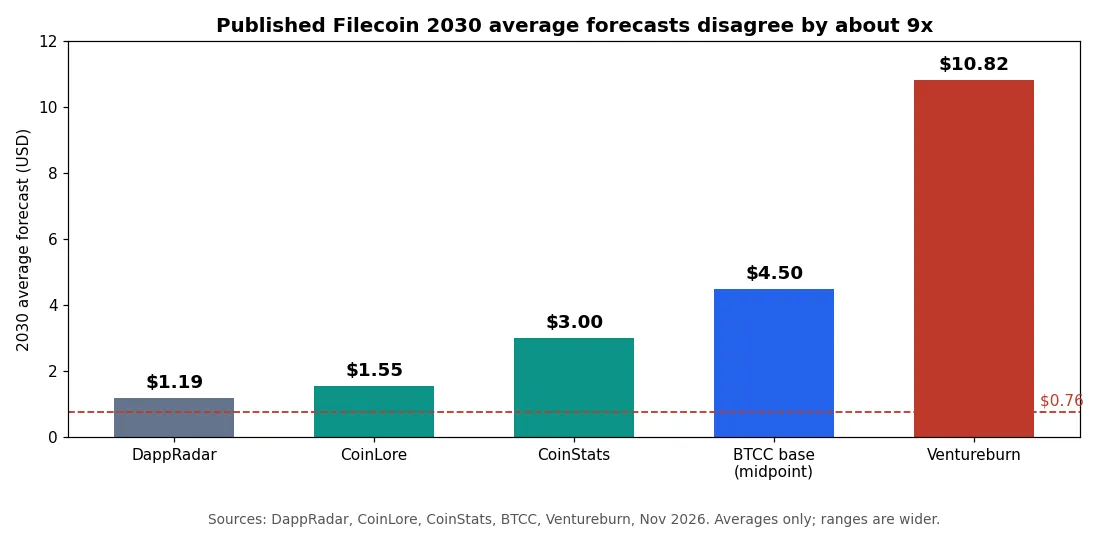
Read that table twice. The cautious forecasts ask FIL to roughly double its market value in four years, which is a normal recovery, not a miracle.
The $10 bull case asks FIL to grow its market value about 15 times, to $10 billion. That is possible only if decentralised storage becomes a major AI infrastructure market and Filecoin wins a real share of it.
The $3.00 base case asks for about 4.7 times today’s market value. That needs steady demand growth plus a healthy crypto cycle, and it is the middle of the road, not the easy path.
For a sense of how other altcoins frame the same math, our Bittensor price prediction runs the same market-value test on TAO, and our Arbitrum price prediction does it for ARB.
Our Filecoin Price Prediction Table 2026-2030
Here is the full BTCRepublic scenario table in one place. These are our scenarios, built from the published forecasts above plus the supply math, not promises.
| Year | Bear case | Base case | Bull case | What decides it |
|---|---|---|---|---|
| 2026 | $0.70 | $0.90 | $1.30 | Bitcoin holds $74,000, FIL reclaims $1.00 |
| 2027 | $0.70 | $1.50 | $3.00 | April 2027 Solstice gate check, paid demand |
| 2028 | $0.90 | $2.00 | $3.50 | AI storage demand, miner share near 50 percent |
| 2029 | $0.90 | $2.50 | $4.00 | Onchain Cloud revenue, crypto cycle |
| 2030 | $0.80 | $3.00 | $10.00 | Storage market share, market value near $3 billion |
The base case implies FIL roughly quadruples from $0.76 to $3.00 over four years. That sounds big, but it still leaves FIL about 99 percent below its 2021 peak, which shows how far this coin has fallen.
The bear case is not a crash to zero. It is FIL drifting near its 2026 low while the network grows slowly and emissions weigh on price.
The bull case is a different coin entirely. It needs Filecoin to convert a large share of its storage capacity into recurring revenue, which is exactly what Solstice was built to reward.
What Could Push FIL Higher
Three drivers matter most, and they are all about demand, not hype. The first is paid storage growth through Filecoin Onchain Cloud and Fil One.
If enterprises and AI projects start paying for decentralised storage in real volume, the Solstice design pays the services that bring them in. That is a direct link between usage and rewards that did not exist before October.
The second driver is the supply squeeze itself. Gross issuance fell about 75 percent, so any demand growth now meets far fewer new coins, and the burn removes unearned service rewards on top.
The third driver is the broader altcoin cycle. FIL fell 69 percent in the last year while Bitcoin fell about 29 percent, so it has more room to bounce if the market turns, and it has a history of violent upside moves.
A fourth driver is quieter: pledge locking. Sectors raised to 10 times quality-adjusted power lock more FIL as pledge collateral, which takes coins out of circulation while the network grows.
What Could Hold FIL Back
The risks are just as concrete. The first is demand that stays tiny, with Filecoin Pay stuck near $138,000 a year while the network needs millions to justify its valuation.
The second is competition. Centralised cloud storage is cheap, fast, and familiar, and decentralised rivals keep improving, so Filecoin has to win on price or trust, not ideology.
The third is the token overhang. Total supply is about 1.96 billion FIL against 846 million circulating, so more than half the eventual supply still sits outside circulation, and future unlocks can weigh on price.
The fourth is Bitcoin. FIL has never decoupled from BTC for long, and a BTC slide toward $70,000 would drag FIL with it no matter how good the Solstice numbers look.
| Bullish | Bearish |
|---|---|
| Gross issuance cut about 75 percent | Paid demand still tiny at $138,000 a year |
| Rewards now tied to paying customers | Centralised cloud is cheaper and easier |
| Unearned rewards burn instead of diluting | Over half of total supply still uncirculated |
| AI storage demand could scale fast | FIL tracks Bitcoin, which sits in fear |
| Down 99.7 percent from ATH, room to recover | Down 32 percent in 30 days, no buyers yet |
Filecoin vs Render and Injective: The Storage Coin Against the AI and Finance Picks
Filecoin is the oldest story in this run of predictions, and the contrast with its neighbours is sharp. Render bets on AI compute, Injective bets on finance, and Filecoin bets on storage.
Render trades as the AI infrastructure pick, and our Render price prediction shows a coin that rode the AI wave. Injective trades as the finance chain with a live ETF, and our Injective price prediction shows what a fresh catalyst can do.
Filecoin has the freshest tokenomics of the three and the weakest price. That is not a contradiction, because tokenomics is a slow force and the market is a fast one.
The honest comparison is this. Render and Injective sell into markets the crypto crowd already loves, while Filecoin sells storage to customers who mostly do not care about crypto at all.
That makes FIL the hardest bet of the three, and the cheapest. It also makes it the one where a single enterprise deal could change the story, because the demand base is so small that real volume moves the needle.
If you believe AI needs decentralised storage, FIL is the direct play. If you believe the AI trade stays in compute and finance, Render and Injective are the cleaner bets.
Is Filecoin a Good Investment?
Filecoin is a real network with real storage, a real supply cut, and a real problem. Paying demand is still tiny, and that mix makes it a speculation, not a safe hold.
The bull case is genuine. A 75 percent issuance cut plus a burn plus a working demand-linked reward system is the best setup FIL has ever had.
The price still sits near its 2026 low.
The bear case is just as genuine. FIL is down 69 percent in a year, down 32 percent in a month, and the market has ignored the best tokenomics news in the coin’s history.
Anyone who buys FIL is betting that usage catches up with the new economics before the next bear market arrives. That is a fair bet to make with money you can afford to lose, and a bad bet to make with money you need.
Size the position for the bear case, not the bull case. A coin that can fall 32 percent in a month can do it again, and no forecast in this article changes that.
This is not financial advice. Do your own research, check the Filecoin Pay numbers yourself, and never buy a prediction, including ours.
Common Mistakes When Buying FIL
The first mistake is reading the vesting end as a supply freeze. Vesting ended, but block rewards still mint about 21 million FIL a year, and pledge unlocks and future allocations still matter.
The second mistake is trusting a single forecast. The 2030 averages run from $1.19 to $10.82, so any article that quotes one number without the spread is hiding the uncertainty.
The third mistake is confusing storage capacity with storage demand. Filecoin has huge capacity, but capacity earns nothing until someone pays to fill it.
The fourth mistake is buying the peak of a bounce. FIL closed at $0.79 on November 7, fell to $0.74 the next day, and that kind of whipsaw punishes anyone who chases green candles.
The fifth mistake is ignoring Bitcoin. FIL follows BTC, so a FIL position is partly a BTC position, and the October inflation report today could move both before lunch.
Frequently Asked Questions
These are the questions readers ask most about Filecoin and its price, answered from the research in this article.
What is the Filecoin price prediction for 2026?
Our base case puts FIL near $0.90 by the end of 2026, with a range from $0.70 to $1.30. Published forecasts range from a $0.61 base case at CoinLore to about $1.46 at Ventureburn, and all of them treat holding $1.00 as the key test.
What is the Filecoin price prediction for 2030?
Our base case puts FIL near $3.00 by 2030, with a bear case near $0.80 and a bull case near $10.00. Published 2030 averages run from $1.19 at DappRadar to $10.82 at Ventureburn, and a $3.00 FIL implies a market value near $3.00 billion at about 1 billion coins in circulation.
Can Filecoin reach $10?
Yes, but only in a strong bull case. A $10 FIL needs a market value near $10 billion at about 1 billion coins in circulation, or about 15 times today’s market value, plus real growth in paid storage demand and a broad crypto rally.
Can Filecoin reach $100?
Not on any published forecast. A $100 FIL would need a market value near $100 billion at 1 billion coins in circulation, which is more than 150 times today’s market value, and no forecaster expects that by 2030.
What is the Filecoin Solstice upgrade?
Solstice is network version 29, activated on October 19, 2026, under FIP-0118. It gives every new storage sector 10 times quality-adjusted power, ends the Filecoin Plus review program, and splits block rewards between miners and services that bring paying customers, burning any service share that goes unearned.
Is Filecoin a good investment in 2026?
Filecoin is a speculation, not a safe hold. It has the best tokenomics setup in its history after the vesting end and the Solstice upgrade, but paying demand is still tiny.
The price is down 32 percent in the last 30 days. This is not financial advice, so do your own research before buying.
Conclusion: A Better Coin at a Worse Price
Filecoin is a better coin today than it was a month ago, and it trades at a worse price. That is the whole story in one sentence.
The vesting end cut new supply by about 75 percent, Solstice tied rewards to paying customers, and the burn removes coins the network fails to earn. No earlier version of Filecoin had all three.
The price has not noticed yet. FIL sits near $0.76, down 32 percent in a month, and the market wants proof that customers will pay, not just a better design.
Our base case is $3.00 by 2030, with $0.80 below and $10.00 above. The April 2027 gate check is the first date that can prove or break that view, so mark it on your calendar.
Next step: watch Filecoin Pay volume and the $0.74 support level this week, then check back after the April 2027 gate check for the first real verdict on Solstice.