



Bitcoin fell hard in 2026. If you sold at a loss, that loss has value.
Bitcoin tax loss harvesting lets you turn a losing trade into a smaller tax bill, and you can do it without giving up your Bitcoin.

Here is the short answer. Sell Bitcoin at a loss before December 31, 2026, and the loss counts on your 2026 return.
- What Is Bitcoin Tax Loss Harvesting?
- How Tax Loss Harvesting Works, Step by Step
- Step 1: Find a losing lot
- Step 2: Sell before December 31, 2026
- Step 3: Decide whether to rebuy
- Step 4: Report the loss on Form 8949
- The Worked Example: A $12,000 Loss Used $3,000 a Year
- Short Term vs Long Term: Why Holding Period Changes the Math
- The Wash Sale Rule Does Not Apply to Bitcoin You Hold Directly
- The 2026 Bill That Could Close the Loophole
- The Wallet by Wallet Basis Trap
- FIFO vs HIFO vs Specific Identification
- Form 1099-DA: What Your Broker Reports in 2026
- Common Mistakes That Cost Bitcoin Holders Money
- Your 2026 Year End Checklist
- Frequently Asked Questions
- Is Bitcoin tax loss harvesting legal in 2026?
- Does the wash sale rule apply to Bitcoin in 2026?
- What is the deadline to harvest losses for the 2026 tax year?
- How much of a capital loss can I deduct per year?
- Can I harvest losses on Bitcoin ETF shares?
- Do I have to report a loss harvest if I rebuy right away?
- What happens to unused capital losses?
- Sources
The loss first cancels your capital gains. Then up to $3,000 of what is left cuts your ordinary income each year, and the rest carries forward.
You can rebuy Bitcoin right after the sale, because the wash sale rule does not apply to Bitcoin you hold directly. That rule may change soon, so the 2026 year end matters more than usual.
This article explains US federal tax rules. It is not tax advice.
Tax law is complex, and your situation may differ. Talk to a qualified tax professional before you act on anything here.

Key Takeaways
- The deadline is December 31, 2026. A sale must settle in 2026 to count on your 2026 return.
- Direct Bitcoin escapes the wash sale rule. You can sell at a loss and rebuy minutes later. Spot ETF shares are different, and the rule applies to them.
- Losses offset gains first. Then up to $3,000 a year cuts ordinary income. Unused losses carry forward without a time limit.
- H.R. 10357 could close the loophole. The House Ways and Means Committee approved it 38 to 5 on September 16, 2026. It is not law yet, but its amended text would apply the wash sale rule to sales after September 14, 2026.
- Basis is now wallet by wallet. Since January 1, 2025, you track cost basis per wallet and account, not across all of them together.
What Is Bitcoin Tax Loss Harvesting?
Tax loss harvesting means selling an investment that has fallen in value so you can claim the loss on your tax return. You sell Bitcoin for less than you paid for it.
The difference becomes a capital loss. That loss then reduces the tax you owe on other gains and income.
The idea sounds strange at first. You lock in a loss on purpose.
But the loss was already real. Your Bitcoin was already worth less than you paid.
Harvesting simply turns that paper loss into a tax benefit while the year is still open.
Bitcoin makes this strategy unusually powerful. The IRS treats Bitcoin as property, not as a security.
That one fact changes everything. The wash sale rule, which blocks stock investors from selling and rebuying the same asset within 30 days, does not reach Bitcoin you hold directly.
You can sell, claim the loss, and buy back your position in the same hour.
Harvesting does not recover your lost money. A $10,000 loss is still a $10,000 loss.
What it does is cut your tax bill, so the damage costs you less. At a 22 percent marginal rate, a $3,000 loss offset saves $660 in tax.
At the 37 percent top rate, the same offset saves $1,110.
How Tax Loss Harvesting Works, Step by Step
The process has four steps. Each one is simple on its own.
Together they decide how much tax you actually save.
Step 1: Find a losing lot
Look at every Bitcoin purchase you made, lot by lot. A lot is one purchase: a date, an amount, and a price.
Any lot now worth less than its cost basis holds a harvestable loss. Cost basis is what you paid, plus fees.
Check each wallet separately. Since 2025, the IRS requires basis tracking wallet by wallet.
A lot in your cold wallet and a lot on an exchange are separate pools, even if they hold the same coin.
Step 2: Sell before December 31, 2026
The sale must happen in the 2026 tax year. A sale on January 1, 2027 belongs on your 2027 return, not your 2026 return.
Do not wait until the last week of December. Exchanges get busy, prices move fast, and a failed order can push you into January.
Record the sale details at once. Note the date, time, amount, sale price, fees, and the wallet or account used.
Your broker will report the sale to the IRS on Form 1099-DA, so your records must match what the IRS receives.
Step 3: Decide whether to rebuy
If you still believe in Bitcoin long term, you can buy it back right away. Current law places no waiting period on directly held crypto.
Your new purchase sets a fresh cost basis at the new, lower price.
That lower basis matters later. If Bitcoin recovers and you sell the rebought coins at a gain, the gain is measured from the new basis.
You traded a loss today for a higher taxable gain tomorrow. The strategy still wins when the tax you save now outweighs the tax you may pay later, especially if you hold the rebought coins for more than a year and qualify for lower long term rates.
Step 4: Report the loss on Form 8949
Every sale goes on Form 8949, then flows to Schedule D of your Form 1040. Report the sale even if you rebought the same day.
Report it even if the loss is small. The IRS receives your broker’s Form 1099-DA, so an unreported sale invites a mismatch notice.
Keep your own records for every wallet, including self custody wallets that issue no 1099-DA. The IRS has no broker report for those sales.
Your records are the only proof of what you paid and what you received.
The Worked Example: A $12,000 Loss Used $3,000 a Year
Numbers make the rule concrete. Say you bought Bitcoin through 2025 and early 2026, and by December 2026 one lot sits $12,000 below what you paid.
You sell that lot in December and you have no capital gains in 2026. Here is what happens to the $12,000.
The IRS lets you use $3,000 of the loss against your ordinary income in 2026. That covers salary, freelance income, and other ordinary income.
The remaining $9,000 does not vanish. It carries forward to 2027, where another $3,000 offsets income.
The same repeats in 2028 and 2029. Four years, $3,000 a year, and the full $12,000 is used.
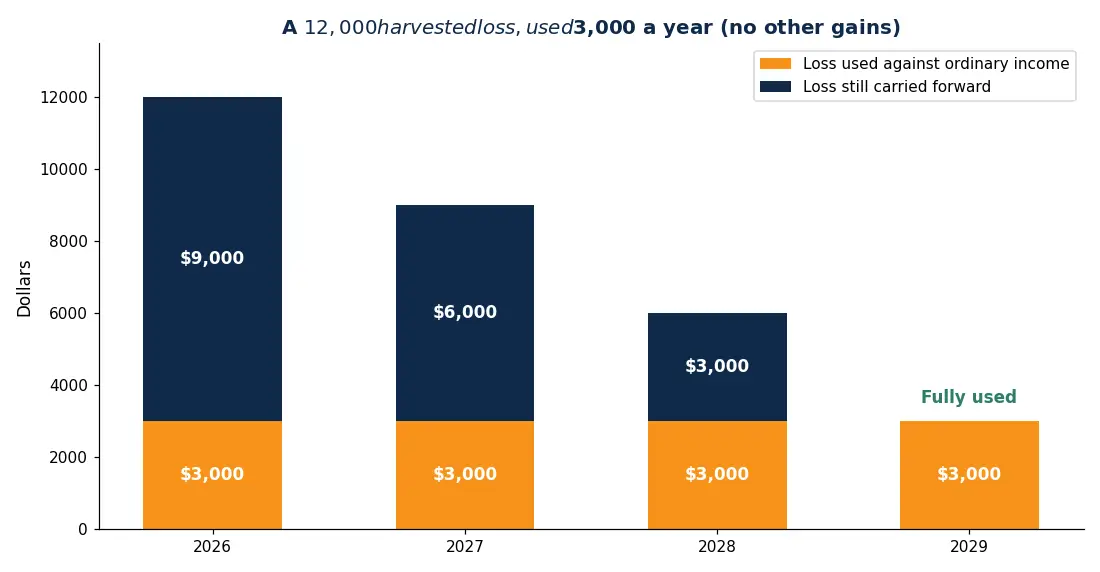
The tax saved depends on your marginal rate. At 22 percent, each $3,000 offset saves $660, or $2,640 over four years.
At 37 percent, each year saves $1,110, or $4,440 in total. The loss never expires.
If you die with unused losses, they die with you, but while you live they carry forward year after year.
Now change one fact. Say you also sold another asset at a $4,000 gain in 2026.
The IRS applies losses in a fixed order. Your $12,000 loss first cancels the $4,000 gain, dollar for dollar.
Then $3,000 of the remaining $8,000 offsets ordinary income in 2026. The last $5,000 carries forward.
Gains always get offset before ordinary income does.
Short Term vs Long Term: Why Holding Period Changes the Math
Not all losses are equal. The IRS sorts capital gains and losses into short term and long term.
Short term means you held the asset for one year or less. Long term means you held it for more than one year.
The split changes your tax rate, and it changes which losses offset which gains.
Short term gains are taxed as ordinary income. That can mean a rate as high as 37 percent in 2026.
Long term gains get preferential rates of 0 percent, 15 percent, or 20 percent, depending on your taxable income. The gap between 37 percent and 15 percent is the reason holding period matters so much.
Losses follow a matching order. Short term losses first offset short term gains.
Long term losses first offset long term gains. Only after that matching can a leftover loss in one group offset gains in the other group.
A long term loss is less valuable when it offsets a long term gain that would have been taxed at only 15 percent, and more valuable when it reaches ordinary income taxed at your full marginal rate.
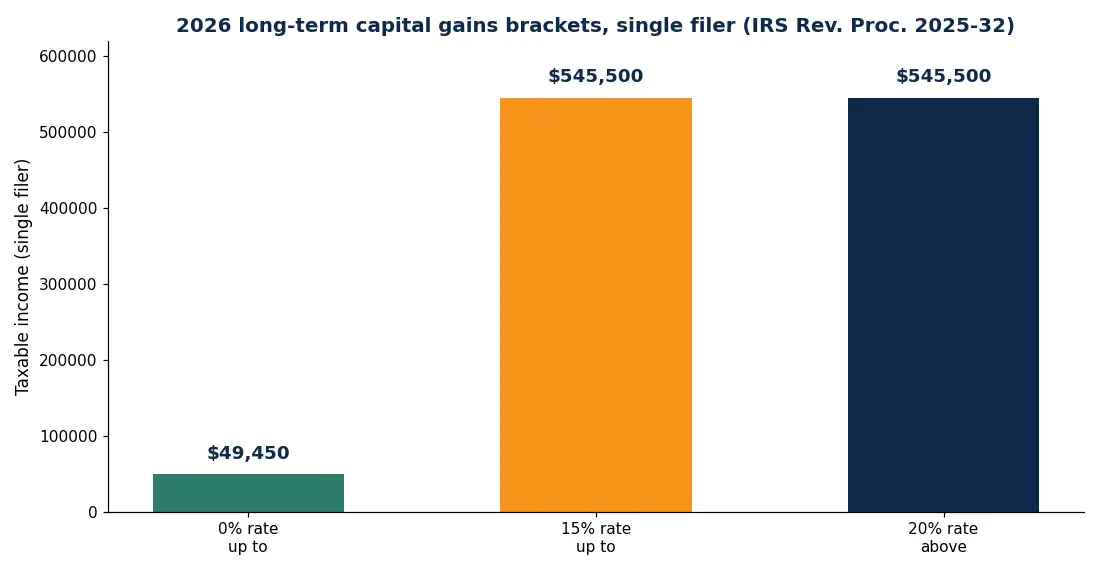
The 2026 long term rates come from IRS Revenue Procedure 2025-32. For single filers, the 0 percent rate covers taxable income up to $49,450.
The 15 percent rate runs up to $545,500. Above that, the rate is 20 percent.
For married couples filing jointly, the 0 percent rate covers income up to $98,900, and the 15 percent rate runs up to $613,700.
| 2026 long term rate | Single filer | Married filing jointly |
|---|---|---|
| 0% | Up to $49,450 | Up to $98,900 |
| 15% | $49,451 to $545,500 | $98,901 to $613,700 |
| 20% | Above $545,500 | Above $613,700 |
One more layer applies to high earners. A 3.8 percent net investment income tax applies above $200,000 of modified adjusted gross income for single filers, and above $250,000 for joint filers.
It stacks on top of the capital gains rate. Our guide to calculating Bitcoin capital gains tax walks through the full rate math with examples.
The Wash Sale Rule Does Not Apply to Bitcoin You Hold Directly
The wash sale rule sits in Section 1091 of the tax code. It blocks a loss deduction when you sell stock or securities at a loss and buy substantially identical stock or securities within 30 days before or after the sale.
That is a 61 day window. Sell a stock at a loss, buy it back the next day, and the IRS refuses the deduction.
Bitcoin escapes the rule because of how the IRS classifies it. IRS Notice 2014-21 says virtual currency is treated as property for federal tax purposes.
Section 1091 covers stock or securities only. Property sits outside its text.
The Joint Committee on Taxation summed up the present law the same way: digital assets are not expressly within the scope of Section 1091, and the IRS has issued no guidance applying the wash sale rule to them.
That means you can sell Bitcoin at a loss at 2 p.m. and buy it back at 2:01 p.m. on the same exchange. The loss stands.
Your cost basis resets to the new purchase price. No 30 day wait applies.
This is the single biggest difference between harvesting crypto losses and harvesting stock losses, and it is the reason the strategy works so well for Bitcoin holders.
The rule has one hard edge. It applies to securities, and some crypto products are securities.
Shares of a spot Bitcoin ETF are exchange traded securities. Sell IBIT or FBTC shares at a loss and rebuy the same ETF within 30 days, and the loss is disallowed.
The same logic covers crypto related stocks and tokenized securities. Only coins you hold directly enjoy the exemption.
September saw $2.65 billion flow into Bitcoin ETFs, so a growing number of holders now sit on the securities side of this line without knowing it.
The 2026 Bill That Could Close the Loophole
The loophole has survived for years, but 2026 brought it closer to closing than ever before. H.R. 10357, the Digital Asset Tax Certainty Act, would extend the wash sale rule to traded digital assets.
The House Ways and Means Committee approved the bill by 38 votes to 5 on September 16, 2026. The vote was bipartisan, with 12 committee Democrats joining every committee Republican.
The bill is not law. It still needs a vote by the full House, a vote by the Senate, and the president’s signature.
No timing for further House action has been announced. The House adjourned early for the November 3 midterm elections, and the bill has not reached the floor.
A separate Senate tax proposal, the ADAPT Act introduced on October 22, would also extend wash sale and constructive sale rules to digital assets. Neither measure has become law as of November 9, 2026.
The detail that matters most is the effective date in the committee’s amended text. The wash sale change would apply to sales after September 14, 2026, the day the bill was introduced.
If the bill passes in that form, a loss harvested and bought back after that date could be disallowed retroactively. That risk is real, but it is not certain.
Bills change as they move, and this one may never reach a vote.
| What you sell | Wash sale rule today | Under H.R. 10357 as amended |
|---|---|---|
| Bitcoin held directly | Not covered | Covered for sales after Sept 14, 2026 |
| Spot Bitcoin ETF shares | Covered already | Covered, no change |
| Tokenized securities | Covered already | Covered, no change |
| Stablecoins | Not covered | Qualified US dollar stablecoins excluded |
What should you do with this uncertainty? Do not panic, and do not assume the bill will pass unchanged.
But do not ignore it either. If you plan to harvest losses in late 2026, keep complete records of every sale and rebuy, including dates and times.
If the bill passes with the September 14 effective date, clean records are your best defense. And if you hold ETF shares rather than coins, the wash sale rule already applies to you today, bill or no bill.
The Wallet by Wallet Basis Trap
Most guides skip this rule, and it is the one most likely to inflate a 2026 tax bill. Since January 1, 2025, cost basis must be tracked wallet by wallet and account by account.
Revenue Procedure 2024-28 ended the old practice of pooling all holdings of one coin across every exchange and wallet into a single universal pool.
Here is why it matters for harvesting. Say you hold Bitcoin in two places.
Your exchange account holds coins you bought at $90,000. Your cold wallet holds coins you bought at $40,000.
You sell from the exchange account at $75,000. The loss is measured against the exchange account’s basis only.
You cannot reach into the cold wallet’s $40,000 basis to turn the sale into a bigger gain, and you cannot use the cold wallet’s cheap coins to erase the exchange loss.
Transfers between your own wallets are still not taxable events. The basis travels with the coins into the receiving wallet.
But once the coins land, future sales from that wallet use that wallet’s basis pool alone. If your tax software still computes gains across all wallets combined, its output no longer matches what the IRS expects, and a Form 1099-DA reconciliation can flag the difference.
The IRS gave taxpayers a one time safe harbor to split pooled basis across wallets as of January 1, 2025. That window has closed for most filers.
The deadline was the earlier of your first 2025 sale of that asset or the due date of your 2025 return. If you never made the allocation, the default FIFO rule applies inside each wallet, using whatever basis records you can prove.
FIFO vs HIFO vs Specific Identification
When you sell part of a holding, the IRS needs to know which coins you sold. The answer decides whether you report a gain or a loss.
Three methods exist, and the choice can move your tax bill by tens of thousands of dollars.
FIFO, first in first out, is the default. The IRS assumes you sold your oldest coins first.
HIFO, highest in first out, means you sell your most expensive coins first. Specific identification means you point to exact units, by acquisition date or transaction hash, and sell those.
Specific identification is the most powerful method for harvesting, and it demands the best records.
Take a real example. You bought 1 BTC at $40,000 in 2023.
You bought another 1 BTC at $90,000 in early 2026. In December 2026, Bitcoin trades at $75,000 and you sell 1 BTC.
Under FIFO, you sold the $40,000 lot, so you report a $35,000 gain. Under specific identification of the $90,000 lot, you report a $15,000 loss.
Same sale, same price, a $50,000 swing in taxable income.
| Method | Lot sold | Result at $75,000 sale price |
|---|---|---|
| FIFO (default) | 2023 lot, $40,000 basis | $35,000 gain |
| HIFO / specific ID | 2026 lot, $90,000 basis | $15,000 loss |
| Difference | Same 1 BTC sold | $50,000 swing in taxable income |
Specific identification has rules. For broker held units, IRS relief lets you identify units by a record made before the sale, or by a standing rule such as highest cost first, recorded in your own books before the sale.
That relief was extended through the end of 2026. You cannot pick the expensive lot after the sale and rewrite history.
Decide the method, write it down, then sell.
The wallet by wallet rule stacks on top of this. Identification happens inside the wallet where the sale occurs.
A specific identification that points to coins sitting in a different wallet does not work. Check which wallet holds the high basis lot before you place the order.
Form 1099-DA: What Your Broker Reports in 2026
Form 1099-DA is the IRS form for digital asset sales. Brokers began reporting gross proceeds for sales on or after January 1, 2025.
The first forms arrived in early 2026, and they showed proceeds only. The basis boxes were blank.
That created a trap for anyone who copied the proceeds figure onto a return without subtracting basis. Proceeds are not profit.
Cost basis reporting phases in for 2026. For digital assets acquired on or after January 1, 2026 and held in the same broker account until sale, brokers must report basis alongside proceeds.
The first forms carrying basis data will arrive in early 2027, when you file your 2026 return. Assets bought before 2026, or moved between platforms, stay noncovered.
Your broker has no duty to report their basis, so the number on the form may be blank or wrong, and the correct figure lives only in your records.
Six transaction types stay temporarily exempt from broker reporting, including some staking, wrapping, and lending transactions. Noncustodial wallets and self hosted addresses get no 1099-DA at all.
Those gains and losses exist only in your records. Reconcile your own books against every 1099-DA you receive before you file.
A mismatch between your return and the IRS copy is the fastest route to a CP2000 notice.
Our Bitcoin tax guide covers how Bitcoin is taxed around the world in 2026, including the US reporting forms and the rules in other major countries. The picture differs sharply outside the US.
India, for example, taxes crypto gains at a flat 30 percent with a 1 percent TDS, and our India crypto tax guide for 2026 explains the new rules that took effect there this year.
Common Mistakes That Cost Bitcoin Holders Money
The rules are unforgiving about paperwork. Most harvesting mistakes are not about the law.
They are about records, timing, and assumptions that quietly fail.
The first mistake is harvesting an ETF loss like a coin loss. Spot Bitcoin ETF shares are securities, so the wash sale rule applies.
Sell IBIT at a loss and rebuy it 10 days later, and the loss is disallowed and added to the new shares’ basis. If you want the crypto exemption, hold the coins directly.
BlackRock’s PBIT ETF adds another twist, since it holds no Bitcoin at all, yet its shares are still securities for wash sale purposes.
The second mistake is trusting pooled basis. Tax software that still nets all wallets together will compute the wrong gain or loss for 2026.
Check that your tool tracks basis per wallet and per account. If it cannot, switch tools or keep a manual ledger before the year ends.
The third mistake is forgetting fees. Fees add to your basis when you buy and reduce your proceeds when you sell.
A harvest that ignores fees overstates the loss. Small fees add up across many trades, and the IRS expects exact numbers.
The fourth mistake is harvesting without a plan for the rebuy. Selling at a loss and forgetting to rebuy leaves you out of the market.
Bitcoin can move 10 percent in a day. Decide the rebuy price and timing before you sell, and place the order the same day if you intend to stay invested.
The fifth mistake is assuming the loss is free money. Harvesting defers tax, it does not erase it.
The rebought coins carry a lower basis, so a future sale produces a larger gain. The strategy pays when your rate today is higher than your rate later, or when the loss offsets gains that would have been taxed at high short term rates.
Your 2026 Year End Checklist
The clock is the whole story now. You have until December 31, 2026 to harvest losses for the 2026 tax year.
Use the remaining weeks well. Start with the records, then make the trades, then file cleanly.
- List every losing lot, wallet by wallet. Write down the purchase date, cost basis, and current value for each lot in each wallet and account.
- Pick your identification method. Decide FIFO or specific identification before you sell, and record the choice in writing.
- Separate coins from ETF shares. Coins you hold directly escape the wash sale rule. ETF shares do not. Treat them as different strategies.
- Execute sales before December 31. Leave a buffer of several days for failed orders, exchange outages, and slow confirmations.
- Rebuy deliberately, or do not rebuy. If you want to stay invested, buy back at once under current law. If you want out, stay out and keep the cash.
- Reconcile every 1099-DA. When the forms arrive in early 2027, match each one against your records before you file. Fix mismatches first.
- File Form 8949 and Schedule D. Report every sale, even the ones you rebought the same day. Unreported sales invite IRS notices.
- Watch H.R. 10357. If the bill advances, check whether its effective date covers your sales. Keep your sale records with dates and times.
Tax loss harvesting rewards the organized and punishes the careless. The loss is already yours.
The only question is whether you claim it before the year closes, or let it sit unused while the calendar turns. Switzerland approved its first spot Bitcoin ETF this year, and new products keep changing how people hold Bitcoin, so the line between coins and securities will only get more important.
Check which side of that line your holdings sit on, then harvest before December 31.
Frequently Asked Questions
These are the questions Bitcoin holders ask most about tax loss harvesting in 2026.
Is Bitcoin tax loss harvesting legal in 2026?
Yes. Selling Bitcoin at a loss and claiming the loss is legal under current US tax law.
The IRS treats Bitcoin as property, and property losses are deductible within the normal capital loss rules. You must report every sale on Form 8949, and the loss must be real, with a genuine sale at market price.
Does the wash sale rule apply to Bitcoin in 2026?
No, not to Bitcoin you hold directly. The wash sale rule in Section 1091 covers stock or securities, and the IRS classifies Bitcoin as property.
You can sell at a loss and rebuy immediately without losing the deduction. The rule does apply to spot Bitcoin ETF shares, because those shares are securities.
A pending bill, H.R. 10357, would extend the rule to digital assets, but it has not become law.
What is the deadline to harvest losses for the 2026 tax year?
December 31, 2026. The sale must occur in the 2026 tax year to count on your 2026 return.
A sale on January 1, 2027 belongs on your 2027 return. Leave several days of buffer, because exchange outages or failed orders can push a trade into January.
How much of a capital loss can I deduct per year?
After your losses offset your capital gains, you can deduct up to $3,000 of the remaining net loss against ordinary income each year, or $1,500 if you are married filing separately. Unused losses carry forward to future years with no time limit.
A $12,000 net loss with no gains takes four years to use at $3,000 per year.
Can I harvest losses on Bitcoin ETF shares?
Yes, but the wash sale rule applies. If you sell ETF shares at a loss and buy the same ETF within 30 days before or after the sale, the loss is disallowed and added to the basis of the new shares.
To keep the loss, wait more than 30 days before rebuying, or buy a different fund that is not substantially identical.
Do I have to report a loss harvest if I rebuy right away?
Yes. Every sale must be reported on Form 8949, even if you rebought the same asset minutes later.
Your broker reports the sale to the IRS on Form 1099-DA, so an unreported sale creates a mismatch. Report the sale, the proceeds, the basis, and the loss, then report the rebuy as a new purchase with its own basis.
What happens to unused capital losses?
They carry forward to the next tax year, and they keep carrying forward until they are fully used. There is no expiration date.
Short term carryover losses offset short term gains first in later years, and long term carryover losses offset long term gains first, before any remainder can offset ordinary income up to the $3,000 annual limit.
Sources
- IRS: Digital Assets, the IRS hub for digital asset tax guidance, including property treatment and reporting rules.
- IRS Topic No. 409: Capital Gains and Losses, the IRS explanation of capital gains, losses, the $3,000 limit, and carryover rules.
- Congress.gov: H.R. 10357, Digital Asset Tax Certainty Act, the bill text and official status, showing committee approval on September 16, 2026 and no House vote yet.