


Russia’s central bank has opened the door to Bitcoin for ordinary Russians. From November 17, 2026, non-qualified investors can buy Bitcoin, Ether and Tether’s USDT through licensed brokers, asset managers and crypto exchanges.
The door is narrow. Purchases are capped at 300,000 roubles a year through each intermediary, and every buyer must pass a test first.

Crypto still cannot pay for anything in Russia. The headline sounds like a breakthrough, but the small print tells a different story.
- What the Bank of Russia actually decided
- The 300,000-rouble cap, worked out in real money
- How an ordinary Russian buys Bitcoin from November 17
- What is still banned
- Why this is a U-turn, not a warm welcome
- Two dates that matter: November 17 and December 1
- Why it matters beyond Russia
- Frequently Asked Questions
- The bottom line
Key takeaways
- Retail Bitcoin trading starts November 17, 2026, under Bank of Russia Indication No. 7441-U.
- Only three assets made the list: Bitcoin, Ether and USDT.
- Annual cap: 300,000 roubles (about $3,652) per intermediary.
- Every buyer must pass a knowledge test and read the risks first.
- Moscow Exchange plans pilot crypto trading from December 1, 2026.
What the Bank of Russia actually decided
The Bank of Russia published its decision on November 6, 2026. The document is Indication No. 7441-U, signed by Governor Elvira Nabiullina on September 11 and registered by the Ministry of Justice on October 30 under number 88991.
The indication takes effect on November 17, ten days after official publication. From that date, trading organisers may admit the three listed assets to public circulation on organised trades.
The three assets on the list
Bitcoin and Ether made the list as digital currencies. Tether’s USDT joined them as a foreign digital instrument, a separate legal category under the same framework.
The central bank picked them on three tests: market capitalisation, average daily trading volume, and at least five years of price history on foreign exchanges. “Only the most liquid assets made the list,” the Bank of Russia said in its statement.

The law behind the decision
The indication sits under Federal Law No. 282-FZ, signed on August 4, 2026. Its main provisions took effect on September 1, and an August consultation had already named the same three assets and the same cap.
Qualified investors face no cap and can buy any crypto asset. The new rules change life only for ordinary, non-qualified investors, who had no legal route to crypto on a regulated exchange before this.
The 300,000-rouble cap, worked out in real money
The cap sounds large in roubles. It shrinks fast in dollars and Bitcoin.
At the central bank’s official rate for November 7, 82.1386 roubles to the dollar, 300,000 roubles is worth about $3,652. That is the full yearly allowance through one broker.
| What the yearly cap buys | Amount |
|---|---|
| In US dollars | About $3,652 |
| In Bitcoin (at $75,984 on Nov 6) | 0.048 BTC |
| In Ether (at $2,226 on Nov 6) | 1.64 ETH |
| Per month, if spread evenly | 25,000 roubles, about $304 |
A full year of permitted buying adds up to less than a twentieth of one Bitcoin. Spread across twelve months, the allowance is about $304 a month.
The per-intermediary detail that changes the math
The cap applies per intermediary, not per person. An investor with accounts at three brokers could in principle buy 900,000 roubles of crypto a year, about $10,957 at the same rate.
The cap also counts what you spend, not what you hold. If Bitcoin doubles after you buy it, your position can grow past 300,000 roubles without breaking the rule.
That detail matters. It keeps the rule aimed at how much new money flows in each year, not at how rich a holder gets.
How an ordinary Russian buys Bitcoin from November 17
The route runs through an intermediary. Retail buyers can use a broker, an asset manager or a crypto exchange, on an exchange or over the counter.
Moscow Exchange is preparing its own crypto market, with pilot trades planned from December 1. Sberbank, Russia’s largest bank, won permission to offer crypto exchange services in October.
- Pass the knowledge test and confirm you have read the risks.
- Open an account with a broker, asset manager or licensed crypto exchange.
- Buy BTC, ETH or USDT up to the 300,000-rouble yearly cap through that intermediary.
- Hold the assets through a licensed depository or keep records through the intermediary.
The test every buyer must pass
Nobody skips the test. Qualified investors skip the cap, but they still sit the same questionnaire and read the same risk notice.
The test is free under the federal law, and a pass stays valid for one year. The central bank has not published the test questions, so buyers will see them first when brokers open the process.
Russia’s major banks have been gearing up for crypto services for months, and several already hold the licences they need.
What is still banned
The new rules open investment. They do not open crypto as money.
Paying for goods and services with cryptocurrency inside Russia stays illegal. That ban is not touched by this decision.
Direct peer-to-peer trades between individuals will also close. The Bank of Russia has confirmed that P2P transactions will no longer be permitted from July 1, 2027.
That last point bites. Russians who bought Bitcoin without ID through informal channels will lose their main route, and the regulated market caps them at $3,652 a year per broker.
The message is clear. Crypto is welcome as a small, supervised investment, not as an alternative to the rouble.
Why this is a U-turn, not a warm welcome
Russia spent years treating retail crypto as a danger. The central bank once pushed for a full ban on buying and mining crypto, and ordinary Russians could only reach Bitcoin through grey channels.
Moscow changed course in stages. Russia legalized crypto mining in 2024, and the August 2026 law built the legal frame for regulated trading.
This decision completes that turn, but it keeps the state firmly in control. Three assets, one cap, one test and a ban on payments make it permission with a leash.
The timing also matters. Bitcoin has fallen hard this month, and the market mood is weak, so the central bank picked a cautious moment to open a cautious door.
Two dates that matter: November 17 and December 1
November 17 is a permission, not a launch. Exchanges may admit the assets to public trading from that day, but nothing forces them to start that morning.
December 1 is the date to watch. Moscow Exchange plans to start digital-currency trading then, beginning with pilot transactions and adding participants gradually.
| Date | What happens |
|---|---|
| Aug 4, 2026 | Federal Law No. 282-FZ signed |
| Sept 1, 2026 | Main provisions of the law take effect |
| Sept 11, 2026 | Indication No. 7441-U signed |
| Oct 30, 2026 | Indication registered by the Ministry of Justice (No. 88991) |
| Nov 6, 2026 | Bank of Russia publishes the decision |
| Nov 17, 2026 | Rules take effect; exchanges may admit BTC, ETH, USDT |
| Dec 1, 2026 | Moscow Exchange plans pilot crypto trading |
| Jul 1, 2027 | Direct P2P crypto trades banned |
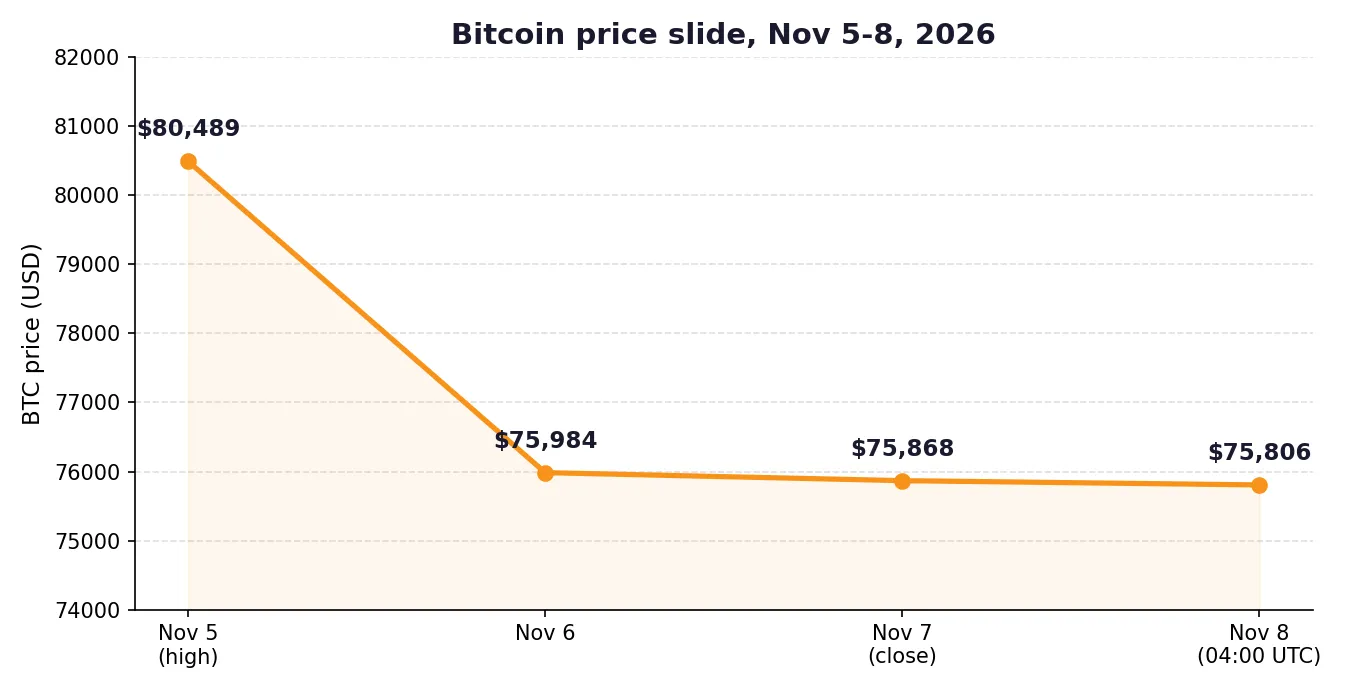
Bitcoin itself arrives at this moment in a weak state. It hit a high of $80,489 on November 5, then slid to about $75,806 by the morning of November 8, a drop of nearly 6 percent in three days.
US spot Bitcoin ETFs have been bleeding money through the same selloff, with the longest streak of daily net outflows on record.
Bitcoin slipped below $76,000 this week, and a $2.65 billion options expiry added to the pressure.
Why it matters beyond Russia
Russia is not a small market. A country of 140 million people just gave its citizens a legal way to buy Bitcoin, even a small one.
Other governments watch these experiments closely. A capped, tested, exchange-only model is the kind of compromise regulators in other countries can copy.
The cap also sets a precedent worth watching. If Moscow raises it later, that will signal real confidence, and if it stays at $3,652, this stays a symbolic opening.
For now, the honest read is simple: Russia did not embrace Bitcoin. It licensed a small piece of it on its own terms and kept the rest locked away.
Frequently Asked Questions
When can Russian retail investors buy Bitcoin?
From November 17, 2026. That is when Bank of Russia Indication No. 7441-U takes effect and exchanges may admit Bitcoin, Ether and USDT to public trading.
How much Bitcoin can a Russian retail investor buy in a year?
Up to 300,000 roubles a year through each intermediary, about $3,652 at the central bank’s November 7 rate. At Bitcoin’s November 6 price of $75,984, that buys about 0.048 BTC.
Which cryptocurrencies can Russian retail investors buy?
Three only: Bitcoin, Ether and Tether’s USDT. Qualified investors can buy any crypto asset with no cap.
Do Russian investors need to pass a test before buying crypto?
Yes, every investor must pass a knowledge test and confirm they have read the risks before the first transaction. The test is free and a pass stays valid for one year.
Can Russians pay for goods with Bitcoin?
No. Paying for goods and services with cryptocurrency inside Russia stays illegal. Direct peer-to-peer trades between individuals will also be banned from July 1, 2027.
When does Moscow Exchange start crypto trading?
Moscow Exchange plans to start with pilot transactions on December 1, 2026, adding participants gradually. November 17 only permits exchanges to admit the assets.
The bottom line
Russia opened Bitcoin to its people this week, and then told them how little they may buy. The cap, the test and the payment ban define the decision more than the headline does.
Watch December 1. If Moscow Exchange’s pilot runs smoothly and brokers open accounts on time, the cap may rise in time, but if it stalls, November 17 will stand as a permission that changed little.
Either way, the direction is set. Russia spent years keeping retail investors out of crypto, and now it lets them in, 300,000 roubles at a time.