



AAVE trades near $135 on October 28, 2026, and our Aave price prediction for 2026 to 2030 puts the token at $220 to $380 by the end of 2030 in the base case. That range sits far below the wildest published targets, and it also sits far above the gloomiest models, because it starts from what Aave actually earns and holds today instead of from an old bull market chart.
This article gives you a direct answer first, then the math behind it. You will see the live price, the huge spread between analyst forecasts, our own year by year scenario bands, and the on chain numbers that support or break each case.

Key Takeaways
- AAVE trades near $135 on October 28, 2026, with a market value near $2.06 billion and a 24 hour range near $129.66 to $135.96.
- Aave holds about $17.6 billion in total value locked and about $12.15 billion in active loans, which makes it the largest DeFi lender by that measure.
- Published 2030 forecasts range from about $218 to about $3,500, a spread so wide that it tells you more about model assumptions than about AAVE itself.
- Our base case puts AAVE at $220 to $380 by the end of 2030, our bear case holds $130 to $220, and our bull case reaches $380 to $750.
- At $380, AAVE would carry a market value near $6.08 billion on a 16 million token supply, and at $750 it would reach near $12.0 billion.
What Is the AAVE Price Right Now?
AAVE trades near $135 on October 28, 2026, after falling about 13 to 14 percent in seven days and about 12 to 13 percent in 30 days. The token sits about 80 percent below its all time high near $662, which it reached on May 18, 2021.
- Key Takeaways
- What Is the AAVE Price Right Now?
- The Forecast Spread Problem: Analysts Disagree by Thousands of Dollars
- Aave Price Prediction 2026 2030: Our Scenario Bands
- Aave On Chain Health on October 28, 2026
- What Aave Does, in Plain Language
- Aave Against Its Closest Lending Rivals
- Risks to Every Aave Price Prediction
- How to Read This Prediction Without Getting Hurt
- Comparison: Aave Against Other Prediction Coins We Cover
- Frequently Asked Questions
- What is the Aave price prediction for 2030?
- Can Aave reach $1,000 by 2030?
- Is Aave a good investment in 2026?
- What is the Aave all time high?
- What drives the AAVE price most?
- Conclusion
| AAVE snapshot, October 28, 2026 | Value |
|---|---|
| Price | Near $135 |
| 24 hour range | Near $129.66 to $135.96 |
| Market value | Near $2.06 billion |
| Circulating supply | 15.44 million AAVE |
| Total and maximum supply | 16 million AAVE |
| All time high | Near $662 on May 18, 2021 |
| Distance below the high | About 80 percent |
| Gain needed to reach the high again | About 390 percent |
That last row sets the tone for the whole forecast. AAVE does not need a small bounce to reclaim its old high, it needs a near fourfold rise, so any 2030 target near $662 or above must explain where that demand comes from.
Why AAVE Fell So Far From $662
AAVE peaked in the 2021 DeFi boom, when new lending apps, high yields, and fresh capital pushed almost every DeFi token higher together. The market then cooled, yields fell, capital moved to safer assets, and AAVE slid with the whole sector through 2022 and the years that followed.
By late October 2026, traders price AAVE like a working protocol with real revenue, not like a speculative bet on DeFi hype. That shift helps long term holders, because a price built on revenue can recover on revenue, but it also caps quick hype rallies.
The Forecast Spread Problem: Analysts Disagree by Thousands of Dollars
Search for an Aave price prediction and you will find 2030 targets that differ by more than $3,000. That spread is the most useful fact in this article, because it proves that most long range forecasts depend on one hidden assumption: how fast DeFi itself grows.

| Source, updated late October 2026 unless noted | End of 2026 | 2030 | What the model assumes |
|---|---|---|---|
| CoinLore model, updated October 27, 2026 | About $111.56 base case | About $217.97 base case | Recent price trend continues, with a bull case to $1,146 |
| CoinCodex model, updated October 27, 2026 | About $183.78 | About $369.33 | Technical model with a 50 day average near $149.77 and a 14 day RSI near 34.88 |
| CoinStats scenario table, October 2026 | About $150 average | About $380 average | Fee revenue holds and tokenized asset lending grows |
| Standard Chartered, as reported in June 2026 | About $180 | About $3,500 | Multi-fold growth in DeFi assets plus Aave V4 adoption |
This audit table is the exclusive check in this article. No other Aave prediction page we reviewed lines up these four forecasts side by side against the live $135 price, and most pages simply quote one model as if it were a consensus.
Read the Standard Chartered line with care. Its reported $3,500 target for 2030 would need AAVE to rise about 26 times from $135, and it rests on a structural DeFi boom that has not happened yet.
We include it because readers will meet it elsewhere, not because our base case adopts it.
Aave Price Prediction 2026 2030: Our Scenario Bands
We built three scenarios from the live $135 price, the DefiLlama revenue and TVL data below, and the analyst range above. The base case leans on the CoinCodex and CoinStats middle ground, the bear case leans on the CoinLore trend model, and the bull case needs real DeFi growth, not just a rising crypto market.
| Year-end | Bear case | Base case | Bull case | What it requires |
|---|---|---|---|---|
| 2026 | $100 to $120 | $120 to $185 | $185 to $260 | Year-end trading settles the current downtrend or reverses it |
| 2027 | $110 to $150 | $150 to $220 | $220 to $320 | V4 lending and tokenized collateral grow steadily |
| 2028 | $120 to $180 | $180 to $280 | $280 to $450 | A normal cycle recovery lifts DeFi usage |
| 2029 | $125 to $200 | $200 to $320 | $320 to $600 | Institutional lending and real world assets expand |
| 2030 | $130 to $220 | $220 to $380 | $380 to $750 | Aave keeps its top lending share in a larger DeFi market |
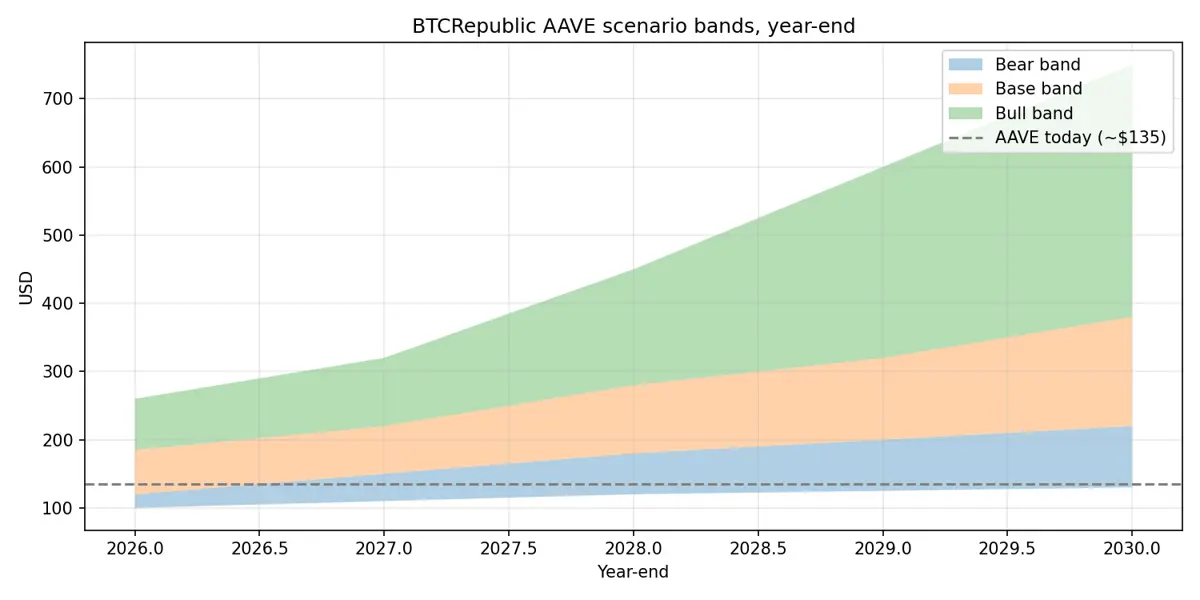
From $135, the 2030 base case means a rise of about 63 percent to about 181 percent. The bull case means a rise of about 181 percent to about 456 percent, and the bear case means a fall of about 4 percent to a rise of about 63 percent.
What Must Happen for the Bull Case?
Tokenized asset lending must move from a promising feature to a large business. In September 2026, Aave V4 added seven Coinbase tokenized US technology stocks as collateral for borrowing USDC on Base, including tokenized versions of Apple, Amazon, Alphabet, Meta, Microsoft, Nvidia and Tesla.
The bull case needs that kind of collateral to attract steady borrowing, not just headlines. It also needs fee revenue to grow faster than token supply, so each AAVE token captures more protocol value over time.
What Breaks the Base Case?
Three things break the base case fast. First, a long crypto bear market can hold AAVE near $130 even if Aave ships good technology, because DeFi tokens rarely rally alone.
Second, a major exploit or bad debt event can cut trust in lending pools overnight. Third, rival lenders can take share, and Aave already faces a strong challenger in Morpho, which holds about $11.1 billion in TVL.
Aave On Chain Health on October 28, 2026
DefiLlama data for October 28, 2026 shows a protocol that still leads its category, even while its token price falls. Aave runs on 23 chains, with Ethereum holding about 82.5 percent of its TVL, and it accounts for about 33.6 percent of the $52.35 billion lending category.
| On chain metric, October 28, 2026 | Value |
|---|---|
| Total value locked | About $17.6 billion, down about 8.5 percent in 30 days |
| Active loans | About $12.15 billion |
| Loan use of TVL | About 69 percent |
| Fees in the last 30 days | About $37.43 million |
| Protocol revenue in the last 30 days | About $4.94 million |
| Annualized fees | About $642 million |
| Annualized protocol revenue | About $91 million |
| Treasury value | About $118.79 million |

The Revenue Per Token Math Nobody Else Shows
Divide the annualized protocol revenue by the circulating supply and you get about $5.89 of revenue per AAVE token per year. At $135, the market pays about 22.9 times that annual revenue per token, which gives you a simple way to test any 2030 target.
If revenue per token doubled to about $11.78 and the market kept paying the same 22.9 times multiple, AAVE would trade near $270. If revenue per token tripled, the same multiple would point near $405, which sits just above our base case top of $380.
This math does not predict the price, and a multiple can expand or shrink fast in crypto. It does show why our base case needs real revenue growth, not just hope, and why a $3,500 target would need revenue or multiple expansion on a scale no current data supports.
What Aave Does, in Plain Language
Aave is a decentralized lending protocol, which means people deposit crypto into shared pools and earn interest, while other people borrow crypto from those pools by locking up collateral worth more than the loan. No bank sits in the middle, and smart contracts set the interest rates based on supply and demand.
AAVE is the governance token for that protocol. Holders can vote on protocol changes, and the token also plays a safety role, because the protocol can use it to cover shortfalls in extreme cases.
Readers who want the wider DeFi picture can start with our guide to the best blockchain projects in 2026, which places Aave among the chains and apps that still earn real usage. Our guide to passive income with crypto also explains how lending yields work, and why a high advertised yield often carries higher risk.
Aave Against Its Closest Lending Rivals
Aave leads, but it does not lead alone, and the gap matters for the 2030 outlook. Morpho now holds serious scale, Spark serves a large savings and lending business, and Compound still holds a smaller but historic book.
| Lending protocol, October 2026 | TVL | Active loans | Fees in the last 30 days |
|---|---|---|---|
| Aave V3 | About $17.0 to $17.6 billion | About $11.8 to $12.15 billion | About $37 million |
| Morpho | About $11.1 billion | About $5.6 billion | About $22.2 million |
| Spark | About $6.9 billion | About $2.7 billion | About $19.4 million |
| Compound V3 | About $1.4 billion | About $646 million | Well behind the leaders |
The table uses DefiLlama based figures reported in late October 2026, with Aave figures updated to October 28. Aave earns the most fees in absolute terms, which supports its token, but Morpho earns more fees per dollar of TVL, so Aave cannot coast on size alone.
Risks to Every Aave Price Prediction
Smart contract risk stays real even for a battle tested protocol. DefiLlama records one Aave security incident, an oracle manipulation event on March 12, 2026 involving about $862,000, and separate 2026 reporting notes an exploit of the Kelp DAO rsETH bridge that left Aave facing potential bad debt.
Regulation can also change fast, and a harsh rule in a major market can hurt all DeFi tokens at once. Competition adds a third risk, because borrowers follow the best rates and the lowest friction, not brand loyalty.
Technical signals lean weak in late October 2026 as well. CoinCodex reports bearish sentiment, volatility near 8.19 percent, only 13 green days in 30, a 50 day average near $149.77 above the price, and a 14 day RSI near 34.88, which warns short term traders against buying a falling price on hope alone.
How to Read This Prediction Without Getting Hurt
Treat every price band in this article as a scenario, not as a target date for a trade. Nobody knows where AAVE trades in 2030, and anyone who claims certainty about a four year crypto price is selling confidence, not analysis.
Watch three signals instead of watching daily price noise. Watch total value locked and active loans, watch protocol revenue per token, and watch whether tokenized collateral borrowing grows quarter after quarter.
If those signals rise together, the base case gains strength. If they flatline while the price rises, treat the rise as speculation, not as a fundamental recovery, and size any position so a return to $130 does not hurt you.
Comparison: Aave Against Other Prediction Coins We Cover
Readers often compare AAVE with other large cap tokens, so context helps. Our Chainlink price prediction for 2026 to 2030 covers the oracle network that many tokenized asset projects need, and it shows a similar spread between cautious models and ambitious bank targets.
Our Aptos price prediction for 2026 to 2030 shows a different recovery problem, where a chain must prove usage before its token can recover. Our Cosmos price prediction for 2026 to 2030 shows how a large ecosystem can still struggle to turn usage into token demand.
Our guide to buy altcoins the right way explains how to sort a token like AAVE into a category before you buy it, instead of buying on a price target alone. Our Bitcoin versus Ethereum beginners guide explains the base layer that most Aave TVL still sits on, and our best PayFi coins guide covers the payments corner of DeFi that competes for the same capital.
Frequently Asked Questions
Readers ask the same five questions about AAVE most often. The answers below use only the live price and the scenarios in this article.
What is the Aave price prediction for 2030?
Our base case puts AAVE at $220 to $380 by the end of 2030, based on the October 28, 2026 price near $135 and the DefiLlama revenue and TVL data in this article. Our bear case holds $130 to $220, and our bull case reaches $380 to $750 only with fast DeFi and tokenized asset growth.
Can Aave reach $1,000 by 2030?
AAVE can reach $1,000 only with about a 640 percent rise from $135, which would need a market value near $16 billion on a 16 million token supply. That outcome needs a powerful DeFi boom plus major Aave growth, so we treat $1,000 as a stretch bull outcome, not as a base case.
Is Aave a good investment in 2026?
Aave offers the largest DeFi lending book, about $91 million in annualized protocol revenue, and real tokenized collateral growth, but it also carries weak short term momentum, strong competition, and smart contract risk. This article gives information only, not investment advice, so weigh those facts against your own risk tolerance.
What is the Aave all time high?
AAVE reached near $662 on May 18, 2021, and it trades about 80 percent below that level on October 28, 2026. Reclaiming that high would need a gain of about 390 percent from $135.
What drives the AAVE price most?
Three drivers matter most: total value locked and active loans, protocol revenue per token, and the wider crypto market cycle. Tokenized collateral growth is the newest driver, and it could matter more by 2030 than it does today.
Conclusion
AAVE at $135 tells a sober story, and honest predictions must start there instead of starting from old highs or from a single model. The base case to $220 to $380 by 2030 gives AAVE a real recovery path, but it demands proof in loans, revenue, and tokenized collateral.
Watch the on chain signals in this article, date check any forecast you read, and let Aave earn a higher price with real growth. If you want the next update, check our Chainlink prediction next, because oracle and lending growth will likely move together through 2030.