


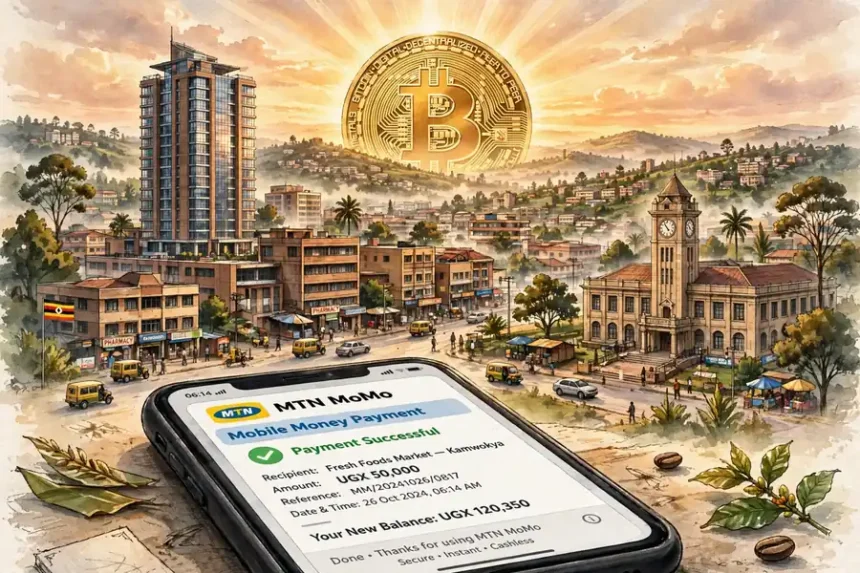
Here is the short answer first. You buy Bitcoin in Uganda by paying in Ugandan shillings through mobile money to a peer-to-peer seller under escrow, or by funding an app like Yellow Card with mobile money and converting that balance to Bitcoin.
Uganda has no locally licensed crypto exchange and no dedicated crypto law. That gap shapes every step in this guide, from the payment method you pick to the records you keep.

This guide is part of our series on how to buy Bitcoin around the world. It follows the same country-guide pattern as our Ghana guide and our Nigeria guide, but every Uganda detail below comes from Uganda sources checked on 26 October 2026.
- Is Bitcoin Legal in Uganda?
- What the Bank of Uganda Has Actually Said
- What the 2023 Court Ruling Changed
- The Late 2025 Six Pillar Plan
- The Route Ugandans Actually Use: Mobile Money P2P
- Step by Step: A Binance P2P Buy With Mobile Money
- The USDT Two Step Many Ugandans Take
- The Yellow Card Route
- What 100,000 UGX Buys Today: The Original Cost Test
- Fees and Costs to Check Before You Confirm
- ID Checks and Your UGX Paper Trail
- Wallets: Move Your Bitcoin Off the Exchange
- Scams and Red Flags in Uganda
- The Kampala Bitcoin ATM: What We Know and Do Not Know
- Common Mistakes Ugandan Beginners Make
- Frequently Asked Questions
- Conclusion
Key takeaways
- Bitcoin is not legal tender in Uganda, and the Bank of Uganda has licensed no firm to sell crypto.
- A 2023 High Court ruling upheld the bar on licensed payment providers converting crypto to mobile money, so expect friction, not a smooth bank route.
- The route Ugandans actually use runs through mobile money P2P: MTN MoMo or Airtel Money, paid to a seller inside escrow.
- At the 26 October 2026 spot rate used in this guide, 100,000 UGX buys about 27,883 satoshis before any seller premium, spread, or network fee.
- Yellow Card lists UGX and mobile money funding, and it asks for national ID verification before you can deposit or withdraw.
- Keep every receipt, screenshot, and transaction reference. Your paper trail is your protection in an unregulated market.
Is Bitcoin Legal in Uganda?
Bitcoin sits in a grey area in Uganda. It is not banned outright, it is not legal tender, and no firm holds a licence to sell it.
That three-part answer matters more than a simple yes or no. It tells you why banks hesitate, why no Ugandan exchange advertises a licence, and why you carry the risk yourself.
What the Bank of Uganda Has Actually Said
The Bank of Uganda has warned the public repeatedly that crypto is unregulated and high risk. Its circular told licensed payment providers to stop dealing with crypto exchanges and to stop converting crypto to mobile money.

The same position appears in the Ministry of Finance statement from October 2019. The government said it had licensed no institution to sell cryptocurrencies or to facilitate crypto trades.
What the 2023 Court Ruling Changed
A High Court ruling in 2023 upheld the Bank of Uganda directive under the National Payment Systems Act. The ruling treated crypto as outside the payments law, which means licensed payment firms cannot legally run the conversion step for you.
Read that ruling carefully, because many summaries overstate it. It bars licensed payment providers from the conversion, and it does not create a criminal offence for an individual who simply owns Bitcoin.
That distinction explains the market you see today. People still trade, but they trade person to person, outside the licensed payment rails.
The Late 2025 Six Pillar Plan
In late November 2025, the Bank of Uganda governor set out six pillars for future crypto regulation. The plan covers supervision, data reporting, and a regulatory sandbox run with the Capital Markets Authority.
The plan is a direction of travel, not a law you can rely on today. Until parliament passes a dedicated virtual assets law, treat Uganda as unregulated and plan accordingly.
The Financial Intelligence Authority already brings virtual asset service providers under anti-money-laundering supervision. Providers must register, run customer checks, file suspicious transaction reports, and keep records for at least ten years.
The Route Ugandans Actually Use: Mobile Money P2P
Most Ugandan buyers start and end with a phone, not a bank branch. MTN MoMo and Airtel Money already reach far more people than card payments do, and P2P sellers accept them.
P2P means you buy from another person, not from the exchange itself. The platform holds the seller’s Bitcoin in escrow until you confirm payment, and that escrow step is the whole safety net.
Step by Step: A Binance P2P Buy With Mobile Money
Open the P2P section, choose Buy, select BTC, and filter the payment method to mobile money. Pick a seller with a completion rate above 95 percent and at least 50 completed trades, and read the limits before you tap anything.
Enter the amount in UGX, for example 100,000 UGX, and check the exact BTC amount the offer promises. The seller’s mobile money number and name appear only after you open the trade, so never pay a number sent to you in a chat message.
Send the exact amount from your MTN MoMo or Airtel Money wallet, keep the confirmation SMS, and take a screenshot. Return to the trade window, tap that you have transferred the money, and wait for the seller to release the Bitcoin from escrow.
Never tap that you have paid before you actually pay. Never release a payment outside the platform, and never accept a seller who asks you to cancel the trade and pay directly.
Binance added fresh weight to this route in October 2026. Its P2P merchant referral campaign, running from 8 October to 7 November 2026, covers Uganda among about 20 African markets, and it rewards merchants only after real completed trades, not signups.
The USDT Two Step Many Ugandans Take
Some buyers first buy USDT, the dollar-pegged stablecoin, with mobile money, then trade USDT for Bitcoin inside the exchange. This route suits you when direct BTC offers look thin or pricey on a given day.
Count the cost honestly before you choose it. You pay a spread or premium on the USDT leg, and you may pay a trading fee on the USDT to BTC leg, so compare the final BTC amount across both routes.
Write both final amounts down before you confirm either trade. The route with the lower headline fee often delivers less Bitcoin, and the final BTC amount is the only number that counts.
The Yellow Card Route
Yellow Card supports Uganda and lists the Ugandan shilling among its supported fiat currencies. Its app lets you deposit with mobile money, buy Bitcoin, Ethereum, or USDT, and withdraw back to mobile money.
Yellow Card asks you to finish account setup before you can deposit or withdraw. That setup includes email verification, national ID details, and address documents, so have your national ID ready before you start.
Yellow Card prices through a spread built into the quote, rather than a separate trading fee you can see line by line. Compare its quoted BTC amount with a P2P offer for the same UGX amount, on the same day, before you decide.
What 100,000 UGX Buys Today: The Original Cost Test
Most Uganda guides quote fees without showing the maths. This section shows the maths, using one dated snapshot, so you can repeat it with live prices on your own buy day.
The snapshot uses Finnhub data checked on 26 October 2026: Bitcoin at $80,308.60 and the dollar at 4,465.79 UGX. Multiply those two numbers and one Bitcoin costs 358,641,343 UGX at spot, before any premium, spread, or fee.
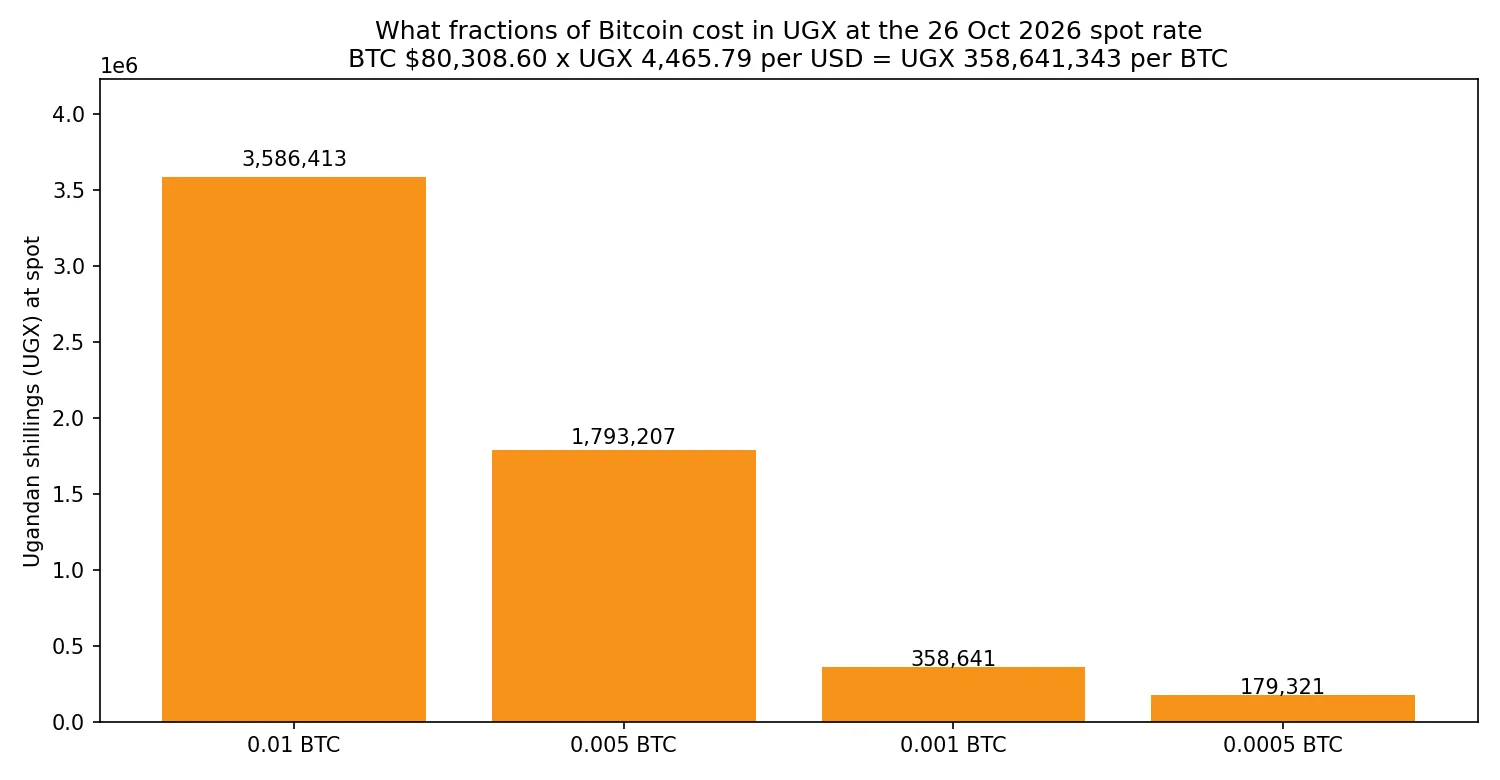
Divide 100,000 UGX by 4,465.79 and you hold $22.39. Divide $22.39 by $80,308.60 and you hold 0.00027883 BTC, which equals 27,883 satoshis at spot.
That figure is a ceiling, not a promise. A P2P seller premium, a Yellow Card spread, or a network withdrawal fee each pulls the final amount below it, and the gap between spot and your final amount is the true cost of your route.
| Amount you spend | Spot value in BTC | Spot value in satoshis |
|---|---|---|
| 50,000 UGX | 0.00013942 BTC | 13,942 satoshis |
| 100,000 UGX | 0.00027883 BTC | 27,883 satoshis |
| 500,000 UGX | 0.00139415 BTC | 139,415 satoshis |
| 1,000,000 UGX | 0.00278830 BTC | 278,830 satoshis |
Run this test again on your buy day with the live price. If a seller offers you far less Bitcoin than the spot maths predicts, walk away and check another offer.
Fees and Costs to Check Before You Confirm
Uganda has no single published fee table, because no licensed local exchange sets one. Your costs hide in four places, and you must check each one before you tap confirm.
The P2P seller premium is the gap between the seller’s UGX price and the spot price. The platform spread is the gap built into an app quote, and the network fee is the amount miners charge to move Bitcoin to your own wallet.
| Cost layer | Where it appears | How to check it |
|---|---|---|
| P2P seller premium | In the seller’s UGX per BTC price | Compare the offer price with the spot maths in this guide |
| App spread | Inside the quoted BTC amount | Compare the quoted BTC with a P2P offer for the same UGX |
| USDT two step cost | Across two trades, not one | Add both legs and compare the final BTC, not each fee alone |
| Network withdrawal fee | On the withdrawal screen | Read the fee before you confirm, and avoid withdrawing tiny amounts often |
| Mobile money charge | On your MoMo confirmation | Check the MoMo fee for your amount before you fund the trade |
Small buys suffer most from fixed fees. A network fee that looks tiny on a 1,000,000 UGX buy can eat a large share of a 20,000 UGX buy, so batch your purchases when you can.
ID Checks and Your UGX Paper Trail
Expect a national ID check on any serious platform. Yellow Card asks for national ID details during setup, and P2P platforms run their own identity verification before they raise your limits.
Use the name on your national ID for every account. A nickname account creates a mismatch that can freeze your money later, and support teams resolve mismatches slowly in an unregulated market.
Keep a simple folder for every buy, digital or paper. Save the MoMo confirmation SMS, the platform trade reference, the date, the UGX amount, and the BTC amount you received.
Uganda has no dedicated crypto tax law in the sources reviewed for this guide. Gains may still fall under existing income or business tax rules, so keep your records clean and ask a Ugandan tax professional before you file.
Never write crypto, Bitcoin, or BTC in a bank transfer note unless the platform tells you to. A flagged transfer can draw questions from a bank that must follow the Bank of Uganda directive, and a clean paper trail answers those questions faster.
Wallets: Move Your Bitcoin Off the Exchange
An exchange wallet suits a quick trade, not long-term storage. Move your Bitcoin to a wallet you control after you buy, especially when the amount matters to you.
Start with a reputable mobile wallet for small amounts, and learn how seed phrases work before you move anything large. Our guide to the best Bitcoin wallets for beginners explains the trade-offs in plain language.
Write your seed phrase on paper, store it offline, and never photograph it. Anyone with that phrase owns your Bitcoin, and no Ugandan regulator can reverse a theft for you.
Test with a small withdrawal first, then confirm it arrived before you move the rest. Our guide on how to store Bitcoin safely walks through hot wallets, cold wallets, and the mistakes that cost beginners money.
Learn how to create your own wallet properly before your first large buy. Our guide on how to get a Bitcoin wallet covers setup, backup, and recovery in step-by-step form.
Scams and Red Flags in Uganda
Scams thrive where regulation stays thin, and Uganda is no exception. Treat every shortcut offer as a scam until it proves otherwise.
Walk away from anyone who promises doubled Bitcoin, guaranteed daily returns, or a secret trading bot. Walk away from a seller who moves the deal to WhatsApp, Telegram, or a direct MoMo number outside escrow.
Check every link before you log in, and type the platform address yourself. Fake apps and fake support accounts copy real brands closely, and one wrong login hands your account to a thief.
Never share your seed phrase, your password, or a code from your phone with anyone. Real support teams never ask for those details, and anyone who asks for them is running a scam.
The Kampala Bitcoin ATM: What We Know and Do Not Know
Older coverage reports a single Bitcoin ATM in Uganda, run by KIPYA Bit2Big and located near the Kampala Post Office. That report dates from the early ATM era, and this guide found no current confirmation that the machine still operates in October 2026.
Do not travel to Kampala for that ATM based on this guide. Treat it as history, not a live route, and use mobile money P2P or Yellow Card instead.
ATMs also charge some of the highest fees in crypto when they do operate. A machine that looks convenient can deliver far less Bitcoin than a P2P offer for the same shillings.
Common Mistakes Ugandan Beginners Make
Beginners lose money on process mistakes more than on price moves. The five mistakes below cover most of the losses this guide aims to prevent.
First, paying outside escrow destroys your only protection. Second, rushing a trade inside the 15 to 30 minute payment window leads to wrong amounts and wrong numbers.
Third, leaving Bitcoin on an exchange for months invites account freezes and hacks. Fourth, buying a random coin a stranger recommended usually ends in a loss, so start with Bitcoin and learn the market first.
Fifth, skipping records leaves you exposed at tax time and during disputes. A screenshot takes seconds, and it can save you weeks of argument later.
Frequently Asked Questions
Is Bitcoin legal in Uganda?
Bitcoin is not legal tender in Uganda, and no firm holds a licence to sell it. Owning Bitcoin sits in an unregulated grey area, while licensed payment providers cannot legally convert crypto to mobile money.
Can I buy Bitcoin with MTN MoMo or Airtel Money?
Yes, through P2P sellers who accept mobile money, or through Yellow Card mobile money funding. You pay the seller inside escrow, never outside the platform.
Do I need a national ID to buy Bitcoin in Uganda?
Yes, in practice. Platforms ask for national ID details during verification, and Yellow Card requires ID verification before deposits or withdrawals work.
How much Bitcoin does 100,000 UGX buy?
At the 26 October 2026 spot rate used in this guide, 100,000 UGX equals about 27,883 satoshis before any premium, spread, or network fee. Your final amount will sit below that figure.
Is there a Bitcoin ATM in Kampala?
Older coverage reports one machine near the Kampala Post Office, but this guide found no current confirmation that it still operates in October 2026. Do not travel for it, and use mobile money P2P instead.
Should I buy Bitcoin or USDT first in Uganda?
Buy Bitcoin directly when a direct P2P offer gives you a good final amount. Use the USDT two step only when direct offers look thin or pricey, and compare the final BTC amount across both routes.
Conclusion
Uganda gives you a workable route, not a licensed one. Mobile money P2P puts Bitcoin within reach of any phone owner, and Yellow Card adds an app-based alternative with the same mobile money rails.
Your edge comes from process, not speed. Check the seller, use escrow, compare the final BTC amount, move your coins to your own wallet, and keep every receipt.
Start small, test the full route once, and scale only after that first withdrawal lands safely in your wallet. That first careful buy teaches you more than any guide, including this one.
For a contrasting P2P-first example in another country, read how to buy Bitcoin in Ukraine for the PrivatBank and Monobank steps and the current tax rules.
Last updated: October 2026