



What is Stratum V2 Bitcoin mining? It is the encrypted, modern way your miner talks to its mining pool.
Stratum V2 replaces the old Stratum V1 protocol, which sends every message in plain text and never checks that the pool on the other end is real.

The upgrade became urgent on November 20, 2026. Attackers hijacked more than 1,000 mining sites in a single second and stole up to 1.9 EH/s of hashrate, all without hacking a single miner or pool.
- Key takeaways
- Why Everyone Is Talking About Stratum V2 Right Now
- What Is Stratum V2 Bitcoin Mining, in Plain Language
- How Stratum V2 Works
- Encryption that proves the pool is real
- A binary format that wastes less bandwidth
- Job negotiation: miners pick their own transactions
- Stratum V1 vs Stratum V2: The Differences That Matter
- Which Pools and Firmware Support Stratum V2 in 2026
- How to Switch to Stratum V2 Today
- Path A: Use firmware with native Stratum V2
- Path B: Use Stratum V1 over TLS with certificate checks
- Path C: Use the free Braiins SV2 proxy
- What to Do If Your Pool Only Offers Plain stratum+tcp://
- Common Mistakes Miners Make With Stratum V2
- The Bottom Line
- Frequently Asked Questions
- What is Stratum V2 in simple terms?
- Is Stratum V2 safer than Stratum V1?
- Do I need new hardware to use Stratum V2?
- Which mining pools support Stratum V2?
- What happens if my pool only offers Stratum V1?
- Does Stratum V2 increase my hashrate or earnings?
- Sources
If you mine Bitcoin on plain Stratum V1 today, your rig can be robbed the same way.
Key takeaways
- Stratum V2 encrypts the connection between your miner and the pool, so a fake pool cannot steal your work.
- It cuts bandwidth by about 70% and lets miners build their own block templates instead of taking the pool’s word for it.
- Braiins Pool, DMND and ckpool run V2 in production today, and Foundry started customer testing on November 13, 2026.
- You can switch today with V2 firmware, V1 over TLS, or Braiins’ free SV2 proxy, even on old hardware.
- If any pool address on your miner starts with stratum+tcp://, that connection can be hijacked.
Why Everyone Is Talking About Stratum V2 Right Now
On November 25, 2026, Braiins published a security alert that shook the mining world. Attackers had rerouted miner traffic by announcing a fake internet route, then posed as the mining pool and collected the miners’ shares under their own account.
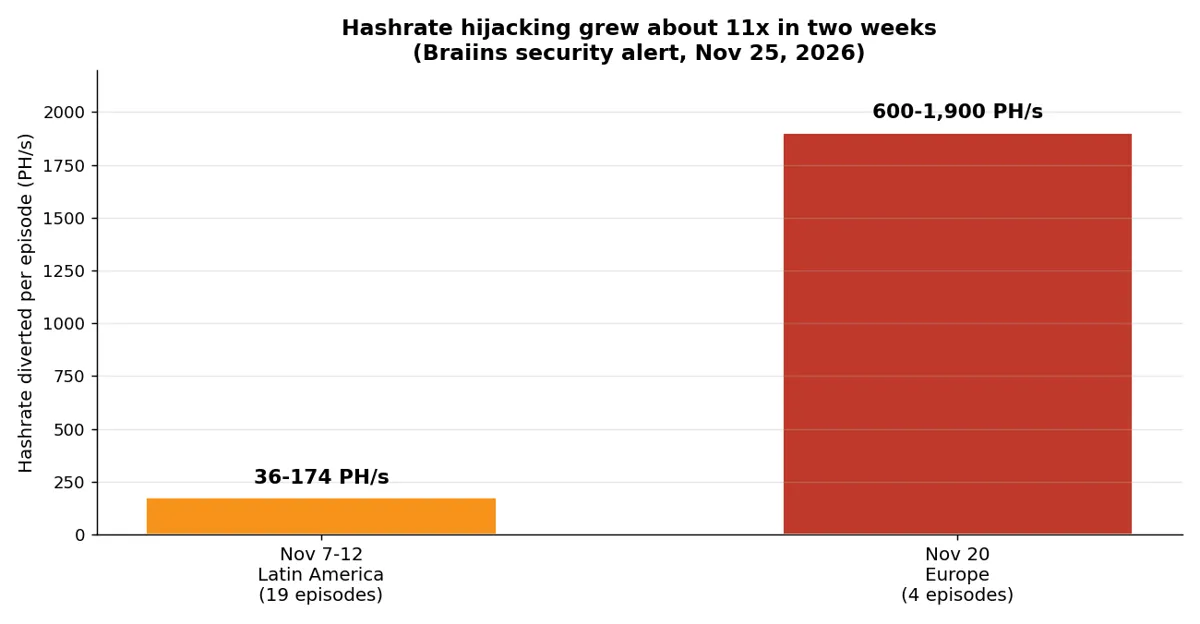
The numbers tell the story. From November 7 to 12, there were 19 episodes in Brazil and Argentina, each hitting 120 to 400 mining sites and diverting 36 to 174 PH/s.
On November 20, four episodes hit mostly Europe, each affecting 1,050 to 1,600 sites and diverting 0.6 to 1.9 EH/s. The attack grew about 11 times bigger in two weeks.

The scariest part is how invisible the attack was. The miners kept hashing at full speed and reported a live pool, while the pool dashboard showed zero hashrate.
One miner’s log showed the share difficulty climbing step by step to 536,870,912, far above anything a real pool sets. Braiins warned that attackers rerouted more than 1,000 mining sites in one second, and the same trick stole about $83,000 in mining rewards back in 2014.
This is not a bug in one pool. It is a flaw in Stratum V1 itself, and it works against any pool that accepts plain V1 connections.
That is why the whole industry is now talking about Stratum V2.
What Is Stratum V2 Bitcoin Mining, in Plain Language
Think of Stratum as the language your miner and your pool use to talk. The pool hands out mining jobs, and your miner sends back proof of work, called shares.
The pool then pays you for those shares.
Stratum V1 speaks that language out loud, like a postcard anyone can read. It sends jobs and shares as plain text, and your miner has no way to check who is really on the other end.
Anyone who controls the road between you and the pool can read the postcard, copy it, or pretend to be the pool.
Stratum V2 speaks in a sealed, coded letter instead. It encrypts every message, checks the pool’s identity with cryptography, and packs the data into a tight binary format.
It also hands miners a power they never had before: the right to build their own block templates and choose which transactions go into a block.
Braiins built the protocol, starting in 2019, together with Bitcoin developer Matt Corallo. The open-source Stratum V2 Reference Implementation reached version 1.0 in March 2024.
In May 2026, seven of the largest pools joined the Stratum V2 Working Group, and in June 2026 the first live job-declared block was mined.
How Stratum V2 Works
Stratum V2 is not one change. It is three fixes packed into one protocol, and each one answers a specific weakness of V1.
Here is what each fix does for a working miner.
Encryption that proves the pool is real
Every V2 connection starts with a Noise Protocol handshake, the same family of cryptography used by modern messaging apps. The pool proves it holds a private key that matches the public key in its connection address, and every message after that is encrypted with ChaCha20-Poly1305.
An attacker can still cut your connection by messing with internet routes. What they cannot do is impersonate your pool and collect your shares.
Your miner simply refuses to work for a server that cannot prove it is the real pool.
A binary format that wastes less bandwidth
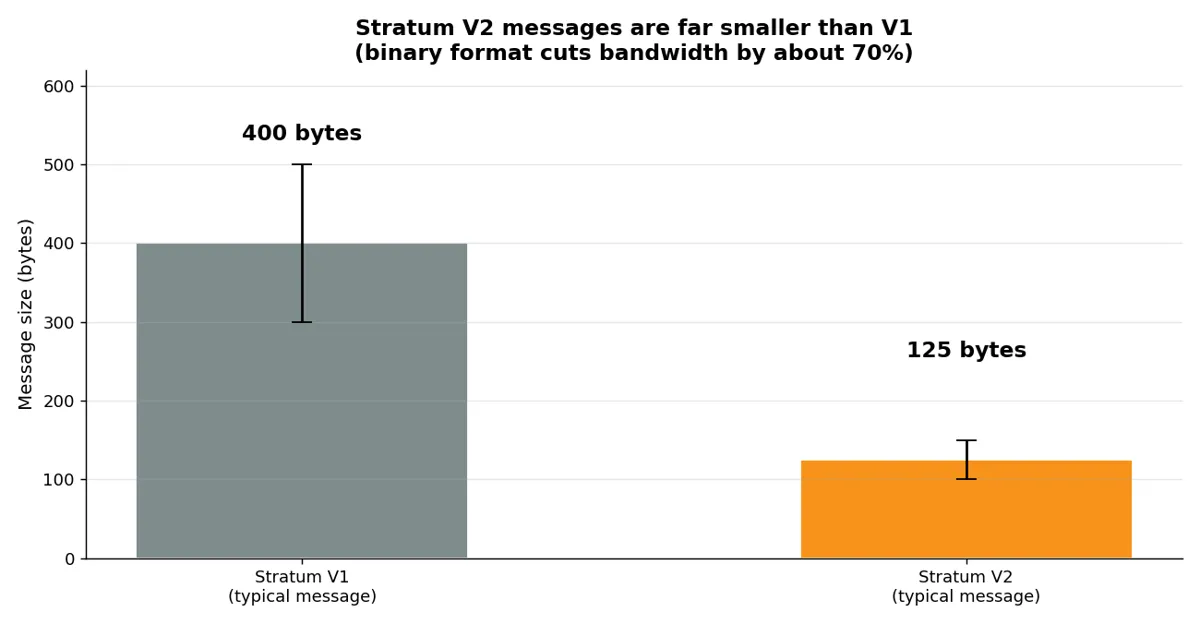
Stratum V1 sends jobs as JSON text, with field names and brackets in every message. A typical V1 message runs 300 to 500 bytes.
Stratum V2 packs the same information into binary, and a typical message runs 100 to 150 bytes.
That smaller size cuts bandwidth by about 70% and lowers latency. For a home miner on a slow connection, that means fewer stale shares and steadier work.
For a big farm, it means less network load across thousands of machines.
Job negotiation: miners pick their own transactions
This is the change that matters most for Bitcoin itself. Under V1, the pool builds every block template, so the pool decides which transactions get mined and which get left out.
A pool can censor a transaction simply by refusing to include it.
Stratum V2 adds a Job Declaration Protocol. Your miner, or a small piece of software next to it, builds its own block template from its own Bitcoin node and proposes it to the pool.
The pool checks the template and approves it, but it cannot rewrite your transaction choices. Pools become coordinators of hashrate, not gatekeepers of transactions.
You can watch a plain-language walkthrough of the protocol in this Braiins explainer with Matt Corallo.
Stratum V1 vs Stratum V2: The Differences That Matter
The table below sums up the practical differences. V1 still runs most of the network, but every row here is a reason the industry is moving on.
| Feature | Stratum V1 (2012) | Stratum V2 |
|---|---|---|
| Message format | JSON text | Compact binary |
| Typical message size | 300 to 500 bytes | 100 to 150 bytes |
| Encryption | None | Noise Protocol, ChaCha20-Poly1305 |
| Pool authentication | None, any server can answer | Cryptographic, pool must prove its key |
| Bandwidth use | High | About 70% lower |
| Block template control | Pool decides everything | Miner can build its own template |
| Hijack risk | High, proven in November 2026 | Low, fake pools are rejected |
| Channels | One connection does everything | Three: mining, job declaration, template distribution |
Which Pools and Firmware Support Stratum V2 in 2026
Adoption is moving fast, but it is still uneven. Three pools run V2 in full production today, and the biggest pools are testing it now.
Here is the honest picture as of November 26, 2026.
| Pool | Stratum V2 status | Notes |
|---|---|---|
| Braiins Pool | Full production, with Job Declaration | Co-authored the protocol, longest-running V2 endpoint |
| DMND (DEMAND) | Full production, V2-native | First pool built entirely on V2, public since November 2025 |
| ckpool | Production since July 31, 2026 | Includes solo ckpool, behind a build flag |
| OCEAN | DATUM protocol, not V2 | Same goal, different design, miner-built templates |
| Foundry USA | Customer testing since November 13, 2026 | Biggest pool by hashrate, testing with customers now |
| MARA | Mined first V2 block, November 11, 2026 | Block 975,369, confirmed by Matt Corallo |
| Antpool, F2Pool, SpiderPool, Block | Working Group members since May 2026 | Committed, no public production date yet |
Firmware is the other half of the story. Braiins OS+ is the only major Antminer firmware with a native V2 client, and it covers the S9, S17, S19 and S21 series.
The open-source Bitaxe firmware AxeOS added native V2 support in ESP-Miner v2.14.0 in June 2026. Stock Antminer firmware, VNish and LuxOS still connect with V1 only, so those miners need another path.
That gap matters because how mining pools pay you does not change with V2. Your payout method stays the same.
Only the connection gets safer and faster.
How to Switch to Stratum V2 Today
You do not need to buy new hardware to switch. There are three paths, and the right one depends on your firmware.
Pick the first path that fits your setup.
Path A: Use firmware with native Stratum V2
If your miner runs Braiins OS+, point it at a V2 pool and you are done. The V2 address looks like this: stratum2+tcp://stratum.braiins.com:3333/ followed by the pool’s public key.
Your miner checks that key on every connection, so a fake pool gets rejected at once.
Home miners have the same option on small rigs. A Futurebit Apollo home miner or an Avalon Nano 3 can connect through a V2 pool or proxy too, and the setup takes minutes once the firmware supports it.
If you are still choosing hardware, check the firmware’s V2 support before you buy.
Path B: Use Stratum V1 over TLS with certificate checks
If your firmware cannot do V2 but supports TLS, switch your pool URLs to the TLS port. Braiins Pool offers stratum+ssl://stratum.braiins.com:3443, with port 33443 as a fallback.
Braiins OS 26.11, released November 25, 2026, adds TLS certificate and hostname verification and blocks fallbacks to plain Stratum.
Do not skip the certificate check. Braiins tested seven firmware versions on November 20 and 23, and two widely used firmwares had a TLS option that still accepted invalid certificates.
A TLS connection that never checks the certificate protects you from almost nothing. Braiins Academy has a step-by-step test that shows in a few minutes whether your firmware rejects a bad certificate.
Path C: Use the free Braiins SV2 proxy
If your firmware has no V2 and no working TLS, run the free Braiins SV2 Proxy on a computer in your own network. Your miners talk plain V1 to the proxy inside your LAN, and the proxy talks encrypted V2 to the pool.
Braiins released it on November 25, 2026, and it runs on Linux or Windows through WSL.
Start with a few miners and watch them for a day before you move the whole farm. The proxy is a first release, and Braiins asks users to report problems to its support team.
This path costs nothing and needs no firmware change.
What to Do If Your Pool Only Offers Plain stratum+tcp://
First, check whether your pool has a TLS port or a V2 endpoint that is not listed on its main setup page. Braiins found on November 23 that most of the largest pools still offered only plain-text Stratum V1, and only a few served Stratum over TLS with a valid certificate.
The situation is changing fast, so check again before you assume nothing exists.
Second, ask your pool directly for a TLS or V2 endpoint, and tell them why. Pools add features when miners ask for them, and the November attacks gave every miner a reason to ask.
If the pool has no secure option, use the free proxy in Path C, or move your hashrate to a pool that does.
Third, check your backup pool entries. A plain-text backup is just as dangerous as a plain-text primary, because the attacker can force your miner to fail over to it.
Braiins saw one miner fail over to a clean backup, then switch back to the hijacked primary two minutes later because the fake pool looked stable. Every pool entry must be secure, not just the first one.
Finally, learn the warning signs. Braiins Pool never sets share difficulty above 16,777,216, so a difficulty in the hundreds of millions means your miner is not talking to the real pool.
Watch for a connection drop, a reconnect to the same hostname, and a pool dashboard that shows nothing while your miner reports full speed. If you want the full cost picture before you change anything, read what one miner really costs to run and whether mining still pays in 2026.
Common Mistakes Miners Make With Stratum V2
The most common mistake is thinking encryption alone fixes everything. It does not stop an attacker from cutting your connection.
It stops them from profiting, because your miner refuses to work for a fake pool.
Another mistake is upgrading firmware and changing nothing else. Braiins OS 26.11 adds certificate verification, but the upgrade alone changes nothing until you also change your pool URLs to TLS.
The setting and the URL must change together.
A third mistake is trusting a TLS option that never verifies anything. If your firmware accepts any certificate, the padlock is decoration.
Test it with a bad certificate before you trust it.
The last mistake is forgetting the backups. One plain-text backup URL can undo every secure setting on the miner.
Audit all three pool slots, not just the first one.
The Bottom Line
Stratum V2 is not a nice-to-have upgrade anymore. The November 20 hijack proved that plain Stratum V1 can cost a miner real money in minutes, with no warning on the machine itself.
The fix exists, it is free in most cases, and it takes less than an hour to apply. If you mine Bitcoin at home, start with the certificate test and the proxy, then move your pool entries to encrypted connections one by one.
Your next step is simple: open your miner settings today and check whether any pool URL still starts with stratum+tcp://.
Frequently Asked Questions
These are the questions miners ask most about Stratum V2, answered in plain language.
What is Stratum V2 in simple terms?
Stratum V2 is the encrypted language miners and pools use to share work. It replaces the plain-text Stratum V1 protocol from 2012, and it adds encryption, pool authentication, smaller messages, and the option for miners to build their own block templates.
Is Stratum V2 safer than Stratum V1?
Yes. Stratum V1 sends everything in plain text and never checks the pool’s identity, which is how attackers hijacked up to 1.9 EH/s on November 20, 2026.
Stratum V2 encrypts every message and makes the pool prove its identity, so a fake pool gets rejected.
Do I need new hardware to use Stratum V2?
No. Braiins OS+ adds native V2 support to existing Antminer S9, S17, S19 and S21 machines, and the free Braiins SV2 proxy lets any V1 miner connect to a V2 pool without a firmware change.
You need new firmware or a proxy, not new hardware.
Which mining pools support Stratum V2?
Braiins Pool, DMND and ckpool run Stratum V2 in production, OCEAN uses its own DATUM protocol with the same goal, and Foundry USA started customer testing on November 13, 2026. MARA mined the first Stratum V2 block, block 975,369, on November 11, 2026.
What happens if my pool only offers Stratum V1?
Ask the pool for a TLS or V2 endpoint first. If it has none, use Stratum V1 over TLS if your firmware checks certificates, or run the free Braiins SV2 proxy on your own network.
If none of those work, consider moving your hashrate to a pool that offers a secure connection.
Does Stratum V2 increase my hashrate or earnings?
No, it does not change your hashrate. It cuts bandwidth by about 70% and can reduce stale shares, which protects the earnings you already have.
Its main value is security: it stops attackers from stealing your work, and it gives miners a real say in which transactions get mined.