



A bill that would lock every bitcoin the US government owns for 20 years reached the House floor this week. The House Financial Services Committee formally reported H.R. 8957 on November 24, which makes the bill eligible for a vote.
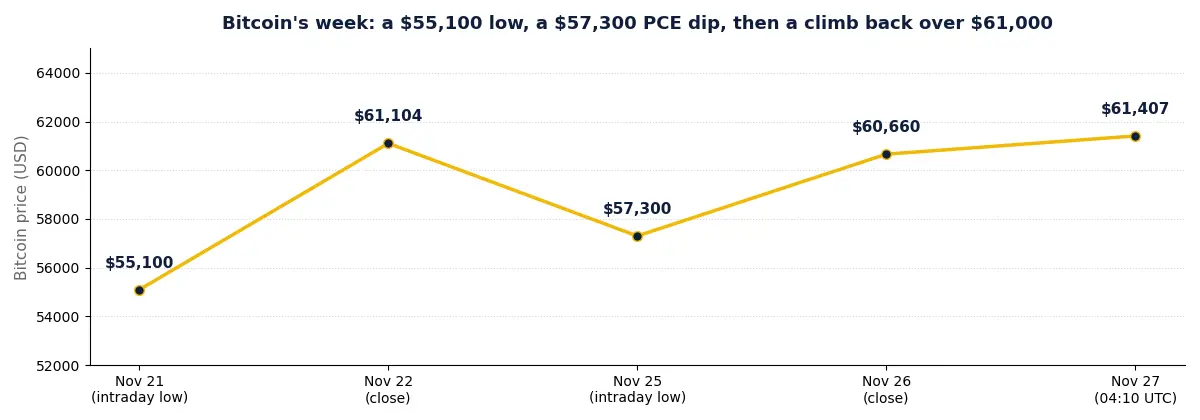
Bitcoin jumped about 3 percent to near $60,900 on the news, but the celebration may be early. Prediction market Polymarket gives a national bitcoin reserve only a 4 percent chance by year end, and Congress runs out of time on January 3.

Key takeaways
- H.R. 8957, the American Reserve Modernization Act of 2026, would write the Strategic Bitcoin Reserve into law and bar any sale of reserve bitcoin for 20 years.
- The bill cleared committee 28-21 on September 16 and was formally reported on November 24 as House Report 119-894, Union Calendar No. 789.
- The US government holds about 306,795 bitcoin, worth roughly $18.6 billion at current prices, according to Arkham.
- Polymarket traders give a national bitcoin reserve a 4 percent chance by the end of 2026, down from 60 percent a year ago.
- The 119th Congress ends on January 3, 2027. The bill must clear the House, the Senate and the president’s desk in about five holiday weeks, or it dies and must start over.
What H.R. 8957 actually does
The bill tells the Treasury secretary to set up two accounts within 180 days of the law taking effect. One is the Strategic Bitcoin Reserve.
- What H.R. 8957 actually does
- How the bill got to the House floor
- Why bitcoin bounced anyway
- The 4% number, and what it really measures
- An executive order is not a law
- What the government actually holds
- The five-week problem
- What to watch next
- Frequently asked questions
- What is H.R. 8957, the Strategic Bitcoin Reserve bill?
- Would the bill make the government buy bitcoin?
- How much bitcoin does the US government hold?
- What happens if the bill does not pass by January 3, 2027?
- Why did bitcoin rise when the bill reached the House floor?
- What is the difference between the reserve and the Digital Asset Stockpile?
- The bottom line
The other is a separate Digital Asset Stockpile for crypto that is not bitcoin.
Every bitcoin the government owns goes into the reserve. That covers coins seized in criminal and civil cases.
The bill does not tell the government to buy bitcoin.
The lock is the heart of the bill. Reserve bitcoin could not be sold, swapped, auctioned, encumbered or otherwise disposed of for at least 20 years after the law takes effect.

After 20 years, Treasury could recommend selling no more than 10 percent of the reserve in any two-year period.
The bill also adds proof. Treasury would run a Proof of Reserve system that uses cryptography to show the bitcoin really exists.
An outside auditor would check the holdings each year, and the results would be public. Federal agencies would have 60 days to report every digital asset they hold to Treasury.
The amended bill also studies how the reserve could grow. It looks at swaps of other digital assets, forfeitures, settlements and partnerships with states or private firms.
It states clearly that nothing in the study allows borrowing, pledging government assets, new taxes or deficit spending to buy bitcoin.
How the bill got to the House floor
The bill moved slowly for six months, then jumped two steps in one day. Here is the path so far.
| Date | What happened |
|---|---|
| May 21, 2026 | Rep. Nick Begich (R-Alaska) introduces H.R. 8957, with Rep. Jared Golden (D-Maine) as an original cosponsor. |
| September 16, 2026 | The House Financial Services Committee approves the bill 28-21 at a markup. All 28 yes votes come from Republicans, all 21 no votes from Democrats. |
| November 24, 2026 | The committee formally reports the bill with amendments as House Report 119-894. It lands on the Union Calendar as Calendar No. 789. Reps. Byron Donalds and Maria Elvira Salazar join as cosponsors, taking the total to 23. |
| Next | A floor vote, if House leaders schedule one. No date has been announced. |
One detail matters for anyone reading the news. Several outlets reported the committee vote as November 24, and that is wrong.
The committee voted on September 16. November 24 was the formal report, the step that put the bill on the House calendar.
The bill is narrower than the version Begich first filed. The original text asked Treasury and Commerce to study funding bitcoin buys with surplus Federal Reserve remittances, a revaluation of gold certificates, tax payments and tariff revenue.
Those options are gone. The reported version studies swaps, forfeitures and partnerships instead, and it bans debt-funded buying outright.
Why bitcoin bounced anyway
Bitcoin had a brutal week before the bill moved. Hot US inflation data hit on Wednesday, November 25.
October PCE came in at 3.8 percent from a year earlier, and core PCE rose to 3.3 percent, above the 3.2 percent economists expected. Bitcoin fell to about $57,300, its lowest in more than two years.
Then it turned. Bitcoin climbed back above $60,000 by Wednesday evening and reached about $60,900 on Thursday, up roughly 3 percent in a day.
By Friday morning it traded near $61,400. The reserve bill gave traders a reason to buy, but the bounce also looks like a short squeeze.
Bearish traders who bet on lower prices had to buy back in a hurry, which pushed the price up fast. Bitcoin has done this before: the $64,600 spike on November 24 was a short squeeze, not a recovery.
The wider picture is still ugly. US spot bitcoin ETFs lost $453 million on November 25, their seventh straight session of outflows.
The run totals $3.05 billion since November 16. November outflows now stand at $5.39 billion, a record for any month.
BlackRock’s IBIT accounted for $329.7 million of Wednesday’s selling alone. 21Shares blamed three forces for the sell-off, and ETF redemptions were one of them.
Galaxy Digital added to the gloom. Its research chief Alex Thorn withdrew the firm’s October call that the bear market ended in June.
Bitcoin lost its 50-week moving average in the week ended November 8, then closed below its 200-week average the next week. Galaxy now flags a daily close below $58,525, the June 30 closing low, as the start of a move to a materially lower low.
The 4% number, and what it really measures
The loudest number in this story is not the price. It is 4 percent.
That is the chance Polymarket traders give a US national bitcoin reserve being established by the end of 2026. The market had the odds at about 60 percent a year ago and 34 percent in May.
Read the number with care. The market asks whether a national reserve exists before 2027, and it settles on December 31.
A bill that passes the House but stalls in the Senate still loses. The market is small, too.
Total volume is only about $68,500, so a few large bets can move it.
Still, the direction is clear. Traders watched the same calendar Congress faces, and they stopped believing.
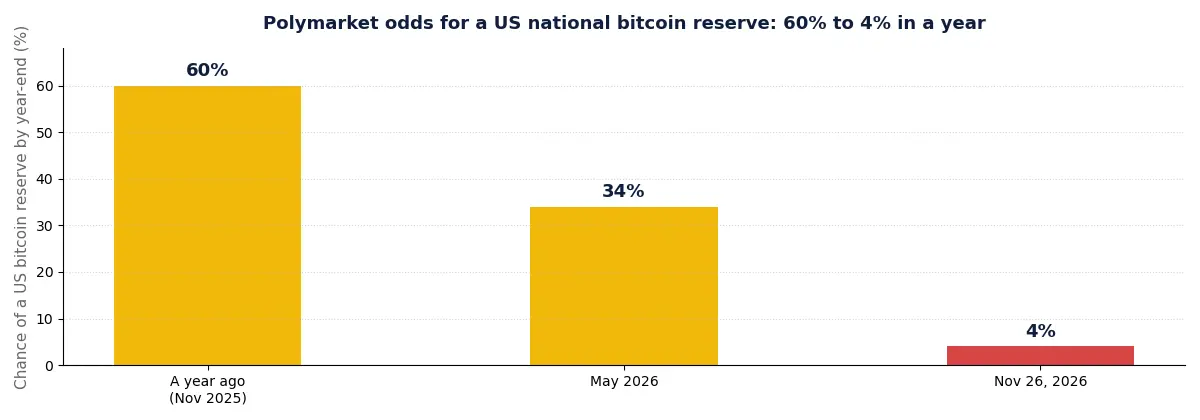
The gap between the market mood and the price move tells the story. Bitcoin rose on the headline, while the people betting real money on the outcome priced in failure.
Both can be right at once. A headline can lift a beaten-down price for a day, and a bill can still die in the Senate.
An executive order is not a law
The reserve already exists. President Donald Trump signed Executive Order 14233 on March 6, 2025.
It told Treasury to hold forfeited bitcoin as a reserve asset and never sell it. It also created the Digital Asset Stockpile for other seized crypto.
But an order is fragile. A future president can revoke it with a single signature, no vote needed.
A law is different. Once Congress passes it and the president signs it, only another law can undo it.
That is the whole point of H.R. 8957. It takes the same reserve and bolts it into statute.
| Executive order (EO 14233) | Law (H.R. 8957) | |
|---|---|---|
| Created | March 6, 2025, by presidential signature | Would be created by Congress and the president together |
| How it ends | One new executive order | Only another act of Congress |
| Sale ban | No sale of reserve bitcoin | No sale, swap, auction or encumbrance for 20 years |
| Proof | Agencies must account for holdings | Annual public audit, Proof of Reserve system |
| New buying | Budget-neutral strategies only | Study of swaps, forfeitures and partnerships; no debt-funded buying |
Senator Cynthia Lummis first floated a reserve law in 2024, before the executive order existed. Her BITCOIN Act would have gone further, with the government buying bitcoin over five years.
H.R. 8957 is the humbler version. It locks up what the government already owns and buys nothing.
What the government actually holds
The pile is big, and the exact size is fuzzy. Arkham’s live tracker puts US government holdings at 306,795 bitcoin, worth about $18.6 billion at roughly $60,500 per coin.
Other estimates run as high as about 328,000 bitcoin. The gap comes from court cases, not bad math.
Most of the coins came from seizures. The Silk Road cases delivered about 69,370 bitcoin in 2020 and 50,676 more from James Zhong in 2021.
The Bitfinex hack recovery added about 94,000 bitcoin in 2022. The largest single forfeiture came in October 2025, when the Justice Department seized 127,271 bitcoin in the Prince Group case.
Not all of those coins are finally the government’s. The Prince Group coins are still tied up in forfeiture proceedings.
The Bitfinex coins may go back to the exchange as restitution. That is why one tracker says 306,795 and another says 328,000.
Both count real coins in government-controlled wallets. They disagree on which ones count as owned.
Here is the math that matters for the market. At 306,795 bitcoin and $60,500 per coin, the reserve holds about $18.6 billion.
A 20-year lock would take that whole pile off the market until 2046 at the earliest. No auctions, no sales, no pledging it as collateral.
For a market that watches every government wallet move, that is the real prize. The government moved $103 million in seized bitcoin to Coinbase Prime in October, and it moved 17,795 bitcoin in three days the same month, so traders watch these wallets closely.
The government has sold before. It auctioned seized coins for years, and Arkham counts close to 195,000 bitcoin sold over time.
The March 2025 order stopped the sales. The bill would make the stop permanent.
The five-week problem
The strategic bitcoin reserve bill has five weeks to live, and most of them are holidays. The 119th Congress ends on January 3, 2027.
Any bill that has not cleared both chambers and reached the president’s desk by then dies. It must be reintroduced in the next Congress and start from zero.
| Step | Status |
|---|---|
| 1. House floor vote | Not scheduled. House leaders control the calendar. |
| 2. Senate passage | No companion bill has moved. The Senate would need to act in the same window. |
| 3. President’s signature | Only after both chambers pass the same text. |
The Senate is the harder wall. The committee vote was a straight party split, 28 Republicans for and 21 Democrats against.
Democrats helped block the CLARITY Act market-structure bill earlier this year, and only one Democrat, Jared Golden, cosponsors H.R. 8957.
A Senate vote would need far more Democratic support than the bill has today.
The clock is the bill’s worst enemy. Congress has about five weeks left, and the session spans Thanksgiving, Christmas and New Year.
Floor time is scarce, and leadership has not put the bill on the schedule. Every week without a vote makes the 4 percent look generous.
What to watch next
Three things will tell you whether this bill lives or dies.
- House floor schedule: if leadership does not list H.R. 8957 before mid-December, the bill is almost certainly dead.
- The Senate: any sign of a companion bill or a Senate sponsor changes the odds fast.
- The price: Bitcoin held $60,000 through a wild week, and a daily close below $58,525 would break the June low. Galaxy calls that the start of a move to a materially lower low, so watch $58,525.
Even if the bill dies, the idea will not. The reserve exists today by executive order, and the 20-year lock will return in the next Congress.
The question is whether the next version gets a full year to run, instead of five holiday weeks.
Frequently asked questions
Here are the questions readers keep asking about the strategic bitcoin reserve bill, answered in plain terms.
What is H.R. 8957, the Strategic Bitcoin Reserve bill?
H.R. 8957 is the American Reserve Modernization Act of 2026, introduced by Rep. Nick Begich of Alaska on May 21, 2026. It would write the US Strategic Bitcoin Reserve into federal law and bar the Treasury from selling, swapping, auctioning or encumbering reserve bitcoin for at least 20 years.
Would the bill make the government buy bitcoin?
No, it covers bitcoin the government already owns, mostly coins seized in criminal and civil cases, and it orders no new purchases. A study would look at swaps, forfeitures, settlements and state partnerships, and the bill bans borrowing, new taxes or deficit spending to buy bitcoin.
How much bitcoin does the US government hold?
Arkham’s live tracker puts the total at about 306,795 bitcoin, worth roughly $18.6 billion at current prices. Broader estimates run as high as about 328,000 bitcoin, because some seized coins, like the 127,271 bitcoin from the Prince Group case, are still tied up in court.
What happens if the bill does not pass by January 3, 2027?
It dies, because the 119th Congress ends on January 3, 2027, and any bill that has not cleared the House, the Senate and the president’s desk must be reintroduced in the next Congress. It would start the whole process over from committee.
Why did bitcoin rise when the bill reached the House floor?
Bitcoin rose about 3 percent to near $60,900 on November 26, after falling to about $57,300 the day before on hot inflation data. The bill gave traders a positive headline, and bearish traders rushing to buy back their positions pushed the price up fast, so the move looks more like a short squeeze than a vote of confidence.
What is the difference between the reserve and the Digital Asset Stockpile?
The Strategic Bitcoin Reserve holds only bitcoin, and the bill would lock it for 20 years. The Digital Asset Stockpile holds other seized crypto, like ether, and Treasury may manage or sell those assets.
The bottom line
The market cheered a bill that has almost no chance of becoming law. That is not a contradiction.
Traders buy headlines, and a 20-year lock on $18.6 billion of bitcoin is a great headline. But headlines do not pass the Senate, and the calendar does not care about the price.
Watch the House schedule, not the chart. If H.R. 8957 gets a floor vote before mid-December, the 4 percent will move.
If it does not, the bill dies on January 3, and the reserve stays an executive order that one signature can erase.