


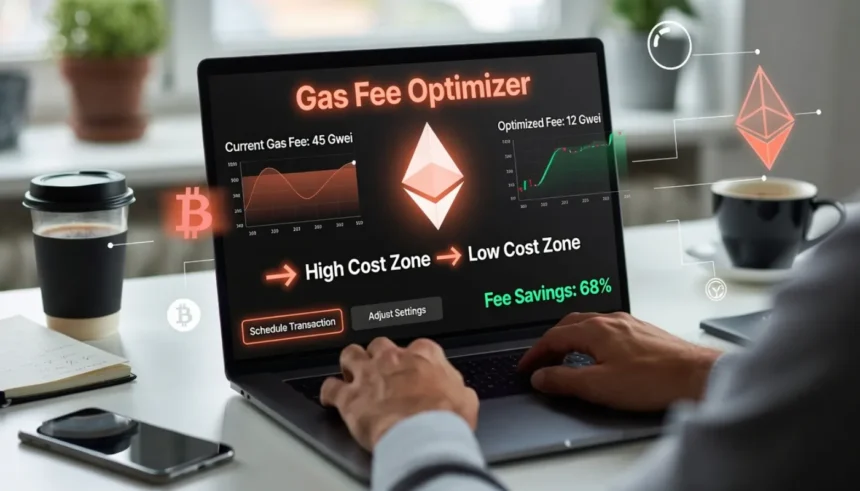
Ethereum gas fees are the small payments you make every time you use the network, whether you’re sending ETH, minting an NFT, or swapping tokens on a DeFi app. Unlike a flat bank fee, gas costs shift constantly based on network demand.
The good news: 2026 fees look nothing like the $50 to $100 charges that defined the 2021 NFT boom.

Average mainnet transactions now run roughly $0.16 to $0.22, a sharp drop driven by the Dencun upgrade and growing Layer 2 adoption.
- Key Takeaways
- Ethereum Gas Fee Data Worth Knowing
- What Are Ethereum Gas Fees, Exactly
- Why Ethereum Gas Fees Rise and Fall
- The Dencun Upgrade Changed the Math Completely
- 7 Proven Ways to Pay Less in Ethereum Gas Fees
- 1. Check Live Gas Prices Before Sending
- 2. Time Transactions for Off-Peak Hours
- 3. Use Layer 2 Networks Whenever Possible
- 4. Set a Maximum Fee Limit, Not Just a Tip
- 5. Avoid Overpaying on the Priority Fee
- 6. Simulate Transactions to Avoid Failed Attempts
- 7. Batch Actions When the Platform Allows It
- Mainnet vs. Layer 2: A Direct Cost Comparison
- Where to Buy and Store ETH Before Worrying About Gas
- How To Spend Less On Ethereum Gas Fees
- Common Mistakes Beginners Make
- Best Tools & Resources for Beginners
- Conclusion
- Frequently Asked Questions (FAQs)
This guide explains what gas fees actually pay for, why they swing up and down, and seven proven, specific ways to pay less on every transaction you send.
Key Takeaways
| Insight | Why It Matters |
| Gas fees fund network security | Validators get paid to confirm transactions and prevent spam. |
| 2026 fees are dramatically lower than 2021 | Average transactions cost cents now, not $50 to $100. |
| The Dencun upgrade changed everything | It cut average gas costs by roughly 95 percent from prior peaks. |
| Layer 2 networks now dominate volume | Roughly 95 percent of Ethereum’s total throughput now runs on L2s. |
| Failed transactions still cost gas | You pay for the computation even if the transaction doesn’t succeed. |
| Timing and tools both matter | Off-peak hours and live gas trackers both meaningfully cut your costs. |
Ethereum Gas Fee Data Worth Knowing
| Metric | Figure | Source |
| Average mainnet fee (March 2026) | $0.16 to $0.22 per transaction. | CoinLaw, 2026 |
| Average fee one year earlier | $1.85 in mid-2025, dropping to about $0.41 by February 2025. | CoinLaw / MEXC, 2026 |
| Post-Dencun swap cost | Dropped from roughly $86 to about $0.39. | SQ Magazine, citing Dencun upgrade data |
| Post-Dencun NFT mint cost | Dropped from roughly $145 to about $0.65. | SQ Magazine, 2025 |
| Layer 2 share of total throughput | Roughly 95 percent of Ethereum’s transaction volume as of late 2025. | CoinLaw, 2026 |
| Typical Layer 2 transaction cost | Often $0.001 to $0.05, versus $0.10 to $0.20 on mainnet. | CoinLaw, 2026 |
What Are Ethereum Gas Fees, Exactly
Gas fees are payments for computational work on the Ethereum network. Every action, sending ETH, minting a token, or executing a smart contract, requires validators to process and confirm it.
Gas fees compensate them for that work and protect the network from spam. Fees are denominated in gwei, a fraction of one ETH. One gwei equals 0.000000001 ETH.
The total cost of any transaction equals the gas units required multiplied by the gas price per unit. A simple ETH transfer uses about 21,000 gas units, while complex DeFi interactions can use 200,000 or more.

Why Ethereum Gas Fees Rise and Fall
Since the EIP-1559 upgrade, every transaction pays two components: a base fee, which is burned and removed from circulation, and a priority fee, which is a tip to validators.
The base fee adjusts automatically based on demand for blockchain space. When more people transact at once, the base fee rises. When activity slows, it falls.
This is why fees spike during NFT drops, major DeFi launches, or periods of high trading volume, and drop sharply on quiet weekends or overnight hours when fewer people compete for block space.
The Dencun Upgrade Changed the Math Completely

The single biggest shift in Ethereum gas fees came from the Dencun upgrade, which introduced EIP-4844 and a new blob-based data structure for Layer 2 rollups.
According to SQ Magazine, average gas prices fell from roughly 72 gwei before the upgrade to about 2.7 gwei after, a reduction of approximately 95 percent.
Swap costs that once ran $86 now average closer to $0.39, and NFT sale costs dropped from around $145 to roughly $0.65.
This single upgrade did more to reduce real-world Ethereum gas fees than years of incremental fixes combined.
Layer 2 networks, which settle their data more cheaply on Ethereum thanks to Dencun, now carry the overwhelming majority of total network activity.
Before Dencun, Layer 2 rollups still had to post their transaction data to Ethereum’s mainnet as regular calldata, which competed directly with every other transaction for the same expensive block space.
Blobs changed that by creating a separate, temporary data lane specifically for rollups, priced independently from regular transactions.
The result is that L2 operators pass dramatically lower costs on to their users, which is the main reason rollup fees now sit in the fractions-of-a-cent range rather than the dollars-per-transaction range seen in earlier years.
7 Proven Ways to Pay Less in Ethereum Gas Fees
These seven methods are the most effective, verified ways to reduce what you actually pay. Combine several at once for the biggest savings.
1. Check Live Gas Prices Before Sending
Use Etherscan’s Gas Tracker or your wallet’s built-in fee estimator before confirming any transaction. Gas prices change minute to minute, and a five-minute wait can sometimes cut your cost noticeably.
2. Time Transactions for Off-Peak Hours
Gas fees are typically lowest during early morning UTC hours and on weekends, when fewer users are active. Industry data shows fees running 25 to 40 percent lower during these quiet windows compared to peak demand periods.
3. Use Layer 2 Networks Whenever Possible
Networks like Arbitrum, Optimism, and Base process transactions off the main chain, then settle the results back to Ethereum. Typical Layer 2 costs now run $0.001 to $0.05, a fraction of mainnet pricing, while still inheriting Ethereum’s underlying security.
4. Set a Maximum Fee Limit, Not Just a Tip
Ethereum lets you set a maxFeePerGas, the highest amount you’re willing to pay. If the actual base fee plus tip comes in lower, you automatically get refunded the difference. This protects you from fee spikes without requiring constant manual monitoring.
5. Avoid Overpaying on the Priority Fee
The priority fee is a tip that makes validators more likely to include your transaction quickly. Paying too much wastes money on transactions that aren’t urgent. Most wallets now suggest a reasonable default, and the “average” speed setting usually balances cost and confirmation time well.
6. Simulate Transactions to Avoid Failed Attempts
Failed transactions still consume gas, since the network performed computational work regardless of the outcome. Tools like Rabby and Tenderly simulate a transaction before you submit it, helping you catch errors that would otherwise cost you gas with nothing to show for it.
7. Batch Actions When the Platform Allows It
Some DeFi protocols let you combine multiple actions into a single transaction instead of submitting them separately. Batching reduces the total gas units required compared to paying the base overhead of several individual transactions.
Mainnet vs. Layer 2: A Direct Cost Comparison

Seeing the numbers side by side makes the case for Layer 2 networks concrete rather than abstract.
| Transaction Type | Mainnet Cost (2026) | Typical Layer 2 Cost |
| Simple ETH transfer | $0.10 to $0.20 | $0.001 to $0.01 |
| Token swap | Around $0.39 post-Dencun | Often under $0.05 |
| NFT mint | Around $0.65 post-Dencun | Frequently under $0.05 |
| Complex DeFi interaction | $0.20 and up, demand dependent | Usually a few cents |
The gap was far wider before Dencun, when mainnet costs for the same actions often ran into the tens or hundreds of dollars.
Even with mainnet fees now dramatically lower than in past cycles, Layer 2 networks still offer a meaningful discount for routine activity, which is why they now handle the large majority of Ethereum’s total transaction volume.
Understanding the math behind Ethereum gas fees helps you spot a bad deal before you confirm a transaction, rather than after.
- Gas units: the amount of computational work your transaction requires. A simple transfer needs about 21,000 units; a complex smart contract call can need 100,000 or more.
- Gas price: what you pay per unit, quoted in gwei. This is the number that rises and falls with network demand.
- Total fee: gas units multiplied by gas price, converted from gwei into ETH, then into your local currency.
Most wallets calculate this automatically and show you an estimated total before you confirm. Still, knowing the formula helps you understand why a complex DeFi swap costs more than a simple ETH transfer, even when network demand is identical for both.
- Setting the gas limit too low, which can cause a transaction to fail while still consuming gas.
- Sending transactions during obvious peak demand, like a popular NFT mint, without checking the cost first.
- Leaving funds on an exchange instead of moving them to a private wallet, covered in our guide to setting up a Bitcoin wallet, which applies the same self-custody logic to Ethereum holdings.
Assuming all Layer 2 networks cost the same. Fees vary by rollup architecture and current congestion.
Where to Buy and Store ETH Before Worrying About Gas
If you’re still acquiring your first ETH, our full walkthrough on how to buy Ethereum covers exchange selection and order types.
Once purchased, moving funds off an exchange and into your own wallet is a gas-paying transaction itself, so timing that transfer using the tips above can save you money from your very first transaction.
How To Spend Less On Ethereum Gas Fees
Some users and developers on Ethereum have devised ways of spending less on the network and making their transactions more efficient. If you want to avoid high gas fees on Ethereum, consider the following:
Time Your Transactions
The first thing to do when you want to pay less on Ethereum gas fees is to time your transactions to minimise gas fees.
Consider making transactions when fewer people use the blockchain to lower the total gas fee payable to the network. The base fee will increase when demand is high, as more work is needed to interact with the blockchain.
If you find periods when the base fee is low, you will find that you will spend less on gas. Some of the best periods to transact on Ethereum are weekends.
Reduce The Priority Fee
The priority fee is a tip that you give to incentivise validators to include a transaction in the block. Validators need tips to sustain their activities. If you want your transaction to be given preferential treatment and executed before other transactions within the same block, you must pay a higher tip.
If you want to reduce Ethereum gas fees, consider paying a lower priority fee. However, a smaller tip will give a validator little incentive to include a transaction. As such, your transaction might be outbid by competing transactions.
Set A Maximum Fee Limit
The Ethereum network allows you to set a maximum fee you will pay per transaction. The maximum fee has to be higher than the total base fee and tip. Once the transaction is executed at your preferred fee, you will get a refund of the difference between the maximum fee and the total of the base fee and the tip.
Having a maximum fee will help you spend less on gas. You will also have peace of mind when executing transactions, knowing you will not pay more than necessary.
Use Layer 2 Scaling Solutions
The other way of spending less gas fees on Ethereum is by using layer two scaling solutions. Scaling tools are networks created on top of Ethereum to increase speed and reduce costs. Some of the most popular layer two networks are Arbitrum, Optimism, and Loopring.
Layer 2 scaling solutions process transactions off-chain. The transactions are then verified on Ethereum before being recorded on-chain. The growing popularity of these platforms has seen them amass massive value, as seen on L2Beat.
Layer 2 scaling solutions give you a way of saving on gas by reducing the number of gas units needed to complete a transaction. These networks also ease congestion on the Ethereum mainnet, resulting in a lower base fee for all network users.
Common Mistakes Beginners Make

New Ethereum users often lose money or get stuck because of a few avoidable mistakes. Here are the most common ones:
- Setting the wrong gas limit: If you set it too low, your transaction may fail. You’ll lose part of the gas used even though nothing went through.
- Ignoring gas price suggestions: Many beginners skip wallet alerts or choose random settings, leading to higher costs.
- Using the network at peak times: Sending transactions when the network is busy can make fees jump several times higher.
- Leaving ETH on exchanges: Always move your funds to a private wallet after buying exchanges can freeze or delay withdrawals.
Best Tools & Resources for Beginners
Using the right tools makes managing Ethereum gas fees easier and cheaper. Here are a few that every beginner should know:
| Resource | Purpose | Why It Helps |
| Etherscan Gas Tracker | Shows live gas prices and fee history. | Helps you pick the best time to send transactions. |
| GasNow or Blocknative | Real-time network congestion updates. | Lets you act when prices drop. |
| MetaMask Wallet | Wallet with built-in gas estimations. | Adjust fees before you confirm any transaction. |
| Arbitrum / Optimism / Base | Layer-2 networks for lower fees. | Reduces cost by moving the activity off the main chain. |
| BTCRepublic Guides | Articles, reviews, and tutorials. | Teach you how to save money and stay safe. |
Conclusion
Ethereum gas fees may look complicated at first, but once you understand how they work, they make perfect sense. They’re simply the cost of using the network, a fair payment for keeping it secure and reliable.
You’ve learned what gas fees are, why they change, and how to check or lower them. By choosing the right time, using Layer-2 networks, and following safe wallet practices, you can save money and avoid failed transactions.
At BTCRepublic, we help beginners stay smart with up-to-date guides, fee trackers, and simple tutorials. Visit the site, share your experience, and keep learning how to make the most of every ETH transaction.
Frequently Asked Questions (FAQs)
What are Ethereum gas fees in simple terms?
Ethereum gas fees are small payments for the computational work needed to process a transaction. They compensate validators and keep the network secure from spam.
Why did Ethereum gas fees drop so much in 2026?
The Dencun upgrade, which introduced EIP-4844, cut typical gas costs by roughly 95 percent by making Layer 2 data settlement dramatically cheaper. Combined with growing L2 adoption, average mainnet fees fell to $0.16 to $0.22 by March 2026.
Do I still pay gas if my transaction fails?
Yes. The network performs computational work regardless of the outcome, so gas is consumed even on a failed transaction. Simulating transactions beforehand helps you avoid this.
Are Layer 2 transactions always cheaper than mainnet?
Almost always, yes. Layer 2 networks typically cost a fraction of mainnet fees, though exact pricing varies by network and current congestion levels.
Is it still worth learning about Ethereum gas fees if they’re this low now?
Yes. Fees can spike sharply during high-demand events like NFT drops or major token launches, even with the network’s overall improvements. Understanding gas fees protects you from overpaying during those moments.