


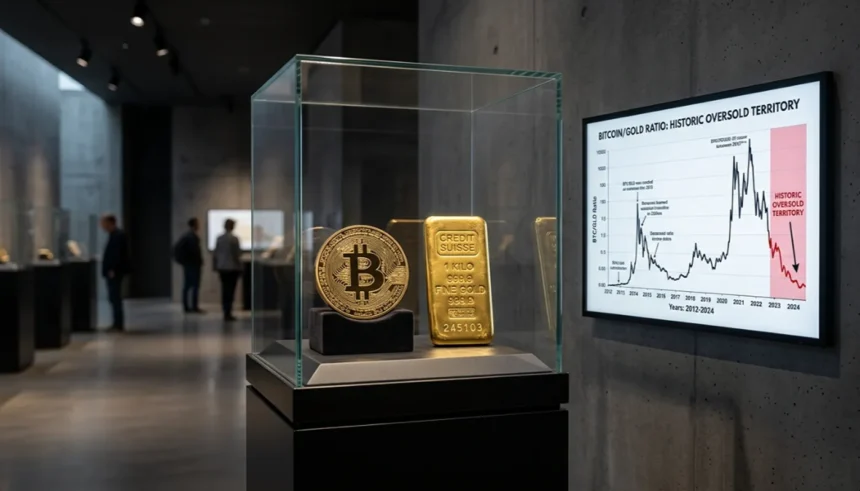
One asset just printed a record high. The other is down almost half from its peak. If you are trying to decide between Bitcoin and gold in 2026, you are not picking between two versions of the same thing.
You are picking between two very different tools.

Here is the direct answer: in 2026, gold is the better store of value right now. Gold hit a record $5,589 an ounce in January while Bitcoin fell roughly 47% by February (and over 50% peak-to-trough by June) from its $126,000 peak. That is not a hot take.
- Quick Answer: The 2026 Verdict in 30 Seconds
- The 2026 Scorecard: Bitcoin vs Gold, By the Numbers
- Bitcoin’s Crash, Month by Month: 47% by February, Over 50% Peak-to-Trough
- Gold’s Record Run, Then a 24% Drawdown
- The Bitcoin-to-Gold Ratio Collapsed
- Central Banks Bought Gold at a Record Pace
- What a Store of Value Really Is (And the Six Attributes That Define It)
- Why Gold Is Still the King of Crises
- 5,000 Years of Trust and Record Central-Bank Buying
- Why Gold Moves Less Than Bitcoin
- The 2026 War Trade That Failed
- What Actually Backs Bitcoin? Answered in Plain English
- Peter Schiff’s Argument: “The Energy Is Gone, So Nothing Backs It”
- The Rebuttal: The Ledger, the Network, and the Capped Supply
- Why “Backed By” Means Something Different Now
- Scarcity Math: Bitcoin’s Fixed Supply vs Gold Mining
- Stock-to-Flow 122 vs 60, Explained Without Jargon
- 0.83% vs About 1.8%: The Annual Supply Growth Gap
- Can Gold Supply Ever Surprise to the Upside?
- The JPMorgan Signal Beginners Should Know
- Portability, Custody, and Verification: A Practical Side-by-Side
- Moving $1 Million Across a Border in a Crisis
- Your Storage Options: Seed Phrase, Vault, or ETF
- Proving What You Own: Assaying Gold vs Running a Node
- The Real Risks of Each, Side by Side
- Tokenized Gold (XAUT, PAXG): The Third Option
- What XAUT and PAXG Are and How They Work
- Schiff’s Case: Tokenized Gold Is the Real “Digital Gold”
- Kratter’s Rebuttal: Counterparty Risk Defeats the Point
- Three-Way Comparison: Physical Gold vs Tokenized Gold vs Bitcoin
- The Beginner Decision Framework: Which Asset for Which Person
- The Two Questions That Decide Everything
- Gold Preserves, Bitcoin Compounds: Which Job Do You Need Done?
- Three Starter Allocation Models for Holding Both
- Will Bitcoin Ever Replace Gold? (And Should You Sell One for the Other?)
- Common Mistakes Beginners Make With Bitcoin and Gold
- Bitcoin vs Gold: Frequently Asked Questions
- Is Bitcoin better than gold in 2026?
- What makes Bitcoin a better store of value than gold?
- Why is gold considered more stable than Bitcoin?
- Can Bitcoin and gold work together in an investment portfolio?
- How does Bitcoin’s fixed supply compare to gold mining?
- What are the main risks of holding Bitcoin versus gold?
- Is Bitcoin actually a safe haven or still a risk asset?
- Will Bitcoin ever replace gold?
- What are the six key attributes of a good store of value?
- Should I sell my gold to buy Bitcoin (or vice versa)?
- Conclusion: The Honest Answer
That is what the scoreboard says.
But the bitcoin vs gold debate is really a question about jobs, not winners. Gold’s job is to preserve wealth through chaos. Bitcoin’s job is to grow wealth over the long run, and it charges brutal volatility as the price of admission.
So here is how to use this article. We start with the 2026 numbers, because facts beat feelings. Then we look at how each asset actually stores value, where each one wins, and the tokenized-gold middle ground most articles ignore.
Finally, you get a simple two-question framework for choosing your own split.

Take a 35-year-old saving for retirement in 15 years. She needs gold to protect what she has already built, and Bitcoin to do the heavy lifting on growth. By the end of this piece, you will know exactly which of those two jobs matters more for you.
Key Takeaways
- Gold won 2026 so far: a record $5,589 an ounce in January, record central-bank buying, and a drawdown half as deep as Bitcoin’s.
- Bitcoin fell roughly 47% by February (and over 50% peak-to-trough by June) from its $126,000 peak, bottomed near $58,600, and has partly recovered to about $83,000.
- The bitcoin vs gold question is really about jobs: gold preserves wealth, Bitcoin compounds it. Most beginners should hold both.
- Bitcoin’s long-horizon case rests on scarcity math (stock-to-flow 112 to 122 vs gold’s 60), digital portability, and JPMorgan’s record-low volatility-ratio signal.
- Use the two-question framework near the end to pick your own split, then rebalance yearly.
Quick Answer: The 2026 Verdict in 30 Seconds
If you only have 30 seconds, here is everything that matters. This is the short version of the honest 2026 bitcoin vs gold scorecard.
- 2026 winner so far: gold: record price of $5,589 an ounce in January, nearly doubling from early-2025 levels at the peak, plus a record 289 tonnes of central-bank buying in Q2 alone.
- Bitcoin in 2026: down roughly 47% by the February close (and over 50% peak-to-trough by the June close) from its $126,000 October 2025 peak, recovering to about $83,000 by late September.
- Bitcoin’s long-horizon case: a harder supply cap (stock-to-flow of 112 to 122 vs gold’s 60), near-instant global portability, and JPMorgan’s record-low volatility-ratio signal.
- The practical verdict: gold preserves, Bitcoin compounds. Your time horizon and your stomach for drops decide the mix. The full decision framework is in the section near the end of this article.
The 2026 Scorecard: Bitcoin vs Gold, By the Numbers
Most bitcoin vs gold articles argue from 2021 talking points. This one does not. Below are the actual 2026 numbers, including the parts that are uncomfortable for Bitcoin holders.
Every figure comes from market data and named sources. Where the data got revised after publication, you will see the revised version. Trust is earned, not asserted.
Bitcoin’s Crash, Month by Month: 47% by February, Over 50% Peak-to-Trough
Bitcoin peaked at $126,198.07 on October 6, 2025. What followed was one of the harshest drawdowns in its history.
Here is the monthly tape (Finnhub market data, Binance BTC):
| Month | Close (USD) |
|---|---|
| 2025-10 | 109,608 |
| 2025-11 | 90,360 |
| 2025-12 | 87,648 |
| 2026-01 | 78,741 |
| 2026-02 | 66,973 |
| 2026-03 | 68,284 |
| 2026-04 | 76,347 |
| 2026-05 | 73,674 |
| 2026-06 | 58,625 |
| 2026-07 | 62,888 |
| 2026-08 | 78,581 |
| 2026-09 | 83,030 |
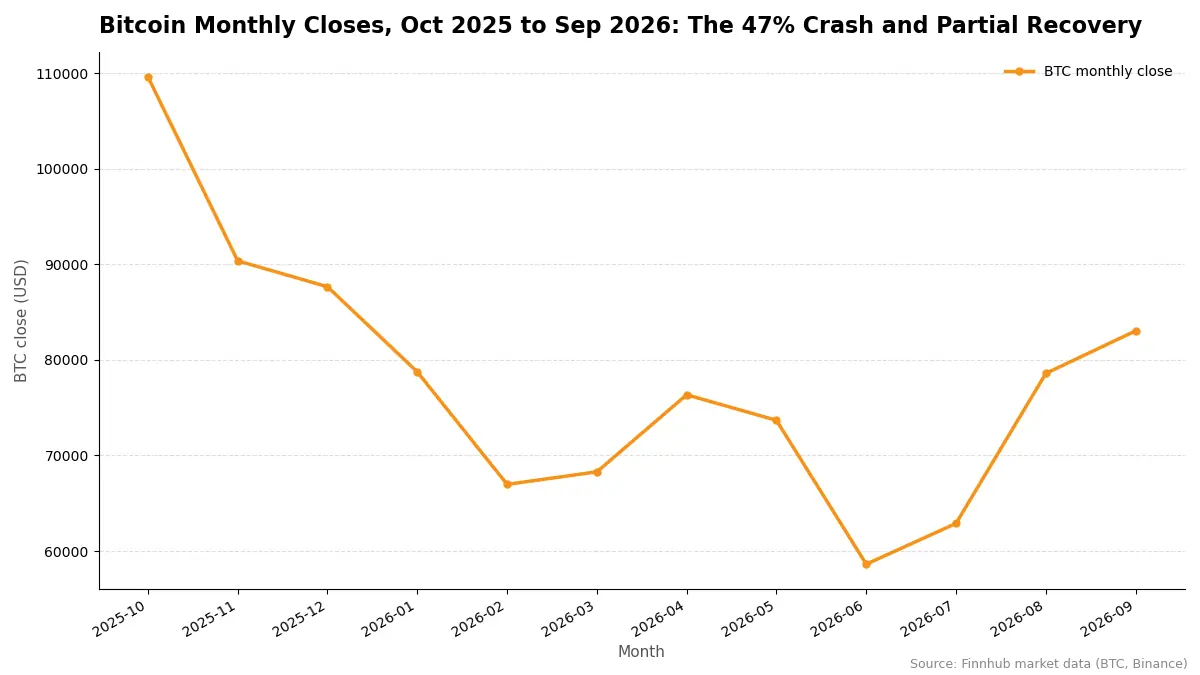
The read: Bitcoin fell roughly 47% by the February close, then over 50% peak-to-trough by the June close of $58,625. The recovery since then has been real but partial.
September closed near $83,030 with a market cap around $1.70 trillion, still roughly a third below the all-time high.
Gold’s Record Run, Then a 24% Drawdown
Gold did the mirror image. Spot gold hit its all-time high of $5,589.38 on January 28, 2026.
Futures settled at a record $5,318.40 the next day.
January was gold’s best start to a year since 1980.
Then came the round trip almost nobody shows you:
| Date | Price (USD/oz) | What happened |
|---|---|---|
| Jan 28, 2026 | 5,589.38 | Spot all-time high |
| Jan 29, 2026 | 5,318.40 | Record futures settlement |
| Jul 16, 2026 | 3,985.60 | 2026 settlement low |
| Aug 31, 2026 | 4,431.10 | August closed up 9.4% |
| Sep 2026 (late) | ~4,254 | About 24% below the record |
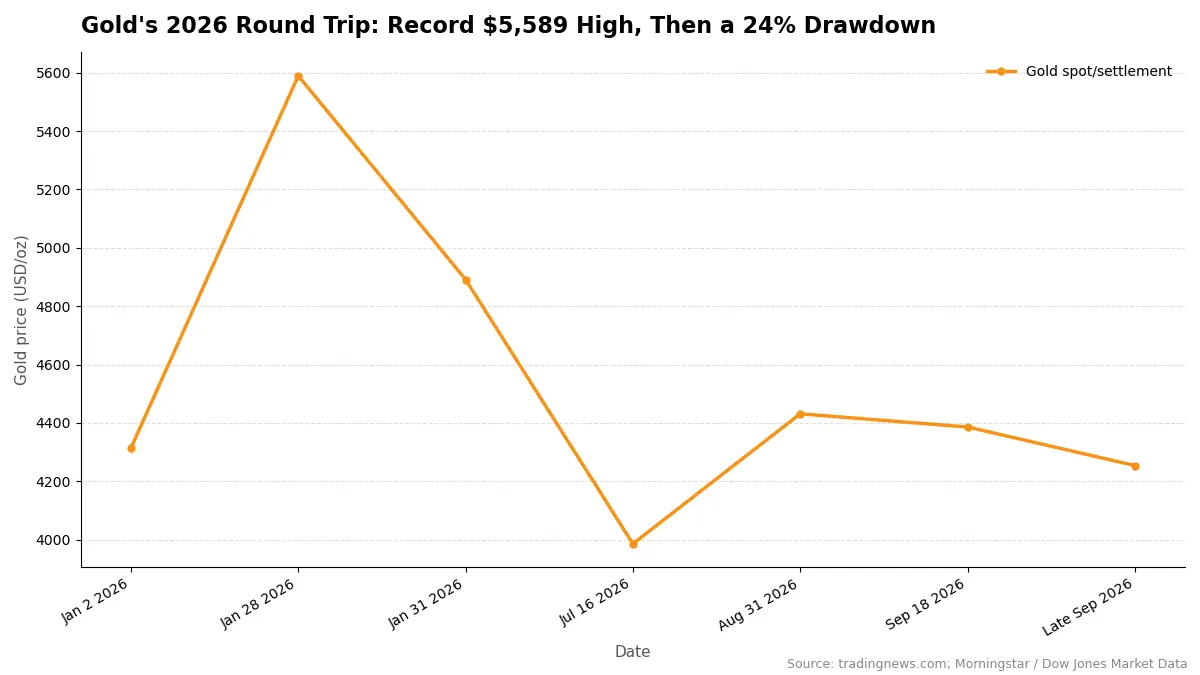
The full story: gold sits about 24% below its record, yet remains roughly 14% above where it stood a year ago. Even in a drawdown, gold’s floor held far above where 2025 began.
That is what a store of value looks like when it is working.
(Sources: Morningstar/Dow Jones Market Data, tradingnews.com.)
The Bitcoin-to-Gold Ratio Collapsed
Want one number that captures 2026? Watch how much gold a single Bitcoin buys.
| Date | 1 BTC buys |
|---|---|
| Dec 2024 | ~38 oz of gold |
| Feb 2026 | ~13 oz of gold |
| Sep 2026 | ~19.8 oz of gold |
From December 2024 to February 2026, Bitcoin lost more than 62% of its gold purchasing power in fourteen months.
It has since recovered to about 19.8 ounces, but that is still roughly half the 2024 peak. Bitcoin also slipped to around 13th place in global asset rankings, behind gold and silver.
Peter Schiff has been hammering this point.
“Putting that into perspective, had you invested $10,000 in Bitcoin back then, it would be worth about $9,100 today. But that same $10,000 invested in gold would be worth over $27,000.”
Peter Schiff, February 24, 2026
His math is fair as far as it goes. But notice what the same math does when you zoom out.
The ratio has already climbed from about 12 to nearly 20 ounces since February. Bitcoin recently hit its most oversold level against gold in history, and analyst Michaël van de Poppe called the February washout the heaviest BTC-vs-gold correction in Bitcoin’s history, a two-standard-deviation outlier.
Extremes like that have marked every major Bitcoin bottom: 2015, March 2020, and late 2022.
Central Banks Bought Gold at a Record Pace
Here is the ultimate smart-money signal. Central banks bought 289 tonnes of gold in Q2 2026, a record for any second quarter and 62% more than a year earlier. Poland led with 51 tonnes.
China added 33 tonnes, its largest quarterly purchase since late 2023.
Two honest footnotes. First, the World Gold Council later revised Q1 buying down to 57 tonnes, so the first half totaled 345 tonnes, the softest first half since 2022. The buying is real, but it is uneven.
Second, official figures understate the truth: Goldman Sachs estimates central banks actually bought about 44 tonnes in July versus 23 tonnes reported, meaning unreported buying runs roughly 158% above the pre-2022 average.
The takeaway for the scorecard: the institutions that guard national wealth keep choosing gold. That says something.
What a Store of Value Really Is (And the Six Attributes That Define It)
A store of value is simple: it is something that holds its purchasing power over time, so your savings do not quietly melt away. A good one lets you save today and spend tomorrow without a nasty surprise.
This matters more in 2026 than it has in years. Inflation is sticky, governments are piling on record debt that quietly debases currencies, and geopolitical shocks keep arriving. Once you understand what makes a good store of value, the whole bitcoin vs gold debate clicks into place.
The Six Attributes, Explained Simply
Every good store of value has six traits. Here they are in plain English:
- Scarcity. Hard to make more of. If anyone could print it at will, it would not hold value.
- Durability. It does not rot, rust, or expire.
- Portability. You can move it without hiring a truck.
- Divisibility. You can split it into small pieces for small payments.
- Verifiability. You can prove it is real without trusting a stranger.
- Wide acceptability. Other people actually want it too.
Bitcoin vs Gold, Scored on Each Attribute
Now score both assets, honestly. No asset sweeps the board, and that is the point.
| Attribute | Gold | Bitcoin | Winner |
|---|---|---|---|
| Scarcity | Supply grows ~1.7% a year; new mines possible | Capped at 21M; growth ~0.83% and shrinking | Contested |
| Durability | 5,000-year track record | 17 years and counting | Gold |
| Portability | Heavy, declarable, seizable | Twelve words in your memory | Bitcoin |
| Divisibility | Hard to split a bar fairly | Divisible to 8 decimal places | Bitcoin |
| Verifiability | Assaying costs money and expertise | Free and mathematical | Bitcoin |
| Acceptability | Central banks and jewelers worldwide | Growing fast, but younger | Gold |
The pattern is clear. Gold wins on history and universal acceptance. Bitcoin wins on the digital traits.
Scarcity is the fight that decides the future, and it deserves its own section below.
Why Gold Is Still the King of Crises
A Bitcoin site admitting gold’s strengths might feel strange. It should not. Gold earned its reputation over millennia, and 2026 added fresh evidence to the bitcoin vs gold debate.
If you cannot make the other side’s case, you do not understand your own.
Here is gold’s case, made properly.
5,000 Years of Trust and Record Central-Bank Buying
Gold has survived every empire, every currency collapse, and every financial innovation thrown at it. When central banks, the most conservative money managers on earth, bought a record 289 tonnes in a single quarter, they were voting with vaults.
The World Gold Council’s 2026 survey found that 89% of reserve managers expect global gold reserves to rise over the next year. Nobody buys an asset for 5,000 years by accident.
Why Gold Moves Less Than Bitcoin
This is pure market-cap math, and it is structural.
Gold’s total market value sits near $30 trillion. Bitcoin’s is around $1.6 to $1.7 trillion.
That makes gold roughly 18 times bigger.
Moving gold’s price takes enormously more money than moving Bitcoin’s. A billion dollars of selling barely dents gold. The same selling can crater Bitcoin.
Gold’s lower volatility is not a mood or a marketing claim. It is arithmetic.
That is also the direct answer to one of the most-searched questions on this topic: gold is considered more stable than Bitcoin because it is a far bigger pool, and bigger pools have smaller waves.
The 2026 War Trade That Failed
Here is the uncomfortable part even gold bugs should face. Gold is supposed to rally when wars start. In 2026, the opposite happened.
Gold topped out around $5,590 to $5,610 in the last days of January. The American and Israeli strikes on Iran began on February 28. Read that order again: the metal that is supposed to insure against exactly this event peaked a full month before the event happened, then fell about 22% while the war was ongoing.
Apollo Research flagged this as the single most instructive market fact of the year.
Why did the insurance fail? Because markets had already priced in the fear, and then the war created an inflation shock that forced the Federal Reserve to turn hawkish. New Fed Chair Kevin Warsh raised rates in September, the first hike since 2023, and real yields surged.
Gold pays no interest, so rising yields punish it.
The lesson cuts deep: gold is a great crisis asset, but “crisis” does not automatically mean “war.” Rate shocks hurt gold too. Beginners who buy gold purely as a war hedge are buying a story, not a guarantee.
That is a nuance the bitcoin vs gold debate usually misses.
What Actually Backs Bitcoin? Answered in Plain English
Every beginner asks this, and almost no article answers it simply. Gold is a shiny metal you can hold. So what is Bitcoin backed by?
Nothing you can touch. That sounds like a trick, so let us take the skeptic’s case seriously first.
This is the fairest version of the argument, then the rebuttal, in language a 12-year-old could follow. The bitcoin vs gold debate starts here for most beginners.
Peter Schiff’s Argument: “The Energy Is Gone, So Nothing Backs It”
Schiff’s case is simple and worth hearing. Bitcoin miners burn enormous amounts of electricity to create new coins. That energy is gone forever.
The money spent is gone. So unlike a gold bar, there is no physical thing left behind. In his view, Bitcoin is backed by nothing but belief.
He extends the logic to price. Bitcoin has never sustainably beaten gold, and when measured in gold, it keeps losing ground. To Schiff, the 2026 scoreboard is the verdict.
The Rebuttal: The Ledger, the Network, and the Capped Supply
Here is the beginner-friendly answer. What backs Bitcoin is three things you cannot hold but also cannot fake.
First, the ledger: a shared record of every Bitcoin transaction ever made, copied across millions of computers worldwide. No single person can rewrite it.
Second, the network: miners keep spending energy to secure that ledger roughly every ten minutes. The energy is not “gone.” It is the ongoing security budget that makes attacks impossibly expensive.
Third, the capped supply: code that says only 21 million Bitcoin will ever exist, enforced by every computer on the network. Change it and you are no longer on Bitcoin.
Now compare: a dollar bill is just paper and ink. What backs it is the network of people and institutions who accept it. Bitcoin works the same way, except its rules are written in code instead of voted on by committees.
Why “Backed By” Means Something Different Now
In a digital economy, “backed by” is evolving. Verifiable scarcity plus global acceptance can function like backing. Gold’s backing is chemistry and history.
Bitcoin’s backing is math and consensus.
Neither side gets a cheap win here. The skeptic is right that Bitcoin lacks a 5,000-year record. The believer is right that you cannot counterfeit math.
You, the reader, get to decide which kind of backing you trust with your savings.
Scarcity Math: Bitcoin’s Fixed Supply vs Gold Mining
This is Bitcoin’s strongest fundamental argument, and it is pure arithmetic. In the bitcoin vs gold debate, scarcity is Bitcoin’s home turf. Keep your calculator handy.
The numbers are simple.
We will cover stock-to-flow, the annual supply growth gap, the honest limits on each side, and the JPMorgan signal that Wall Street is watching.
Stock-to-Flow 122 vs 60, Explained Without Jargon
Stock-to-flow asks one question: how many years of new supply would it take to equal everything that already exists? Higher means harder to dilute.
Gold’s stock-to-flow sits around 60. Bitcoin’s is roughly 112 to 122 since the 2024 halving, about double gold’s. In plain English: Bitcoin is now about twice as hard to inflate as gold.
The halving is what did it. Every four years, the new Bitcoin paid to miners gets cut in half. The next halving lands in 2028.
Gold has no halving. Its new supply just keeps flowing.
0.83% vs About 1.8%: The Annual Supply Growth Gap
Flip it around and look at yearly inflation. Since the 2024 halving, Bitcoin’s annual supply growth is about 0.83%. Gold miners add roughly 1.7 to 1.8% to the gold supply each year.
Analyst Matthew Kratter argues that at gold’s current growth rate, its supply doubles in roughly four decades. Bitcoin’s new supply keeps shrinking toward zero and stops entirely at 21 million coins.
VanEck’s CEO has predicted Bitcoin could hit $350,000 as it inches toward flipping gold’s market cap. Bold calls like that rest on exactly this math: if Bitcoin keeps taking market share as the scarcer asset, the price has room to run.
Can Gold Supply Ever Surprise to the Upside?
Honesty requires the other side of the trade. Gold’s supply growth is not fixed. New discoveries, better mining technology, and much higher prices can all pull more gold out of the ground.
At $5,589 an ounce, miners were reopening long-dormant mines across northern Ontario. Price creates supply.
Bitcoin’s cap cannot change without breaking the consensus of the entire network. That is a feature, but it comes with a caveat of its own: the cap is a social agreement enforced by software, not a law of physics. It has held for 17 years.
Gold’s scarcity has held for millennia. Give both claims their proper weight.
The JPMorgan Signal Beginners Should Know
In February 2026, JPMorgan’s crypto team published a striking call. Bitcoin’s volatility relative to gold had fallen to around 1.5, a record low.
On that basis, the bank called Bitcoin “more attractive than gold” as a long-term investment and sketched a long-term, volatility-adjusted valuation of $266,000.
Two more details from the bank: Bitcoin was trading below its estimated production cost of about $87,000, the February estimate (the bank’s later September note put it near $77,000), and Goldman Sachs stayed bullish on gold for its stability. Treat the $266,000 as one bank’s scenario, not a prophecy. But the direction of the signal matters: Wall Street now measures Bitcoin against gold with a straight face.
Portability, Custody, and Verification: A Practical Side-by-Side
Theory is nice. This section is about real life. Imagine you need to protect $100,000 through a genuine crisis.
What does each asset actually demand of you? Nobody writes this comparison practically, so here it is.
We will walk through moving money across a border, your storage options, how you prove what you own, and the real risks of each. For background on the easiest on-ramp, see our beginner’s guide to what Bitcoin ETF approval means for investors.
Moving $1 Million Across a Border in a Crisis
Gold: a million dollars of gold weighs about 25 kilograms. You must declare it, transport it, and guard it. Borders can seize it.
History is full of confiscations.
Bitcoin: twelve words memorized, or written on a piece of paper in your shoe. The value crosses the border in your head and settles anywhere in the world within the hour. No declaration.
No truck. No vault.
This is not a thought experiment for everyone, but in countries with capital controls or collapsing currencies, it is the single most practical difference between the two assets. Portability is where the bitcoin vs gold contest is not close.
Your Storage Options: Seed Phrase, Vault, or ETF
Beginners have three doors for each asset.
- Self-custody. For Bitcoin, that means a seed phrase: twelve or twenty-four words that are literally your money. Lose the words and the money is gone forever. For gold, it means a safe or vault at home, with the theft risk sitting on you.
- Professional vaulting. Gold vault storage costs annual fees and requires trusting the vault operator. Bitcoin has custodians too, with similar trust tradeoffs.
- ETFs. The easy door: IBIT for Bitcoin, GLD for gold. You buy a ticker in your brokerage account and skip the logistics. But you own paper, not the asset, with counterparty risk and management fees.
One warning from the 2026 tape: ETF flows cut both ways. BlackRock’s IBIT saw one of its largest single-day outflows in 2026 (our report on the $54.8 million IBIT sale has the details), and spot Bitcoin funds suffered their first-ever losing half with $5.4 billion in net redemptions.
Easy in, easy out.
Proving What You Own: Assaying Gold vs Running a Node
Fake gold is a real industry. Verifying a gold bar means assaying it: melting, drilling, or X-raying, which costs money and expertise. Most buyers simply trust the dealer.
Bitcoin verification is free and mathematical. Anyone can run a node, a small piece of software that checks every transaction against the ledger’s rules. No trust required.
No expert needed. This is one of Bitcoin’s most underrated advantages: perfect verifiability at near-zero cost.
The Real Risks of Each, Side by Side
No minimizing. Here are the genuine risks of each asset:
| Risk | Bitcoin | Gold |
|---|---|---|
| Volatility | Extreme: 50%+ drawdowns happen | Moderate: a 24% drawdown was the 2026 shock |
| Custody | Lose your keys, lose your coins | Theft, vault fees, insurance costs |
| Counterparty | Exchange hacks, frozen accounts | Paper gold products that may not hold metal |
| Regulation | Bans, taxes, or restrictions possible | Confiscation has happened before (US, 1933) |
| Growth | Massive upside, massive downside | Slower, steadier, lower ceiling |
Tokenized Gold (XAUT, PAXG): The Third Option
Most bitcoin vs gold articles pretend this does not exist. Tokenized gold puts gold on a blockchain: the metal sits in a vault, and you hold a digital token representing it. It borrows strengths from both sides, so it deserves a fair hearing.
This matters because tokenized gold is the compromise candidate in the three-way comparison. Tether’s $100 million gold investment to back its XAUT token shows how seriously big players take it.
What XAUT and PAXG Are and How They Work
One token equals one ounce of vaulted gold. You can buy fractions of an ounce, trade 24/7 like crypto, and send it across borders in minutes. It is gold’s value with crypto’s rails.
The catch is obvious once you say it: you must trust the company holding the vault, the auditors checking the vault, and the token issuer itself. Every one of those is a middleman.
Schiff’s Case: Tokenized Gold Is the Real “Digital Gold”
Peter Schiff made the bull case himself in May 2026: “For real savings they will buy gold. If they want crypto instead, they will buy tokenized gold.”
His logic: you get gold’s 5,000-year stability plus crypto’s portability and divisibility. If “digital gold” is the goal, why accept Bitcoin’s volatility when you can hold the actual metal in digital form?
Kratter’s Rebuttal: Counterparty Risk Defeats the Point
Matthew Kratter’s rebuttal is equally sharp. Bitcoin was built to remove trusted middlemen. Tokenized gold reintroduces them: the vault, the issuer, the auditor.
If any link breaks, your token is a souvenir.
Redemption is the other friction. Try converting a large XAUT position back into physical bars during a real crisis and discover what “backed by” means in practice. Bitcoin needs no redemption.
It is the asset itself.
Three-Way Comparison: Physical Gold vs Tokenized Gold vs Bitcoin
| Feature | Physical Gold | Tokenized Gold (XAUT/PAXG) | Bitcoin |
|---|---|---|---|
| Trust required | Minimal (the metal is the metal) | High (vault, issuer, auditor) | Minimal (verify it yourself) |
| Portability | Poor | Excellent | Excellent |
| Divisibility | Poor | Excellent | Excellent |
| 24/7 trading | No | Yes | Yes |
| Crisis behavior | Proven over centuries | Untested in a true panic | Volatile, unproven as a haven |
| Fees | Storage and insurance | Issuer and redemption fees | Network fees only |
The verdict: tokenized gold is a convenience product, not a replacement for either. It suits traders who want gold exposure on crypto rails. It is not a substitute for vault gold in a crisis, nor for Bitcoin’s trustless scarcity.
The Beginner Decision Framework: Which Asset for Which Person
This is the section no competitor writes. Enough with “it depends on your risk tolerance” followed by nothing. Here are two questions, three profiles, and real allocation models you can act on.
No other bitcoin vs gold article gives you this.
This framework also answers the four questions beginners actually ask: can the two work together, is Bitcoin a safe haven, will it replace gold, and should I sell one to buy the other.
The Two Questions That Decide Everything
Question 1: When might you need this money? Under 3 years, 3 to 10 years, or 10-plus years. Short horizons punish volatility, while long horizons reward it.
Question 2: How would a 50% drop feel? Would you panic sell, feel uncomfortable but hold, or see a buying opportunity? Answer honestly: your 2026 self already lived through the answer, with Bitcoin falling by half and gold by a quarter.
Note: These are educational starting points, not financial advice. No article knows your debts, your timeline, or your nerves. Use the framework to think, then decide for yourself.
Gold Preserves, Bitcoin Compounds: Which Job Do You Need Done?
Here is the core mental model. Gold’s job is to protect purchasing power through chaos. Bitcoin’s job is asymmetric long-term growth with stomach-churning volatility.
And here is the direct answer to a top search question: no, Bitcoin is not a safe haven in 2026. It is still a risk asset. It fell nearly 50% during a year of geopolitical shocks, which is the opposite of haven behavior.
That is exactly why its upside exists: risk assets pay you for enduring the ride. Expecting Bitcoin to behave like gold in a crisis is the single most expensive misunderstanding in this debate.
Bitwise’s Matt Hougan has framed the macro choice as a bet on how America handles its massive national debt pile: own AI stocks if growth does the work, own Bitcoin if the debt gets inflated away instead. Gold and Bitcoin are both hedges against the same debasement. The question is which kind of protection your timeline needs.
Three Starter Allocation Models for Holding Both
Pick the profile that fits. Each model gives a rough split and the one-sentence logic behind it.
The Preserver: 80% gold, 20% Bitcoin
For money you may need within 3 years, or if a big drop would keep you up at night. Capital preservation comes first, with a small growth engine that cannot sink the plan.
The Balanced Beginner: 60% gold, 40% Bitcoin
For a 3 to 10 year horizon with the stomach for a bad year. A gold core holds through chaos, plus a real Bitcoin position that compounds if the scarcity thesis plays out.
The Long-Horizon Compounder: 30% gold, 70% Bitcoin
For 10-plus years, treating 50% drops as sales. Time turns Bitcoin’s volatility from a threat into an advantage, and gold is the stabilizer that lets you hold through the crashes.
Whichever model you pick, rebalance once a year. If Bitcoin doubles, sell some back into gold. If it halves, buy some with gold profits.
Rebalancing is the strategy. Going all-in on either asset is the mistake.
Will Bitcoin Ever Replace Gold? (And Should You Sell One for the Other?)
Direct answer: replacement is the wrong frame. Central banks hold gold, not Bitcoin, and that will not change soon. Gold’s monetary role is embedded in the global system.
Bitcoin is building a parallel one. They can coexist the way email coexists with physical mail.
On switching: selling all of one for the other is the mistake. Institutions are voting with real money in both directions at the same time.
From MicroStrategy’s massive Bitcoin buys to central banks’ record gold purchases, the winning move is holding both and rebalancing between them.
That is the strategy this framework is built for. In September 2026, Bitwise reported that at least one sovereign wealth fund has been selling gold reserves to buy Bitcoin.
Common Mistakes Beginners Make With Bitcoin and Gold
Five mistakes, each with the one-line fix. Learn these and you are ahead of most of the market.
- Buying gold at the peak of a fear rally and selling Bitcoin at the bottom of a crash. January 2026 gold buyers and June 2026 Bitcoin sellers made the same error in opposite directions: price-chasing. Fix: decide your allocation in advance and rebalance on a schedule.
- Keeping life-changing amounts of Bitcoin on an exchange. Exchanges get hacked and accounts get frozen. Fix: learn self-custody basics before your stack gets big.
- Buying “gold exposure” that is not gold. Leveraged paper products can diverge wildly from the metal. Fix: know whether you own bullion, an ETF, or a derivative.
- Expecting Bitcoin to behave like gold in a crisis. It is still a risk asset in 2026. Fix: size your Bitcoin position so a 50% drop is survivable.
- Going all-in on one asset instead of rebalancing. Concentration feels brave until it does not. Fix: use the framework above and rebalance yearly.
Bitcoin vs Gold: Frequently Asked Questions
Short, direct answers to the ten questions searchers ask most. Each one is consistent with everything above.
Is Bitcoin better than gold in 2026?
No, not as a store of value right now. Gold hit a record $5,589 an ounce while Bitcoin fell roughly 47% by February (and over 50% peak-to-trough by June) from its peak, and central banks bought gold at a record pace. Bitcoin’s case is long-term: harder scarcity math and digital portability.
In 2026, gold preserves better. Bitcoin is the higher-risk, higher-reward bet on the future.
What makes Bitcoin a better store of value than gold?
Three things: a fixed supply of 21 million coins versus gold’s growing mine supply, near-perfect portability (twelve words can cross any border), and free mathematical verifiability. Its stock-to-flow of 112 to 122 is roughly double gold’s 60. The tradeoff is brutal volatility and a much shorter track record.
Why is gold considered more stable than Bitcoin?
Market-cap math. At roughly $30 trillion, gold is about 18 times bigger than Bitcoin, so it takes far more money to move its price. Add 5,000 years of universal acceptance and constant central-bank demand, and you get structurally smaller waves.
Stability is arithmetic, not marketing.
Can Bitcoin and gold work together in an investment portfolio?
Yes, and that is the honest answer most articles avoid. They do different jobs: gold preserves wealth through chaos, Bitcoin compounds it over long horizons. A beginner framework: mostly gold for short horizons, a growing Bitcoin slice as your horizon and risk tolerance lengthen, rebalanced yearly.
How does Bitcoin’s fixed supply compare to gold mining?
Bitcoin’s supply is capped at 21 million coins by code, growing about 0.83% a year and shrinking toward zero.
Gold miners add roughly 1.7 to 1.8% to supply yearly, and higher prices can unlock more mining. At current rates, gold’s supply doubles about every 40 years.
Bitcoin’s never doubles again.
What are the main risks of holding Bitcoin versus gold?
Bitcoin’s risks: extreme volatility, lost private keys, exchange hacks, and regulatory shifts. Gold’s risks: theft and storage costs, confiscation history, slower growth, and fake or paper products that are not really gold. Neither asset is risk-free.
Their risks are just different shapes.
Is Bitcoin actually a safe haven or still a risk asset?
Still a risk asset in 2026. It fell nearly 50% during a year of geopolitical shocks, which is the opposite of haven behavior. Bitcoin may mature into a haven over time as volatility keeps compressing, and JPMorgan’s record-low volatility-ratio reading points that way.
But today it behaves like high-octane risk.
Will Bitcoin ever replace gold?
Probably not in the way the question imagines. Central banks hold gold as reserves and show no sign of switching. Gold’s monetary role is embedded in the global system.
The more likely future is coexistence: Bitcoin keeps taking market share as digital scarcity while gold remains the crisis reserve. Replacement is the wrong frame.
What are the six key attributes of a good store of value?
Scarcity (hard to make more of), durability (does not rot or expire), portability (easy to move), divisibility (easy to split), verifiability (easy to prove real), and wide acceptability (others want it too). Gold leads on durability and acceptability. Bitcoin leads on portability, divisibility, and verifiability.
Scarcity is contested.
Should I sell my gold to buy Bitcoin (or vice versa)?
No. Selling all of one for the other is the classic mistake this article exists to prevent. The better move is holding both and rebalancing: trim the winner yearly and feed the loser.
Use the two-question framework above to set your split, then let the schedule, not your emotions, do the trading.
Conclusion: The Honest Answer
Here is the verdict without hedging it into mush. Gold won 2026 and remains the better crisis store of value today: record price, record central-bank buying, and a drawdown half as deep as Bitcoin’s. Bitcoin’s scarcity math, portability, and the institutional signals make it the stronger long-horizon compounding bet.
The beginner’s edge is holding both, with a clear job for each. That is the honest bitcoin vs gold verdict for 2026.
Start with the two questions: when do you need the money, and how would a 50% drop feel? Pick your model, rebalance yearly, and ignore the tribal shouting from both camps.
To go deeper, read our beginner’s guide to Bitcoin ETFs, the story of Tether’s gold-backed XAUT token, and why Bitcoin hit historically oversold levels against gold.
Every number in this article was checked against market data and named sources, and a human editor reviews every number before publication. This is education, not financial advice.
One more bridge between the two worlds: Europe’s currency-hedged gold products proved the model works at scale, and that playbook directly inspired HANetf’s newly launched euro-hedged bitcoin ETC.