



SARS can now see your crypto. From 1 March 2026, South African exchanges report your trades directly to the tax authority under the Crypto-Asset Reporting Framework, known as CARF.
That changes the question for every beginner. It is no longer whether SARS will find out about your Bitcoin.

It is whether you declare it correctly before SARS comes to you.
- Key Takeaways
- The 2026 Change That Matters Most: SARS Now Sees Your Crypto
- How SARS Treats Your Bitcoin
- Income or Capital Gain? The Test That Decides Your Rate
- Worked Example: The Same R200,000 Gain, Two Very Different Tax Bills
- The R50,000 Annual Exclusion, and When It Does Not Help
- What Counts as a Disposal?
- Mining, Staking and Getting Paid in Bitcoin
- How to Declare Crypto on Your ITR12
- The Voluntary Disclosure Programme: The Window Closes When SARS Knocks
- Penalties, Audits and Record Keeping
- 7 Mistakes Beginners Make With Crypto Tax in South Africa
- Frequently Asked Questions
- Do I pay tax on Bitcoin in South Africa if I never sell it?
- What is the crypto tax rate in South Africa?
- What is the R50,000 annual exclusion?
- Does SARS know about my crypto?
- How do I declare crypto on my tax return?
- What happens if I never declared crypto before?
- The Bottom Line
- Sources
This guide explains crypto tax in south africa for beginners in plain English, with the 2026 rates, the R50,000 annual exclusion, and a worked example that shows how the same R200,000 gain can cost R24,600 or R82,000 depending on how SARS classifies you.
This guide is general information only, not tax advice, and tax rules depend on your own situation, so talk to a qualified tax practitioner before you file.
Key Takeaways
- SARS treats crypto as an intangible asset, not as money. Tax starts when you dispose of it, not while you hold it.
- From 1 March 2026, CARF requires South African exchanges to report your trades to SARS. The first reports are due by 31 May 2027, and the first international data exchange happens in September 2027.
- Your gain is taxed in one of two ways: as income at your marginal rate, up to 45%, if SARS sees you as a trader, or as a capital gain, with a maximum effective rate of 18%, if you held as a long-term investor.
- The annual capital gains exclusion is R50,000 for the 2026/27 tax year, up from R40,000. Only 40% of the gain above that amount counts as taxable income.
- Declare crypto trading income on your ITR12 under source code 4522. Capital gains go in the CGT section of the same return.
- If you never declared crypto before, the Voluntary Disclosure Programme can wipe out penalties, but only if you apply before SARS starts an audit.
- Penalties for undeclared crypto can reach 200% of the tax owed, plus interest. Keep your records for at least 5 years.
The 2026 Change That Matters Most: SARS Now Sees Your Crypto
For years, many South Africans treated crypto tax as optional. SARS asked questions, but it had to rely on what taxpayers chose to declare.
That era ended on 1 March 2026.

On that date, South Africa put the OECD Crypto-Asset Reporting Framework into force. Every crypto exchange, broker, and custody provider with a South African connection must now collect your identity details and report your trades, transfers, and wallet movements to SARS.
You do not file a CARF report yourself. Your exchange does it for you.
SARS published the full CARF rules on its own website, and the timeline is public. The first reporting period runs from 1 March 2026 to 28 February 2027.
Providers must send their first reports to SARS by 31 May 2027. SARS then shares that data with tax authorities in other countries from September 2027, which closes the offshore exchange route too.
| Date | What happens |
|---|---|
| 1 March 2026 | CARF takes effect in South Africa, and exchanges start collecting reportable data |
| 1 July 2026 | SARS publishes its draft guide to the taxation of crypto assets, open for comment until 31 August 2026 |
| 31 May 2027 | First CARF reports from exchanges are due to SARS |
| September 2027 | First international exchange of CARF data between countries |
CARF does not create a new tax. It only creates visibility.
The tax rules themselves are the same ones SARS has applied since 2018, when it first confirmed that normal income tax rules apply to crypto.
SARS has also built a dedicated crypto audit unit, and it has sent crypto questionnaires to taxpayers since 2021. With exchange data now flowing in automatically, a return that omits crypto is much easier for SARS to spot.
That is why the practical advice in 2026 is simple: declare first, and let SARS argue about classification later.
How SARS Treats Your Bitcoin
SARS does not treat Bitcoin as currency or legal tender. It treats crypto as an asset of an intangible nature, and since 2022 it is also a financial product under South African financial law.
That classification decides everything that follows.
Because crypto is an asset, the normal rules of the Income Tax Act apply. Your gain is either revenue, taxed as ordinary income, or capital, taxed under the capital gains tax rules in the Eighth Schedule.
SARS decides which one fits your facts. You do not get to pick the cheaper option.
Crypto Is an Asset, Not Money
The asset label matters because it brings crypto inside the capital gains tax system. If Bitcoin were treated as foreign currency, different rules would apply.
SARS settled this point years ago, and its Budget 2026 answers repeat it: crypto is an asset, and gains are taxed as income or as capital gains depending on how you used it.
The asset label also means crypto is not a personal-use asset. The R50,000 annual exclusion still applies to your crypto gains, but the personal-use exemptions that cover your car or your furniture do not help you here.
Tax Starts at Disposal, Not While You Hold
You pay no tax while your Bitcoin sits in your wallet and rises in value. Tax starts only when you dispose of it, which means you sell it, swap it, spend it, or give it away.
That single rule shapes good planning. A gain on paper is not a tax bill yet, but the moment you convert Bitcoin to rand, or trade it for another coin, the tax year of that disposal is the year you must declare it.
Income or Capital Gain? The Test That Decides Your Rate
This is the most important section in the guide, because the same gain can cost three times as much tax under one label as under the other. SARS looks at your intention, how often you trade, and how business-like your activity is.
No single fact decides it.
If you bought Bitcoin once, held it for years, and sold it to fund a house deposit, SARS will usually treat the gain as capital. If you trade every week, chase short-term price moves, and run your crypto like a business, SARS will usually treat the profits as income.
Most beginners sit closer to the first group, but frequent trading can push you into the second.
When SARS Taxes You as a Trader: Up to 45%
Revenue treatment applies when SARS sees trading as your business or a profit-making scheme. Frequent buying and selling, short holding periods, borrowed money, and marketing yourself as a trader all point this way.
Mining, staking rewards, and crypto you receive as pay are also income, because you earned them rather than gained on an investment.
Under revenue treatment, the full gain counts as taxable income. It stacks on top of your salary and other income, and it is taxed at your marginal rate.
South African marginal rates for individuals run from 18% to 45%, so a top-bracket trader pays 45% on the crypto gain. There is no annual exclusion on the income path.
When SARS Taxes You as an Investor: Maximum 18%
Capital treatment applies when you held crypto as a long-term investment. You take the gain, subtract the R50,000 annual exclusion, and include only 40% of what is left in your taxable income.
That 40% is then taxed at your marginal rate.
The maths caps the effective rate at 18%. That is 40% inclusion times the top marginal rate of 45%.
If your marginal rate is lower, your effective crypto rate is lower too. A taxpayer on a 31% marginal rate, for example, pays an effective 12.4% on the capital gain above the exclusion.
| Feature | Taxed as income | Taxed as capital gain |
|---|---|---|
| Who it fits | Frequent traders, miners, stakers, people paid in crypto | Long-term holders who bought to invest |
| Annual exclusion | None | R50,000 for 2026/27 |
| How much counts | 100% of the gain | 40% of the gain above the exclusion |
| Top rate on the gain | 45% marginal rate | 18% effective |
| Losses | Revenue losses offset other income in limited cases | Capital losses offset capital gains only, and unused losses carry forward |
| Where it goes on the ITR12 | Source code 4522 for crypto trading income | The capital gains section of the return |
Our complete Bitcoin tax guide compares these two paths across many countries, and the pattern is the same almost everywhere. South Africa is unusual only in how wide the gap is: 18% against 45% is a difference worth planning around.
Worked Example: The Same R200,000 Gain, Two Very Different Tax Bills
Take a beginner who bought Bitcoin for R100,000 and sold it later for R300,000. The gain is R200,000, and the tax year is 2026/27.
Assume a marginal rate of 41% in both cases, so the only difference is the classification.
On the capital path, the R50,000 annual exclusion comes off first, which leaves R150,000. Only 40% of that counts, which is R60,000 of taxable income.
At 41%, the tax is R24,600.
On the income path, there is no exclusion and no 40% rule. The full R200,000 counts as income, and at 41% the tax is R82,000.
The same gain, the same sale, and a difference of R57,400 in tax.
| Step | Capital gains path | Income path |
|---|---|---|
| Gain | R200,000 | R200,000 |
| Annual exclusion | Minus R50,000 | None |
| Amount that counts | R150,000 x 40% = R60,000 | R200,000 x 100% = R200,000 |
| Tax at 41% marginal rate | R24,600 | R82,000 |
| Effective rate on the gain | 12.3% | 41% |
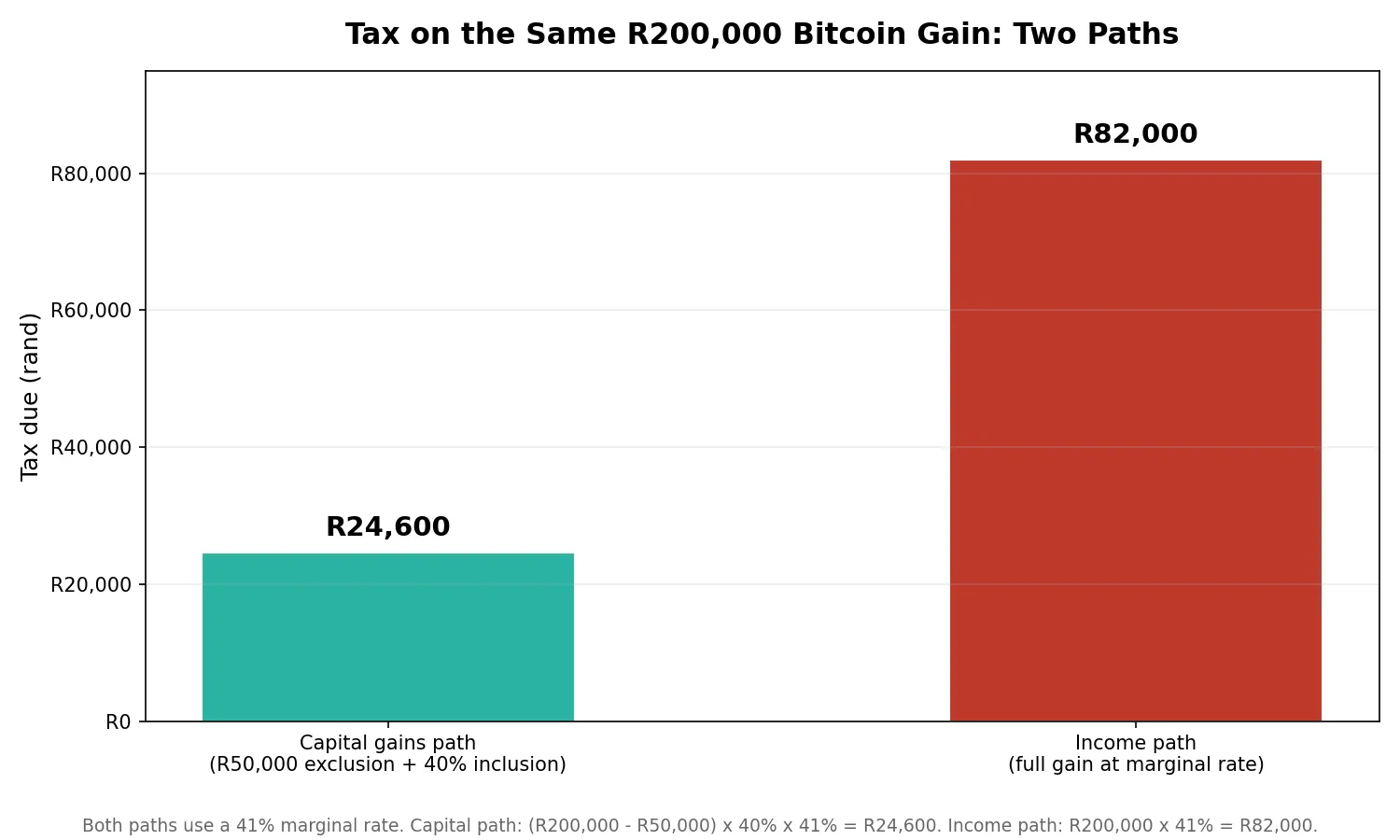
The lesson is not to game the classification. SARS decides it from your facts, and pretending to be an investor while trading daily will not survive an audit.
The lesson is to keep records that prove your real intention, and to hold for the long term if the capital path is what you want.
The R50,000 Annual Exclusion, and When It Does Not Help
The annual exclusion is the most useful number in this guide for small investors. For the 2026/27 tax year, which runs from 1 March 2026 to 28 February 2027, the first R50,000 of your net capital gains is tax-free.
The Budget 2026 raised it from R40,000, its first increase since 2017.
That means a beginner who makes a R40,000 gain in the year and has no other capital gains pays no capital gains tax at all. The gain sits below the exclusion, so nothing is left to include.
Sell a little each year, inside the exclusion, and the tax stays at zero.
Three limits apply. First, the exclusion covers your total net capital gains for the year, not each sale, so two R30,000 gains add up to R60,000 and R10,000 is exposed.
Second, it only helps on the capital path, because income has no exclusion. Third, it is an annual figure, so it does not carry forward if you do not use it.
There is also a larger exclusion in the year of death, which rose to R440,000 for 2026/27. That is an estate planning detail, not a trading strategy, but it shows how seriously the exclusion figures are set.
What Counts as a Disposal?
Every one of these events triggers tax in the year it happens. The list surprises most beginners, because only the first item looks like a sale.
- Selling Bitcoin for rand, on any exchange or peer to peer.
- Swapping Bitcoin for another crypto, such as Ethereum or a stablecoin. The swap is a disposal of the Bitcoin, even though no rand changed hands.
- Paying for goods or services with Bitcoin. Buying a laptop with crypto is a disposal at the market value on that day.
- Giving Bitcoin away as a gift or donation. The disposal happens at market value, and donations tax can also apply above the annual donations exemption.
- Losing Bitcoin through theft or fraud can count as a disposal too, and it may create a capital loss if the facts fit.
Moving Bitcoin between your own wallets is not a disposal. Neither is simply holding it while the price moves.
The tax event needs a change of ownership, or a conversion into something else.
For a practical walkthrough of the buying side, see our guide on how to buy Bitcoin in South Africa, which covers the local exchanges that now report to SARS under CARF.
Mining, Staking and Getting Paid in Bitcoin
Not all crypto income comes from selling. Mining rewards, staking rewards, airdrops, and salary paid in Bitcoin are all income in the year you receive them, at their rand value on the day you received them.
SARS taxes the receipt, and then taxes any later gain when you sell.
That creates two tax events from one coin. If you earn 0.1 BTC from staking when Bitcoin trades at R1,000,000, you declare R100,000 as income that year.
If you later sell that 0.1 BTC for R150,000, the extra R50,000 is a gain on disposal, and it follows the income or capital rules above.
Expenses linked to earning that income can be deducted, if they meet the requirements of the Income Tax Act. Electricity and hardware for a mining rig, or fees paid to a staking service, are the usual examples.
Keep the invoices, because SARS will ask for proof.
How to Declare Crypto on Your ITR12
South Africa runs on a March to February tax year. The 2026/27 year runs from 1 March 2026 to 28 February 2027, and you declare it on the ITR12 income tax return for individuals.
SARS confirms the crypto trading source code is 4522, and capital gains go in the CGT section of the same return.
Work through these steps before the filing deadline, and do not leave the crypto section blank because you are unsure of the numbers. A blank section is what the CARF data will contradict.
- Export your full transaction history from every exchange and wallet you used, including offshore platforms. CARF covers foreign providers that serve South African residents too.
- Work out each disposal: proceeds minus base cost, where base cost is what you paid plus allowable fees. SARS accepts FIFO or specific identification for working out which coins you sold.
- Separate revenue items from capital items. Trading profits, mining, staking, and salary in crypto go under source code 4522. Long-term investment gains go in the CGT section.
- Apply the R50,000 annual exclusion to your net capital gains, then include 40% of the rest in your taxable income.
- Check whether you must register as a provisional taxpayer. If your taxable income from crypto and other sources passes the threshold, provisional tax applies, with payments during the year.
- File the ITR12 on eFiling, keep the calculation, and keep every exchange statement behind it.
If the numbers feel too tangled, a tax practitioner can do the calculation from your exchange exports in an hour or two. That fee is small next to a penalty, and it is deductible if the work relates to earning income.
The Voluntary Disclosure Programme: The Window Closes When SARS Knocks
If you traded crypto in past years and never declared it, the Voluntary Disclosure Programme, or VDP, is the way back. It is a permanent programme under the Tax Administration Act, and it can remove the understatement penalty entirely and protect you from prosecution for the disclosed default.
The catch is timing. You must apply before SARS notifies you of an audit or investigation.
Once SARS sends an audit letter, or a crypto questionnaire that starts an investigation for that period, the VDP window for that period is probably closed. A CARF data match that triggers a SARS letter has the same effect.
The VDP never waives the tax itself, and it never waives the interest. You still pay what you owed, plus interest from the original due date.
What it waives is the penalty, which can reach 200% of the tax owed. On a R100,000 tax bill, that is the difference between paying about R100,000 plus interest and paying up to R300,000 plus interest.
Apply through a tax practitioner if the amounts are large. The disclosure must be complete, because a VDP that covers one year and hides another is not voluntary for the hidden years.
Penalties, Audits and Record Keeping
SARS can audit up to 5 years back, and further if it finds evidence of evasion. It can also ask for your records at any time, and the Tax Administration Act requires you to keep them for at least 5 years after you file.
Keep every exchange statement, wallet address, and calculation for that long, even after you stop trading.
The penalty scale depends on behaviour. A simple mistake can attract 10%, a substantial understatement 10% to 20%, and intentional evasion 150% to 200% of the tax shortfall.
Interest runs from the original due date on top of all of it. Administrative penalties for late filing can add up to R16,000 per month.
Two traps catch beginners. The first is loss harvesting: if you sell Bitcoin at a loss and buy the same coin back within 45 days either side of the sale, the loss limitation rules in paragraph 42 of the Eighth Schedule can disregard the loss for now and add it to the base cost of the coins you bought back.
The second is thinking that a foreign exchange is invisible. CARF covers foreign providers with a South African connection, and the first international data exchange lands in September 2027.
Crypto exchanges operating in South Africa must also be licensed as crypto asset service providers by the Financial Sector Conduct Authority, the FSCA. A licensed exchange is a reporting exchange, so using a licensed local platform is the opposite of hiding.
7 Mistakes Beginners Make With Crypto Tax in South Africa
Most crypto tax trouble in South Africa comes from simple errors, not from deliberate evasion. These seven are the ones SARS sees most often.
- Assuming SARS will never know. CARF reporting started on 1 March 2026, and the first data batch reaches SARS by 31 May 2027. The hiding window has closed.
- Forgetting crypto-to-crypto swaps. Trading Bitcoin for Ethereum is a disposal of the Bitcoin, even though no rand entered your bank account. Many beginners only declare rand withdrawals and miss every swap.
- Declaring trading profits as capital gains. If you trade daily, SARS will treat the profits as income at up to 45%. Calling it capital does not make it capital, and the reclassification brings penalties.
- Claiming the R50,000 exclusion on income. The exclusion only applies to capital gains. A trader who subtracts R50,000 from trading income has understated by R50,000.
- Keeping no records. Without exchange statements, you cannot prove your base cost, so SARS can treat the full proceeds as a gain. Keep 5 years of records.
- Ignoring mining and staking rewards. Rewards are income when received, at their rand value that day. Waiting until you sell to declare them understates the year you received them.
- Waiting for SARS to find you. Once SARS starts an audit, the VDP window closes and the penalty protection goes with it. Disclose first, while the choice is still yours.
The same beginner errors show up in other countries too. Brazil taxes crypto under a similar split between domestic and offshore rules, and Ireland cut its CGT rate to 31% for disposals from October 2026.
The details change, but the record keeping habit is the same everywhere.
Frequently Asked Questions
These are the questions South African beginners ask most often about crypto tax. The short answers below match the detail in the sections above.
Do I pay tax on Bitcoin in South Africa if I never sell it?
No. SARS taxes disposals, not holdings, so Bitcoin that stays in your wallet creates no tax bill, while mining rewards, staking rewards, and salary paid in Bitcoin count as income in the year you receive them even if you never sell the coins.
What is the crypto tax rate in South Africa?
There is no single crypto tax rate. Long-term investors pay capital gains tax at a maximum effective rate of 18% after the R50,000 annual exclusion and the 40% inclusion rule, while frequent traders pay income tax at a marginal rate from 18% to 45%, and SARS decides which rate applies from your trading pattern and your intention.
What is the R50,000 annual exclusion?
It is the amount of net capital gains that is tax-free each year, and for the 2026/27 tax year the first R50,000 of your total net capital gains is excluded before any tax is worked out. It applies once per year to all of your capital gains added together, not once per sale, it does not apply to income, and it does not carry forward to the next year if you do not use it.
Does SARS know about my crypto?
In most cases, yes, or it soon will. Under CARF, South African exchanges report your trades to SARS from 1 March 2026, with the first reports due by 31 May 2027, SARS also receives data from foreign exchanges that serve South African residents, and its dedicated crypto audit unit has sent questionnaires to taxpayers since 2021.
How do I declare crypto on my tax return?
Declare it on your ITR12 income tax return for the year of the disposal, with crypto trading income under source code 4522 and capital gains in the capital gains section of the same return. After you subtract the R50,000 annual exclusion and apply the 40% inclusion rate, keep your exchange statements and your calculation for at least 5 years after you file.
What happens if I never declared crypto before?
Use the Voluntary Disclosure Programme before SARS contacts you, because a voluntary disclosure can remove the understatement penalty and protect you from prosecution for the disclosed default. You still pay the tax and the interest, and once SARS starts an audit or sends a crypto questionnaire for that period, the window to use the programme for that period is usually closed.
The Bottom Line
Crypto tax in South Africa is no longer a grey area. The rules are settled, the rates are public, and from 1 March 2026 the reporting is automatic.
The only real choice left is whether you declare your crypto yourself or wait for SARS to ask about it.
Start with the basics: work out whether you are an investor or a trader, apply the R50,000 exclusion if you are on the capital path, declare on your ITR12 under source code 4522, and keep 5 years of records. If past years are undeclared, talk to a tax practitioner about the Voluntary Disclosure Programme now, while the window is still open.
South Africa is not the only country tightening crypto reporting. Nigeria introduced new rules from 2026, and New Zealand has no capital gains tax but still taxes crypto gains as income in many cases.
The direction of travel is the same everywhere, and it points toward declaring early.