



Yes, you pay tax on Bitcoin in Japan, and the rate can reach about 55%. The National Tax Agency (NTA) treats Bitcoin gains as miscellaneous income, so your profit joins your salary and gets taxed at your marginal rate.
That sounds harsh, and it is. Japan has one of the highest crypto tax rates of any major economy.

But a big change is already law. The 2026 tax reform moves crypto to a flat 20.315% separate tax from January 1, 2028, with a three year loss carryforward.
- Key Takeaways
- Bitcoin Tax in Japan Explained: The Short Answer
- What Counts as a Taxable Bitcoin Event in Japan
- Japan Bitcoin Tax Rates in 2026
- The 2028 Reform: 20% Tax Is Law, But the Date Has a Catch
- The Catch: Only Sales Through Registered Japanese Exchanges Qualify
- Loss Carryforward Finally Arrives
- 2026 vs 2028: A Worked Example on a 1,000,000 Yen Gain
- Do You Need to File? The 200,000 Yen Rule
- How to File Bitcoin Taxes in Japan
- Common Mistakes That Cost Bitcoin Holders Money
- What to Do in 2026 and 2027
- Frequently Asked Questions
- Is Bitcoin taxed in Japan?
- Do I need to file a tax return if I made less than 200,000 yen from Bitcoin?
- Is swapping Bitcoin for another cryptocurrency taxable in Japan?
- When does Japan’s 20% crypto tax start?
- Does the 20% rate apply to Bitcoin held on overseas exchanges?
- Can I carry forward crypto losses in Japan?
- Sources
The catch is that the new rate only covers sales through registered Japanese exchanges, and the 2028 start date depends on a cabinet order that has not been set yet.
This guide explains bitcoin tax in japan explained in plain English. It covers the current rates, the taxable events, the 200,000 yen filing rule, the NTA calculation worksheet, and exactly what to do in the two transition years before the reform starts.
This guide is general information only. It is not tax advice.
Tax rules depend on your own situation, so talk to a licensed tax accountant (zeirishi) before you file.

Key Takeaways
- Bitcoin gains in Japan are miscellaneous income in 2026 and 2027, taxed at progressive rates up to about 55.9% including resident tax and the reconstruction surtax.
- A flat 20.315% separate tax was enacted on March 31, 2026 and is expected to start on January 1, 2028, but it only covers sales of specified crypto assets through registered Japanese operators.
- Salaried workers must file a tax return if their total miscellaneous income, including crypto, is more than 200,000 yen in the year.
- Swapping Bitcoin for another coin is a taxable event, even though no yen changes hands.
- You cannot offset crypto losses against other income or carry them forward until the reform starts in 2028, and losses from 2027 and earlier can never be carried forward.
- The 2026 tax return is due between February 16 and March 15, 2027.
Bitcoin Tax in Japan Explained: The Short Answer
Japan taxes Bitcoin like salary, not like shares. When you sell Bitcoin at a profit, swap it for another coin, or spend it, the NTA treats the gain as miscellaneous income (zatsu shotoku).
That income is added to your other income for the year. Your total income then decides your tax bracket, and the rate runs from 5% to 45% national income tax, plus a flat 10% resident tax and a 2.1% reconstruction surtax on the national tax.
The result is a top rate of about 55.9%. A stock investor in Japan pays a flat 20.315% on the same gain.
A Bitcoin holder in 2026 can pay almost three times as much, which is why the 2028 reform matters so much.
Our Bitcoin tax guide compares how other countries treat the same trade, and Japan stands out as one of the toughest.
What Counts as a Taxable Bitcoin Event in Japan
You do not pay tax for owning Bitcoin. You pay tax when something happens to it.
The NTA taxes the gain at the moment you dispose of the coin or receive new coins as income.
The table below lists the common events, so you can check your own year in seconds.
| Action | Taxable event? | What it means |
|---|---|---|
| Sell Bitcoin for yen | Yes | Your gain is the sale price minus what you paid for the coins |
| Swap Bitcoin for another crypto | Yes | A crypto-to-crypto swap counts as selling Bitcoin, even with no cash involved |
| Spend Bitcoin on goods or services | Yes | Paying with Bitcoin is treated like selling it at that day’s price |
| Receive staking rewards or mining income | Yes | Taxed as miscellaneous income at the fair market value on the day you received it |
| Receive an airdrop | Yes | Taxed at the fair market value on the day the tokens arrived |
| Buy Bitcoin with yen | No | Buying is not a taxable event |
| Move Bitcoin between your own wallets | No | No change of ownership, so no taxable event |
| Simply hold Bitcoin while the price rises | No | Paper gains are not taxed until you dispose of the asset |
Events That Trigger Tax
The swap row catches the most people. Swapping Bitcoin for Ethereum on an exchange feels like one trade, but the NTA sees it as selling Bitcoin and buying Ethereum in the same moment.
You owe tax on the Bitcoin gain in that swap, even though you received no yen. The same logic applies when you pay a shop in Bitcoin.
The NTA values the payment in yen on that day and treats it as a sale.
Staking rewards, mining income and airdrops are taxed when you receive them, at their yen value on that day. You then owe a second tax later if those coins rise in value and you sell them.
Events That Do Not Trigger Tax
Buying Bitcoin creates no tax bill. Holding it through a bull run creates no tax bill either.
Moving coins from an exchange to your own wallet is not a disposal, because you still own the same coins.
That distinction is useful in the transition years. You can keep holding through 2026 and 2027 without any tax event, and decide when to sell once the 2028 rules are clear.
Japan Bitcoin Tax Rates in 2026
Japan has no special crypto rate in 2026. Your Bitcoin gain is added to your salary and other income, and the combined total falls into the progressive income tax brackets.
The table below shows the national brackets, the flat resident tax, and the combined rate at each level. The reconstruction surtax adds 2.1% on top of the national tax portion, which is why the top rate reaches about 55.9% rather than a round 55%.
| Total taxable income (yen) | National income tax | Resident tax | Combined rate (approx.) |
|---|---|---|---|
| Up to 1,950,000 | 5% | 10% | 15.1% |
| 1,950,001 to 3,300,000 | 10% | 10% | 20.2% |
| 3,300,001 to 6,950,000 | 20% | 10% | 30.4% |
| 6,950,001 to 9,000,000 | 23% | 10% | 33.5% |
| 9,000,001 to 18,000,000 | 33% | 10% | 43.7% |
| 18,000,001 to 40,000,000 | 40% | 10% | 50.8% |
| Over 40,000,000 | 45% | 10% | 55.9% |
Your salary decides your bracket, so the same Bitcoin gain can cost two people very different amounts. A part-time worker in the 5% bracket pays about 15.1% on a gain, while a high earner in the 45% bracket pays about 55.9% on the same gain.
That is the core problem with the current system. Your crypto tax depends on your job, not on your trade.
If you want to see how the same gain is taxed elsewhere, our guides to Bitcoin tax in Canada and Bitcoin tax in Australia show two very different answers.
The 2028 Reform: 20% Tax Is Law, But the Date Has a Catch
Here is the news every Japanese Bitcoin holder has waited for. The reform is real, and it is already law.
The income tax amendment that creates separate taxation for crypto was enacted on March 31, 2026, as Act 12 of 2026.
The Diet then passed the companion law on July 15, 2026, and it was promulgated on July 23, 2026 as Act 64 of 2026. That law moves crypto trading from the Payment Services Act into the Financial Instruments and Exchange Act (FIEA), which is the law that governs securities in Japan.
Once the FIEA move takes effect, crypto gains leave the miscellaneous income box. They become a new category of capital gains, taxed separately at 20.315%: 15% national income tax, 5% resident tax, plus the reconstruction surtax on the national portion.
That matches how Japan taxes listed stocks today.
| Date | What happened | What it means for you |
|---|---|---|
| December 19, 2025 | The ruling parties publish the FY2026 tax reform outline, proposing a flat 20% separate tax on crypto gains | The plan becomes public |
| March 31, 2026 | The income tax amendment is enacted (Act No. 12 of 2026), creating the separate taxation rules | The 20.315% rate is now law |
| July 15, 2026 | The Diet passes the FIEA amendment moving crypto under securities law | Crypto becomes a financial product |
| July 23, 2026 | The FIEA amendment is promulgated (Act No. 64 of 2026) | The clock starts on its effective date |
| By July 23, 2027 | The FIEA amendment must take effect, on a date set by cabinet order | The cabinet order is the last open step |
| January 1, 2028 | Separate taxation at 20.315% is expected to start, if the FIEA takes effect in 2027 | Your 2028 sales get the flat rate |
The Catch: Only Sales Through Registered Japanese Exchanges Qualify
Most guides stop at the 20% headline. The scope rule is the part they miss, and it changes the answer for a lot of holders.
The 20.315% rate covers only gains on specified crypto assets sold to, or through, a registered crypto asset trading operator in Japan. The list covers about 105 coins, and Bitcoin and Ethereum are expected to qualify.
Sales on overseas exchanges, decentralised exchanges and person-to-person deals stay under the old aggregate taxation, even after 2028.
That means the exchange you use decides your tax rate from 2028. A sale on a registered Japanese exchange can get the 20.315% rate.
The same sale on an overseas exchange can still be taxed at up to 55.9%.
If you hold Bitcoin on an overseas exchange today, moving it to a registered Japanese operator before you sell is worth planning now, not in December 2027. Check the operator’s registration status first, because only registered operators count.
Loss Carryforward Finally Arrives
The reform also fixes the second-biggest flaw in the current system. From 2028, net losses on specified crypto assets can be carried forward for three years and offset against later gains in the same category.
That matches how stocks work in Japan today. A loss in 2028 can cut your tax on a gain in 2029, 2030 or 2031.
One hard limit applies. Losses from 2027 and earlier can never be carried forward.
The new rule only covers losses made after the reform starts, so a loss you take in 2026 or 2027 stays a dead loss for tax purposes.
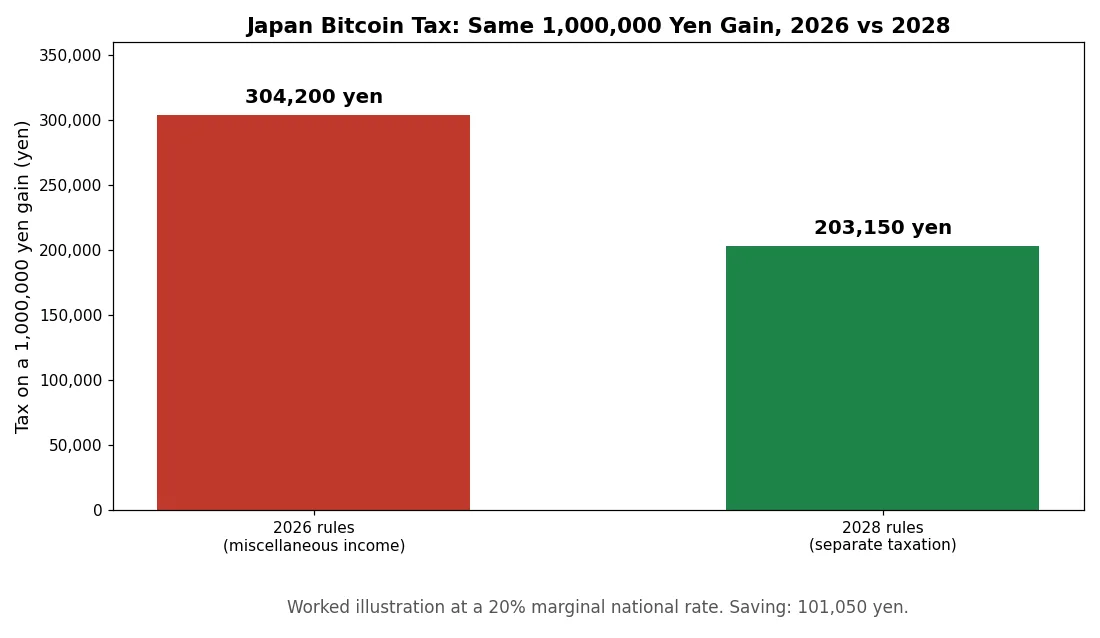
2026 vs 2028: A Worked Example on a 1,000,000 Yen Gain
Numbers make the reform concrete. Take a salaried worker whose total taxable income puts them in the 20% national bracket.
They bought 0.5 Bitcoin for 5,000,000 yen and later sold it for 6,000,000 yen, a gain of 1,000,000 yen.
The table below shows the tax on that same gain under the 2026 rules and under the expected 2028 rules. The figures are a worked illustration at a 20% marginal national rate, so your own bill depends on your total income.
| Item | 2026 rules (miscellaneous income) | 2028 rules (separate taxation) |
|---|---|---|
| Gain on the sale | 1,000,000 yen | 1,000,000 yen |
| National income tax | 200,000 yen (20%) | 150,000 yen (15%) |
| Reconstruction surtax | 4,200 yen (2.1% of national tax) | 3,150 yen (2.1% of national tax) |
| Resident tax | 100,000 yen (10%) | 50,000 yen (5%) |
| Total tax | 304,200 yen | 203,150 yen |
| Effective rate on the gain | 30.42% | 20.315% |
The same trade costs 101,050 yen less under the 2028 rules. The saving grows with your income, because the 2026 rate rises with your bracket while the 2028 rate stays flat.
At the top bracket, the gap is far bigger. A 1,000,000 yen gain taxed at about 55.9% costs about 559,450 yen in 2026, against 203,150 yen in 2028.
That is a difference of about 356,300 yen on the same trade.
Do You Need to File? The 200,000 Yen Rule
Not every Bitcoin holder in Japan must file a tax return. The rule turns on one number: 200,000 yen.
If you are a salaried worker with one employer and a completed year-end tax adjustment, you generally do not need to file a national income tax return when your total income outside salary is 200,000 yen or less for the year. That total includes crypto gains, so a small Bitcoin profit can sit under the threshold.
Three warnings come with that rule. First, it covers national income tax only.
You may still need to declare the income to your local municipality for resident tax, even when the amount is small.
Second, the threshold counts all your miscellaneous income together, not just crypto. A 150,000 yen Bitcoin gain plus 100,000 yen of side income is 250,000 yen in total, which crosses the line.
Third, the rule does not apply if you have another reason to file, such as income from two employers, medical expense deductions, or a business. If you are unsure, file anyway.
Filing when you did not need to costs you an afternoon, while not filing when you had to can cost you penalties.
How to File Bitcoin Taxes in Japan
Filing a crypto return in Japan is a five-step job, and most of the work is gathering records before you open the form. The return for the 2026 tax year is due between February 16 and March 15, 2027.
Start by pulling your full transaction history from every exchange and wallet you used. You need the date, the amount, and the yen value of every buy, sell, swap, spend and reward.
Exchanges keep this data, but some delete old records, so download it before the year ends.
Next, work out your gain on each disposal. Japan allows two cost methods, the total average method and the moving average method, and the NTA publishes free Excel templates for both on its website.
Pick one method and use it consistently for the whole year, because switching methods mid-year is not allowed.
Then add up your total miscellaneous income, including crypto, and check whether it crosses the 200,000 yen line. If it does, you must file.
File through the NTA e-Tax portal, or at your local tax office. The NTA’s Kakutei Shinkoku Sakusei Corner walks you through the return online, and you can submit it electronically without visiting an office.
Finally, keep every record for at least five years. The NTA can ask for your exchange statements, wallet addresses and calculation sheets, and a clean record set is your best defence if it does.
If the numbers feel heavy, our guide to crypto tax software explains how reporting tools pull exchange data and build the calculation for you. Our capital gains tax calculator guide also walks through the gain calculation step by step.
Common Mistakes That Cost Bitcoin Holders Money
Four mistakes show up again and again in Japanese crypto returns. Each one is easy to avoid once you know it exists.
The first is forgetting that swaps are taxable. Many holders swap Bitcoin for altcoins all year and only count their yen sales.
The NTA counts every swap as a sale, so an unreported swap year can produce a large surprise bill.
The second is using the wrong cost method. Japan does not allow FIFO, the first-in-first-out method common in other countries.
Use one of the two NTA-approved average methods, and keep the worksheet that proves it.
The third is ignoring the resident tax filing. The 200,000 yen rule excuses you from the national return, but your municipality can still ask for its 10%.
File the local declaration even when the national return is not needed.
The fourth is assuming the 20% rate already applies. It does not.
Any sale in 2026 or 2027 is taxed under the old miscellaneous income rules, no matter how many headlines say the rate has been cut. Selling in 2026 expecting 20% is the most expensive misunderstanding in this guide.
Losses deserve a note of their own. Until 2028 you cannot offset a crypto loss against your salary or against stock gains, and you cannot carry it forward.
Our guide to Bitcoin tax loss harvesting explains the timing rules in detail, but in Japan the honest summary is simple: a 2026 loss saves you nothing on your 2026 return.
What to Do in 2026 and 2027
The two transition years reward patience and record keeping. The reform is law, but the lower rate does not help a single sale made before January 1, 2028.
If you can choose when to sell, a sale in January 2028 can cost far less than the same sale in December 2027. At a 20% marginal rate the saving is about 10% of the gain.
At the top rate it is about 35% of the gain. Nobody should make an investment decision on tax alone, but the calendar matters when the sale is already planned.
Use the transition years to tidy your records. Download every exchange statement, reconcile your wallets, and pick your cost method now.
The NTA worksheet is free, and a clean 2026 file makes the 2027 return far easier.
Check where your coins sit. If your Bitcoin is on an overseas exchange, remember that the 20.315% rate from 2028 only covers sales through registered Japanese operators.
Moving coins to a registered operator before you sell is a decision to make with your accountant, not a last-minute transfer.
Watch for the cabinet order. The FIEA amendment must take effect by July 23, 2027, and the exact date decides whether January 1, 2028 holds.
If the cabinet sets a date in 2026, which no longer looks possible, the start would move earlier. The 2028 date is the realistic expectation, not a guarantee.
For a visual explainer of the reform, this Altcoin Buzz video covers the FIEA move and the planned tax cut.
Frequently Asked Questions
The questions below come from the searches beginners actually run about bitcoin tax in japan explained. Each answer uses the same numbers and rules as the guide above.
Is Bitcoin taxed in Japan?
Yes. Bitcoin gains are taxed as miscellaneous income in 2026 and 2027, at progressive rates up to about 55.9% including resident tax and the reconstruction surtax.
A reform to a flat 20.315% separate tax is expected from January 1, 2028.
Do I need to file a tax return if I made less than 200,000 yen from Bitcoin?
Usually not for national income tax, if you are a salaried worker with one employer and a completed year-end adjustment, and your total income outside salary is 200,000 yen or less. You may still need to declare the income to your local municipality for resident tax.
Is swapping Bitcoin for another cryptocurrency taxable in Japan?
Yes. A crypto-to-crypto swap is a taxable disposal, even though no yen changes hands.
The NTA treats it as selling Bitcoin at its yen value on that day and buying the other coin.
When does Japan’s 20% crypto tax start?
The 20.315% separate tax is expected to apply to sales from January 1, 2028. The tax law was enacted on March 31, 2026, and the rate starts on January 1 of the year after the FIEA amendment takes effect, which is expected to be 2027.
The cabinet order setting the FIEA effective date has not been issued yet.
Does the 20% rate apply to Bitcoin held on overseas exchanges?
No. The 20.315% rate only covers gains on specified crypto assets sold to, or through, a registered Japanese crypto asset trading operator.
Sales on overseas exchanges, decentralised exchanges and person-to-person deals stay under aggregate taxation at up to about 55.9%, even after 2028.
Can I carry forward crypto losses in Japan?
Not until the reform starts. From 2028, net losses on specified crypto assets can be carried forward for three years against later gains in the same category.
Losses from 2027 and earlier can never be carried forward.