



Yes, you pay tax on Bitcoin in Canada. The Canada Revenue Agency (CRA) treats Bitcoin as property, not money, so selling, swapping, spending or gifting it can trigger a tax bill.
That one fact shapes everything else in this guide. If you bought Bitcoin as an investment and later sold it for more than you paid, the profit is usually a capital gain.

If you earned Bitcoin from staking, mining or frequent trading, the CRA may treat the profit as business income instead.
- Key Takeaways
- Bitcoin Tax in Canada for Beginners: The Rules in Plain English
- The 66.67% Rate Myth: Why Popular Guides Are Wrong in 2026
- Capital Gains or Business Income: Which One Applies to You
- How to Work Out Your Bitcoin Tax in Canada
- Step 1: Track Your Adjusted Cost Base
- Step 2: Work Out the Gain or Loss
- Step 3: Apply the 50% Inclusion Rate
- The Superficial Loss Rule: The 61-Day Trap
- Staking, Mining and Airdrops: Taxed as Income
- How to Report Bitcoin on Your Canadian Tax Return
- Records the CRA Expects You to Keep
- CARF: What Changes in 2027, and What Does Not
- Common Mistakes Beginners Make
- Frequently Asked Questions
- Is Bitcoin taxed in Canada?
- What is the capital gains inclusion rate for Bitcoin in Canada in 2026?
- Do I pay tax when I swap Bitcoin for another crypto in Canada?
- Can I use FIFO to calculate my Bitcoin taxes in Canada?
- Does the superficial loss rule apply to crypto in Canada?
- Do I need to file Form T1135 for Bitcoin held on a foreign exchange?
- Sources
This guide explains bitcoin tax in canada for beginners in plain English. It covers the 50% inclusion rate, the adjusted cost base method, the superficial loss rule, the forms you file, and the one big myth that still misleads beginners in 2026.
This guide is general information only. It is not tax advice.
Tax rules depend on your own situation, so talk to a registered tax professional before you file.
Key Takeaways
- The CRA treats Bitcoin as a commodity. Every disposal can trigger tax.
- The capital gains inclusion rate is 50% in 2026. Half of your net gain enters your taxable income.
- The proposed 66.67% rate on gains above $250,000 was cancelled on March 21, 2025. It never became law.
- You must use the adjusted cost base method. FIFO and other cost methods are not allowed in Canada.
- Selling at a loss and rebuying within 30 days triggers the superficial loss rule. The loss is denied for now.
- Report capital gains on Schedule 3 and business income on Form T2125. Keep records for at least six years.
Bitcoin Tax in Canada for Beginners: The Rules in Plain English
The CRA updated its crypto-asset guidance pages on November 10, 2025. Its position has stayed consistent for years: crypto assets are not a form of money for tax purposes.

That means Bitcoin sits in the same tax box as shares or an investment property. You do not pay tax just for owning it.
You pay tax when something happens to it.
Bitcoin Is Property, Not Money
The CRA says cryptocurrencies are a type of virtual asset protected by cryptography. You can transfer, store or trade them electronically, but the tax law does not treat them as currency.
This matters because it decides which tax rules apply. A payment in dollars is not a capital gains event.
A payment in Bitcoin usually is.
What Counts as a Disposal
A disposal happens whenever you give up ownership of your Bitcoin. The table below lists the common triggers.
| Action | Taxable disposal? | What it means |
|---|---|---|
| Sell Bitcoin for Canadian dollars | Yes | Compare the sale price with your adjusted cost base |
| Swap Bitcoin for another crypto | Yes | A crypto-to-crypto swap is a disposal, even with no cash involved |
| Spend Bitcoin on goods or services | Yes | Paying with Bitcoin is treated like selling it |
| Gift Bitcoin to someone | Yes | Gifting is a disposal at fair market value |
| Move Bitcoin between your own wallets | No | No change of ownership, so no taxable event |
| Simply hold Bitcoin while the price rises | No | Paper gains are not taxed until you dispose of the asset |
Many beginners get caught by the second row. Swapping Bitcoin for Ethereum on an exchange feels like one trade, but the CRA sees it as selling Bitcoin and buying Ethereum in the same moment.
Every disposal needs a Canadian dollar value on the day it happened. That value decides your gain or loss, so record it at the time, not months later.
The 66.67% Rate Myth: Why Popular Guides Are Wrong in 2026
Search for bitcoin tax in canada for beginners and you will find a split. Some guides say the inclusion rate is 50%, while others say it rose to 66.67% on gains above $250,000 from January 1, 2026.
Only one side is right. The 66.67% rate never became law, and the guides that still print it are out of date.
This is the single most expensive mistake a Canadian Bitcoin holder can make in 2026. Believing the higher rate means overpaying tax or filing a return built on a rule that does not exist.
The Timeline: Proposed, Deferred, Cancelled
The story has three dates, and each one matters. The table below lays them out in order.
| Date | What happened | Status for 2026 |
|---|---|---|
| April 2024 | Budget 2024 proposed raising the inclusion rate to 66.67% on individual gains above $250,000 a year, and on all corporate and most trust gains | Proposal only |
| January 31, 2025 | The Department of Finance deferred the start date from June 25, 2024 to January 1, 2026 | Still a proposal |
| March 21, 2025 | The Government of Canada announced it would not proceed with the increase at all | Cancelled |
| 2026 tax year | Budget 2025 confirmed the cancellation, and the CRA administers the 50% rate | 50% for everyone |
The proposal was deferred once and then scrapped before it ever took effect. There is no $250,000 threshold in 2026, and there is no two-tier system.
Every net capital gain is included at 50%, whatever its size. That applies to individuals, corporations and trusts alike.
Which Guides Still Get It Wrong
Two widely read guides still publish the cancelled rate as if it were live. Finder Canada states that from January 1, 2026, individuals include 66.67% of annual gains above $250,000.
MEXC makes the same claim in its Canada crypto tax guide. Both pages were written before the cancellation and never corrected.
LegalClarity and Orbit Accountants repeat the same error. They describe a two-tier 2026 rate that does not exist in the Income Tax Act.
By contrast, the CRA, the Department of Finance, Insight CPA, TokenTax and House of Assets all confirm the 50% rate. The pattern is easy to spot once you know it.
Before you trust any guide, check three things. First, does it mention the March 21, 2025 cancellation by name?
Second, does it cite a CRA or Department of Finance source dated after that cancellation? Third, does it claim a $250,000 threshold still applies in 2026?
If the answer to the third question is yes, the guide is stale. Close it and use a source that follows the CRA instead.
Capital Gains or Business Income: Which One Applies to You
The CRA asks one question before it taxes your Bitcoin profit. Were you investing, or were you running a business?
The answer changes your tax bill by a lot. Capital gains get the 50% inclusion rate, so only half the gain enters your income.
Business income is fully taxable, so the whole profit enters your income. There is no bright line between the two, and the CRA decides case by case.
It weighs six factors, drawn from Interpretation Bulletin IT-479R. The table below lists them in plain English.
| Factor the CRA weighs | Points toward investing | Points toward business |
|---|---|---|
| How often you trade | Occasional buys and long holds | Frequent, extensive buying and selling |
| How long you hold | Months or years | Days or weeks |
| Your market knowledge | Little or no trading experience | Deep experience in the markets |
| Time spent studying markets | Little research time | Hours of daily research |
| Financing | Your own savings | Borrowed money to buy crypto |
| Advertising | You never promoted trading | You advertised that you deal in crypto |
Most beginners fall on the investing side. You bought Bitcoin, held it, and sold some later.
Day traders, market makers and people who run trading bots usually fall on the business side. If you are unsure which bucket fits you, ask a tax professional before you file, because the choice changes every number on your return.
One more point matters. The CRA looks at your activity in the year under review, not at a label you gave yourself years ago.
A buy-and-hold investor who starts day trading in 2026 can be taxed as a business for 2026, even if earlier years were capital gains.
How to Work Out Your Bitcoin Tax in Canada
The maths has three steps. Work out your adjusted cost base, subtract it from what you received, then apply the 50% inclusion rate.
Canada does not use a flat crypto tax rate. Your taxable capital gain joins your other income and is taxed at your marginal rate, which depends on your province and your total income.
For 2026, the lowest federal rate is 14% on taxable income up to $58,523. Provincial rates sit on top of that, so your combined marginal rate is what really matters.
Step 1: Track Your Adjusted Cost Base
Canada uses the adjusted cost base (ACB) method for identical property. Every purchase of the same crypto goes into one running pool, and the cost base is the weighted average across that pool.
You cannot choose FIFO, LIFO or specific lots. The CRA requires ACB, and no other method is allowed.
Here is a worked example with real numbers. You buy 0.2 BTC at $50,000 per coin, which costs $10,000.
Later you buy 0.1 BTC at $80,000 per coin, which costs $8,000. Your total cost is now $18,000 for 0.3 BTC, so your ACB is $60,000 per coin.
Fees count too. Transaction fees paid when you buy add to your cost base, and fees paid when you sell reduce your proceeds.
Track the pool across every wallet and every exchange you use, in Canadian dollars and in date order. Separate books per platform do not work, because the CRA treats all your Bitcoin as one pool.
Step 2: Work Out the Gain or Loss
Take the same example forward. You sell 0.1 BTC when the price is $90,000 per coin, so you receive $9,000.
Your cost base for those coins is 0.1 times $60,000, which is $6,000. Your capital gain is $9,000 minus $6,000, which is $3,000.
Your remaining 0.2 BTC still carries a cost base of $12,000. That number stays in your pool for your next sale.
If the sale price had been below your cost base, the result would be a capital loss instead. Capital losses can offset capital gains in the same year, and unused losses can be carried back up to three years or forward indefinitely.
Step 3: Apply the 50% Inclusion Rate
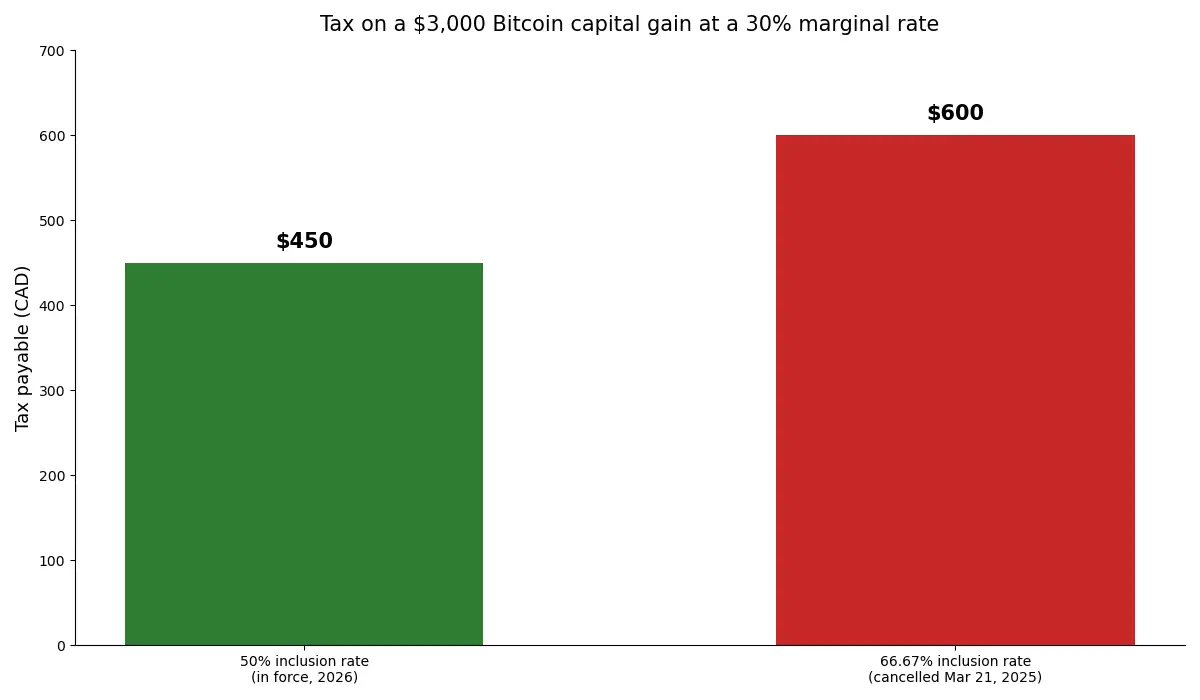
Only half of a capital gain enters your taxable income. In our example, the $3,000 gain becomes a $1,500 taxable capital gain.
At an example combined marginal rate of 30%, the tax on that sale is $450. That is the whole calculation, and it is the part of bitcoin tax in canada for beginners that most guides rush through.
At the cancelled 66.67% rate, the same sale would have produced a $2,000 taxable gain and $600 of tax. The myth costs real money if you follow it.
To keep the maths straight, use crypto tax software that supports the Canadian ACB method. Most global tools default to FIFO, which is wrong for Canada, so check the method before you trust the output.
The Superficial Loss Rule: The 61-Day Trap
Canada has its own version of the wash sale rule, and it applies to crypto. It is called the superficial loss rule, and it catches beginners who sell at a loss and buy straight back.
The rule denies your capital loss if three things are true. You sold crypto at a loss, you or an affiliated person bought the same crypto within 30 days before or after the sale, and you still owned it at the end of the 30th day after the sale.
The window runs 61 days in total: 30 days before the sale, the sale day, and 30 days after. Your spouse or a corporation you control counts as an affiliated person, so their purchases trigger the rule too.
A denied loss is not lost forever. It is added to the ACB of the repurchased crypto, so you get the benefit when you eventually sell without triggering the rule again.
To claim a loss cleanly, stay out of that coin for 31 full days after the sale. If you want exposure in the meantime, swap into a different token, because Bitcoin is Bitcoin no matter which exchange holds it.
Our guide to Bitcoin tax-loss harvesting walks through this timing in detail, including the December 31 settlement deadline for 2026.
Staking, Mining and Airdrops: Taxed as Income
Not every crypto gain is a capital gain. Rewards you receive for staking, mining or airdrops are usually income when you receive them, valued in Canadian dollars on that day.
Staking rewards enter your income at their fair market value on the day you receive them. If you later sell those tokens at a higher price, that second step is a separate capital gain.
Mining works the same way, with one split. A hobby miner pays nothing on receipt and treats the later sale as a capital gain from a zero cost base.
A commercial miner reports each payout as business income on Form T2125, and can deduct electricity, hosting fees and other costs. Our guide on how Bitcoin miners are taxed explains the hobby versus business split in full.
Airdrops are usually income at their value on receipt, though the CRA has not published airdrop-specific guidance. Keep the receipt date and value in your records either way.
None of these rewards use the 50% inclusion rate at the income stage. The rate applies only to capital gains, so do not mix the two buckets.
How to Report Bitcoin on Your Canadian Tax Return
Reporting is simpler than most beginners expect. Capital gains go on Schedule 3, business income goes on Form T2125, and foreign holdings may need Form T1135.
The table below maps each situation to the right form. Keep it beside you when you file.
| Your situation | Form | Where it lands |
|---|---|---|
| Capital gain or loss from selling Bitcoin | Schedule 3 | Taxable capital gains at line 12700 |
| Business income from trading or mining | Form T2125 | Flows to line 13500 on your T1 return |
| Foreign property cost above $100,000 at any time in the year | Form T1135 | Filed with your return; crypto on foreign exchanges can count |
| Staking or airdrop rewards | T1 general return | Reported as other income at fair market value on receipt |
The 2025 Schedule 3 already has a dedicated crypto-assets line. The 2026 tax year runs from January 1 to December 31, 2026, and dispositions must settle by December 31, 2026 to count in that year.
Most individuals must file by April 30, 2027. If you or your spouse carry on a business, you have until June 15, 2027 to file, but any balance owing is still due by April 30, 2027.
The T1135 threshold deserves a second look. It applies to the cost of your specified foreign property, not its market value, and it triggers if the cost crossed $100,000 at any point in the year.
Bitcoin held on a foreign exchange can count as specified foreign property. If your cost base on a foreign platform ever passed $100,000 in 2026, file the form even if you sold nothing.
If you are still unsure how the forms fit together, our guide on how to calculate your Bitcoin capital gains tax shows the full calculation from ACB to Schedule 3.
Records the CRA Expects You to Keep
The CRA expects detailed crypto records, not just yearly totals. Keep them for at least six years after the end of the tax year they relate to.
For every transaction, record the date, the amount and type of crypto, the wallet addresses involved, the exchange used, and the value in Canadian dollars at the time.
Also keep your yearly balances, the cost of your opening balance, and receipts for accounting, legal and software costs. The CRA updated its records page on November 10, 2025, and it lists exactly these items.
Keep your records even if a platform closes. Exchanges disappear, but your tax obligation does not, and the CRA can ask for records years after the fact.
Good records also protect you if the CRA questions your filing. A clean transaction history turns a stressful audit letter into a short exchange of documents, and this habit is the part of bitcoin tax in canada for beginners that pays off years later.
CARF: What Changes in 2027, and What Does Not
Canada plans to adopt the OECD Crypto-Asset Reporting Framework, known as CARF. Under it, crypto platforms would collect identity and tax-residence information and report user transactions to the CRA each year.
Budget 2025 deferred the application date to January 1, 2027. The implementing bill, C-31, had not received Royal Assent as of October 30, 2026, so CARF is proposed law, not law in force.
On the proposed timeline, the first provider return would be due before May 2, 2028 and would cover calendar year 2027. Check the bill’s status before you rely on any CARF date, because it can still change.
One thing CARF does not change is your own reporting duty. You must report your crypto gains and income whether or not a platform reports them, and that duty exists today.
The CRA already receives data from Canadian registered crypto platforms and can request account information. CARF would widen that visibility, not create it from scratch.
Common Mistakes Beginners Make
The first mistake is trusting a stale guide. If a page still claims the 66.67% rate applies in 2026, every number on it is suspect, so verify the rate against a CRA source first.
The second mistake is using FIFO. American tax software defaults to it, but Canada requires the ACB average cost method, and the two can produce very different gains.
The third mistake is forgetting crypto-to-crypto swaps. Swapping Bitcoin for Ethereum is a disposal, even though no dollars reached your bank account.
The fourth mistake is rebuying too fast after a loss sale. The superficial loss rule denies the loss, and the 61-day window catches purchases made before the sale as well as after it.
The fifth mistake is ignoring Form T1135. A cost base above $100,000 on a foreign exchange triggers the form, and the penalty for missing it is separate from any tax owing.
The sixth mistake is keeping no records. Without dates and Canadian dollar values, you cannot prove your cost base, and the CRA will not guess in your favour.
For a wider view of how other countries handle the same questions, see our Bitcoin tax guide, which covers the rules around the world, and our Bitcoin tax in Australia for beginners guide for a comparison with the ATO system.
Frequently Asked Questions
The questions below come from the searches Canadian beginners actually run. Each answer uses the same numbers and rules as the guide above.
Is Bitcoin taxed in Canada?
Yes. The CRA treats Bitcoin as a commodity, not currency, so selling, swapping, spending or gifting it is a taxable disposition.
Buying and holding Bitcoin is not taxable, and moving it between wallets you own is not taxable either.
What is the capital gains inclusion rate for Bitcoin in Canada in 2026?
The inclusion rate is 50% for 2026. Half of your net capital gain is added to your taxable income and taxed at your marginal rate.
The proposed increase to 66.67% on gains above $250,000 was cancelled on March 21, 2025 and never became law.
Do I pay tax when I swap Bitcoin for another crypto in Canada?
Yes. A crypto-to-crypto swap is a disposition of the Bitcoin you gave up, valued in Canadian dollars on the day of the swap.
You compare that value with your adjusted cost base to work out the gain or loss, even though no cash changed hands.
Can I use FIFO to calculate my Bitcoin taxes in Canada?
No. Canada requires the adjusted cost base method, which pools all your purchases of the same crypto into one weighted average.
FIFO, LIFO and specific-lot methods are not allowed, so check that your tax software uses ACB before you trust its numbers.
Does the superficial loss rule apply to crypto in Canada?
Yes. If you sell Bitcoin at a loss and buy the same crypto back within 30 days before or after the sale, the loss is denied for now.
The denied loss is added to the cost base of the repurchased coins, and you must stay out of that coin for 31 full days to claim the loss.
Do I need to file Form T1135 for Bitcoin held on a foreign exchange?
You may. Form T1135 applies if the cost of your specified foreign property exceeded $100,000 at any time in the year, and crypto on a foreign exchange can count.
The test uses cost, not market value, so check your highest cost base during the year rather than your year-end balance.
Sources
- Canada Revenue Agency: What is cryptocurrency? (Canada.ca)
- Canada Revenue Agency: Keeping records of your cryptocurrency transactions (Canada.ca)
- Canada Revenue Agency: Valuing your cryptocurrency (Canada.ca)
Tax rules change, and the CRA updates its guidance without notice. Check the sources above before you file, and talk to a registered tax professional about your own situation, because that is the complete picture of bitcoin tax in canada for beginners in 2026.
If you are new to buying Bitcoin in Canada, our guide on how to buy Bitcoin in Canada covers the exchanges and steps for beginners, and our Bitcoin tax in the UK for beginners guide shows how the HMRC rules compare.