



Coinbase now holds a federal trust charter. The Office of the Comptroller of the Currency gave final approval on Friday, November 6, 2026, and Coinbase announced it on Monday, November 9.
The news sounds bigger than it is. This charter changes how Coinbase stores crypto for big clients, and it changes almost nothing for everyone else.

Key takeaways
Read these five points first, then judge the rest of the evidence for yourself.
- Key takeaways
- What happened, in plain terms
- The three day gap tells you how to read this news
- What the charter changes, and what it does not
- The market barely blinked
- Why it took thirteen months
- Ripple got there first, and the queue is long
- The charter is already in court
- What to watch next
- Frequently Asked Questions
- What is the Coinbase National Trust Company OCC charter?
- When did the Coinbase OCC charter take effect?
- Does the charter make Coinbase a bank?
- Will Coinbase offer FDIC insured deposits now?
- Can the trust company issue stablecoins?
- What happens to Coinbase Custody Trust Company in New York?
- The bottom line
- The OCC record lists the Coinbase National Trust Company charter as consummated and effective on November 6, 2026, under control number 2025-Charter-343449. Coinbase announced the final approval three days later, on November 9.
- The charter covers fiduciary custody of digital assets for institutional clients, under direct federal supervision. It does not turn Coinbase into a normal commercial bank.
- Coinbase plans to move its custody business from its New York state trust company into the federal trust over three years. The application reported $245.7 billion in custody assets as of June 30, 2025.
- Nothing changes for retail users. The charter brings no retail deposits, no traditional lending, no FDIC insurance, no direct stablecoin issuance, and no automatic access to Federal Reserve payment systems.
- The market barely reacted. COIN closed November 9 at $136.10, up 0.99% on the day, while Bitcoin traded near $74,609 on the morning of November 10.
What happened, in plain terms
Coinbase applied to the OCC in October 2025 to charter a national trust company. The regulator gave preliminary conditional approval on April 2, 2026, and the charter became effective on November 6, 2026.
Rick Schonberg, who leads prime trading and custody at Coinbase, announced the final approval in a company blog post on November 9. He wrote that the approval lets Coinbase expand its custody business under a federal regulatory framework.
Coinbase Vice Chairman Ryan VanGrack called the approval another major step in integrating digital assets into the core infrastructure of the American financial system. That is the company’s line, and it is worth reading with care.
The new entity, Coinbase National Trust Company, will hold client crypto as a fiduciary. In practice it will receive, hold, and transfer assets inside custody accounts for institutional clients.

Our reporting on the US government moving seized Bitcoin to Coinbase Prime shows why this custody business matters. Governments and funds already trust Coinbase to hold large amounts of Bitcoin, and a federal charter gives that business a single national regulator.
The three day gap tells you how to read this news
Most headlines date this story to November 9, the day Coinbase announced it. The regulatory event happened three days earlier, on November 6, when the OCC record marked the charter consummated and effective.
The gap matters because it shows how this approval actually works. The OCC did not decide anything new on November 9.
It closed a process that started more than a year ago.
The April 2 decision, Corporate Decision 1370, gave only preliminary conditional approval. It said final authority to open for business would wait until Coinbase met preopening requirements, and it set a deadline of 18 months from April 2.
Coinbase met those requirements inside the window. The November 6 entry in the OCC applications record is the moment the charter became real, and the November 9 blog post is the moment Coinbase told the public.
The April decision also set hard terms for the first three years. The trust must hold at least $60 million in Tier 1 capital, and it must keep liquid assets equal to 180 days of wind down expenses.
What the charter changes, and what it does not
This is the part most coverage gets wrong. A national trust charter sounds like a banking license, but the OCC wrote this one narrowly.
The table below separates the real changes from the things people assume.
| Item | What changes | What does not change |
|---|---|---|
| Who supervises custody | Moves from New York state oversight to the OCC over three years | Clients still get custody, not banking |
| Retail deposits | Nothing | The trust takes no ordinary retail deposits |
| Traditional lending | Nothing | The trust makes no traditional loans |
| FDIC insurance | Nothing | The trust is not FDIC insured |
| Stablecoin issuance | Nothing in this charter | The OCC decision says the application did not propose stablecoin issuance |
| Fed payment access | Nothing automatic | Direct access to Federal Reserve payment systems needs a separate process |
| Staking, trading, financing | Nothing | These stay with Coinbase affiliates, not the trust company |
Read the table twice and the story gets simpler. Coinbase gains a federal supervisor for its custody business, and it gains nothing else yet.
That does not make the charter small. Custody is the business that holds other people’s crypto, and a federal charter gives large clients one regulator to deal with instead of a state patchwork.
For a company that already stores crypto for ETF issuers and governments, that single framework is the whole point.
Coinbase has said its focus after the approval is custody first, then stablecoin issuance and servicing and payments later. American Banker reported that sequence on November 9, and it fits the OCC record, which authorizes custody now and stablecoins not at all.
The market barely blinked
COIN closed November 9 at $136.10, up $1.34 or 0.99% from the prior close of $134.76. The stock traded between $131.10 and $139.75 during the session, so the charter news moved it less than the normal daily swing.
The wider picture explains the shrug. COIN has fallen about 24% in the past month, and its market value sits near $35.68 billion.
A custody charter does not fix a weak crypto market, and traders know it.
Bitcoin traded near $74,609 on the morning of November 10, after closing November 9 at $74,899.67. The coin has fallen about 7% over five sessions, and it sits just above its 200 day average near $73,151.
Spot Bitcoin ETFs lost about $1.28 billion in the week to November 6, and the October consumer price index lands at 8:30 in the morning ET on November 10. Traders have bigger things on their minds than a custody charter this week.
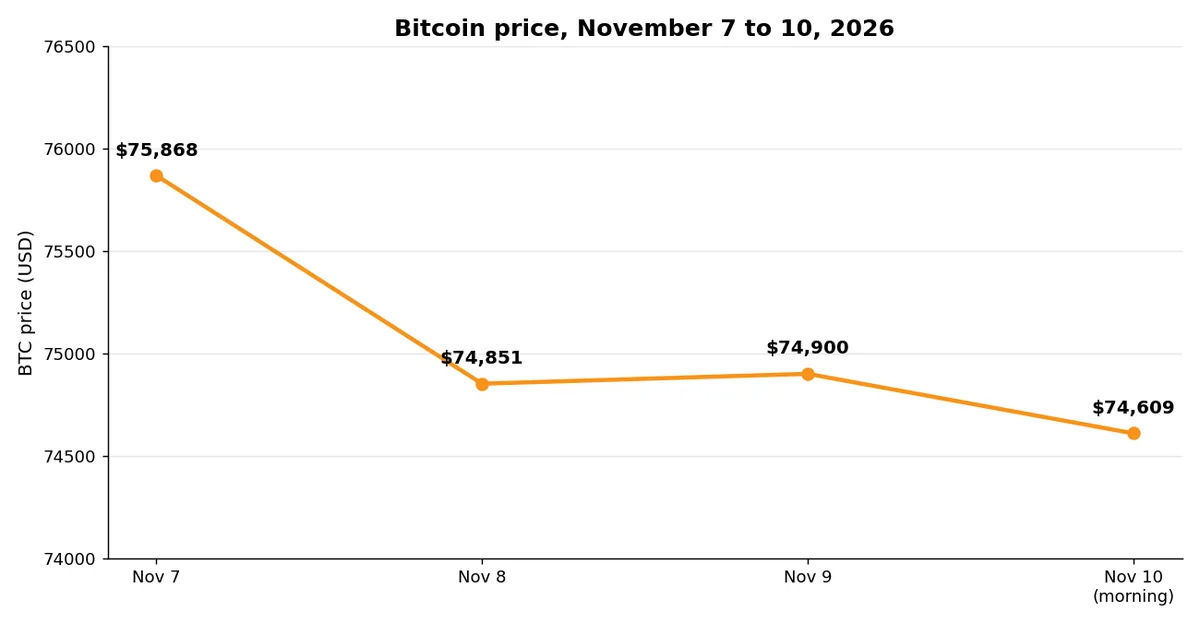
The chart above shows Bitcoin closing prices from November 7 to November 10, 2026, using Finnhub market data. The coin closed at $75,867.59 on November 7, $74,851.44 on November 8, and $74,899.67 on November 9, then traded near $74,609 on the morning of November 10.
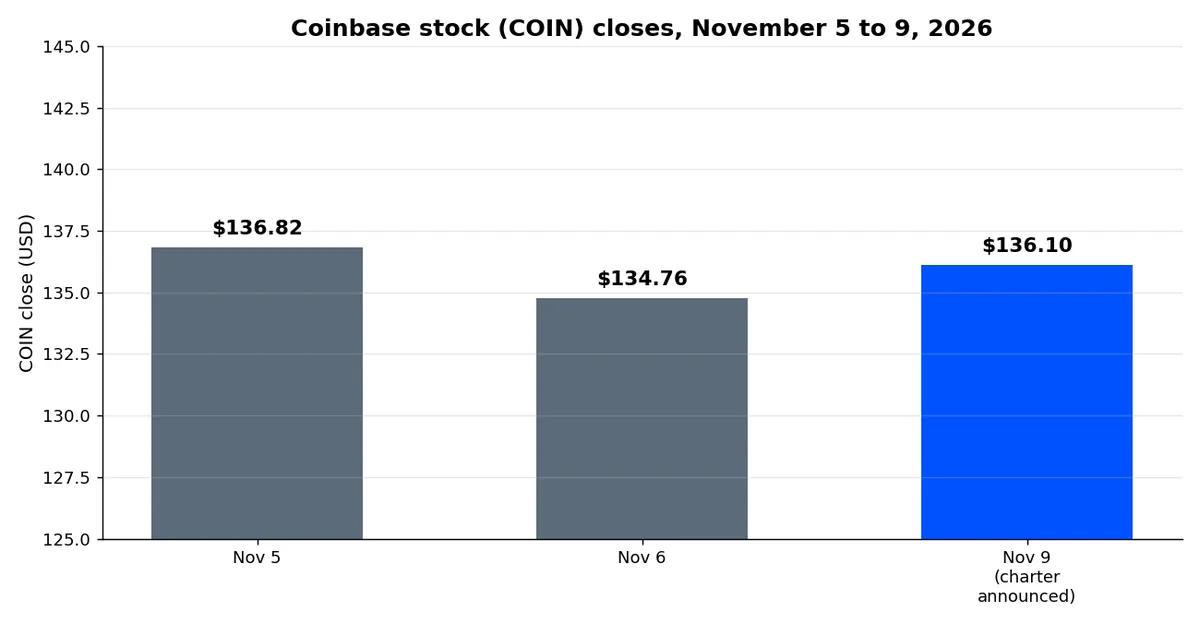
The second chart shows COIN closing prices across the same stretch, using Finnhub market data. The stock closed at $136.82 on November 5, $134.76 on November 6, and $136.10 on November 9, the day Coinbase announced the charter.
Here is my honest take. A charter is plumbing, not a product launch.
It makes custody cheaper to run and easier to sell to cautious institutions, but it adds no revenue on day one and it cannot lift a falling market.
The US government transfer of $288 million in Bitcoin to Coinbase Prime shows the same pattern. Big clients already use Coinbase custody, and the charter protects that business rather than creating a new one.
Why it took thirteen months
The OCC process runs in slow, public steps. Coinbase filed its application on October 3, 2025, won conditional approval on April 2, 2026, and saw the charter take effect on November 6, 2026.
The three year migration clock now runs from the approval. Coinbase told the OCC it will move the entirety of its custody business from Coinbase Custody Trust Company to the federal trust during that period, which puts full migration around April 2029.
The April decision also put Coinbase in a very large club. OCC supervised uninsured national trust banks reported $7.0 trillion in assets under administration as of December 31, 2025, split between $1.7 trillion in custody and safekeeping accounts and $5.3 trillion in fiduciary accounts.
Coinbase joins that club as a small member with a narrow business. The $245.7 billion custody figure in its application dates to June 30, 2025, and it measures the whole custody business then, not money already moved into the new trust.
No client money has moved yet. The charter confirms the legal structure, while the actual transfer of accounts happens over the next three years.
Ripple got there first, and the queue is long
Coinbase is not the first crypto firm to win a federal trust charter. Ripple announced on October 26, 2026 that it had received final OCC approval for Ripple National Trust Bank, two weeks before Coinbase.
The OCC has approved or conditionally approved nearly two dozen national trust bank charters during the second Trump administration, including more than a dozen for crypto firms, according to American Banker. The Coinbase charter is part of a wave, not a one off event.
The wave follows the GENIUS Act, the federal stablecoin law signed on July 18, 2025. The OCC issued its final rule to implement the GENIUS Act on October 21, 2026, and the law takes effect on January 18, 2027.
That timing explains the rush. Crypto firms want federal charters in place before the new stablecoin rules bite, and the OCC has opened the door wider than any past administration.
The wider market structure fight still drags on. Our report on the CLARITY Act dying in the Senate explains why the bill that would set federal rules for crypto markets stalled, and the SEC’s Project Crypto effort to clarify token rules shows the regulator trying to fill the gap by itself.
The charter is already in court
Not everyone cheers this wave of charters. The Independent Community Bankers of America sued the OCC on October 2, 2026, in the US District Court for the District of Columbia, challenging the regulator’s trust charter policy for crypto firms.
The community banks argue that crypto trust banks lack safeguards that insured banks must follow. They see the charters as a shortcut into the banking system without the duties that come with taking deposits.
The lawsuit does not block the Coinbase charter, and it may take years to resolve. But it means the legal footing of these charters stays contested, and a court could still narrow what they allow.
That risk matters for investors more than for users. A charter that a court later limits would still leave Coinbase with its state trust business, so the downside is smaller than the headlines suggest.
My view is simple. The OCC has chosen to bring crypto custody inside the federal tent, and the courts will now decide whether that choice holds.
Coinbase bet early on the OCC route, and the bet has paid off so far.
What to watch next
Four things will show whether this charter matters in practice. First, watch for the first client accounts moving from the New York trust into the federal trust, and for any timetable Coinbase publishes.
Second, watch the Federal Reserve angle. The OCC decision notes that the trust will apply for Federal Reserve Bank stock, which is a step toward payment system access, but approval is not guaranteed.
Third, watch stablecoins. Coinbase wants to move into stablecoin issuance and servicing eventually, and the GENIUS Act rules that take effect in January 2027 will shape what it can do.
Fourth, watch the court case. A ruling against the OCC would shake every crypto trust charter, not just this one, and community banks have shown they will fight.
The HTX exchange passing Coinbase in trading volume is a useful reminder here. Custody charters do not win trading volume, and Coinbase still faces fierce competition on the exchange side while it builds its federal custody business.
Our report on Bitcoin holding $81,000 after exchange outflows also shows how fast the market mood can turn. A charter is a slow asset in a fast market, and its value shows up over years, not days.
Frequently Asked Questions
These are the questions readers keep asking about the Coinbase charter, answered in plain terms.
What is the Coinbase National Trust Company OCC charter?
It is a federal charter from the Office of the Comptroller of the Currency that lets Coinbase National Trust Company hold digital assets as a fiduciary for institutional clients. The charter puts the custody business under direct federal supervision instead of New York state supervision.
When did the Coinbase OCC charter take effect?
The charter became effective on November 6, 2026, when the OCC applications record listed it as consummated and effective under control number 2025-Charter-343449. Coinbase announced the final approval on November 9, 2026.
Does the charter make Coinbase a bank?
No, Coinbase National Trust Company is a national trust company, not a commercial bank. It cannot take ordinary retail deposits or make traditional loans.
Will Coinbase offer FDIC insured deposits now?
No. The trust company is not FDIC insured, and the charter changes nothing about deposit insurance for Coinbase users.
Can the trust company issue stablecoins?
The charter does not authorize stablecoin issuance. The OCC decision states that the application did not propose stablecoin issuance, and Coinbase has said it wants to move into stablecoin issuance and servicing later.
What happens to Coinbase Custody Trust Company in New York?
Coinbase plans to migrate its entire custody business from the New York state trust company into the federal trust over three years. The New York entity keeps operating until the migration finishes, around April 2029.
The bottom line
Coinbase won a real prize on November 6, and the prize is narrower than the headlines. A federal trust charter gives its custody business one national regulator, a three year path out of state oversight, and a stronger pitch to cautious institutions.
It gives retail users nothing new, it gives traders no reason to buy COIN, and it gives stablecoin plans no license yet. The value will show up slowly, in client wins and lower friction, not in a single day of trading.
Watch the migration, watch the court case, and watch the GENIUS Act rules in January. The charter is a foundation, and foundations only matter if something gets built on them.