



The short answer
India taxes profit from selling crypto at a flat 30 percent. Add a 4 percent cess and the real rate starts at 31.2 percent.
A separate 1 percent TDS also applies to most sales.

The rates did not change in 2026. What changed is the law around them.
- The short answer
- What counts as a virtual digital asset
- The 30 percent tax, explained simply
- The 1 percent TDS: the part that surprises traders
- What changed in 2026: the new section numbers
- Section 509: the tax department now sees your trades
- Worked example: Rs 2 lakh profit, step by step
- The no-loss rule, in full
- Not all crypto income pays 30 percent
- How to report: Schedule VDA and the right ITR form
- FIU-IND registration: use a registered exchange
- Common mistakes Indian crypto taxpayers make
- What to do before December 31, 2026
- Frequently asked questions
- Is crypto legal in India in 2026?
- What is the crypto tax rate in India?
- How much TDS applies to crypto in India?
- Can I set off crypto losses against crypto gains in India?
- Which ITR form do I use for crypto in India?
- What is Section 509 of the Income-tax Act, 2025?
- Do I pay tax on crypto-to-crypto swaps in India?
- Sources
A new Income-tax Act took effect on April 1, 2026. It renumbered every crypto rule.
It also gave the tax department a direct feed of your exchange trades.
This guide explains the 30 percent tax, the 1 percent TDS, the new section numbers, and the new reporting rule. It also works through a full example so you can see the exact rupee amounts.
Key takeaways
- 30 percent flat tax on every profitable crypto sale, plus 4 percent cess. The effective rate starts at 31.2 percent.
- 1 percent TDS applies to most transfers above Rs 50,000 a year (Rs 10,000 for other payers). TDS is not extra tax. You claim it back as a credit.
- No loss set-off. A loss on one coin cannot reduce a gain on another coin. Losses cannot carry forward either.
- New section numbers from April 1, 2026. The 30 percent rule moved from Section 115BBH to Section 194 of the Income-tax Act, 2025. The 1 percent TDS moved from Section 194S to Section 393.
- Section 509 reporting. Indian exchanges must now send your user-level trading history to the Income Tax Department on Form 167. Hiding trades is no longer a realistic option.
- Report in Schedule VDA of ITR-2 or ITR-3, transaction by transaction.
What counts as a virtual digital asset
Indian tax law does not use the word crypto in its charging sections. It uses the term Virtual Digital Asset, or VDA.

The definition covers cryptocurrencies, tokens, and NFTs.
The old definition sat in Section 2(47A) of the Income-tax Act, 1961. The new Act carries it forward as Section 2(111).
From April 1, 2026, a new limb adds the word crypto-asset in plain terms. The net now catches any crypto-asset that relies on a cryptographically secured distributed ledger, even if it fits none of the older limbs.
Indian currency, foreign currency, gift cards, and loyalty points do not count as VDAs. Central bank digital currency is also excluded.
Everything else you trade on an exchange almost certainly counts.
Buying crypto is not a taxable event. Tax starts when you transfer a VDA.
A transfer includes selling for rupees, swapping one coin for another, and spending crypto on goods or services.
The 30 percent tax, explained simply
Profit from a VDA transfer is taxed at a flat 30 percent. Your income slab does not matter.
Your holding period does not matter. A person in the 5 percent slab and a person in the 30 percent slab both pay 30 percent on crypto profit.
The rule started with the Finance Act, 2022. It sat in Section 115BBH of the 1961 Act.
From April 1, 2026, the same rule lives in Section 194(1), Table Serial No. 4, of the Income-tax Act, 2025.
The rate, the scope, and the calculation did not change. Only the address changed.
One deduction is allowed: the cost of acquisition. You subtract what you paid to buy the asset.
You cannot deduct exchange fees, gas fees, brokerage, or internet costs. The law allows nothing else.
The 4 percent health and education cess applies on top of the tax. That lifts the real rate to 31.2 percent for most taxpayers.
Surcharge applies at higher income levels and can push the effective rate toward 42 percent.
Why the flat rate hurts more than it looks
Most capital gains in India enjoy slab rates or indexation. Crypto gets neither.
The law treats VDA gains more like lottery winnings than like share gains.
Short holding periods do not help. Long holding periods do not help.
A coin you held for four years pays the same 30 percent as a coin you flipped in four days.
The flat rate also ignores your basic exemption limit. You cannot use unused slab space to shelter crypto gains.
The 30 percent applies from the first rupee of profit.
The 1 percent TDS: the part that surprises traders
TDS stands for Tax Deducted at Source. When you sell crypto, the buyer or the exchange deducts 1 percent of the total sale value before the money reaches you.
This is not an extra tax on top of the 30 percent. It is an advance payment.
You claim it as a credit when you file your return.
The old rule was Section 194S of the 1961 Act. The new rule is Section 393(1), Table Serial No.
8(vi), of the Income-tax Act, 2025. The rate and the thresholds stayed the same.
TDS applies to the full consideration, not just the profit. Sell Rs 1 lakh of Bitcoin and Rs 1,000 goes out as TDS, even if your profit was only Rs 5,000.
Active traders feel this as a cash-flow drag, because TDS piles up on every trade while the final tax bill arrives only at filing time.
When TDS does not apply
TDS has annual thresholds. For a specified person, an individual or HUF with no business income, or with business turnover up to Rs 1 crore or professional receipts up to Rs 50 lakh, no TDS applies if the total consideration in the financial year stays below Rs 50,000.
For other payers, the threshold is Rs 10,000 a year. Cross the threshold and TDS applies to the whole consideration, not only the part above the threshold.
On Indian exchanges, the platform usually handles the deduction for you. In a peer-to-peer deal, the buyer must deduct it.
Many P2P traders miss this duty entirely, and that creates a compliance gap the tax department can now spot through exchange data.
TDS deducted appears in your Form 26AS and your Annual Information Statement. Check both before you file.
If the exchange deducted TDS but your return does not claim the credit, you lose money you already paid.
What changed in 2026: the new section numbers
The Income-tax Act, 2025 replaced the 1961 Act with effect from April 1, 2026. The substance of crypto tax stayed the same.
The section numbers changed. That matters because old guides, old YouTube videos, and even some exchange help pages still quote the old numbers.
The date that governs is the date of the transfer, not the date you file. A sale on March 15, 2026 falls under the old sections.
A sale on April 15, 2026 falls under the new ones. Your return for the year may cite both sets of sections.
| Rule | Old: 1961 Act (to Mar 31, 2026) | New: 2025 Act (from Apr 1, 2026) |
|---|---|---|
| What is a VDA | Section 2(47A) | Section 2(111), limb (d) adds crypto-asset |
| 30% flat tax | Section 115BBH | Section 194(1), Table Sl. No. 4 |
| 1% TDS | Section 194S | Section 393(1), Table Sl. No. 8(vi) |
| TDS threshold exemption | Section 194S proviso | Section 393(4), Table Sl. No. 12 |
| Exchange reporting | Section 285BAA (inserted by Finance Act, 2025) | Section 509(1), filed on Form 167 |
| Reporting penalties | General penalty provisions | Section 446: Rs 200 per day, Rs 50,000 for wrong data |
Budget 2026 kept the 30 percent rate and the 1 percent TDS unchanged. The government tightened enforcement instead of raising rates.
That choice tells you where the risk now sits: not in a higher rate, but in better detection.
Section 509: the tax department now sees your trades
This is the biggest change in the 2026 framework, and most guides bury it at the bottom. Section 509(1) of the Income-tax Act, 2025 requires prescribed reporting entities to send crypto-asset transaction statements to the Income Tax Department.
In practice, that means your exchange.
The statements go on Form 167. They carry user-level trading history, not just totals.
The exchange reports your transactions. The department can then match that data against your return.
The Central Board of Direct Taxes issued a guidance note on Section 509 in August 2026. It confirms the duty falls on Reporting Crypto-Asset Service Providers: exchanges, brokers, dealers, and similar intermediaries.
The duty does not fall on you as an individual investor. Your job is to report honestly.
Their job is to hand over the data.
Penalties for failure sit in Section 446. An exchange that fails to file pays Rs 200 per day of default.
Wrong information carries a Rs 50,000 penalty. Those numbers look small, but they signal intent: the department built a reporting pipe and attached a fine to it.
India also plans to adopt the OECD Crypto-Asset Reporting Framework, with cross-border data sharing from April 2027. Trades on foreign exchanges will not stay invisible for long either.
If you hold crypto on a foreign exchange at any point in the year, you must also disclose the holding in Schedule FA (Foreign Assets) of your return.
What Section 509 means for you, in practice
First, assume the department sees every trade you make on an Indian exchange. That was true in theory before 2026.
Section 509 makes it true in practice, with a standard form and a deadline.
Second, keep your own records. Download your trade history every quarter.
Exchanges change, shut down, or lose data. Your return depends on records you control.
Third, reconcile before you file. Compare your exchange statement with your Form 26AS and your Annual Information Statement.
Fix mismatches before the department sends a notice. A mismatch after filing costs far more time than a correction before filing.
Worked example: Rs 2 lakh profit, step by step
Examples make the rules concrete. Take a simple case.
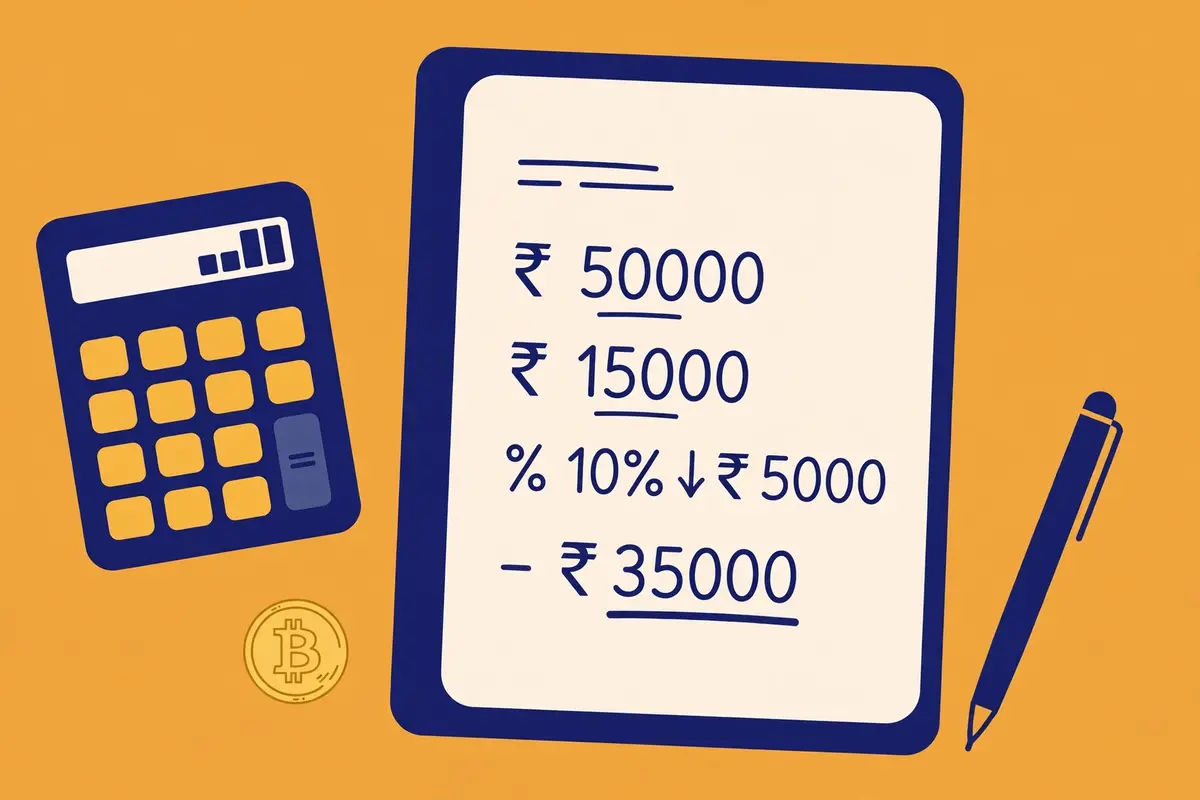
You bought Bitcoin for Rs 5 lakh in June 2025. You sold it for Rs 7 lakh in October 2026.
Your profit is Rs 2 lakh.
| Step | Amount |
|---|---|
| Sale value | Rs 7,00,000 |
| Cost of acquisition | Rs 5,00,000 |
| Profit (sale minus cost) | Rs 2,00,000 |
| Tax at 30% | Rs 60,000 |
| Health and education cess at 4% | Rs 2,400 |
| Total tax payable | Rs 62,400 |
| TDS already deducted at 1% of Rs 7,00,000 | Rs 7,000 |
| Net tax to pay with the return | Rs 55,400 |
Notice what the example shows. The tax is Rs 62,400 on Rs 2 lakh of profit.
That is an effective rate of 31.2 percent. The TDS of Rs 7,000 reduces the cash you pay at filing time, but it does not reduce the tax itself.
Now change one fact. Suppose you also lost Rs 1 lakh on an Ethereum trade in the same year.
Your tax bill does not change. The loss cannot offset the Bitcoin gain.
You still pay Rs 62,400 on the Bitcoin profit, and the Ethereum loss simply disappears for tax purposes.
That single rule catches more Indian traders than any other. Every other asset class in India allows some form of loss set-off.
Crypto allows none.
The no-loss rule, in full
Section 115BBH, and now Section 194 of the 2025 Act, blocks three things at once. A loss on one VDA cannot offset a gain on another VDA.
A loss on a VDA cannot offset any other income, such as salary or share gains. A VDA loss cannot carry forward to a future year.
Each profitable transfer stands alone. Each one pays 30 percent.
Losses vanish. This makes record-keeping by coin essential.
You need the cost and sale price of every single transfer, because netting across coins is not allowed.
Our Bitcoin tax guide compares this treatment with other countries. Most major economies allow loss set-off.
India stands out for refusing it. That difference shapes every trading decision an Indian investor makes.
Not all crypto income pays 30 percent
The 30 percent rate applies when you transfer a VDA. Income you receive, rather than trade, follows a different path.
Staking rewards, mining rewards, and airdrops are taxed at your income slab rate when you receive them, based on their fair market value on that date.
When you later sell those coins, the 30 percent rate applies to the gain above the value already taxed. The first tax hits at receipt.
The second tax hits at sale. Keep both dates and both values in your records.
Gifts follow their own rule. Crypto received as a gift from a non-relative above Rs 50,000 in a financial year is taxable in the receiver’s hands as income from other sources, at slab rates.
Gifts from specified relatives, such as a spouse, parents, or siblings, are exempt at receipt. Sell the gifted coins later and the 30 percent rate applies to the gain from the original cost.
| Income type | Tax at receipt | Tax on later sale |
|---|---|---|
| Trading profit | None | 30% plus cess |
| Staking rewards | Slab rate on fair market value | 30% on gain above that value |
| Mining rewards | Slab rate on fair market value | 30% on gain above that value |
| Airdrops | Slab rate on fair market value | 30% on gain above that value |
| Gift from non-relative above Rs 50,000 | Slab rate as other income | 30% on gain from original cost |
| Gift from close relative | Exempt | 30% on gain from original cost |
| Salary paid in crypto | Slab rate as salary | 30% on gain above that value |
Derivatives and futures trading sit outside the VDA transfer rules. They are generally treated as speculative business income and taxed at slab rates.
That puts them in ITR-3 territory, not Schedule VDA.
How to report: Schedule VDA and the right ITR form
All crypto gains go in Schedule VDA. It is a dedicated section in the return, separate from the normal capital gains schedule.
You report transaction by transaction: date of acquisition, date of transfer, cost of acquisition, sale consideration, and the gain or loss. You cannot net gains and losses across VDAs in the schedule.
Salaried individuals who trade crypto as investors usually file ITR-2. They report gains under Schedule VDA as capital gains.
Traders who treat crypto as a business, with books of account and significant turnover, file ITR-3.
For assessment year 2026-27, covering financial year 2025-26, the filing deadline for most individuals was July 31, 2026. Audit cases had until October 31, 2026.
Late filing draws interest at 1 percent per month plus a late fee of up to Rs 10,000.
Undisclosed crypto income carries a sharper risk. Since February 2025, crypto counts as undisclosed income in search cases, taxed at 60 percent plus penalty.
That is the cost of leaving trades off the return entirely.
If you are new to Indian exchanges, read our guide on how to buy Bitcoin in India before your first trade. It covers the FIU-IND registered platforms you should use and the documents you need.
FIU-IND registration: use a registered exchange
Indian law does not ban crypto. It also does not give crypto a full licensing framework.
What exists is anti-money-laundering oversight plus tax. Exchanges that serve Indian users must register with the Financial Intelligence Unit India, or FIU-IND.
Trading on a registered exchange matters for two reasons. First, the exchange handles your TDS deduction and issues the records you need.
Second, Section 509 reporting flows through registered entities. An unregistered platform leaves you to handle TDS yourself and still leaves a data trail through your bank account.
Payments in India usually run through UPI. Our guide on how to buy Bitcoin with UPI walks through that route.
Whatever route you use, keep the bank trail clean and matched to your exchange records.
Common mistakes Indian crypto taxpayers make
The first mistake is treating TDS as the tax. TDS is 1 percent of the sale value.
The real tax is 30 percent of the profit plus cess. Traders who budget only for TDS get a shock at filing time.
The second mistake is netting losses. Many traders compute one net number for the year and report that.
The law forbids it. Report each transfer separately and pay tax on each gain.
The third mistake is forgetting crypto-to-crypto swaps. Swapping ETH for SOL is a transfer of ETH.
It triggers the 30 percent tax on the ETH gain, even though no rupees changed hands. The tax department sees the swap in your exchange data.
The fourth mistake is skipping Schedule VDA. Some taxpayers report crypto gains as ordinary capital gains and skip the VDA schedule.
That invites a notice, because the department now expects the VDA schedule from anyone with exchange data on file.
The fifth mistake is ignoring foreign exchanges. Holdings on Binance, Coinbase, or KuCoin must appear in Schedule FA.
The CARF framework will share that data across borders from April 2027. Disclose now and the problem stays small.
The sixth mistake is deducting fees. Exchange fees, gas fees, and advisory fees are not deductible under the VDA rules.
Only the cost of acquisition counts. Claiming fee deductions inflates your refund claim and invites scrutiny.
For the mechanics of working out what you owe, our guide on how to calculate Bitcoin capital gains tax walks through the same cost-basis method step by step.
What to do before December 31, 2026
The financial year ends on March 31, 2027. But the practical deadline for planning is much earlier.
Review your trades now, while the year still has months left in it.
Download your full trade history from every exchange you used. Match it against your bank statements.
List every transfer, every swap, and every staking reward. Note the fair market value of each reward on its receipt date.
Check your Form 26AS and Annual Information Statement. Confirm that the TDS shown there matches what your exchanges deducted.
If a deduction is missing, ask the exchange to correct it before filing season.
Decide whether you need professional help. A salaried investor with ten trades can often file alone.
A trader with hundreds of trades, DeFi activity, or foreign exchange accounts should talk to a chartered accountant who handles VDA returns.
The political debate continues. An Indian former MP has called for crypto tax cuts and clear rules, and the government has collected billions in crypto tax revenue while weighing tighter banking rules, as covered in our report on India’s banking clampdown debate.
Rates may change in a future Budget. Until they do, the 2026 framework above is the law you must follow.
Frequently asked questions
These are the questions Indian crypto investors ask most often. Each answer follows the rules explained above.
Is crypto legal in India in 2026?
Yes. Crypto is legal to buy, hold, and trade in India, provided you pay tax and use FIU-IND registered platforms.
Crypto is not legal tender, so you cannot use it to settle debts as money.
What is the crypto tax rate in India?
Profit from transferring a virtual digital asset is taxed at a flat 30 percent, plus a 4 percent cess, which makes the effective rate 31.2 percent before any surcharge. The rate applies regardless of your income slab or holding period.
How much TDS applies to crypto in India?
TDS of 1 percent applies to the total sale value of a VDA transfer, once your yearly consideration crosses Rs 50,000 for specified persons or Rs 10,000 for other payers. TDS is an advance payment, not an extra tax, and you claim it as a credit in your return.
Can I set off crypto losses against crypto gains in India?
No. A loss on one VDA cannot offset a gain on another VDA, cannot offset other income, and cannot carry forward to a future year.
Each profitable transfer is taxed separately at 30 percent.
Which ITR form do I use for crypto in India?
Most salaried investors file ITR-2 and report gains in Schedule VDA. Traders who treat crypto as a business file ITR-3.
Report every transaction separately in Schedule VDA, with dates, cost, and sale value.
What is Section 509 of the Income-tax Act, 2025?
Section 509 requires crypto exchanges and similar reporting entities to send user-level transaction statements to the Income Tax Department on Form 167. The rule took effect on April 1, 2026, and the CBDT issued guidance on it in August 2026.
Do I pay tax on crypto-to-crypto swaps in India?
Yes. Swapping one coin for another counts as a transfer of the coin you gave up.
The 30 percent tax applies to the gain on that coin, even though no rupees changed hands.
Sources
- Income Tax Department, Government of India, e-Filing portal (incometax.gov.in)
- Income Tax Department explainer on Virtual Digital Assets (incometaxindia.gov.in)
- Financial Intelligence Unit India, FIU-IND (fiuindia.gov.in)
Disclaimer: This article explains Indian crypto tax rules for general information only. It is not tax advice.
Tax law changes often and individual situations vary, so consult a qualified chartered accountant or tax advisor before filing.