


Yes, you can still buy Bitcoin without handing your ID to a company in 2026. The honest answer is that it costs more, takes longer, and demands more care than it did five years ago.
This guide ranks every method that still works by the two things that matter: how much of a trail it leaves, and what it really costs. We checked fees and limits live for this article, and we flag the routes that closed in 2026.

One rule runs through all of it. Bitcoin is pseudonymous, not anonymous.
- First, the honest truth: Bitcoin is pseudonymous, not anonymous
- What changed in 2026: the walls closed in
- Every method ranked: privacy vs real cost
- Method 1: Bisq, the decentralised exchange
- Method 2: Hodl Hodl, Peach and RoboSats
- Method 3: Bitcoin ATMs
- Method 4: Azteco vouchers
- Method 5: Low-KYC swap services
- What no longer works in 2026
- The legal line: mixers and CoinJoin
- After you buy: move it to your own wallet
- 7 mistakes that expose you anyway
- Frequently asked questions
- Can you buy Bitcoin completely anonymously in 2026?
- What is the cheapest way to buy Bitcoin without ID?
- Do Bitcoin ATMs require ID?
- Is buying Bitcoin without KYC legal?
- How much does a Bitcoin ATM charge?
- What happened to Paxful and LocalBitcoins?
- Sources
One linked address can expose your whole history, so the buying method is only half the job.
Key takeaways
- Bitcoin is pseudonymous. One linked address exposes your whole transaction history.
- Bisq and RoboSats leave the smallest trail, at about 0 to 1.3% in fees.
- Bitcoin ATMs are the easiest cash route, but expect to pay 10 to 20% above the market price.
- EU rules now force identity checks on every regulated crypto provider, and 83% of surveyed countries have passed Travel Rule laws.
- Paxful shut down in November 2025. LocalBitcoins closed in 2023. The easy routes keep disappearing.
- Whatever you buy, move it to a wallet you control, and never reuse an address tied to your identity.
First, the honest truth: Bitcoin is pseudonymous, not anonymous
Every Bitcoin transaction sits on a public ledger forever. Anyone can look up an address and see every payment that ever touched it.
Chain analysis firms do this for a living, and they sell the results to exchanges and governments.
That means “anonymous” has a narrow meaning here. It means no company stores your ID next to your coins.

It does not mean nobody can ever trace you.
The moment your identity touches an address once, the whole history of that address becomes visible. A single withdrawal from a KYC exchange to your “private” wallet links the two forever.
This is the mistake that ruins most privacy plans, and it happens after the purchase, not during it.
What “anonymous” really means in practice
A private purchase has three parts. No ID sits on file with a company.
No payment method carries your real name. No address gets reused across your public and private activity.
Miss any one of the three and the trail exists, even if the purchase itself asked for nothing. Keep all three intact and your coins stay hard to link to you.
What changed in 2026: the walls closed in
The EU’s MiCA rulebook, Regulation (EU) 2023/1114, became fully applicable on December 30, 2024. Its transition period for existing providers ended on July 1, 2026.
Any crypto provider that wants to operate legally in the EU now verifies its customers, full stop.
The EU Travel Rule runs alongside it. Since December 2024, transfers that involve an EU provider carry sender and receiver identity data, with no minimum amount.
Transfers above 1,000 euros need full identity details attached.
The trend is global, not just European. The FATF reported in July 2026 that 83% of surveyed jurisdictions have now passed Travel Rule legislation, up from 73% in 2025.
Eleven more jurisdictions told the FATF that implementation is under way.
The old P2P giants are gone too. LocalBitcoins closed in February 2023.
Paxful shut down on November 1, 2025, after US regulator FinCEN fined it $3.5 million. Both were once the default answer to this exact question.
Even the cash route shrank. The US started 2026 with about 30,600 Bitcoin ATMs.
By late September the count sat near 19,500, after Bitcoin Depot, the largest North American operator, filed for Chapter 11 in May and took its network offline.
Put it together and the picture is clear. The routes that survive are the decentralised ones, because no company sits in the middle to collect your ID.
If you want a fuller picture of every way to pay, start with our complete payment methods hub, then come back here for the privacy-first options.
Every method ranked: privacy vs real cost
Here is the whole market on one table. The traceability score runs from 1 to 5, where 1 leaves the smallest trail and 5 leaves a clear paper trail.
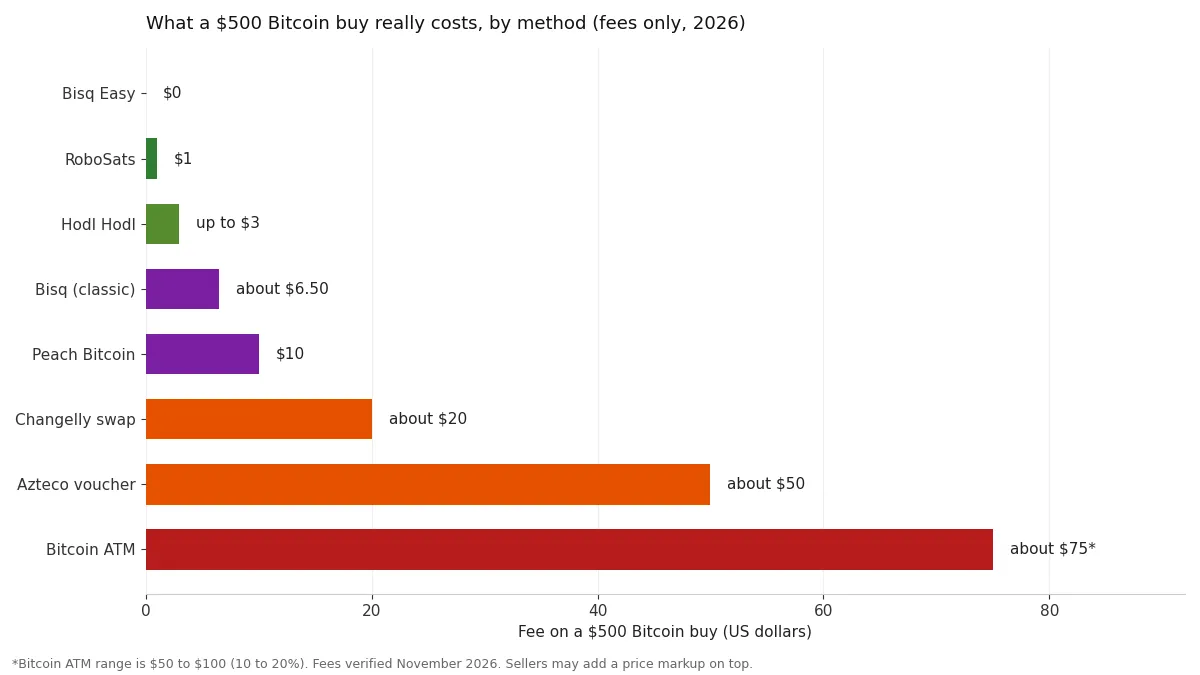
The cost column shows what a $500 buy really costs in fees alone, using figures we verified for this article.
This ranking is the core of this guide. Other guides list the same methods and stop there.
We scored them, priced them, and show you the trade-off in dollars, so you can pick with your eyes open.
| Method | Traceability (1 = smallest trail) | Typical fee | Fee on a $500 buy | No-ID limit |
|---|---|---|---|---|
| Bisq Easy | 1 | 0% | $0 | About $600 per trade |
| RoboSats | 1 | 0.2% | $1 | About $1,400 per trade |
| Bisq (classic) | 1 | About 1.3% | About $6.50 | Set by the offer |
| Hodl Hodl | 2 | Up to 0.6% | Up to $3 | Set by the seller |
| Peach Bitcoin | 2 | 2% (buyer) | $10 | 1,000 CHF per day |
| Azteco voucher | 2 | About 10% | About $50 | $1,000 per voucher |
| Swap service (Changelly) | 3 | About 4% | About $20 | $150 per trade |
| Bitcoin ATM | 3 | 10 to 20% | $50 to $100 | Varies by machine |
Two notes on the numbers. Fees are the trading fee only.
Sellers on P2P markets often price above the market rate, so always check the total before you confirm. The traceability scores are our own assessment, not a guarantee, because your payment method can move any method up or down the scale.
Method 1: Bisq, the decentralised exchange
Bisq is the strongest option for most people, and it has been for years. It launched in 2014 as Bitsquare, and it still runs with no company, no account, and no ID check of any kind.
Trades run peer to peer over Tor, and both sides lock Bitcoin in a two-of-two multisig escrow until the trade completes. Nobody holds your funds, and nobody stores your data, because there is no central server to store it on.
Our guide to buying Bitcoin without ID covers the same ground from the no-ID angle, if you want a second view.
Here is how a first buy works. Download Bisq from bisq.network and verify the installer signature before you run it.
Write down your seed words on paper and set a wallet password. Add a payment method, such as a bank account or a cash-based option.
Then take an offer or make your own, send the payment, and wait for the seller to confirm. The Bitcoin, plus your deposit, lands in your Bisq wallet.
The catch: you need Bitcoin to buy Bitcoin
Classic Bisq trades ask both sides for a security deposit, typically 15% of the trade amount, with a minimum of 0.001 BTC. In practice you need about 0.002 BTC on hand before your first trade, which is roughly $150 at current prices.
Bisq Easy fixes this for small buys. It runs inside Bisq 2, skips the security deposit, charges 0% in trading fees, and caps trades at about $600.
Start there if you own no Bitcoin yet, then move to classic trades once you hold some.
The combined trading fee on classic trades is about 1.3%, split between maker and taker. One warning from 2026: Bisq disclosed a trade-protocol exploit in May 2026 that affected altcoin trades on Bisq v1.
Bisq 2 and Bisq Easy were not affected, and fiat trades stayed protected. Update to the latest release before you trade, and check the current Bisq status page first.
Bisq’s official short tour of the app interface, from the Bisq getting-started guide.
Method 2: Hodl Hodl, Peach and RoboSats
If Bisq feels too heavy, three lighter P2P options cover the same ground. All three use multisig escrow, so the seller cannot run off with your payment and you cannot run off with their Bitcoin.
The trade-off is smaller limits and, in two cases, a little more personal data.
Your payment method still sets your real privacy level here. A bank transfer shows your name to the seller, whatever the platform promises.
Cash, gift cards, and Lightning payments leave far less behind.
Hodl Hodl
Hodl Hodl asks for an email address and nothing else. Fees run up to 0.6% per trade, split between buyer and seller, and sellers list over 100 payment methods, from SEPA transfers to PayPal.
The platform never holds your funds. Bitcoin sits in multisig escrow until both sides confirm, then releases to the buyer.
One limit to know: Hodl Hodl does not serve US customers.
Peach Bitcoin
Peach is a mobile app built for quick, small buys. It asks for no ID, charges the buyer 2%, and caps KYC-free trading at 1,000 Swiss francs per day.
Payment options include SEPA, mobile money, and cash in person. The app suits someone who wants Bitcoin on a phone today, not a desktop trading setup.
RoboSats
RoboSats runs over Tor and gives every trader a disposable robot avatar instead of an account. There is no email, no username, and no profile to link back to you.
Trades settle over Lightning or on-chain Bitcoin, with escrow and reputation scores for safety.
The fee is 0.2%, split between buyer and seller, and trades currently cap at about $1,400. It is the cheapest option on this list after Bisq Easy, and the most private one for Lightning users.
Method 3: Bitcoin ATMs
Bitcoin ATMs are the simplest cash route, and the most expensive one. You walk up, feed in cash, scan your wallet address, and Bitcoin arrives in minutes.
No account, no app, no download.
The price is the problem. Most machines charge 10 to 20% above the market price, and the industry average sits around 11 to 15%.
On a $500 buy, that means $50 to $100 in fees. Some operators in competitive cities charge as little as 6 to 8%, so check the rate on the machine screen before you confirm anything.
Use CoinATMRadar to find machines near you and filter by fee before you leave the house. The site tracks tens of thousands of machines worldwide and shows fees and limits for many of them.
Do not assume a machine is ID-free. Many now ask for a phone number, and larger amounts usually need ID.
US rules tightened in 2025, and some operators now verify at far lower amounts than before. California caps ATM fees at 15% and limits purchases to $1,000 per day.
If speed matters more than privacy, our comparison of the fastest ways to buy Bitcoin covers the instant options side by side. ATMs win on simplicity and lose on cost, every time.
Method 4: Azteco vouchers
Azteco sells Bitcoin vouchers that work a lot like gift cards. You buy a voucher with cash at a retail store or online, then redeem it with a wallet address.
No account, no ID, no personal data at redemption, up to $1,000 per voucher.
The cost is the catch. Online vouchers often carry about a 10% markup over the market price, so a $500 buy costs about $50 extra.
Retail prices vary by store.
Vouchers suit small, one-off buys where you want zero setup. They make no sense for regular stacking, because the markup eats your money every single time.
Method 5: Low-KYC swap services
Swap services sit in the middle. They are fast, they take cards, and they ask for very little at small amounts.
Changelly processes trades under $150 with just an email, a card number, and a wallet address, at roughly 4% all-in. MoonPay’s first tier asks for email and phone only, with a $150 monthly cap and $50 per purchase.
Call this what it is: low-KYC, not anonymous. A card payment leaves your name, your bank, and your address in a record that lives on servers you do not control.
That record links your identity to the wallet address you gave them.
Use swaps for small top-ups when you accept the trail. Do not use them for the coins you want to keep private.
For a wider look at platforms that ask for little or no ID, see our roundup of the best no-KYC crypto exchanges.
What no longer works in 2026
Some methods only live on in old guides. LocalBitcoins closed in February 2023, and Paxful shut down on November 1, 2025.
Any article that still recommends them as live options is out of date.
Prepaid cards sound clever and mostly disappoint. Cards bought with cash usually cap at $200 to $500, many crypto platforms reject them outright, and the card fee stacks on top of the platform fee.
Credit cards are worse. A card carries your name, your bank, and your address, and the transaction record lives forever.
Anyone who promises anonymous Bitcoin buys on a credit card is selling something.
Centralised “no-KYC” exchanges deserve the same caution. Their low tiers shrink without warning, accounts freeze mid-trade, and a platform can add full KYC overnight when a regulator leans on it.
Treat them as temporary, never as your privacy plan.
The legal line: mixers and CoinJoin
Buying Bitcoin privately is legal in most jurisdictions, in the same way paying cash is legal. Your tax obligations still apply, whatever route you use.
Buying without ID does not make the gain tax-free, and tax offices in many countries now receive exchange data automatically.
Mixers and CoinJoin sit on a different line. These tools break the trail between coins, and some jurisdictions treat their use as a red flag.
Some exchanges and services also refuse coins that passed through a mixer, which can leave you holding Bitcoin you cannot easily spend.
This guide does not recommend mixers, and it does not explain how to use them. The methods above give you real privacy without touching tools that can mark your coins as tainted.
Not legal or tax advice. Rules differ by country and change fast.
Check your local law before you buy, keep records of every purchase, and report your taxes whatever route you use.
After you buy: move it to your own wallet
Coins left on a platform are not really yours. The platform holds the keys, and it can freeze, lose, or hand over your funds.
Move your Bitcoin to a wallet you control, and do it before you make your next buy.
The steps are simple. Generate a fresh receiving address in your own wallet for every purchase.
Send a small test amount first. Confirm it arrives, then send the rest.
Never send private coins to an address you once used with a KYC exchange, because that one transfer links the two histories.
Pick a wallet that fits how you hold Bitcoin. Our guide to the best decentralized crypto wallets compares the options, and if your payment method is a bank transfer, read our guide to buying Bitcoin with a wire transfer so you know what the bank sees.
7 mistakes that expose you anyway
Most privacy failures happen after a clean purchase. These seven are the common ones.
- Reusing one address for everything. A single reused address ties all your payments together in public.
- Sending private coins to a KYC exchange address. One transfer links your private history to your verified identity, and you cannot undo it.
- Paying by bank transfer and thinking the trade was anonymous. The seller sees your real name on the payment, whatever the platform promised.
- Posting your address or trade screenshots online. A screenshot with an address or a trade ID is a public link to your wallet.
- Using the same email or phone across KYC and no-KYC services. One shared detail connects accounts that should stay separate.
- Skipping the test transaction. A typo in an address can lose funds forever, and a small test costs almost nothing.
- Trusting a random seller on Telegram or WhatsApp with no escrow. No escrow means no protection, and “trusted seller” lists are easy to fake.
Frequently asked questions
Here are the questions readers ask most about buying Bitcoin privately, with short answers.
Can you buy Bitcoin completely anonymously in 2026?
No, not completely. The closest options are Bisq, RoboSats, and cash Bitcoin ATMs, because no company stores your ID.
Even then, your payment method and how you reuse addresses can still link the coins to you, so the method alone is never enough.
What is the cheapest way to buy Bitcoin without ID?
Bisq Easy charges 0% in trading fees for trades up to about $600, and RoboSats charges 0.2% for trades up to about $1,400. Both beat Bitcoin ATMs, which typically cost 10 to 20% above the market price.
Do Bitcoin ATMs require ID?
It depends on the machine, the operator, the amount, and the location. Many machines ask for a phone number, and larger amounts usually need ID.
Check CoinATMRadar for the limits on machines near you before you go.
Is buying Bitcoin without KYC legal?
In most jurisdictions, yes, when you buy for privacy reasons, in the same way paying cash is legal. Tax obligations still apply to your holdings whatever route you use.
Rules differ by country, so check your local law first.
How much does a Bitcoin ATM charge?
Bitcoin ATMs typically charge 10 to 20% above the market price, with the industry average around 11 to 15%. A $500 buy costs about $50 to $100 in fees, so always check the rate on the screen before you confirm.
What happened to Paxful and LocalBitcoins?
LocalBitcoins closed in February 2023. Paxful shut down on November 1, 2025, after US regulator FinCEN fined it $3.5 million.
Both were once the default P2P options for private Bitcoin buys.






