


Here is the short answer first. You buy Bitcoin in Ghana by checking the platform against the new licensing system, verifying your identity with your Ghana Card, buying USDT first on P2P with mobile money, and then placing a BTC/USDT order inside the exchange.
Ghana changed its law in December 2025, and old how-to guides missed that change. This guide is part of our series on how to buy Bitcoin around the world, and it puts the law check before the buy button.

Key takeaways
- The Virtual Asset Service Providers Act, Act 1154, passed in December 2025 and ended the warning-only era. The Bank of Ghana and the SEC now share oversight.
- Full licensing is still in transition in October 2026. The SEC sandbox lists 20 firms, and sandbox entry is a pilot, not a full licence.
- A joint Bank of Ghana and SEC directive on February 20, 2026 banned public crypto advertising. A billboard or social media seller is a red flag, not a route.
- The real route runs through P2P escrow. You pay with MTN MoMo, Telecel Cash, or bank transfer, and you never pay outside escrow.
- On a 1,000 GHS buy, the seller premium costs you far more than the 0.10 percent spot fee. Compare the final BTC amount, not the headline fee.
Is Bitcoin Legal in Ghana Now?
Yes, buying and holding Bitcoin sits inside a legal framework for the first time. The Virtual Asset Service Providers Act, Act 1154, passed in December 2025 and gave Ghana its first dedicated crypto law.
- Is Bitcoin Legal in Ghana Now?
- How to Check if a Platform Is Licensed or in Transition
- The February 2026 Ad Ban, and Why It Protects You
- Where Ghanaians Actually Buy in 2026
- The True Cost of a 1,000 GHS Buy
- How to Buy Bitcoin in Ghana, Step by Step
- Tax and Records in Ghana
- Staying Safe After You Buy
- FAQs
- Is it legal to buy Bitcoin in Ghana?
- Which platforms are licensed in Ghana?
- Can I buy Bitcoin with MTN MoMo?
- Why did Ghana ban crypto billboards?
- What is the cheapest way to buy Bitcoin in Ghana?
- Do I pay tax on Bitcoin in Ghana?
- The Bottom Line
Bitcoin is still not legal tender in Ghana. The cedi remains the only legal tender, and the Act regulates the firms that serve you, not the coin itself.
What the VASP Act Changes for a Normal Buyer
Exchanges, wallet firms, and brokers must now get a licence or registration from the Bank of Ghana or the SEC. The law also brings identity checks, anti-money laundering controls, and the FATF travel rule into normal buying.
The Bank of Ghana created a Virtual Assets Regulatory Office to run enforcement. A coordinating committee with the Bank, the SEC, the Finance Ministry, and other agencies started work in August 2026.
Why Transition Matters in October 2026
Full operation of the Act is targeted for 2027, so October 2026 sits in the middle of the changeover. The SEC sandbox started in March 2026 for 12 months, and firms that prove ready may move to activity-based licences earlier.

That timing explains the honest answer on platform status. A global exchange can be widely used in Ghana and still sit outside the new local licence list, so you check status instead of assuming it.
How to Check if a Platform Is Licensed or in Transition
Do this check before you send any cedi. It takes a few minutes and it separates a supervised pilot firm from a random app with a logo.
The SEC published a sandbox list of 20 entities on August 19, 2026. Four names on that list test virtual asset exchange services: Yellow Card Ghana, Hyro Exchange, Whitebit Ghana, and Koinkoin Ghana.
Step by Step: Run the Ghana Check
First, find the legal company name in the platform terms, not just the brand name. Second, search that exact name on the SEC sandbox and licensing lists, and match the approved activity to what the app offers you.
Third, ask the SEC directly if the name does not appear. The SEC lists a toll-free line, 0800100065, and a VASP contact email, vasp@sec.gov.gh, for exactly this question.
What Sandbox Status Does and Does Not Mean
Sandbox entry means the SEC watches the firm while it tests a product in a controlled setting. It does not mean the firm holds a full licence, and it does not protect your money like a bank deposit.
No entry on any list means extra risk, not automatic proof of a scam. Treat a missing status as a reason to start tiny, keep records, and move coins to your own wallet fast.
The February 2026 Ad Ban, and Why It Protects You
On February 20, 2026, the Bank of Ghana and the SEC ordered all virtual asset firms to stop public advertising. Firms had 48 hours to remove billboards in Accra and other cities, and even sandbox firms needed express permission for mass marketing.
The regulators said virtual asset advocacy counts as a regulated activity under Act 1154. A firm that still shouts from a billboard or a loud social media campaign breaks a clear public order.
Use that rule as a filter. A seller who finds you through a flashy ad, a WhatsApp broadcast, or a promise of fixed returns fails the first test before you check any fee.
Where Ghanaians Actually Buy in 2026
Two routes cover most honest demand today. One route uses a sandbox exchange firm for a simple buy, and the other uses P2P markets on large global exchanges for deeper GHS liquidity.
Our Nigeria Bitcoin guide shows a similar P2P pattern in West Africa. Our South Africa guide shows a market where local licensing started earlier.
The Sandbox Exchange Route
Yellow Card Ghana sits in the SEC sandbox for virtual asset exchange services. That status makes it the clearest local example to check first if you want a simple app route inside the new system.
Check its live quote before you buy, because a simple app price hides its cost in the rate. Compare the BTC you receive against the P2P route on the same day.
The P2P Route on Global Exchanges
Binance, Bybit, and Bitget all run GHS P2P markets with MTN MoMo, Telecel Cash, AT Money, and bank transfer options. Binance lists zero maker and taker fees for GHS P2P pairs during a promotion that runs from August 12 to October 31, 2026.
Spot fees on those platforms sit at 0.10 percent for a normal BTC/USDT trade. The platform fee is small, and the seller price in P2P carries the real cost.
The True Cost of a 1,000 GHS Buy
Bitcoin traded near 950,600 GHS on October 17, 2026, so 1,000 GHS buys about 0.001052 BTC before any cost. The table below shows what happens after the two costs on the normal P2P route.
Cost one is the P2P premium, the gap between the seller USDT price and the spot value. Cost two is the spot fee of 0.10 percent, which equals 1 GHS on this buy.
| P2P premium you accept | Premium cost plus 1 GHS spot fee | BTC you receive, about |
|---|---|---|
| 0 percent, price matches spot | 1 GHS | 0.001051 BTC |
| 1 percent above spot | 11 GHS | 0.001041 BTC |
| 2 percent above spot | 21 GHS | 0.001031 BTC |
| 3 percent above spot | 31 GHS | 0.001021 BTC |
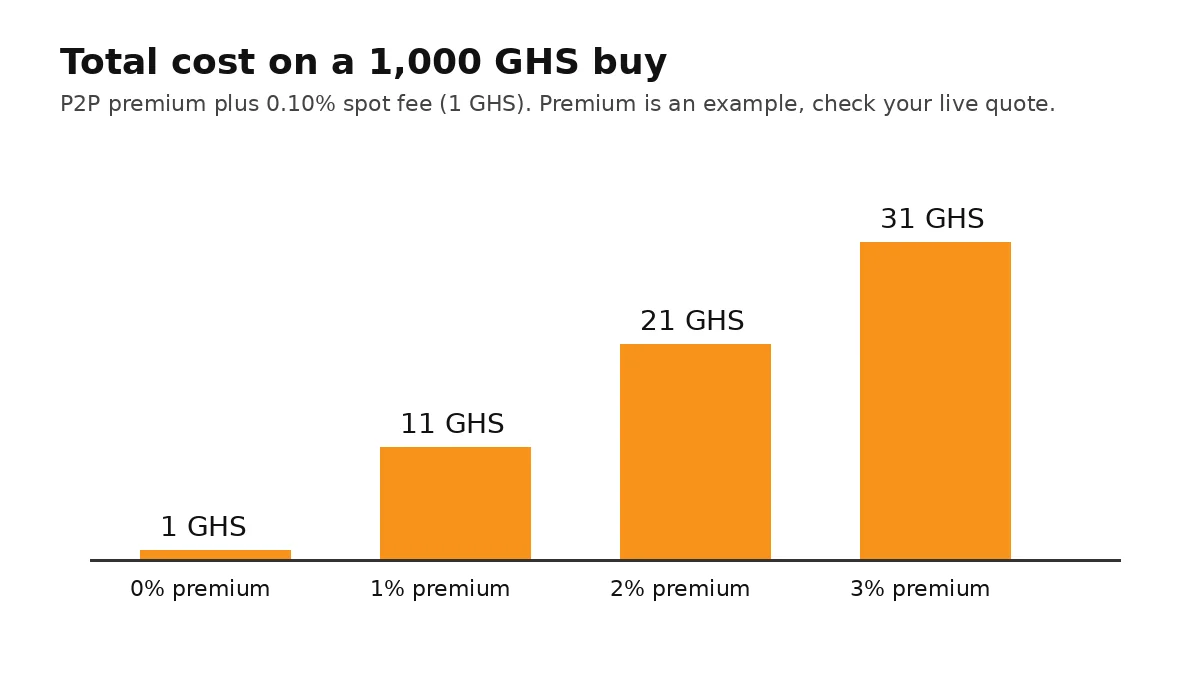
Read the table as a shopping rule, not a fixed price list. Compare three sellers, work out the premium on the best quote, and walk away if every quote sits far above spot.
How to Buy Bitcoin in Ghana, Step by Step
The full process takes under an hour once your identity check clears. If the asset itself is still new to you, skim what Bitcoin is first.
- Run the licence check. Match the legal name on the SEC sandbox or licensing list, or ask the SEC on 0800100065 if you cannot find it.
- Open the account in your own name. The name on the exchange account must match the name on your MoMo wallet, because sellers can reject a payment from a different name.
- Verify with your Ghana Card. Platforms ask for the Ghana Card or a passport, plus a selfie check, under the new KYC rules.
- Turn on two factor authentication. Set it up before you hold any balance, and save the backup codes offline.
- Buy USDT first on P2P. Filter by GHS and by MTN MoMo, Telecel Cash, or bank transfer, then pick a seller with a high completion rate and many finished orders.
- Pay only inside escrow. The platform holds the seller coins while you send MoMo payment, and you tap Paid only after you send the money.
- Trade USDT for Bitcoin. Place a limit order on the BTC/USDT pair, check the 0.10 percent fee, and confirm the BTC amount before you submit.
- Move large amounts to your own wallet. Our guide to the best Bitcoin wallets for beginners covers safe first wallets.
Start with a small test buy, even 100 GHS. A test run proves the seller route, the name match, and the withdrawal path before real money moves.
Payment Methods Compared Honestly
MTN MoMo wins on reach for most buyers in Ghana. Telecel Cash and AT Money work on the same P2P screens, and bank transfer suits larger buys where a paper trail matters.
Cards lose on price and access for most Ghanaian buyers. A card quote hides conversion and issuer costs, so compare its final BTC amount against the P2P quote before you use it.
Tax and Records in Ghana
Ghana has no specific crypto tax law in force in October 2026. General income tax rules can still apply to trading profits, and the Ghana Revenue Authority plans to bring crypto activity into the tax net.
Keep records as if a tax question will arrive. Save the date, the GHS amount, the seller quote, the BTC amount, and every withdrawal address for each buy.
Our Egypt guide shows a stricter market by contrast. Ghana chose licensing over a ban, and good records help you prove a clean route under the new system.
Staying Safe After You Buy
An exchange account is a place to buy, not a vault. Move any amount that would hurt to lose into a wallet where you hold the keys, and read our walkthrough on how to store Bitcoin safely before you move it.
Write your recovery phrase on paper and store it offline. No licensed or sandbox firm will ask for that phrase, and anyone who does runs a theft, not a support desk.
Scams That Target Ghanaian Buyers
Off-escrow MoMo deals lead the current wave. A seller asks you to send MoMo payment on WhatsApp first and promises to send Bitcoin after, and the Bitcoin never arrives.
Fake investment groups run the second pattern. Regulators counted 352 online investment fraud cases in the first half of 2026, with 3.4 million GHS lost, so a promise of fixed daily returns should end the chat at once.
FAQs
Ghanaian readers ask us the same first questions again and again. Here are the short answers, with the 2026 rules applied.
Is it legal to buy Bitcoin in Ghana?
Yes. The Virtual Asset Service Providers Act, Act 1154, passed in December 2025 and created a legal framework for buying and holding Bitcoin, with licensing run by the Bank of Ghana and the SEC.
Which platforms are licensed in Ghana?
Full licensing is still in transition in October 2026. The SEC sandbox lists 20 firms, including Yellow Card Ghana, Hyro Exchange, Whitebit Ghana, and Koinkoin Ghana for exchange services, and sandbox entry is a pilot, not a full licence.
Can I buy Bitcoin with MTN MoMo?
Yes. GHS P2P markets on platforms such as Binance, Bybit, and Bitget accept MTN MoMo, Telecel Cash, AT Money, and bank transfer, and the platform holds the seller coins in escrow while you pay.
Why did Ghana ban crypto billboards?
The Bank of Ghana and the SEC ordered firms on February 20, 2026 to stop public advertising and remove billboards within 48 hours. The order treats virtual asset advocacy as a regulated activity that needs registration and express permission.
What is the cheapest way to buy Bitcoin in Ghana?
Buy USDT on P2P at the lowest premium you can find, then place a limit order on the BTC/USDT pair. On a 1,000 GHS buy the spot fee costs 1 GHS at 0.10 percent, while a 3 percent P2P premium costs 30 GHS.
Do I pay tax on Bitcoin in Ghana?
Ghana has no specific crypto tax law in force in October 2026. General income tax rules can apply to trading profits, so keep full records of every buy and sale.
The Bottom Line
Ghana gives beginners a legal route in 2026, as long as you respect the new gate. Check the licence status, match your names, pay only inside escrow, and compare the premium before you buy.
Skip any seller who advertises big promises or asks for MoMo payment outside the platform. Your first buy should be small, boring, and fully documented, and that is a compliment in this market.