


The VanEck Lido Staked Ethereum ETF is dead before it ever traded. VanEck Digital Assets filed a one page Form RW with the US Securities and Exchange Commission on October 14, 2026, and it asked the SEC to withdraw the fund registration.
The filing gives no reason. It says only that the sponsor does not intend to proceed with the planned distribution of the trust shares.

Key takeaways
- VanEck filed the withdrawal on October 14, 2026, under Rule 477, for File No. 333-290918.
- The original Form S-1 dates to October 16, 2025, so the fund spent almost a full year in limbo.
- The registration never became effective, and VanEck sold no shares and sent out no preliminary prospectus.
- This withdrawal is a sponsor decision, not an SEC rejection, and VanEck stated no commercial or regulatory reason.
- Reports conflict on VanEck’s other liquid staking filing, JitoSOL, so readers should check the SEC docket before trusting any deadline claim.
What the one page SEC filing actually says
Form RW is a withdrawal request, and Rule 477 requires SEC consent before the withdrawal takes effect.
- What the one page SEC filing actually says
- What this fund would have held, and why it was a first
- Our exclusive comparison: the two VanEck liquid staking filings side by side
- The context VanEck did not state: Lido shrank and a giant moved first
- Why Bitcoin readers should care about an ether fund dying
- Common mistakes readers make with withdrawal news
- FAQs
- Conclusion
Vice President Matthew A. Babinsky signed the letter for VanEck Digital Assets.
The letter covers the Form S-1 that VanEck first filed on October 16, 2025, plus its amendments and exhibits. It asks for an effective withdrawal date of October 14, 2026, or the earliest practicable date after that.
The three facts VanEck confirmed in writing
VanEck confirmed that the SEC never declared the registration statement effective. It also confirmed that it issued and sold no securities under that registration.
VanEck added that it distributed no preliminary prospectus to investors. That means no ETF holders need refunds, and no fund assets need selling, because the fund never started.

What the filing does not say
The filing names no regulatory blocker, no market problem, and no replacement product. Anyone who claims VanEck quit because of fees, demand, or SEC pressure adds facts that the document does not contain.
That silence matters for honest reporting. This guide separates the confirmed record from the likely context, and it labels each part clearly.
What this fund would have held, and why it was a first
Most staking funds hold ether and stake it through chosen validators. This fund took a different route, and it planned to hold stETH, the liquid staking token that Lido issues.
stETH represents ether that users staked through Lido, plus the rewards that stake earns. Holders can trade stETH while the underlying ether stays staked, and you can read our explainer on what Ethereum is and how its network works for the base layer basics.

Why the stETH route raised harder questions
A fund that holds stETH carries two layers of risk at once. It carries ether price risk, and it also carries Lido smart contract risk, validator risk, and the risk that stETH trades away from the value of ether.
The original prospectus listed those risks in plain terms. It covered validator penalties, smart contract flaws, liquidity limits, and swings in the market value of ether.
Our exclusive comparison: the two VanEck liquid staking filings side by side
No other coverage puts both VanEck liquid staking filings in one table with their real status today. We built this table from the SEC record and from reporting dated October 14 to October 16, 2026.
| Detail | Lido Staked Ethereum ETF | JitoSOL ETF |
|---|---|---|
| Token the fund would hold | stETH, from Lido on Ethereum | JitoSOL, from Jito on Solana |
| First filing | Form S-1 on October 16, 2025 | Nasdaq listing proposal on March 10, 2026 |
| Key date | Withdrawal filed October 14, 2026 | SEC set November 15, 2026 as its final decision date on September 9, 2026 |
| Status at publish time | Withdrawn at the sponsor request, pending SEC consent | Unclear, because late reports conflict with each other |
Read the JitoSOL row with care. One exchange blog reported on October 15 that Nasdaq withdrew its listing proposal on October 14, while other coverage on October 16 said the Lido withdrawal left JitoSOL unaffected.
We found no SEC withdrawal notice for JitoSOL in the public record we could check before publishing. Treat the November 15 date as the last confirmed SEC deadline, and treat any claim that JitoSOL already died as unconfirmed until an SEC notice appears.
The context VanEck did not state: Lido shrank and a giant moved first
Two background facts changed while the filing sat in limbo. Neither fact proves why VanEck quit, and this article does not pretend otherwise.
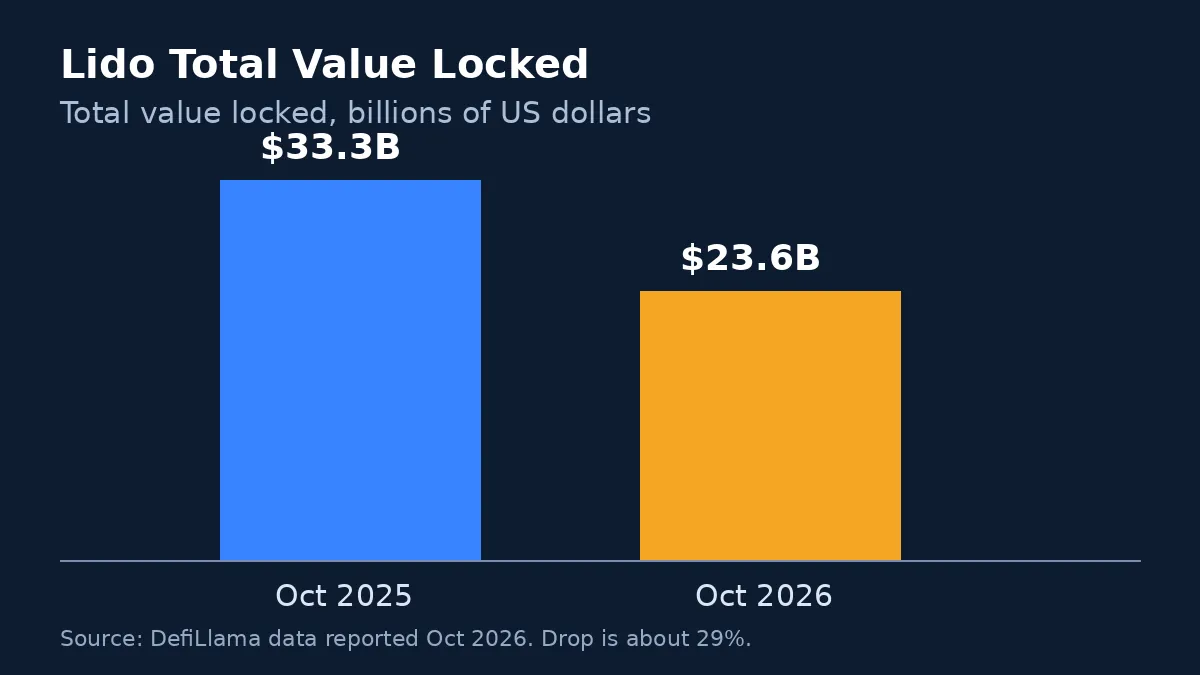
First, Lido got smaller. Data trackers put Lido total value locked near $23.6 billion in mid October 2026, down from about $33.3 billion a year earlier.
Second, BlackRock moved first with a simpler design. Its iShares Staked Ethereum Trust, ticker ETHB, started trading on Nasdaq on March 12, 2026, and it stakes ether directly through professional validators instead of holding a liquid staking token.
ETHB stakes between 70% and 95% of its ether and keeps the rest liquid for redemptions. A sponsor who still wants staking demand can point clients to that live product category, while a stETH fund still waits for a first approval.
Our Ethereum price prediction for 2026 to 2030 shows why long term ether demand still matters beyond one fund.
October flows made new launches harder to sell
US spot crypto ETFs bled money in October, and Farside Investors data shows Bitcoin ETFs lost a net $532.3 million from October 1 to October 15. Ether ETFs lost $578.9 million in the first part of October alone, through October 9.
Weak flows do not kill a filing by themselves. They do lower the commercial payoff of fighting a long regulatory battle for a complex product, and our report on Bitcoin ETFs opening October with $103M in inflows shows how fast that mood swung within days.
Why Bitcoin readers should care about an ether fund dying
Bitcoin has no native staking yield, so Bitcoin ETFs never face this exact problem. A Bitcoin fund holds one asset, and it does not need a validator, a staking token, or a rewards policy.
Our comparison of Bitcoin vs Ethereum for beginners explains that design gap in simple terms.
That simplicity helped Bitcoin ETFs win approval first and gather the most assets. Every staking fight since then tests a harder question, and regulators must judge yield, custody, and token mechanics on top of price exposure.
The Lido exit also sends a signal about product discipline in a soft market. Bitcoin traded near $81,554 and ether near $2,426 on October 17, while LDO, the Lido governance token, traded near $0.40.
Sponsors cut slow, complex products first in markets like this. They protect simple products that already gather assets, such as the funds in our September Bitcoin ETF inflows report.
What happens next for staking ETFs
The validator staking route now carries the momentum, because ETHB already trades and other issuers copy live templates faster than new ones. Liquid staking token funds need either a brave sponsor or a clearer SEC signal, and you can track that regulatory pattern in our coverage of the SEC postponing decisions on Ethereum, XRP and Solana ETFs.
Solana products show the same split between simple and complex designs. Plain Solana funds already trade in the US, as our story on Litecoin, Hedera and Solana ETFs launching covered, while JitoSOL still tests the liquid staking version.
Common mistakes readers make with withdrawal news
The biggest mistake treats a withdrawal as a ban. The SEC banned nothing here, and VanEck can file a new product later if it chooses.
The second mistake treats stETH as ether itself. stETH adds a protocol layer, a peg that can slip, and a separate risk profile, so the two assets do not behave in exactly the same way.
The third mistake trusts every deadline post on social media. The JitoSOL reports this week contradict each other, so the SEC docket, not a screenshot, settles that question.
FAQs
Did the SEC reject the VanEck Lido Staked Ethereum ETF?
No. VanEck asked the SEC to withdraw the registration in a Form RW filed on October 14, 2026. A withdrawal request under Rule 477 is a sponsor decision, not an SEC rejection.
Did any investor buy shares in this fund?
No. VanEck confirmed that the registration never became effective, that it issued and sold no securities, and that it distributed no preliminary prospectus.
What token would the fund have held?
The fund planned to hold stETH, the liquid staking token that Lido issues. stETH represents ether staked through Lido plus the rewards that stake earns.
Why did VanEck withdraw the filing?
VanEck gave no reason in the filing. It said only that it does not intend to proceed with the planned distribution, so any claimed motive beyond that statement is speculation.
What is the status of the VanEck JitoSOL ETF?
The SEC set November 15, 2026 as its final decision date for the Nasdaq listing proposal on September 9, 2026. Late reports conflict on whether Nasdaq withdrew that proposal on October 14, and no SEC withdrawal notice was confirmed before this article published.
Conclusion
The VanEck Lido Staked Ethereum ETF ends with a single page and no stated reason. A year of waiting produced no launch, no holders, and no ruling on whether an ETF can hold a liquid staking token in the US.
Watch two things next. First, watch whether the SEC posts a withdrawal order for File No. 333-290918.
Second, watch the SEC docket for JitoSOL. That record, not social media, will show whether any liquid staking ETF path still lives.