


Yes, you can mine Bitcoin at home in 2026. The honest version is narrower than the hype. A tiny Bitaxe on your desk is a lottery ticket. A home ASIC like the Avalon Q can pay its power bill if your electricity is cheap. A full Antminer in the garage is a small business, with noise, heat and a power bill to match.
This guide shows how to mine bitcoin at home with each of the three setups. It covers the real numbers first, then the setup steps. Bitcoin traded near $82,961 on October 11, 2026. The block reward is 3.125 BTC. Network difficulty sat at 132.72 trillion after the October 3 adjustment, and total hashrate was roughly 950 to 983 EH/s in early October.

Key takeaways
- Home mining works in 2026, but electricity price decides almost everything.
- A Bitaxe Gamma costs about $100, uses about 15 watts, and mines solo for a full 3.125 BTC block.
- An Avalon Q gives 90 TH/s at 1,674 watts and 45 to 65 dB, built for houses, not warehouses.
- An Antminer S21 Pro gives 234 TH/s at 3,510 watts and about 75 dB. That is garage or shed territory.
- At a hashprice near $39.5 per PH/s per day, thin margins mean most home miners need power under $0.10 per kWh.
Can you really mine Bitcoin at home in 2026?
Yes, and thousands of people do. What changed is the scale of the competition. Miners worldwide now produce close to one zettahash per second. Your home machine is a very small part of that total, so the setup has to match the goal.
- Can you really mine Bitcoin at home in 2026?
- The three realistic ways to mine Bitcoin at home
- Home miner comparison: Bitaxe vs Avalon Q vs Antminer S21 Pro
- The honest math: what home mining earns in October 2026
- What you need before you start
- Step by step: set up a home miner
- Noise, heat and power: the reality check
- Common mistakes new home miners make
- So, is mining Bitcoin at home worth it in 2026?
- FAQs
If the goal is learning and a shot at a full block, a small solo miner makes sense. If the goal is steady income, only a real ASIC on cheap power has a chance. New readers should first understand how Bitcoin mining works, because pools, difficulty and block rewards explain every number in this guide.
Why the block reward matters for home miners
Every block pays 3.125 BTC, plus fees. That reward halves about every four years. Our explainer on when the next Bitcoin halving hits in 2028 shows why the reward drops to 1.5625 BTC then. Home miners who start now should plan for that smaller reward from day one.
The three realistic ways to mine Bitcoin at home
Forget PC mining. A graphics card cannot compete with ASIC chips built only for Bitcoin’s SHA-256 math. In practice, home miners pick one of three paths, and each path has a different cost, noise level and chance of paying back.
Path 1: Bitaxe lottery mining
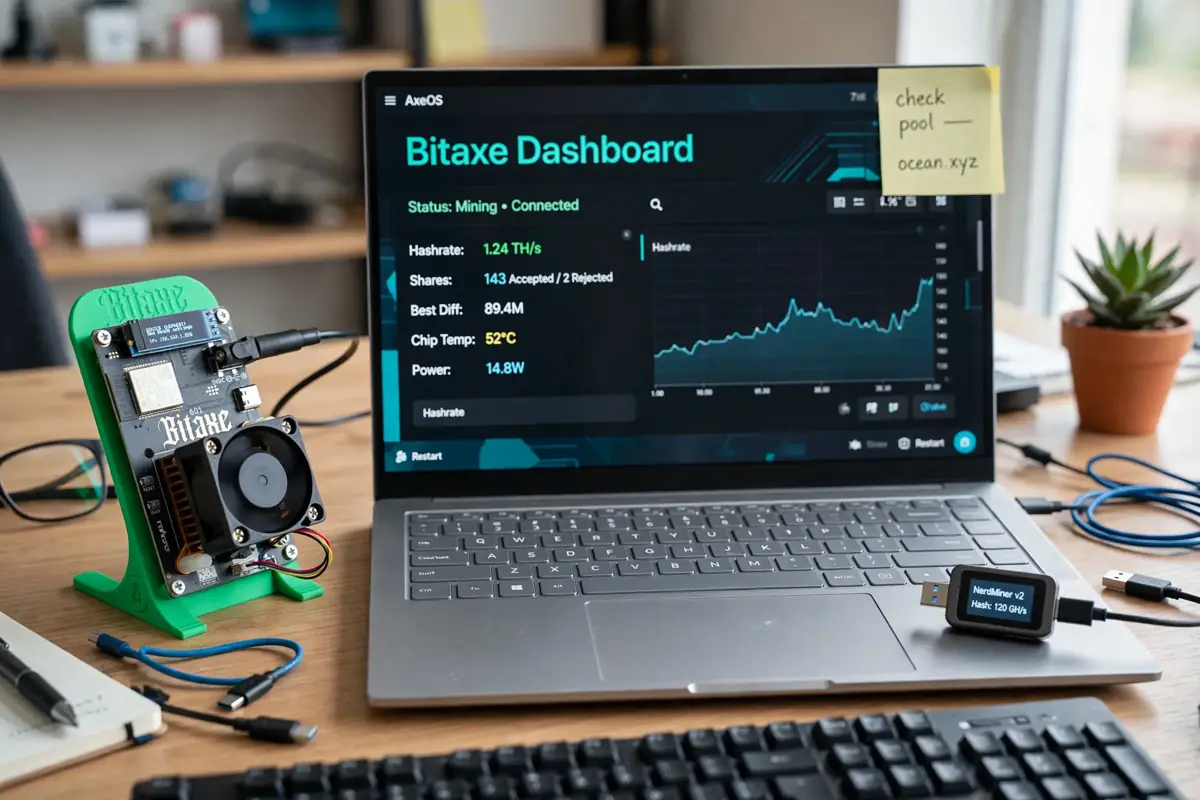
The Bitaxe Gamma 601 is an open source solo miner. It hashes at about 1.2 TH/s on 15 to 17 watts. It connects over WiFi, but only on the 2.4 GHz band. The device costs roughly $100 to $105, and the power bill is about $2 a month at typical home rates.

The trade is clear. You will almost certainly earn nothing on any given day. If your tiny miner finds a block, you keep the full 3.125 BTC. The odds are roughly 1 in 5.5 million per day for one unit. Our full explainer on what a Bitaxe Bitcoin miner is covers the hardware in detail.
Path 2: A home ASIC built for houses
The Canaan Avalon Q was designed for homes and small offices. It delivers 90 TH/s at about 1,674 watts, with efficiency near 18.6 J/TH. Noise is rated at 45 to 65 dB, and some sellers have tested it closer to 39 to 47 dB in normal use. It runs on standard household power, including 120V circuits in the US.
That mix matters. You get real hashrate without rewiring the house or shouting over the fans. The catch is the math. At $0.10 per kWh, the Avalon Q earns less than its power costs at today’s hashprice. At $0.05 per kWh, it moves into profit. Winter heat reuse helps too, since every watt becomes heat in your home anyway.
Path 3: A full ASIC in the garage
The Antminer S21 Pro is the serious option. It produces 234 TH/s at 3,510 watts, at 15 J/TH. It needs 220 to 277 volt power, draws real current, and is rated at about 75 dB. That is roughly vacuum cleaner loud, all day, every day.
People do run these at home. They put them in garages, sheds or basements with venting. Some duct the hot air into the house in winter. Nobody sane puts one in a bedroom. Prices in October 2026 listings ranged from about $2,000 to $3,100 depending on the batch and seller.
Home miner comparison: Bitaxe vs Avalon Q vs Antminer S21 Pro
The table below uses maker specs and October 2026 listings. Prices move, so treat them as a starting point, not a promise.
| Miner | Hashrate | Power | Noise | Best for |
|---|---|---|---|---|
| Bitaxe Gamma 601 | 1.2 TH/s | 15 to 17W | Almost silent | Learning and solo lottery mining |
| Canaan Avalon Q | 90 TH/s | 1,674W | 45 to 65 dB | Pool mining inside a home |
| Antminer S21 Pro | 234 TH/s | 3,510W | About 75 dB | Garage mining on cheap power |
The honest math: what home mining earns in October 2026
Hashprice is the easiest yardstick. In early October 2026 it sat near $39.5 per PH/s per day. That means each terahash earns about 4 cents a day before power and pool fees. Small numbers, so power cost eats them fast.
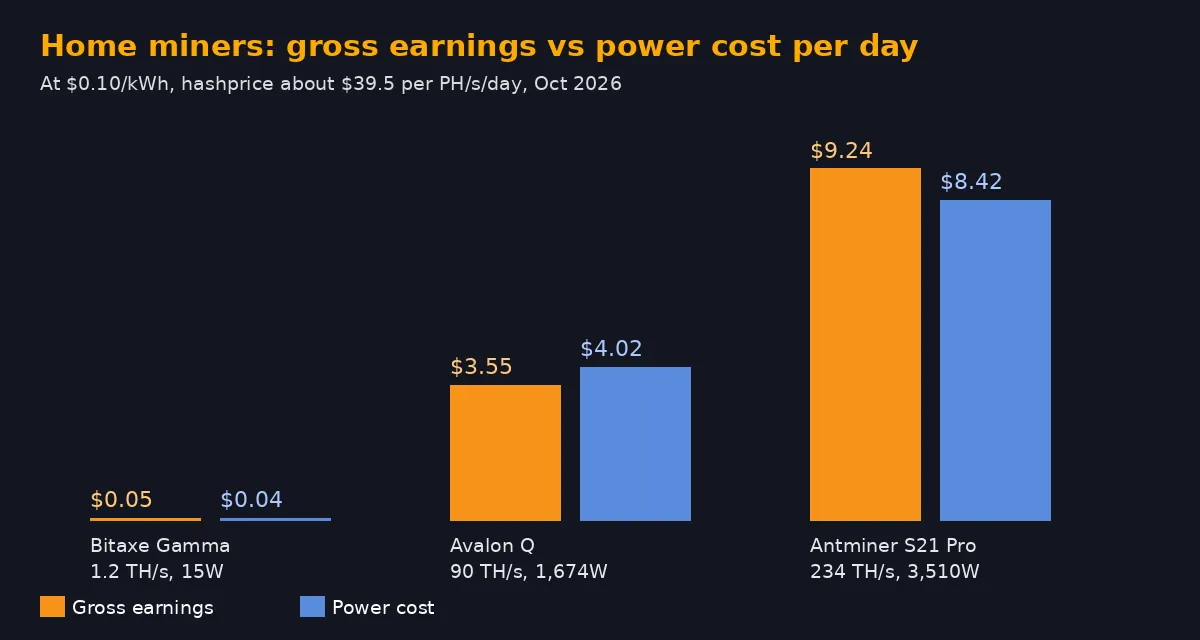
An S21 Pro at 234 TH/s grosses about $9.24 a day. Its 84.24 kWh daily power use costs $8.42 at $0.10 per kWh, leaving about $0.82 before pool fees. At $0.05 per kWh the same machine keeps about $5.03 a day. Same miner, same Bitcoin price, five times the profit. That is the whole game.
The Avalon Q grosses about $3.55 a day and uses 40.18 kWh. At $0.10 per kWh it loses about $0.47 a day. At $0.05 it earns about $1.54 a day, and reusing its heat in winter improves the picture further. We ran the wider numbers in our guide on whether Bitcoin mining is still profitable in 2026.
What you need before you start
Most failed home setups fail on basics, not on the miner itself. Check these five things before you spend anything.
- Power: Know your rate per kWh from your bill. A full ASIC also needs the right voltage and a circuit that can carry the load all day.
- Space and venting: Miners turn power into heat. A 3,510 watt ASIC is a big space heater that never switches off.
- Internet: A stable connection is enough. Mining uses very little data, but dropouts cost shares.
- A wallet: Pool payouts need a Bitcoin address you control. Anything you earn should move to storage you own. Our guide on how to store Bitcoin offline long term shows a safe cold storage setup.
- A pool account: Pool mining pays small, steady amounts. Solo mining pays rarely, if ever. Pick based on your goal, not on hope.
Step by step: set up a home miner
The steps below fit a Bitaxe or a home ASIC. A full ASIC follows the same logic, with extra electrical work first.
- Unbox the miner and place it where air can flow and noise will not drive you mad.
- Connect power. For a full ASIC, confirm the circuit and voltage first, ideally with an electrician.
- Connect the miner to your network by Ethernet, or join the 2.4 GHz WiFi band for a Bitaxe.
- Open the miner dashboard in your browser. On a Bitaxe this is the AxeOS screen. On an ASIC it is the web panel at the miner’s IP address.
- Enter your pool details. For solo mining, a solo pool URL such as solo.ckpool.org works. For pool mining, use your pool’s URL and your Bitcoin address as the username.
- Save, restart, and watch the dashboard. Shares should start landing within a minute or two.
- Check again after 24 hours. Note the average hashrate, temperature and any rejected shares.
One nice upgrade later: point your miner and wallet at your own node. It adds privacy and removes trust in third party servers. Our walkthrough on how to run a Bitcoin node at home shows the Raspberry Pi and Umbrel route.
Noise, heat and power: the reality check
This is the part sales pages skip. A full ASIC at 75 dB will be heard through walls. Families notice. Neighbours in flats notice. Silencer boxes and immersion kits exist, but they add cost and their own risks.
Heat cuts both ways. In a cold climate, a miner heats a room and the power bill partly replaces a heating bill. In a hot climate, you pay twice: once to run the miner, and again to air condition its heat away. Many home miners in warm places run small units only, or mine in winter and pause in summer.
Safety is not optional. Continuous loads stress old wiring. If a plug, socket or cable feels hot, stop and get an electrician. Cheap extension leads and full ASICs do not mix.
Common mistakes new home miners make
The same errors show up again and again in mining forums.
- Buying an old Antminer S9 for $50. At about 98 J/TH it burns more in power than it earns, unless your power is nearly free.
- Trusting cloud mining contracts. Many are scams or pay less than the fees. Hardware you can touch is easier to judge.
- Ignoring the power rate. A miner that profits at $0.05 per kWh can lose every day at $0.15.
- Mining to an exchange address you do not control, or losing the seed phrase for the payout wallet.
- Forgetting taxes. Mined Bitcoin is income in many countries at the value on the day you receive it. Keep records from the start.
So, is mining Bitcoin at home worth it in 2026?
For most people, the Bitaxe is the honest buy. It costs little, teaches a lot, supports the network, and keeps a real, if tiny, shot at 3.125 BTC. Treat it as a hobby with a jackpot, never as income.
A home ASIC or a garage ASIC is a numbers decision. Run your own rate, your own climate and today’s hashprice through the math above. If the numbers only work at power prices you do not have, buying Bitcoin directly is usually the better deal. There is no shame in that answer. The miners who last are the ones who did the boring math first.
FAQs
Short answers to the questions new home miners ask most. The sections above carry the full detail behind each one.
Can you mine Bitcoin at home in 2026?
Yes. You can mine Bitcoin at home in 2026 with a small Bitaxe, a home ASIC like the Avalon Q, or a full ASIC in a garage. Profit depends mostly on your electricity price.
How much does it cost to start mining Bitcoin at home?
A Bitaxe starts at about $100. A home ASIC like the Avalon Q costs much more, and a full Antminer S21 Pro sits in the $2,000 to $3,100 range before any electrical work.
Is mining Bitcoin at home profitable?
It can be, but margins are thin. At a hashprice near $39.5 per PH/s per day, an Antminer S21 Pro earns about $9.24 a day before power. At $0.10 per kWh its power costs about $8.42 a day.
Can I mine Bitcoin with my PC or laptop?
No, not in any useful way. GPUs and CPUs cannot compete with ASICs on Bitcoin’s SHA-256 network, and you would earn close to zero while wearing out your hardware.
How loud is a Bitcoin miner at home?
A Bitaxe is almost silent. An Avalon Q runs at about 45 to 65 dB. A full ASIC like the Antminer S21 Pro is rated at about 75 dB, which is too loud for a living space.
Start small, measure everything, and let the numbers decide your next step. That is how home miners survive every cycle, including this one.