

Algorand Price Prediction 2026-2030: The Short Answer
Algorand (ALGO) trades near $0.076 on November 20, 2026. That price sits just above the all-time low of about $0.0751 that ALGO set on November 14, and it leaves the token down 32% in a month.
Our Algorand price prediction 2026-2030 puts the base case at $0.09 by the end of 2026, $0.15 in 2027, $0.25 in 2028, $0.35 in 2029, and $0.50 in 2030. The $1 target stays a bull-case outcome, not the base case, because $1 would demand a $9.08 billion market cap at the current supply.

Read on for the math, the catalysts, and the risks that could break this forecast.
- Algorand Price Prediction 2026-2030: The Short Answer
- Algorand (ALGO) Price Today
- Why ALGO Is Near Its All-Time Low
- What Is Algorand?
- The 2026 Catalysts That Could Change the Story
- SEC Names ALGO a Digital Commodity
- Japan Opens the Door
- Post-Quantum Accounts Go Live
- A New CEO With an Institutional Brief
- Real-World Use Keeps Growing Quietly
- Algorand Price Prediction 2026
- Algorand Price Prediction 2027
- Algorand Price Prediction 2028
- Algorand Price Prediction 2029
- Algorand Price Prediction 2030
- What Would It Take for ALGO to Reach $1?
- Key Levels to Watch
- Risks: What Could Go Wrong
- DeFi Activity Is Thin
- The Treasury Overhang Caps Rallies
- Supply Keeps Growing
- Usage Has Not Matched the News
- Is Algorand a Good Investment?
- Algorand Price Prediction 2026-2030: FAQs
- What is the Algorand price prediction for 2026?
- What will ALGO be worth in 2030?
- Can Algorand reach $1?
- Can Algorand reach $10?
- Why is ALGO so low right now?
- Is Algorand a good long-term investment?
- Conclusion
Key takeaways
- ALGO trades at about $0.076, down 32% in 30 days and 46% over the past year.
- ALGO set a fresh all-time low near $0.0751 on November 14, 2026.
- Real catalysts exist in 2026: an SEC digital commodity listing, a Japan Green List spot, native post-quantum accounts, and a new CEO.
- Our 2030 base case is $0.50. Our bull case is $1.20. Our bear case is $0.12.
- $1 needs a $9.08 billion market cap, about 13 times the current value.
- Thin DeFi activity and a large Foundation treasury remain the biggest drags on price.
Algorand (ALGO) Price Today
Here is the snapshot as of November 20, 2026, at about 08:07 UTC. Prices move fast, so treat these numbers as a morning reading, not a live quote.
| Metric | Value |
|---|---|
| Price | About $0.0766 |
| 24-hour change | Down about 1.2% |
| 7-day change | Down about 12% |
| 30-day change | Down about 32% |
| 1-year change | Down about 46% |
| Market cap | About $695 million |
| Market cap rank | Near 84th |
| Circulating supply | 9.08 billion ALGO |
| Maximum supply | 10 billion ALGO |
| All-time high | $3.28 (June 2019) |
| All-time low | About $0.0751 (November 14, 2026) |
| 24-hour trading volume | About $30 million |
The 30-day drop tells the story. ALGO traded near $0.095 on October 31, then slid through November as Bitcoin fell below $62,000 and the whole market turned risk-off.
ALGO now sits 98% below its 2019 all-time high.

Why ALGO Is Near Its All-Time Low
Three forces pushed ALGO to the edge of its all-time low. The broad market sold off, Algorand’s own ecosystem stayed quiet, and sellers found few buyers at these levels.
Bitcoin drives most altcoins, and Bitcoin has had a rough November. When Bitcoin drops, money leaves smaller coins first, and ALGO is no exception.
The token fell 32% in a month while Bitcoin lost far less in percentage terms.
The November Slide, Day by Day
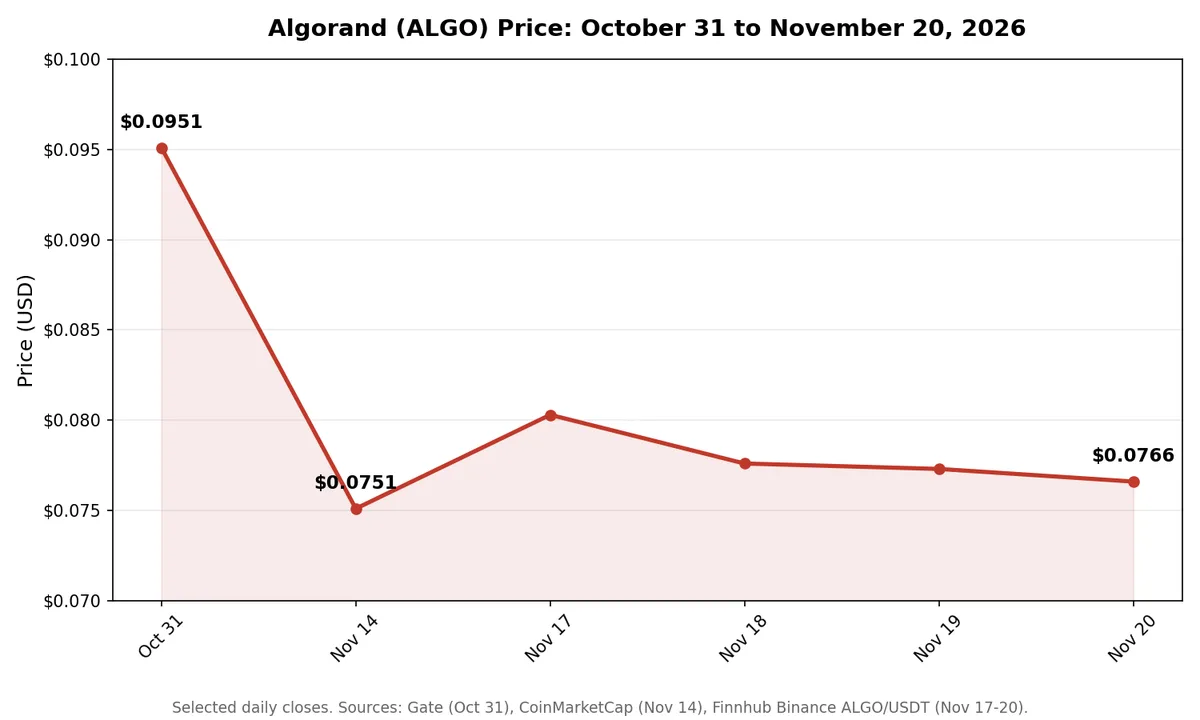
The slide shows up clearly in the daily closes. ALGO closed at $0.0951 on October 31, then lost ground almost every day in the first half of November.
It touched about $0.0751 on November 14, the lowest price in its history. It bounced to $0.0803 on November 17, then drifted back to $0.0773 on November 19 and about $0.0766 this morning.
The chart below tracks that fall.
The Vestige Shutdown Hurt Sentiment
Algorand also took a direct hit on November 14. Vestige, a trading aggregator and DeFi data platform on Algorand, announced it will close its website, API, and trading services.
Vestige blamed a year of low trading volume that could not cover its running costs. The closure does not touch user wallets, and assets in Vestige vaults stay reachable through a legacy front end.
Still, the shutdown of a major DeFi front end signals weak app activity, and traders noticed.
What Is Algorand?
Algorand is a Layer-1 blockchain that MIT professor Silvio Micali founded in 2017. It runs on pure proof-of-stake, a system where anyone who holds ALGO can take part in consensus without locking tokens or running heavy mining rigs.
The network confirms transactions in under three seconds and charges tiny fees. That speed and low cost made it a natural home for payments, tokenized assets, and real-world use cases in places where banking is weak.
If you want the wider staking picture, see our guide to the best crypto staking platform for passive earning.
What Makes Algorand Different
Two features set Algorand apart from most chains. First, it finalizes blocks instantly, so a transaction never forks or reverses once it confirms.
Second, it built quantum resistance into the protocol itself, not as an add-on.
Those strengths matter for institutions. Banks and payment firms need finality and long-term security, and Algorand pitches itself directly at them.
The problem so far is that the pitch has not turned into big on-chain volume.
The 2026 Catalysts That Could Change the Story
Algorand collected more real catalysts in 2026 than in any recent year. Each one is verifiable, and each one targets institutional money rather than retail hype.
SEC Names ALGO a Digital Commodity
On March 17, 2026, the U.S. SEC issued an interpretation with the CFTC that named 18 crypto assets as digital commodities rather than securities. ALGO made the list, and it was one of only two named assets that did not underlie a futures contract.
The label cuts legal uncertainty for U.S. platforms that list or build with ALGO. It does not guarantee demand, but it removes one reason institutions stayed away.
Japan Opens the Door
Japan added ALGO to the JVCEA Green List on April 2, 2026. The list covers more than 30 tokens that Japanese exchanges can list under a lighter review process.
Japan is one of the largest crypto markets in the world. Regulated listings there can bring in local buyers who had no compliant way to buy ALGO before.
Post-Quantum Accounts Go Live
Algorand shipped native Falcon-1024 post-quantum accounts in its v5.0.0 upgrade in August 2026. The upgrade followed a post-quantum roadmap that the Algorand Foundation published in June, and it targets broad quantum resilience by the end of 2027.
Pera Wallet passed 1 million post-quantum transactions in September. Quantum safety sounds abstract, yet it gives Algorand a genuine edge: no other major Layer-1 has shipped this at the protocol level.
A New CEO With an Institutional Brief
William Herkelrath, a former Chainlink executive, became Algorand CEO on August 31, 2026. He leads a push into institutional finance and quantum security, and he has made self-sustainability the first priority of what the team calls Algorand 2.0.
His stated plan is to sell services the market will pay for, then use that revenue to become a net buyer of ALGO and raise payouts to node operators. That plan only works if revenue actually arrives.
Real-World Use Keeps Growing Quietly
HesabPay, an Afghan digital wallet built on Algorand, now serves more than 1 million users and moves about $183 million a month. It has channeled more than $35 million in UNHCR aid to refugees and displaced people.
Algorand also partnered with Flow Traders for 24/7 institutional liquidity, and the network hit a record 1,540 validators. Agentic payments grew too: x402 settlements through the GoPlausible facilitator reached 1.04 million successful settlements in the third quarter.
These numbers prove real usage, even while the price falls. For the payments angle, our list of the best PayFi coins to invest in 2026 puts Algorand’s payment story in context.
Algorand Price Prediction 2026
ALGO ends 2026 in a weak position. It trades near its all-time low, the market is risk-off, and only six weeks remain in the year.
Our 2026 base case is $0.09. That needs a modest bounce from $0.0766, not a rally.
The bull case is $0.12, which needs Bitcoin to stabilize and buyers to defend the November low. The bear case is $0.06, which follows if Bitcoin breaks lower and ALGO prints a new all-time low.
CoinStats expects ALGO to trade between $0.085 and $0.140 for the rest of 2026, with an average near $0.110. VentureBurn puts the fourth quarter range at $0.072 to $0.104.
Both ranges sit close to our own, and both agree that 2026 ends quietly.
| 2026 scenario | Price target | What it needs |
|---|---|---|
| Bear | $0.06 | Bitcoin breaks lower, ALGO sets a new all-time low |
| Base | $0.09 | Bitcoin stabilizes, the November low holds |
| Bull | $0.12 | Risk appetite returns, buyers defend $0.075 |
Algorand Price Prediction 2027
2027 is the first year where the 2026 catalysts can show results. The post-quantum roadmap targets broad resilience by the end of 2027, and the SEC listing needs time to turn into real listings and products.
Our 2027 base case is $0.15, roughly double the current price. That assumes a moderate crypto recovery and steady growth in on-chain activity.
The bull case is $0.30, which needs tokenization and DeFi activity on Algorand to scale fast. The bear case is $0.05, which follows if the market stays flat and the catalysts produce no usage.
CoinStats sees a 2027 average of $0.20 with a high of $0.40. VentureBurn is more cautious, with a fourth-quarter 2027 range up to $0.164.
Our base case sits between the two, closer to VentureBurn.
Algorand Price Prediction 2028
By 2028 the picture should be clearer. Either Algorand’s institutional push produces real volume, or the market will have priced it as another quiet chain with good tech and little demand.
Our 2028 base case is $0.25. The bull case is $0.55, which needs Algorand to win a larger share of institutional tokenization and stablecoin settlement.
The bear case is $0.08, which means the token barely moves for two more years.
CoinStats puts the 2028-2029 average at $0.35 with a high of $0.80. VentureBurn sees a fourth-quarter 2028 high near $0.27.
Changelly takes the cautious view, with a 2028 range of $0.057 to $0.115. The spread between these forecasts is wide, and that spread is the honest story: nobody can pin 2028 down yet.
Algorand Price Prediction 2029
Our 2029 base case is $0.35. That assumes the ecosystem grows at a steady pace and the remaining supply unlocks get absorbed without crushing the price.
The bull case is $0.80, which needs a full bull market plus real institutional flows into Algorand-based assets. The bear case is $0.10, which follows if adoption stalls and the Foundation’s treasury sales keep capping rallies.
Few forecasters publish detailed 2029 numbers. CoinStats folds 2028 and 2029 into one range with a $0.35 average.
VentureBurn sees a 2029 high near $0.36. Both land close to our base case, which adds some comfort to the number.
Algorand Price Prediction 2030
Our 2030 base case is $0.50. That is about 6.5 times the current price, and it assumes sustained ecosystem growth over four years.
The bull case is $1.20, which needs a strong bull market and a real breakout in tokenized assets on Algorand. The bear case is $0.12, which means five years of flat, disappointing progress.
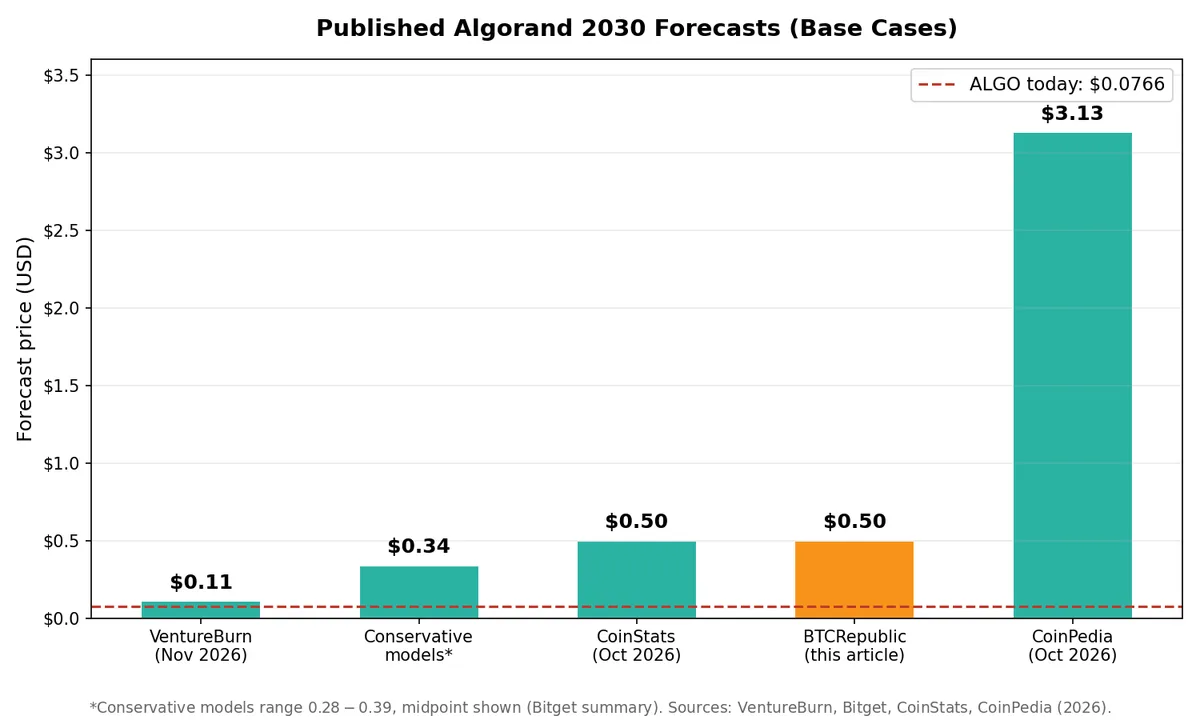
Published forecasts for 2030 disagree sharply, and the chart below shows the gap. CoinStats expects an average of $0.50 with a high of $1.20, which matches our base and bull cases exactly.
VentureBurn expects about $0.11. Conservative models tracked by Bitget put 2030 at $0.28 to $0.39.
CoinPedia is the outlier, with an average of $3.13 and a high above $6.
| Year | Bear | Base | Bull |
|---|---|---|---|
| 2026 | $0.06 | $0.09 | $0.12 |
| 2027 | $0.05 | $0.15 | $0.30 |
| 2028 | $0.08 | $0.25 | $0.55 |
| 2029 | $0.10 | $0.35 | $0.80 |
| 2030 | $0.12 | $0.50 | $1.20 |
What Would It Take for ALGO to Reach $1?
The $1 question dominates every Algorand discussion, so here is the exact math. ALGO has 9.08 billion tokens in circulation, so every price target maps to a fixed market cap.
At $0.0766, the market cap is about $695 million. At $0.50, it would be about $4.54 billion.
At $1, it would be about $9.08 billion, roughly 13 times the current value. At the old all-time high of $3.28, it would be about $29.8 billion.
| ALGO price | Implied market cap | Multiple from today |
|---|---|---|
| $0.0766 (today) | About $0.70 billion | 1x |
| $0.10 | About $0.91 billion | 1.3x |
| $0.25 | About $2.27 billion | 3.3x |
| $0.50 | About $4.54 billion | 6.5x |
| $1.00 | About $9.08 billion | 13.1x |
| $3.28 (all-time high) | About $29.8 billion | 42.9x |
This table is our own calculation from the circulating supply, and it frames the debate honestly. A $9 billion market cap is not fantasy: it would put Algorand near the top 20 coins at today’s values.
But it needs either a huge bull market or a step change in usage, and neither is visible yet.
For comparison, Ondo, the RWA leader, faces the same market-cap math on its own road to $1. Tokenized real-world assets are the shared bet for both chains.
Key Levels to Watch
Traders watch a few clear levels on ALGO. Support sits at $0.0751, the November 14 all-time low.
If that level breaks, there is no price history below it to catch the fall.
The next support is psychological: $0.07, then $0.05. Resistance sits at $0.08, the level ALGO briefly reclaimed on November 17, then at $0.095, the October 31 close, and at $0.10, the round number that capped the October slide.
A close above $0.10 would be the first real sign that the downtrend is breaking.
Risks: What Could Go Wrong
Algorand’s risks are concrete, and any honest forecast must name them. The catalysts are real, but so are the headwinds.
DeFi Activity Is Thin
Algorand’s DeFi TVL sits near $25 million, down from about $42 million in mid-May. That is tiny next to rival Layer-1 chains, and the Vestige shutdown shows the cost of low volume.
A chain needs apps people use, not just fast blocks.
The Treasury Overhang Caps Rallies
The Algorand Foundation holds roughly 680 million ALGO in its treasury. That overhang creates steady sell pressure whenever the price tries to rise.
The CEO’s plan to become a net buyer of ALGO depends on revenue that has not arrived yet.
Supply Keeps Growing
Circulating supply reached 9.06 billion ALGO at the end of September, about 90.6% of the 10 billion maximum. The remaining supply will keep entering the market through 2030.
Every new token needs a new buyer, or the price drifts lower.
Usage Has Not Matched the News
Monthly active addresses jumped to 518,000 at the end of September, up from 140,000 in June, which is a bright spot. But transactions fell 13.8% in the third quarter to 104.9 million, and fees on the main exchanges roughly halved.
Good headlines have not yet turned into sustained activity.
Is Algorand a Good Investment?
Algorand offers a real asymmetry at these prices. The downside from $0.0766 to a new low is limited in dollar terms, while the base case implies a 6.5x gain by 2030.
That math attracts buyers who believe the tech will eventually find its market.
The other side of the trade is just as real. ALGO has fallen 46% in a year, it sits near its all-time low, and its ecosystem is small.
A buyer here bets that institutions care about post-quantum security and commodity status more than they care about DeFi volume. That bet has not paid off yet.
This article is not financial advice. Do your own research, size any position for a total loss, and never invest money you need soon.
If you hold ALGO for the long term, staking can add yield: about 1.97 billion ALGO was staked at the end of September, with the community holding 80% of it. Our roundup of security tokens smart investors are quietly watching covers the tokenization theme from a different angle.
Algorand Price Prediction 2026-2030: FAQs
These are the questions readers ask most about ALGO. Each answer uses the numbers and facts from this article.
What is the Algorand price prediction for 2026?
Our Algorand price prediction for 2026 has a base case of $0.09, a bull case of $0.12, and a bear case of $0.06. CoinStats expects a range of $0.085 to $0.140 for the rest of the year.
What will ALGO be worth in 2030?
Our 2030 base case for ALGO is $0.50, with a bull case of $1.20 and a bear case of $0.12. CoinStats expects an average of $0.50, while VentureBurn expects about $0.11 and CoinPedia expects an average of $3.13.
Can Algorand reach $1?
Yes, but only in a bull case. At the current supply of 9.08 billion tokens, $1 needs a market cap of about $9.08 billion, roughly 13 times the current value.
That needs a strong bull market or a big jump in real usage.
Can Algorand reach $10?
Not in any realistic forecast for 2030. At the current supply, $10 would need a market cap above $90 billion, which would put Algorand among the top five cryptocurrencies.
No published forecaster expects that this decade.
Why is ALGO so low right now?
ALGO trades near $0.076 because the whole crypto market sold off in November, Algorand’s DeFi activity is thin, and the Vestige platform announced its closure on November 14. The token set a fresh all-time low near $0.0751 that day.
Is Algorand a good long-term investment?
Algorand has genuine strengths: pure proof-of-stake, instant finality, native post-quantum accounts, an SEC digital commodity listing, and real-world use through HesabPay. It also has real weaknesses: small DeFi activity, a large treasury overhang, and a price near its all-time low.
Whether it is a good investment depends on your risk tolerance and your time horizon, and this article is not financial advice.
Conclusion
Algorand in November 2026 is a coin with better news than price action. The SEC listing, the Japan Green List, post-quantum accounts, and a new CEO all point the right way, yet ALGO trades near its all-time low because usage and market mood have not caught up.
Our base case sees a slow climb: $0.09 by the end of 2026, $0.15 in 2027, $0.25 in 2028, $0.35 in 2029, and $0.50 in 2030. The $1 target stays a bull case, and the math shows why: it needs a $9.08 billion market cap.
Watch the $0.0751 low first. If it holds, the bottom may be in.
If it breaks, the bear case takes over.
Want the same treatment for another beaten-down Layer-1? Read our Ethereum Classic price prediction 2026-2030, which tracks a similar climb from a 2026 low.
And if you use Algorand’s own wallet, see how Pera Wallet by Algorand integrates Mastercard for everyday payments.