



New Zealand has no capital gains tax. That does not make your Bitcoin gains tax-free.
Inland Revenue treats Bitcoin and other cryptoassets as property, not money. If you bought Bitcoin with the purpose of selling it later, the profit is usually taxed as income at your normal marginal rate, from 10.5% to 39%.

And from 1 April 2026, Inland Revenue no longer waits for you to tell it what you traded. Your exchange now reports your activity directly.
- Key Takeaways
- The Short Answer: No Capital Gains Tax, But Most Gains Are Taxed
- The 2026 Change: CARF Reporting Is Live
- Why Most Bitcoin Gains Are Taxable: The Dominant Purpose Test
- What Counts as a Taxable Disposal
- How Much Tax You Pay: The 2026 Rates
- Staking, Mining and Airdrops
- How to Report Bitcoin Tax in New Zealand
- Records You Must Keep for Seven Years
- Common Mistakes That Cost New Zealand Bitcoin Holders
- Bitcoin Tax in New Zealand vs Australia: The Comparison Nobody Makes
- Frequently Asked Questions
- Sources
This guide explains bitcoin tax in new zealand explained in plain English, with the 2026 reporting rules, the rates, a worked example, and the filing steps.
This guide is general information only. It is not tax advice.
Tax rules depend on your own situation, so talk to a registered tax adviser before you file.
Key Takeaways
- New Zealand has no capital gains tax, but Inland Revenue taxes most Bitcoin gains as ordinary income at marginal rates of 10.5% to 39%.
- Cryptoassets are property. The dominant purpose test decides whether your gain is taxable: if you bought to sell later, the profit is income.
- CARF reporting started on 1 April 2026. New Zealand exchanges now collect and report your transaction data to Inland Revenue, and the first report is due by 30 June 2027.
- Inland Revenue has already identified about 355,000 cryptoasset users and sent letters to people it knows have traded. The letters invite them to correct their tax position.
- Swapping Bitcoin for another coin is a taxable disposal, even if no New Zealand dollars ever reach your bank account.
- Staking, mining and airdrop rewards are taxable income when you receive them, valued in New Zealand dollars on that day.
- Report crypto income on your IR3 return, due 7 July after the tax year ends on 31 March. Keep records for at least seven years.
The Short Answer: No Capital Gains Tax, But Most Gains Are Taxed
New Zealand is one of the few developed countries with no general capital gains tax. Many Bitcoin holders read that headline and stop there.

That reading is wrong, and it is expensive. Inland Revenue applies the ordinary income tax rules to cryptoassets, and its default position is that most people buy crypto to sell it later for a profit.
When you sell Bitcoin for more than you paid, the gain is added to your other income for the year. You then pay tax on it at your marginal rate, the same rate that applies to your salary.
The only way a gain escapes tax is if you can show you bought the Bitcoin for a purpose other than disposal. Inland Revenue says that is hard to prove for crypto, because Bitcoin pays no dividend and produces no rent.
Our full Bitcoin tax guide shows how the same idea plays out in other countries, and New Zealand is one of the strictest versions of it.
The 2026 Change: CARF Reporting Is Live
The biggest change to New Zealand crypto tax in 2026 is not a new tax rate. It is visibility.
Inland Revenue now gets your exchange data automatically.
The Crypto-Asset Reporting Framework, known as CARF, is an OECD standard that New Zealand wrote into law in March 2025. From 1 April 2026, reporting crypto-asset service providers must collect customer details and transaction data and send it to Inland Revenue once a year.
The CARF Timeline
The framework arrived in stages, and each stage matters for your return. The table below sets out the dates that count.
| Date | What happened |
|---|---|
| March 2025 | CARF written into New Zealand law under the Taxation (Annual Rates and the OECD Crypto-Asset Reporting Framework) measures |
| 1 April 2026 | Reporting providers start collecting customer and transaction data |
| 20 April 2026 | Inland Revenue sends the first batch of letters to people it knows have traded on exchanges |
| 22 April 2026 | Inland Revenue publishes a public reminder to cryptoasset investors to check their tax position |
| 31 March 2027 | First reporting period ends (1 April 2026 to 31 March 2027) |
| 30 June 2027 | First CARF report due to Inland Revenue |
| 30 September 2027 | Inland Revenue shares relevant data with overseas tax authorities under the OECD exchange timetable |
CARF does not create a new tax. It enforces the old rules with better data.
If your exchange reported a sale and your IR3 return shows nothing, Inland Revenue can now spot the gap.
The data already existed before CARF. Inland Revenue has identified about 355,000 cryptoasset users in New Zealand, with about 57 million transactions worth roughly $36 billion.
It also receives customer and transaction files from domestic exchanges under its existing powers. CARF adds overseas exchanges to the same picture.
What CARF Reports Include
Your provider reports your identity and tax residence, plus your crypto transactions for the year. That covers buys and sells, crypto-to-crypto swaps, and transfers in and out.
Decentralised exchanges and pure self-custody activity sit outside CARF, because no central operator exists to report them. Direct peer-to-peer trades between individuals are also outside the framework.
Everything on a centralised exchange is in scope.
Why Most Bitcoin Gains Are Taxable: The Dominant Purpose Test
New Zealand has no dedicated crypto tax law. Inland Revenue applies the existing income tax rules, and one test does most of the work.
The test comes from section CB 4 of the Income Tax Act 2007. It asks a simple question: what was your dominant purpose when you acquired the cryptoasset?
If your purpose was to dispose of it later, by selling or exchanging it, then the profit is taxable income. If you bought it for another purpose, such as spending it on goods, the gain may not be taxable.
Inland Revenue starts from the position that most crypto is bought to sell, so the burden of proof sits with you.
What Inland Revenue Looks At
Your intention is judged by what you did, not by what you say. Inland Revenue looks at how often you traded, how long you held, and whether you talked about the purchase as an investment.
Frequent trading, short holding periods, and using leverage all point toward a disposal purpose. Buying once, holding for years, and using Bitcoin to pay for things points the other way, but it does not guarantee a tax-free result.
A long hold does not save you on its own. Unlike Bitcoin tax in Australia, where a 12-month hold earns a 50% capital gains discount, New Zealand has no discount for long holding.
Time held changes nothing about the rate.
Traders, Investors and Businesses
If you trade Bitcoin as a business, your coins are trading stock and every profit is business income. The same applies if you run a profit-making scheme, even without a formal business.
Ordinary investors face the same dominant purpose test, just without the business labels. Either way, the gain lands in your taxable income.
The difference matters mainly for which deductions you can claim and which form you file.
New and returning tax residents get one break worth knowing. If you qualify as a transitional tax resident, a four-year exemption covers most foreign income, and that can include tax on selling cryptoassets you hold.
Income with a New Zealand source, such as trading on a New Zealand exchange, stays taxable during the exemption.
What Counts as a Taxable Disposal
A disposal happens whenever you give up ownership of your Bitcoin. The table below lists the common triggers and the ones that are not disposals.
| Action | Taxable disposal? | Why |
|---|---|---|
| Sell Bitcoin for New Zealand dollars | Yes | You realise a gain or loss against your cost |
| Swap Bitcoin for another crypto | Yes | A crypto-to-crypto swap is a disposal at the New Zealand dollar value on that day |
| Spend Bitcoin on goods or services | Yes | Paying with Bitcoin is treated like selling it |
| Gift Bitcoin to someone | Yes | Gifting is a disposal at fair market value |
| Buy Bitcoin and hold it | No | No disposal has happened yet, so no tax is due |
| Move Bitcoin between your own wallets | No | You still own the same coins, so nothing was disposed of |
The swap rule catches the most people out. You can owe tax on a Bitcoin-to-Ether trade even though no cash touched your bank account.
Inland Revenue values the trade in New Zealand dollars on the day it happened, and the gain is taxable then.
Your gain is the sale value minus your cost. Cost includes the purchase price plus fees such as exchange and network fees.
You can choose FIFO or weighted-average costing to work out which coins you sold, and you should use the same method consistently. Our guide on how to calculate your Bitcoin capital gains walks through the maths step by step.
How Much Tax You Pay: The 2026 Rates
There is no separate crypto tax rate in New Zealand. Your Bitcoin gain is added to your other income and taxed at your marginal rate, so the rate depends on your total income for the year.
The table below shows the personal income tax rates for the 2025-26 and 2026-27 tax years. Confirm the current bands on the Inland Revenue website before you file, because thresholds can change.
| Taxable income | Tax rate |
|---|---|
| Up to $15,600 | 10.5% |
| $15,601 to $53,500 | 17.5% |
| $53,501 to $78,100 | 30% |
| $78,101 to $180,000 | 33% |
| Over $180,000 | 39% |
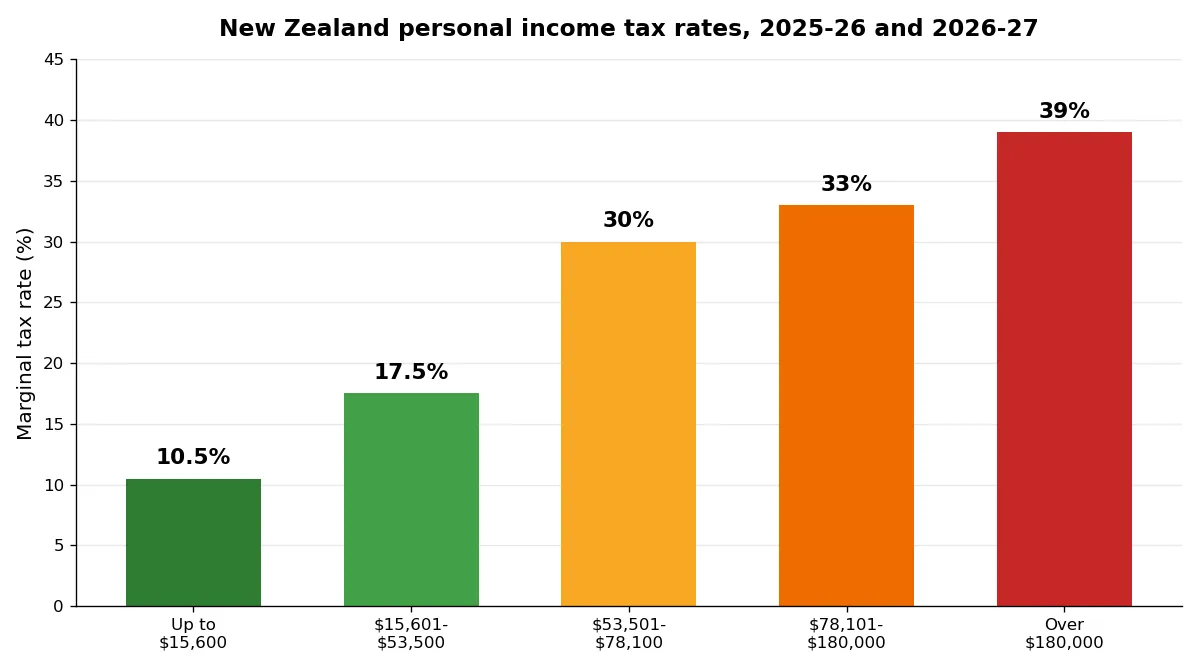
Because the rates are progressive, only the part of your income inside each band pays that band’s rate. A Bitcoin gain can push you into a higher band, so a large sale can cost more than the rate on your salary alone suggests.
Worked Example: A $30,000 Gain
Imagine you bought 1 Bitcoin for $60,000 and later sold it for $90,000. Your gain is $30,000, before fees.
If your marginal rate is 30%, the tax on that gain is $9,000. If your other income already puts you in the 33% band, the tax is $9,900.
The same gain costs a different amount depending on what else you earned that year.
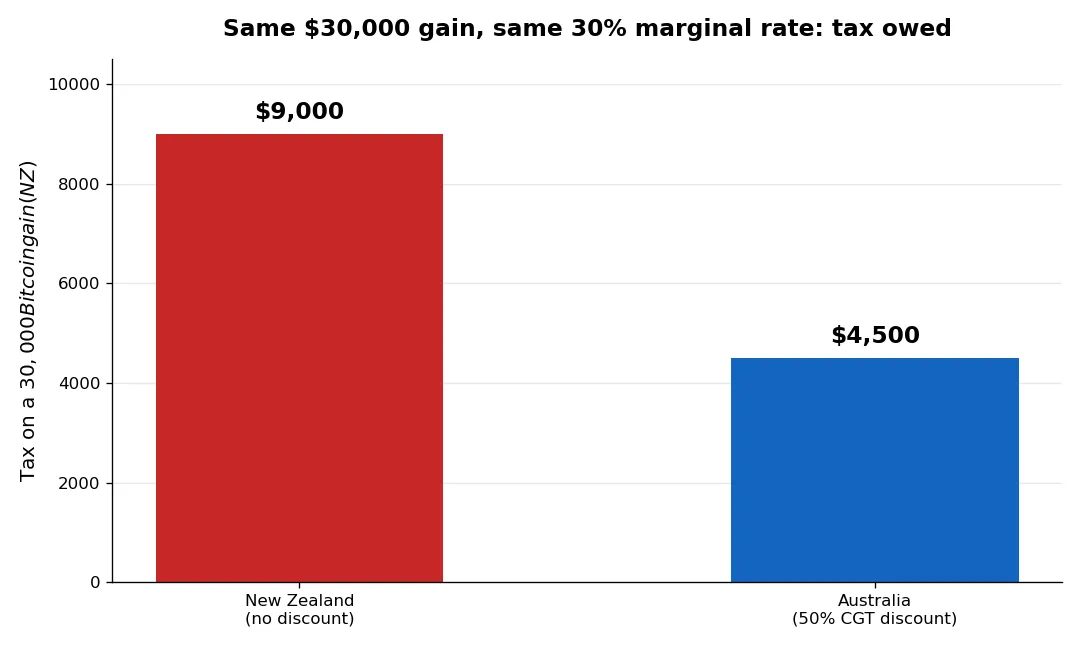
Now compare that with Australia. The same $30,000 gain, on Bitcoin held for more than 12 months, gets a 50% capital gains discount there.
Only $15,000 enters taxable income, so the tax at 30% is $4,500. New Zealand charges double in this example, because it has no discount and no capital gains regime to soften the result.
The chart below shows the gap.
Staking, Mining and Airdrops
Not all crypto income comes from selling. Rewards you receive are taxed too, and the timing is different.
Staking rewards, mining rewards and airdrops are taxable income when you receive them. You value them in New Zealand dollars on the day of receipt, and that value goes on your return for that year.
If you later sell those coins for more than their receipt value, the extra gain is taxed as well. That means one batch of coins can be taxed twice in effect: once as income on receipt, and again as a gain on disposal.
Keep the receipt value as your cost base so you do not pay tax on the same dollars twice. If you mine at scale, read our guide on how Bitcoin miners are taxed to see where hobby mining ends and business income begins.
Decentralised finance adds a grey area. Inland Revenue published an issues paper in January 2026 with its initial view that wrapping, bridging and lending crypto through DeFi apps create disposals.
That view is not final, so treat DeFi moves as taxable disposals unless the final guidance says otherwise.
How to Report Bitcoin Tax in New Zealand
Reporting follows the normal individual tax return process. There is no separate crypto form, and no special crypto rate to look up.
The tax year runs from 1 April to 31 March, not the calendar year. Your IR3 individual income tax return for the year is generally due by 7 July after the year ends, unless you have a tax agent and an extension of time.
Five Steps to File
Start early, because the numbers take longer to gather than the form takes to fill in. Follow these five steps in order.
- Gather your records. Download your full transaction history from every exchange and wallet you used, including swaps and transfers.
- Work out each disposal. For every sale, swap, spend or gift, record the New Zealand dollar value on the day, subtract your cost and fees, and note the gain or loss.
- Value your rewards. Convert staking, mining and airdrop income to New Zealand dollars at the spot rate on the day you received it.
- Add it to your IR3. Enter crypto income in the other income field of your IR3 return through myIR, with your gain, loss and reward figures behind it.
- File by 7 July. File on time or through your tax agent, and keep your working papers for seven years.
Good crypto tax software can do steps one to three for you, but you still need to check its output. The software only knows the data you feed it, and a missing wallet can mean a missing gain.
Records You Must Keep for Seven Years
Inland Revenue expects you to keep records for at least seven years. The list is specific, so treat it as a checklist rather than a vague suggestion.
For every transaction, keep the date, the type of transaction, the amount of crypto, its New Zealand dollar value on the day, the wallet addresses involved, and any fees you paid. Keep exchange statements, wallet exports, and bank records that show fiat moving in and out.
Keep a note of your intention when you bought, too. If you ever argue that a gain was not taxable, your records are your evidence.
Screenshots of exchange dashboards fade; CSV exports and a short written note do not. If you sold at a loss, the same records support your claim, and our guide to tax loss harvesting explains how to use losses properly before 31 March.
Common Mistakes That Cost New Zealand Bitcoin Holders
Most crypto tax bills in New Zealand come from honest mistakes, not deliberate evasion. The five below show up again and again.
The first is believing that no capital gains tax means no tax at all. It means the gain is taxed as income instead, which is often worse.
The second is forgetting that swaps count as sales. A year of active trading can create dozens of taxable events with no cash to pay the bill.
The third is ignoring staking and airdrop income. Rewards are income on receipt, even if you never sold them.
The fourth is poor records. Without a cost base, Inland Revenue may treat the full sale price as your gain.
The fifth is waiting for the CARF letter. Inland Revenue sent its first letters in April 2026 to people it already knew had traded.
If you get one, it is a chance to correct your position before further action, not a fine. Voluntary disclosure beats a reassessment, and the reassessment window is unlimited if you never disclosed the income at all.
Bitcoin Tax in New Zealand vs Australia: The Comparison Nobody Makes
New Zealand and Australia look similar from a distance. Both treat crypto as property, both tax disposals, and both now share data with tax authorities overseas.
The details diverge sharply.
Australia has a capital gains tax regime with a 50% discount for individuals who hold for more than 12 months. New Zealand has no capital gains tax and no discount, so the same gain is taxed in full as income.
Australia lets you carry capital losses forward against future capital gains only. New Zealand lets a realised loss reduce your total taxable income, which can mean a refund.
| Feature | New Zealand | Australia |
|---|---|---|
| Capital gains tax | None, gains taxed as income | Yes, with 50% discount after 12 months |
| Tax on a $30,000 gain at 30% | $9,000 | $4,500 |
| Cost methods | FIFO or weighted average | Specific identification, FIFO or weighted average |
| Losses | Reduce total taxable income | Offset capital gains only, carried forward |
| Automatic exchange reporting | CARF from 1 April 2026 | CARF from 1 January 2026 |
| Records to keep | 7 years | 5 years |
| Return due | 7 July (IR3) | 31 October (self-lodger) |
The comparison matters because many New Zealanders hold accounts on Australian exchanges, and some guides mix the two systems up. If a guide tells you to claim a 50% discount on your New Zealand return, it is wrong.
For the Australian side in full, see our guide to Bitcoin tax in Australia for beginners. For the European contrast, Bitcoin tax in Ireland shows a country that does have capital gains tax, at 31% since October 2026.
Frequently Asked Questions
Is Bitcoin taxed in New Zealand?
Yes. New Zealand has no capital gains tax, but Inland Revenue treats Bitcoin as property, and most disposal profits are taxed as ordinary income at your marginal rate of 10.5% to 39%.
Do I pay tax if I only hold Bitcoin and never sell?
No. Buying and holding Bitcoin is not a taxable event, and moving coins between your own wallets is not a disposal either.
Tax applies when you sell, swap, spend or gift the coins.
What is CARF and how does it affect me?
CARF is the OECD Crypto-Asset Reporting Framework. From 1 April 2026, New Zealand crypto providers collect your identity and transaction data and report it to Inland Revenue once a year, with the first report due by 30 June 2027.
It does not create a new tax, but it means Inland Revenue can see your exchange activity even if you do not declare it.
What tax rate applies to my Bitcoin gains?
Your gain is added to your other income and taxed at your marginal rate. The 2025-26 and 2026-27 bands are 10.5% up to $15,600, 17.5% to $53,500, 30% to $78,100, 33% to $180,000, and 39% above $180,000.
How do I report Bitcoin on my tax return?
Report crypto income on your IR3 individual income tax return through myIR, in the other income field, with your gain, loss and reward figures behind it. The tax year runs 1 April to 31 March, and the IR3 is generally due by 7 July.
Can I deduct Bitcoin losses?
Yes, if the loss is realised. Selling or swapping at a loss reduces your total taxable income for the year, which can lower your bill or produce a refund.
A paper loss from a price dip does not count until you actually dispose of the coins.