



The short answer
Bitcoin tax in Ireland explained in one line: most people pay Capital Gains Tax, or CGT, on the profit when they sell, swap, spend, or gift Bitcoin.
That rate changed in October 2026. Disposals on or after 7 October 2026 pay 31 percent.

Disposals before that date pay 33 percent.
- The short answer
- The big change: CGT falls from 33% to 31%
- Worked example: the same gain, two tax bills
- What counts as a disposal
- Selling Bitcoin for euro
- Swapping Bitcoin for another crypto
- Spending Bitcoin on goods or services
- Gifting Bitcoin
- The 1,270 euro annual exemption
- When and how to pay
- When your Bitcoin income is taxed at up to 52%
- DAC8: your exchange now reports to Revenue
- MiCA: only use authorised providers
- How Ireland compares with other countries
- Common mistakes Irish Bitcoin holders make
- Frequently asked questions
- What is the CGT rate on Bitcoin in Ireland in 2026?
- Does the 31% rate apply to gains I made before 7 October 2026?
- What is the annual CGT exemption in Ireland?
- When do I pay CGT on Bitcoin in Ireland?
- Is swapping Bitcoin for another crypto taxable in Ireland?
- Do Irish exchanges report my Bitcoin trades to Revenue?
- Sources
The first 1,270 euro of chargeable gains each year is tax free. You pay tax only on the gain above that amount.
Revenue treats Bitcoin as property, not as currency. That single fact decides almost everything else in this guide.
This guide walks through the new rate, the worked numbers, the payment deadlines, and the reporting rules that started in 2026. It ends with the mistakes that cost Irish holders the most money.
Key takeaways
- 31 percent CGT on Bitcoin disposals made on or after 7 October 2026. The old rate of 33 percent still applies to disposals made before that date.
- 1,270 euro annual exemption per person, per year. It cannot transfer to a spouse and cannot carry forward.
- Pay by 15 December for gains made between January and November. Pay by 31 January for gains made in December. File your return by 31 October of the following year.
- Swaps count as sales. Trading Bitcoin for another coin is a taxable disposal, even though no euro changes hands.
- Trading, mining, and staking income can face up to 52 percent in income tax, USC, and PRSI, not the CGT rate.
- DAC8 reporting started 1 January 2026. Your exchange sends its first report on your trades to Revenue by 31 May 2027.
- MiCA authorisation is now mandatory. Since 1 July 2026, every crypto service provider serving Irish customers needs authorisation.
The big change: CGT falls from 33% to 31%
Budget 2027 cut the standard CGT rate from 33 percent to 31 percent. The cut took effect through a financial resolution passed by the Dail on 6 October 2026.

That timing matters more than the size of the cut. The rate follows the date of your disposal, not the date you file your return.
Sell on 6 October 2026 and you pay 33 percent. Sell one day later and you pay 31 percent.
The same gain costs a different amount depending on which side of that line it falls.
Revenue already applies the new rate. Its CGT overview page now states that the current rate of CGT is 31 percent for most gains.
The Finance (No. 2) Bill 2026, published on 19 October 2026, carries the cut into permanent law. The bill had not yet been signed into law when checked in early November 2026, but the financial resolution already gives the 31 percent rate legal effect for disposals from 7 October.
| Disposal date | CGT rate | Legal basis |
|---|---|---|
| 6 December 2012 to 6 October 2026 | 33% | Standard rate before Budget 2027 |
| On or after 7 October 2026 | 31% | Budget 2027 financial resolution, 6 October 2026 |
That is bitcoin tax in Ireland explained in one sentence: the date you sell decides the rate you pay.
Two points keep readers out of trouble. First, the 31 percent rate is the standard rate, not a special crypto rate.
Crypto follows the same CGT rules as shares and property.
Second, the cut does not change the exemption or the deadlines. Those stayed exactly where they were.
Why the bill is not law yet, and why the rate still applies
Irish budgets work in two steps. The Dail passes a financial resolution on Budget night, and that resolution takes effect at once.
The Finance Bill follows weeks later and turns the resolution into permanent law.
The resolution of 6 October 2026 already covers the CGT cut. The Finance (No. 2) Bill 2026 now moves through the Oireachtas and may change in detail before it is signed.
For a Bitcoin holder, the practical point is simple. The 31 percent rate is real today.
You do not wait for the bill to finish its journey before you use it.
Worked example: the same gain, two tax bills
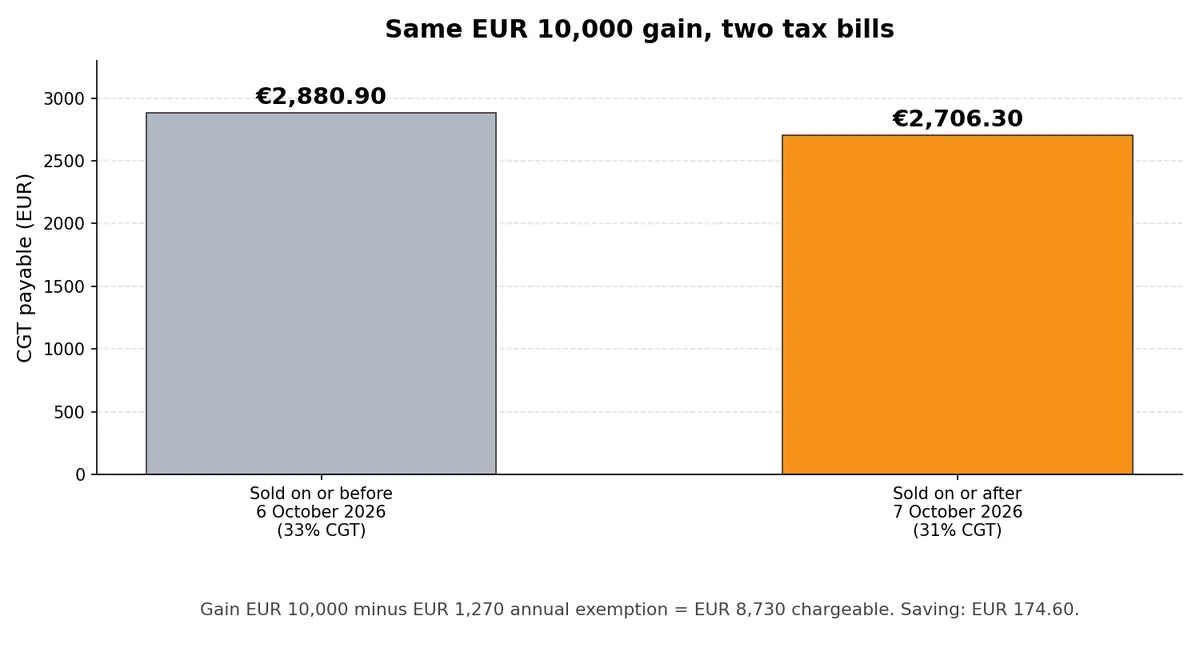
Examples make the rate cut concrete. Take one simple case and run it twice, once on each side of the 7 October line.
You bought 0.5 Bitcoin for 20,000 euro in January 2026. You sold it for 30,000 euro later in the year.
Your gain is 10,000 euro.
Subtract the 1,270 euro annual exemption first. Your chargeable gain is 8,730 euro.
The rate then applies to that figure, not to the full 10,000 euro.
| Step | Sold 6 October 2026 or earlier | Sold 7 October 2026 or later |
|---|---|---|
| Sale value | 30,000 euro | 30,000 euro |
| Cost of acquisition | 20,000 euro | 20,000 euro |
| Gain (sale minus cost) | 10,000 euro | 10,000 euro |
| Less annual exemption | 1,270 euro | 1,270 euro |
| Chargeable gain | 8,730 euro | 8,730 euro |
| CGT rate | 33% | 31% |
| Tax payable | 2,880.90 euro | 2,706.30 euro |
| Saving from the rate cut | – | 174.60 euro |
That is bitcoin tax in Ireland explained with real numbers, and the same maths works for any gain you plug in.
The saving looks small on a 10,000 euro gain. It grows fast on bigger gains.
A 100,000 euro gain saves about 1,746 euro at the new rate, after the exemption.
Timing a sale purely to save 2 percent is still a gamble. Bitcoin can move far more than 2 percent in a day.
The rate cut is a bonus for a sale you already planned, not a reason to rush one.
What the example leaves out
The example assumes one disposal in the year and no losses. Real tax years are messier.
Losses can offset gains in the same year. If you lost 2,000 euro on another coin, you subtract that loss from your gains before you apply the exemption.
Unused losses carry forward to future years. The exemption does not.
Use the 1,270 euro or lose it.
Costs of buying and selling, such as exchange fees, are deductible from the gain. Keep the fee receipts with your trade records.
Our guide on how to calculate Bitcoin capital gains tax walks through the same cost-basis method step by step.
What counts as a disposal
Revenue taxes the disposal, not the holding. You can hold Bitcoin for ten years and owe nothing.
Tax starts the day you dispose of it.
A disposal is wider than a sale. It covers every way Bitcoin leaves your hands for value.
Four cases cover almost every Irish holder.
Selling Bitcoin for euro
This is the obvious case. You sell Bitcoin on an exchange and receive euro.
The gain is the euro you received minus what you paid for the Bitcoin.
The disposal date is the date of the sale, not the date the money reaches your bank account. That date decides whether you pay 31 or 33 percent.
Swapping Bitcoin for another crypto
Swapping Bitcoin for Ethereum, or for a stablecoin, counts as a disposal of the Bitcoin. You owe CGT on the gain even though no euro changed hands.
This rule catches more people than any other. Many traders swap coins all year and only count their euro withdrawals.
Revenue counts every swap.
Value the swap in euro on the day it happened. That euro value becomes your sale price for the CGT calculation.
Spending Bitcoin on goods or services
Paying for something with Bitcoin is also a disposal. You sold the Bitcoin at its euro value on that day, even if the shop never touched euro.
Small everyday spends still count in theory. In practice, most people track the larger ones and keep a full exchange history for the rest.
Gifting Bitcoin
Gifting Bitcoin counts as a disposal too. You pay CGT on the gain as if you had sold the coins at their market value on the day of the gift.
The person who receives the gift may also face Capital Acquisitions Tax, depending on the relationship and the amount. Gifts between spouses are generally exempt from that second tax.
The 1,270 euro annual exemption
Every person gets 1,270 euro of chargeable gains tax free each year. It applies across all your gains, not per coin and not per sale.
Sell Bitcoin for a 1,000 euro gain and sell shares for a 500 euro gain in the same year. Your total is 1,500 euro.
You pay tax on 230 euro, which is the amount above the exemption.
Three limits matter. The exemption cannot transfer to your spouse.
You cannot carry an unused exemption into the next year. And you cannot use it against income, only against capital gains.
A married couple gets 2,540 euro between them, because each spouse holds a separate exemption. Plan disposals across both names where that fits your situation.
When and how to pay
Irish CGT has two payment dates inside the year. Miss them and interest starts to run.
Gains made between 1 January and 30 November are due by 15 December of the same year. Gains made in December are due by 31 January of the following year.
Our Bitcoin tax guide compares these deadlines with other countries. Ireland is unusual in demanding payment before the tax year even ends.
| When you made the gain | Pay CGT by | File your return by |
|---|---|---|
| 1 January to 30 November 2026 | 15 December 2026 | 31 October 2027 |
| 1 to 31 December 2026 | 31 January 2027 | 31 October 2027 |
You pay through Revenue Online Service, known as ROS, or through myAccount. The payment and the return are separate steps.
Paying on time does not file the return for you.
Keep every trade record for at least six years. Download your exchange history every quarter, because exchanges change, shut down, or lose old data.
Crypto tax software can pull that history together and work out your gains for you. It helps most when you trade across more than one exchange.
Which form do I file
Most PAYE workers file Form CG1 for capital gains. It is a paper form in most cases.
Self-assessed taxpayers report the same gains on Form 11 through ROS.
The deadline for both is 31 October of the year after the gain. For 2026 gains, that is 31 October 2027.
File even when your gains fall inside the exemption. Revenue expects a return when you made disposals, and a clean filing protects you if questions come later.
When your Bitcoin income is taxed at up to 52%
Not everything in crypto pays CGT. The 31 percent rate covers gains on disposals.
Income you earn in crypto follows the income tax rules instead.
The line depends on what you did. An investor who buys and sells occasionally pays CGT.
A person who trades full time, mines at scale, or earns staking rewards as a business may pay income tax.
Income tax in Ireland can reach 52 percent at the top. That figure combines the 40 percent higher income tax rate with USC of up to 8 percent and PRSI of 4 percent.
Revenue decides trading versus investing on the facts: how often you trade, how organised the activity is, and whether you depend on it for a living. There is no fixed number of trades that flips the switch.
| Income type | Tax at receipt | Tax on later sale |
|---|---|---|
| Investment gain on a sale | None | 31% CGT (after exemption) |
| Trading profit | Income tax up to 52% | Already taxed as income |
| Staking rewards | Income tax on euro value at receipt | 31% CGT on gain above that value |
| Mining rewards | Income tax on euro value at receipt | 31% CGT on gain above that value |
| Airdrops | Income tax on euro value at receipt | 31% CGT on gain above that value |
| Salary paid in Bitcoin | Income tax as salary | 31% CGT on gain above that value |
Staking and mining rewards get taxed twice in effect, but on different amounts. You pay income tax on the value when you receive the coins.
You pay CGT later only on the gain above that value.
Record the euro value and the date of every reward. Without that record, you cannot prove the cost basis when you sell.
Our guide on how Bitcoin miners are taxed explains where Revenue draws the line between a hobby miner and a mining business.
DAC8: your exchange now reports to Revenue
The biggest change for Irish holders in 2026 is not the rate cut. It is the reporting pipe behind it.
Under DAC8, the EU crypto reporting directive, reporting crypto providers started collecting user and transaction data on 1 January 2026. The first reports go to Revenue by 31 May 2027.
That means your exchange already holds the data Revenue will see. Your return should match it.
A mismatch is the fastest route to a Revenue query.
The rule covers exchanges, brokers, and similar platforms. It does not cover your own wallet.
Moving coins between wallets you own is not a disposal and is not reported as one, but keep the trail clear so a transfer is never mistaken for a sale.
The practical advice is boring and it works. Download your trade history every quarter.
Reconcile it against your bank statements. Fix errors before you file, not after Revenue writes to you.
Our Bitcoin tax loss harvesting guide shows how to use losses before 31 December to reduce the bill, while staying inside the rules.
MiCA: only use authorised providers
Since 1 July 2026, every crypto service provider serving EU customers needs authorisation under MiCA, the EU Markets in Crypto-Assets Regulation. The transitional periods that let older firms operate without a licence have all ended.
The Central Bank of Ireland is the competent authority for firms authorised in Ireland. A firm authorised in any EU state can serve Irish customers through passporting, so an Irish licence is not the only valid one.
Check any provider before you deposit money. Search the firm on the ESMA interim MiCA register and confirm Ireland is among the countries it serves.
Firms authorised in Ireland also appear on the Central Bank register.
Authorisation is not a safety guarantee. It does not cover you against price falls, and crypto has no deposit compensation scheme.
It does mean the firm meets capital, custody, and conduct rules, and that it reports under DAC8.
Our guides to how to buy Bitcoin in Ireland and the best crypto exchanges in Ireland list providers checked against the official registers.
How Ireland compares with other countries
Here is bitcoin tax in Ireland explained against the neighbours, so you can see where the 31 percent rate sits.
A rate means more in context. Ireland sits in the middle of the pack for crypto tax, cheaper than Japan and dearer than Germany for long term holders.
| Country | Tax on a typical investor gain | Annual exemption |
|---|---|---|
| Ireland | 31% CGT from 7 October 2026 | 1,270 euro |
| United Kingdom | 18% basic rate, 24% higher rate | 3,000 pounds |
| Germany | 0% after holding for 1 year, otherwise personal income tax rate | 1,000 euro |
| Japan | Up to 55% as miscellaneous income now, 20% flat from 2028 | None |
| Canada | 50% of the gain taxed at your marginal rate | None |
The details sit in our country guides: Bitcoin tax in the UK, crypto tax in Germany, Bitcoin tax in Japan, and Bitcoin tax in Canada.
Moving country does not erase Irish tax by itself. Tax residence, not citizenship, decides where you pay.
Get advice before you move coins or yourself across a border for tax reasons.
Common mistakes Irish Bitcoin holders make
The first mistake is using the wrong rate for the wrong date. A sale in September 2026 pays 33 percent.
A sale in October pays 31 percent. Check the disposal date on every trade, not the filing date.
The second mistake is forgetting swaps. Swapping Bitcoin for another coin is a disposal.
Traders who only report euro withdrawals understate their gains and invite a DAC8 mismatch.
The third mistake is wasting the exemption. The 1,270 euro exemption dies at year end.
If your gains sit just above it, a small planned disposal in December can use the rest.
The fourth mistake is paying late. CGT for January to November gains falls due on 15 December, before the year ends.
Interest runs from the day after the deadline.
The fifth mistake is ignoring staking and mining income. Rewards are income on receipt, not a free top-up to your holdings.
Report them at their euro value on the day you received them.
The sixth mistake is trusting the exchange to do the maths. Your platform reports the trades.
It does not work out your Irish CGT, your exemption, or your losses. That part is yours.
The seventh mistake is using an unauthorised provider. Since 1 July 2026, a platform without MiCA authorisation should not serve you at all.
Check the register before you deposit.
Frequently asked questions
These are the questions Irish Bitcoin holders ask most often, and they cover bitcoin tax in Ireland explained from every angle a reader needs.
What is the CGT rate on Bitcoin in Ireland in 2026?
It depends on the date you sold. Disposals on or before 6 October 2026 pay 33 percent.
Disposals on or after 7 October 2026 pay 31 percent. The 1,270 euro annual exemption applies first, so you only pay tax on the gain above that amount.
Does the 31% rate apply to gains I made before 7 October 2026?
No. The rate follows the disposal date, not the date you file.
A sale in March 2026 still pays 33 percent, even if you file your return in 2027.
What is the annual CGT exemption in Ireland?
Every person gets 1,270 euro of chargeable gains tax free each year. You cannot carry an unused exemption to the next year, and you cannot transfer it to your spouse.
When do I pay CGT on Bitcoin in Ireland?
Pay by 15 December of the same year for gains made between January and November. Pay by 31 January of the next year for gains made in December.
File your return, Form 11 or Form CG1, by 31 October of the following year.
Is swapping Bitcoin for another crypto taxable in Ireland?
Yes. Swapping Bitcoin for another coin counts as a disposal of the Bitcoin.
You owe CGT on the gain, even though no euro changed hands.
Do Irish exchanges report my Bitcoin trades to Revenue?
Yes, from 2026. Under DAC8, reporting crypto providers collect your transaction data from 1 January 2026 and send the first report to Revenue by 31 May 2027.
Assume Revenue already has the data when you file.
Sources
- Revenue, Capital Gains Tax on the disposal of an asset (revenue.ie)
- Department of Finance, Department of Finance publishes Finance (No.2) Bill 2026 (gov.ie)
- Central Bank of Ireland, Markets in Crypto Assets Regulation (MiCAR) (centralbank.ie)
Disclaimer: This article explains Irish crypto tax rules for general information only. It is not tax advice.
Tax law changes often and individual situations vary, so consult a qualified tax adviser before filing.