



Polygon price prediction 2026-2030 starts with a coin that used to matter a lot more than it does today. POL trades near $0.09 on November 11, 2026, and it has lost about half its value in the last year while the network underneath it quietly got faster, cheaper, and more useful.
Our short answer is this. Our base case puts POL near $0.25 by 2030, with a bull case near $0.60 and a bear case near $0.07.

Nobody knows the real outcome. Published forecasts for 2030 run from about $0.035 to about $0.72, a gap of roughly twenty times, and that spread tells you more about this coin than any single number does.
- Key Takeaways
- POL Price Today: Where It Stands on November 11, 2026
- What Is Polygon (POL), in Plain English
- POL Price History: The Last 12 Months
- The Fresh Story: A Hard Fork to Recover 70.49 Million POL
- Polygon Price Prediction 2026: The Rest of the Year
- Polygon Price Prediction 2027: The AggLayer Test Year
- Polygon Price Prediction 2028-2029: Payments or Fade
- Polygon Price Prediction 2030: What $1 Would Actually Take
- Our Polygon Price Prediction Table 2026-2030
- What Analysts Say: Eight Forecasts Side by Side
- What Could Push POL Higher
- What Could Hold POL Back
- Polygon vs Ethereum and Arbitrum: The Scaling Race
- Is POL a Good Investment?
- Common Mistakes When Predicting POL
- Frequently Asked Questions
- What is the Polygon price prediction for 2026?
- What is the Polygon price prediction for 2030?
- Can POL reach $1?
- Why is POL so far below its all-time high?
- What is the Polygon hard fork proposal about?
- Is POL a good investment in 2026?
- Conclusion: A Cheap Coin With a Real Job to Do
POL trades near $0.088 on November 11, 2026, based on live price pages that put it between about $0.088 and about $0.089 during the morning. Its market value sits near $940 million, with about 10.65 billion coins in circulation, and it ranks near 73 among all cryptocurrencies.
That puts Polygon about 93 percent below its March 2024 peak near $1.29, and it is down about 16 percent in the last 30 days alone. The network just got a major speed upgrade and a controversial hard fork proposal in the same month, but the price has not cared yet, and that gap is what this article is really about.
Key Takeaways
- POL trades near $0.088 on November 11, 2026, with a market value near $940 million, rank 73, and about 10.65 billion coins in circulation.
- POL is down about 6 percent in the last 5 sessions and about 16 percent in the last 30 days, and it sits about 93 percent below its March 2024 peak of $1.29.
- The MATIC to POL migration is 99 percent complete, and the network now targets up to 5,000 payments per second with 1.5 second block times.
- A Polygon Improvement Proposal from November 4, 2026 would use a one-off hard fork to return 70.49 million frozen POL to Binance and Polymarket.
- Our base case puts POL near $0.25 by 2030, with a bull case near $0.60 and a bear case near $0.07.
- A $1 POL in 2030 would need a market value near $11.5 billion, about 12 times what the coin is worth today.
POL Price Today: Where It Stands on November 11, 2026
POL opened the day near $0.088 and traded in a tight range between about $0.085 and about $0.090. The previous close sat near $0.088, so the coin is barely moving while the rest of the market watches Bitcoin.
The short-term trend is weak. POL closed at $0.087 on November 10, at $0.089 on November 9, and at $0.087 on November 8, which means it has spent the last three days pinned under $0.09.

The longer trend is worse. POL is down about 49 percent over the last year and about 18 percent since the start of 2026, according to Finnhub market data.
The coin set its 2026 low near $0.069 in late June, touched an all-time low near $0.07 on July 1, and has not held above $0.10 for more than a few days at a time since.
Trading volume tells the same quiet story. Roughly $47 million of POL changed hands in the last 24 hours, which is small for a coin that once traded billions a day.
Low volume cuts both ways, since a little buying can move the price fast, but it also shows how few traders care about POL right now.
The on-chain picture looks stronger than the price. Polygon holds about $622 million in DeFi value locked and about $2.86 billion in stablecoins, according to DefiLlama data from November 11, 2026.
Polymarket alone accounts for about $317 million of that locked value, which makes the prediction market the biggest app on the chain by a wide margin.
What Is Polygon (POL), in Plain English
Polygon is a network that makes Ethereum faster and cheaper to use. It runs its own chain next to Ethereum, processes transactions there for a fraction of a cent, and settles the results back to Ethereum for security.
POL is the token that pays for gas on that chain, secures it through staking, and now coordinates a whole family of connected chains. If you use an app on Polygon, you pay fees in POL, and validators stake POL to keep the network honest.
The token used to be called MATIC. Polygon replaced it with POL on September 4, 2024, at a one-to-one ratio, and the swap is now about 99 percent complete.
The name change was not cosmetic, since POL can be staked across many Polygon chains at once while MATIC only worked on one.
The MATIC to POL migration
The migration started in September 2024, when POL became the native gas and staking token of Polygon PoS. Holders swapped MATIC for POL at a one-to-one ratio, and the big exchanges handled the swap automatically for their customers.
By September 2025, Polygon and the major exchanges reported that about 99 percent of MATIC had been swapped. Anyone still holding MATIC in a self-custody wallet can still migrate through the official Polygon portal, but most tools have already dropped MATIC support.
The supply side changed with the token. POL started with 10 billion tokens, matching the old MATIC supply, and now adds about 2 percent per year in new issuance to pay validators and fund the ecosystem.
That steady dilution is one of the headwinds any price forecast has to account for.
What AggLayer does
AggLayer is Polygon’s bet that the future of crypto is many chains, not one. It is a settlement layer that lets independent chains share liquidity and move assets between each other without the clumsy bridges that hackers love to attack.
The current version, AggLayer v0.3, arrived in June 2025 and supports both Ethereum-style chains and chains built on other technology. Connected chains include X Layer from OKX and Polygon PoS itself, with more CDK-based chains joining over time.
POL sits at the center of this plan as the coordination token. Validators can stake POL once and help secure several connected chains, which is the “hyperproductive” idea Polygon talks about.
The promise is real, but the payoff depends on chains actually connecting and users actually moving money through them.
The 2026 pivot to payments
Polygon Labs spent 2026 refocusing the whole project on two jobs: stablecoin payments and tokenized real-world assets. The old zkEVM chain was shut down, with its sequencer stopping block production on July 3, 2026, so the team could put its energy into Polygon PoS and AggLayer.
The network got faster to match the payments pitch. A capacity upgrade in June 2026 lifted the gas limit to 160 million and cut block times to about 1.5 seconds, which Polygon tested at up to 5,000 simple payments per second.
That is the kind of speed a payments network needs, and it is a genuine technical achievement.
The team also built an Open Money Stack for institutions and fintechs, and completed a SOC 2 Type I examination of its API and dashboard in September 2026. These are the boring credentials that banks and payment companies ask for before they touch a chain, and Polygon now has them.
POL Price History: The Last 12 Months
The last year of POL reads like a slow leak with two brief rallies. The coin started near $0.19 in late October 2025, fell to about $0.10 by the end of that year, and has spent most of 2026 bouncing between $0.07 and $0.13.
January 2026 gave holders a false dawn. POL peaked near $0.18 early in the month, then slid for five straight months until it bottomed near $0.069 at the end of June.
That June low sits just above the all-time low of $0.07 set on July 1, 2026.
September brought the best month of the year, with POL closing the month near $0.114 after touching higher levels mid-month. October gave it all back, closing near $0.092, and November has so far kept the coin pinned under $0.09.
The chart below shows the full year of daily closes, from about $0.19 down to about $0.09. The shape matters more than any single day, because it shows a coin that rallies get sold into, over and over again.
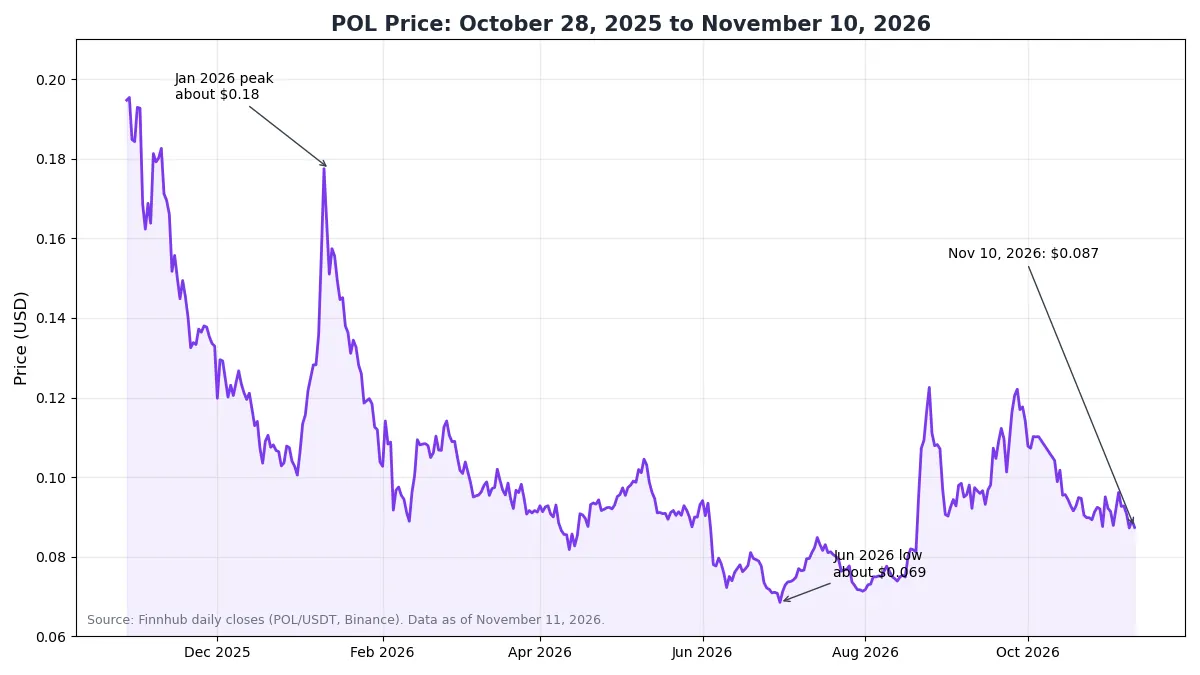
POL daily closing prices from October 28, 2025 to November 10, 2026. Source: Finnhub daily closes (POL/USDT, Binance).
The Fresh Story: A Hard Fork to Recover 70.49 Million POL
The biggest Polygon story of November has nothing to do with price charts. On November 4, 2026, a member of Polygon Labs posted a Polygon Improvement Proposal that asks the network to do something blockchains almost never do: rewrite balances to return stolen funds.
The proposal covers 70.49 million POL sitting in five attacker-controlled addresses after separate security incidents at Polymarket and Binance on October 29 and 30, 2026. About 46.63 million POL sits in one address tied to the Binance incident, and about 23.86 million POL sits in four addresses tied to the Polymarket incident.
The funds cannot move today. Polygon block producers added the five addresses to a blocklist on October 30, at Binance’s request, so the tokens are frozen in place.
But a blocklist only stops movement, and the proposal argues that leaving $6.5 million of POL locked forever is not a stable end state either.
The fix would be a one-off hard fork. At a fixed activation block, the network would set the five attacker balances to zero and credit the same amounts to recovery wallets controlled by Polymarket and Binance.
The change would not mint new tokens and would not change total supply, so it is a transfer, not an inflation event.
The proposal went to the Polygon Protocol Governance Call on November 5, 2026, and has since moved into internal planning, according to coverage of the governance process. It still needs formal governance approval and a rehearsal on the Amoy testnet before any mainnet activation, and the timeline is about two weeks after approval.
What does it mean for the price? Almost nothing directly, since 70.49 million POL is less than 1 percent of the circulating supply.
The real signal is about governance, because a chain willing to rewrite balances for victims is a chain that can also be pressured to do it again. Traders who value immutability will watch this vote closely, and our Polymarket and Chainlink partnership coverage shows how deeply Polymarket is now tied to Polygon’s future.
Polygon Price Prediction 2026: The Rest of the Year
There are only seven weeks left in 2026, so this is a short forecast. Our base case puts POL between $0.09 and $0.12 by the end of the year, with $0.07 as the bear case and $0.15 as the bull case.
The published forecasts mostly agree with that range. Coinbird’s AI model averages $0.1225 for the rest of 2026, PrimeXBT averages about $0.082, and CoinStats averages $0.095.
Only VentureBurn sits higher, at $0.1392, while DappRadar sits lower, at $0.0736.
Two things could move POL before New Year. A decision on the hard fork proposal would settle the governance question either way, and any broad crypto rally into year-end would lift POL with it.
Neither is something to count on, since POL has underperformed the wider market all year.
The level to watch is $0.10. POL has failed to hold above it for months, and a clean break with real volume would be the first sign that sellers are tired.
Until then, the base case is more sideways drift than a breakout.
Polygon Price Prediction 2027: The AggLayer Test Year
Our base case puts POL near $0.13 by the end of 2027, with a bear case near $0.06 and a bull case near $0.22. That range is wide because 2027 is the year the AggLayer story has to prove itself or fade.
The published forecasts split the same way. Coinbird averages $0.1496 for 2027, PrimeXBT averages about $0.118, and CoinStats averages $0.13.
DappRadar is the outlier on the low side at $0.0677, and VentureBurn is the outlier in the other direction only in the first quarter before falling to $0.0861 by year end.
Three catalysts matter most in 2027. First, more chains need to connect to AggLayer and actually route volume through it, since a settlement layer with no traffic is just a whitepaper.
Second, the payments push needs real merchant and fintech volume, not just partnerships and press releases. Third, the fee burn needs to grow enough to offset the 2 percent annual emission, or the supply keeps rising while demand stays flat.
The bear case is simple and plausible. If AggLayer adoption stalls and the payments pivot produces headlines but no volume, POL drifts back toward its 2026 lows near $0.07.
The bull case needs a broad altcoin recovery plus real AggLayer usage, and both together could carry POL toward $0.22.
Polygon Price Prediction 2028-2029: Payments or Fade
Our base case puts POL near $0.18 by the end of 2028 and near $0.21 by the end of 2029. The bear case holds near $0.07 in both years, while the bull case reaches $0.30 in 2028 and $0.40 in 2029.
These years are where the payments bet pays off or it does not. If stablecoin payments on Polygon grow the way the team expects, the network earns real fees, the burn eats into the 2 percent emission, and POL starts to look like a token with demand tied to usage.
If that growth never arrives, POL stays a cheap coin with a good story and no buyers.
Competition is the other force that decides these years. Ethereum’s own scaling roadmap keeps improving, and rival Layer 2 networks are fighting for the same developers and the same users.
Polygon’s edge is its payments focus and its head start in real-world assets, but an edge only counts if it turns into volume.
One more factor deserves attention. By 2028 and 2029, the MATIC migration will be a distant memory, and the market will judge POL purely on what the network does.
That is healthy in the long run, but it removes the last excuse for weak performance.
Polygon Price Prediction 2030: What $1 Would Actually Take
Our base case puts POL near $0.25 by the end of 2030, with a bear case near $0.07 and a bull case near $0.60. That base case implies a market value near $2.9 billion, about three times what POL is worth today.
The published forecasts for 2030 disagree wildly, and the chart below shows the gap. Changelly and CoinCodex sit near $0.035, DappRadar sits near $0.076, and Cryptopolitan and Benzinga sit near $0.64 and $0.72.
The middle of the pack, PrimeXBT at $0.211, Coinbird at $0.2725, and CoinStats at $0.30, is where our base case lives.
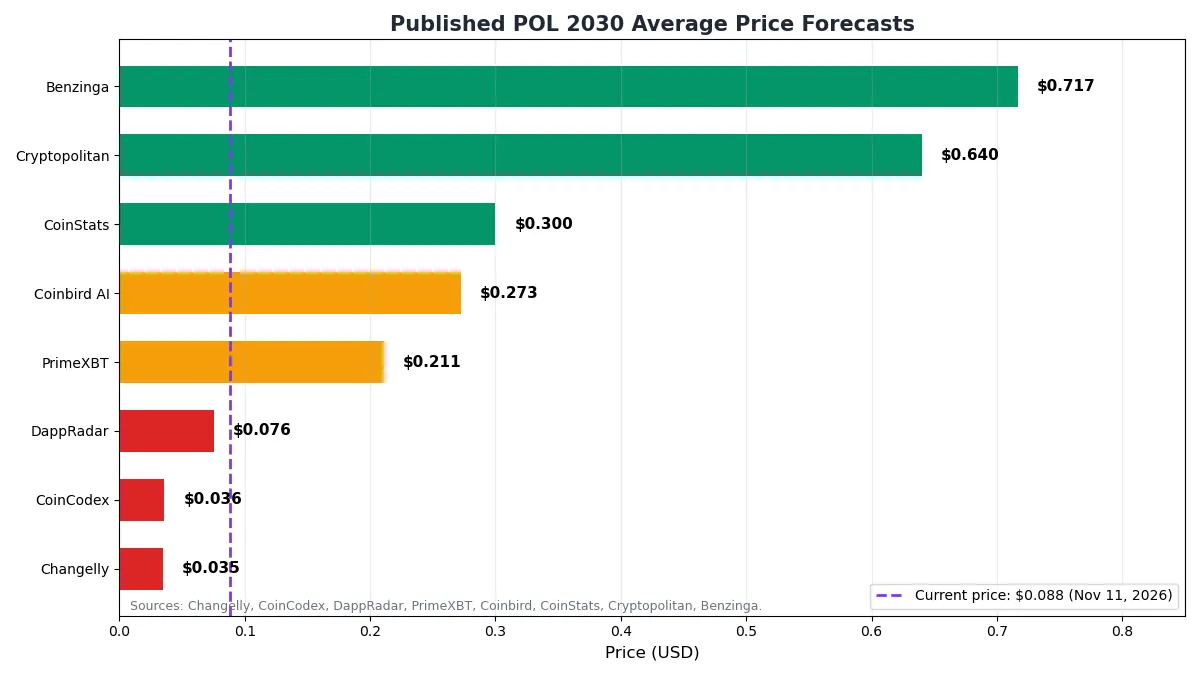
Published POL 2030 average price forecasts, from about $0.035 to about $0.72. The dashed line marks the current price near $0.088.
The market cap test
Price targets mean little without market value, so we translated every published 2030 average into the market cap it would need. We used about 11.5 billion POL in circulation by 2030, which follows from today’s 10.65 billion plus the 2 percent annual emission.
| 2030 target | Source | Implied market value |
|---|---|---|
| $0.035 | Changelly | About $0.40 billion |
| $0.036 | CoinCodex | About $0.41 billion |
| $0.0756 | DappRadar | About $0.87 billion |
| $0.211 | PrimeXBT | About $2.43 billion |
| $0.2725 | Coinbird AI | About $3.13 billion |
| $0.30 | CoinStats | About $3.45 billion |
| $0.64 | Cryptopolitan | About $7.36 billion |
| $0.717 | Benzinga | About $8.25 billion |
| $1.00 | Round number | About $11.5 billion |
This table is the honest way to read a price prediction. A $1 POL in 2030 would need a market value near $11.5 billion, about 12 times today’s $940 million, which would put Polygon alongside the biggest Layer 2 and payments tokens in crypto.
Our $0.25 base case needs about $2.9 billion, which is a big climb but a believable one.
The bearish forecasts are also worth reading carefully. DappRadar’s $0.0756 implies a market value near $0.87 billion, barely above today’s level, which means four years of sideways drift.
Changelly and CoinCodex imply a market value under $0.5 billion, which means the market gives up on POL almost entirely.
Our Polygon Price Prediction Table 2026-2030
Here is our full scenario table in one place. The base case is our central view, not a promise, and the bear and bull cases show how wide the range of honest outcomes really is.
| Year | Bear case | Base case | Bull case | What decides it |
|---|---|---|---|---|
| 2026 | $0.07 | $0.09 to $0.12 | $0.15 | Year-end market mood and the hard fork vote |
| 2027 | $0.06 | $0.13 | $0.22 | AggLayer adoption and real payments volume |
| 2028 | $0.07 | $0.18 | $0.30 | Stablecoin payments growth and fee burns |
| 2029 | $0.07 | $0.21 | $0.40 | Whether Polygon holds its edge over rival Layer 2s |
| 2030 | $0.07 | $0.25 | $0.60 | Full payments and AggLayer thesis playing out |
Notice how the bear case barely moves across five years. That is deliberate, because a coin that spends a year near its all-time low has already shown what failure looks like.
The bull case needs almost everything to go right, including a strong altcoin market, real AggLayer usage, and growing payments volume.
What Analysts Say: Eight Forecasts Side by Side
No single forecast deserves your trust, but eight of them together show where the consensus sits and where it splits. The table below lines up the published numbers we verified for this article.
| Source | 2026 | 2027 | 2030 |
|---|---|---|---|
| Coinbird AI model (Nov 3, 2026) | $0.1225 avg | $0.1496 avg | $0.2725 avg |
| PrimeXBT (Nov 11, 2026) | $0.082 avg | $0.118 avg | $0.211 avg |
| CoinStats (Oct 19, 2026) | $0.095 avg | $0.13 avg | $0.30 avg |
| VentureBurn (Dec 2025) | $0.1392 | $0.0861 | $0.1988 |
| DappRadar (Jul 23, 2026) | $0.0736 | $0.0677 | $0.0756 |
| Changelly (algorithmic) | About $0.15 avg | Not published | About $0.035 avg |
| CoinCodex (algorithmic) | Not published | Not published | About $0.036 avg |
| Cryptopolitan (editorial model) | Not published | Not published | About $0.64 avg |
The pattern is easy to see. The newer forecasts from November 2026 cluster between $0.21 and $0.30 for 2030, while the algorithmic models that extrapolate past price action sit far lower.
Benzinga’s aggregate of analyst views sits higher still, near $0.717 for 2030, which shows how much the answer depends on method.
Past forecasts are a warning about all of these numbers. Older projections once called for POL to reach several dollars by 2025, and the actual 2025 price never got close.
Treat every figure in this article as a scenario, not a promise, and revisit it as the network data changes.
What Could Push POL Higher
The strongest catalyst is real usage of AggLayer. If more chains connect and route serious volume through it, POL becomes the token that coordinates a growing multi-chain economy instead of a single chain.
That is the whole thesis, and it either happens in the next two years or it does not.
Payments growth is the second catalyst. Polygon now holds about $2.86 billion in stablecoins, and the Open Money Stack gives fintechs a ready-made way to move that money.
If merchants and payment apps start settling on Polygon in volume, fees rise, burns grow, and the 2 percent emission stops mattering.
Polymarket is the third catalyst, and it is already working. The prediction market holds about $317 million in value on Polygon, roughly half of the chain’s total DeFi value, and it keeps growing.
Every Polymarket trade touches Polygon, which gives the chain a flagship app that most Layer 2s would envy.
The fourth catalyst is the simplest one: a broad crypto recovery. POL fell harder than the market in 2026, so it has more room to bounce if Bitcoin leads a fresh rally.
A rising tide lifts the cheapest boats fastest, and POL is one of the cheapest large-cap coins left.
What Could Hold POL Back
Emission is the quietest risk and the most certain one. POL adds about 2 percent to its supply every year, which means the price has to rise 2 percent a year just to hold its market value flat.
Burns from fees are supposed to offset this, but the burn has not yet grown big enough to do the job.
Competition is the loudest risk. Ethereum keeps improving its own scaling, and rival Layer 2 networks are fighting for the same developers, the same stablecoin volume, and the same users.
Polygon’s payments focus is a real edge, but it is not a moat, and a rival can copy it.
Governance is the newest risk. The hard fork proposal to recover 70.49 million POL asks the network to rewrite balances, and whatever the vote decides, the debate itself puts a spotlight on how centralized that decision is.
Some holders will like the rescue, and others will see it as proof that Polygon is not as neutral as a blockchain should be.
History is the final risk. POL has spent a year making lower highs and lower lows, and every rally has been sold.
Trends like that can reverse, but they usually need a real catalyst, not just hope, and the market has stopped giving POL the benefit of the doubt.
Polygon vs Ethereum and Arbitrum: The Scaling Race
Polygon does not compete in a vacuum, so it helps to see how it stacks up against the rest of the scaling race. Ethereum is the base layer everything settles on, and our Ethereum price predictions show a coin with a much larger market and a much slower decline this year.
Arbitrum is the closest rival, and it fights Polygon for the same developers and the same DeFi users. Both chains are fast and cheap, so the contest comes down to apps and liquidity, not technology.
Polygon’s answer is Polymarket and payments, while Arbitrum’s answer is DeFi depth and gaming.
Other prediction coins in this series show how different the outcomes can be. Our Uniswap price prediction covers a token with a working product and real fees, our Render price prediction covers an AI infrastructure coin that rode a hot narrative, and our Sui price prediction covers a newer Layer 1 that grew faster than Polygon this year. For a fast proof-of-work contrast, see our best blockchain projects guide lists the networks actually winning users in 2026, and Polygon makes the list on payments and real-world assets, not on hype.
That is a solid place to be, but it is not a guarantee of price growth.
Is POL a Good Investment?
POL is cheap by every measure, and cheap can mean opportunity or it can mean a trap. The coin trades at about $0.09, roughly 93 percent below its peak, with a working network, real stablecoin volume, and a flagship app in Polymarket.
That combination is rare at this price.
But cheap alone is not a reason to buy. POL has been cheap for a year and kept getting cheaper, because the market doubts whether AggLayer and payments will ever turn into token demand.
A good investment needs a catalyst, and POL’s catalysts are all in the future tense.
The honest answer is that POL suits patient buyers who believe in the payments and AggLayer thesis and can wait two to four years for it to play out. It does not suit anyone looking for a quick gain, because the chart shows what happens to quick buyers in this coin.
Do your own research, size any position for a total loss, and never invest money you need soon.
Common Mistakes When Predicting POL
The first mistake is confusing the old MATIC price with the POL price. MATIC peaked near $2.92 in December 2021, while POL as a token peaked near $1.29 in March 2024, and mixing the two up makes every target look wrong.
Always check which token a forecast is talking about.
The second mistake is reading a price target without checking the market cap behind it. A $1 POL sounds modest until you learn it needs an $11.5 billion market value, about 12 times today’s level.
Always translate targets into market value before you believe them.
The third mistake is trusting a single forecast. The published 2030 numbers in this article range from $0.035 to $0.72, and both ends come from real models with real methods.
If you only read one source, you will feel certain about a number that the next source contradicts.
The fourth mistake is ignoring the 2 percent emission. POL adds supply every year, so the price must climb just to stand still in market value terms.
Any forecast that never mentions supply is incomplete.
The fifth mistake is treating the hard fork proposal as a price event. It moves 70.49 million POL, which is less than 1 percent of supply, so its real effect is on governance trust, not on price.
Watch the vote for what it says about the network, not for a pump.
Frequently Asked Questions
These are the questions readers ask most about Polygon and its price, answered from the research in this article.
What is the Polygon price prediction for 2026?
Our base case puts POL between $0.09 and $0.12 by the end of 2026, with a bear case near $0.07 and a bull case near $0.15. Published forecasts mostly agree, with Coinbird averaging $0.1225, PrimeXBT averaging about $0.082, and CoinStats averaging $0.095.
What is the Polygon price prediction for 2030?
Our base case puts POL near $0.25 by the end of 2030, with a bear case near $0.07 and a bull case near $0.60. Published 2030 averages range from about $0.035 at Changelly and CoinCodex to about $0.72 at Benzinga, with PrimeXBT at $0.211, Coinbird at $0.2725, and CoinStats at $0.30 in the middle.
Can POL reach $1?
POL can reach $1, but it would need a market value near $11.5 billion at the projected 2030 supply of about 11.5 billion tokens, which is about 12 times today’s market value near $940 million. No published forecast we verified calls for $1 by 2030, and the highest credible average we found is about $0.72 from Benzinga’s analyst aggregate.
Why is POL so far below its all-time high?
POL trades about 93 percent below its March 2024 peak near $1.29 because the market has spent two years doubting the token’s demand story. The MATIC to POL migration changed the token’s job without changing its demand, the 2 percent annual emission keeps adding supply, and rival Layer 2 networks have taken mindshare while Polygon rebuilt around payments and AggLayer.
What is the Polygon hard fork proposal about?
A Polygon Improvement Proposal posted on November 4, 2026 asks for a one-off hard fork to return 70.49 million frozen POL to Binance and Polymarket after security incidents on October 29 and 30, 2026. The fork would zero five attacker-controlled addresses and credit the same amounts to verified recovery wallets without minting new tokens, but it still needs formal governance approval and a rehearsal on the Amoy testnet.
Is POL a good investment in 2026?
POL suits patient buyers who believe in the payments and AggLayer thesis and can wait two to four years, but it does not suit anyone looking for a quick gain. The coin is cheap and the network is genuinely useful, yet the price has fallen all year and the catalysts are all in the future, so this article is not financial advice and you should do your own research before buying.
Conclusion: A Cheap Coin With a Real Job to Do
Polygon is a strange coin to write about in November 2026. The network has never been faster, the payments strategy has never been clearer, and Polymarket has never been bigger, yet the token trades near its all-time low and barely anyone is watching.
That gap is either the opportunity of the cycle or a warning that the market has moved on. Our base case of $0.25 by 2030 bets on the first answer, but it is a modest bet, and the bear case of $0.07 is just as easy to imagine.
The next two years will settle the question, because AggLayer either finds real users or it does not.
If you hold POL, watch the right numbers: AggLayer chains and volume, stablecoin growth, fee burns against the 2 percent emission, and the hard fork vote. Price follows usage in the end, and usage is the one thing this article cannot predict for you.
This article is for education only and is not financial advice. Crypto prices are volatile, predictions are scenarios rather than promises, and you should do your own research or speak to a licensed adviser before making any investment decision.