



Bitcoin miners pay tax twice on the same coins. The IRS taxes the coins as ordinary income the day they arrive, then taxes the profit again as a capital gain when the miner sells them.
The bill changes a lot with one choice. A miner who runs the rigs as a business can deduct electricity, hardware, and hosting, but also pays self-employment tax.

A hobby miner deducts nothing and skips that extra tax. This guide walks through both paths with real 2026 numbers, so you can see which one fits your setup.
- The Short Answer: Mined Bitcoin Is Taxed Twice
- Tax Event 1: Ordinary Income the Day You Receive Coins
- Tax Event 2: Capital Gains When You Sell
- Hobby vs Business: The Choice That Changes Your Tax Bill
- The Worked Example: One Miner, Two Tax Bills
- What Business Miners Can Deduct
- Self-Employment Tax: The 15.3% Surprise
- Form 1099-DA and Your Mining Income
- Record-Keeping: The Habit That Saves You
- Common Mistakes Bitcoin Miners Make
- Frequently Asked Questions
- Do I pay tax on Bitcoin I mine but never sell?
- Is Bitcoin mining a hobby or a business?
- Can I deduct electricity costs for mining?
- What tax form do I use for mining income?
- Does Form 1099-DA report my mining income?
- How much is the self-employment tax for miners in 2026?
- Sources
If you are new to crypto tax, start with our full Bitcoin tax guide. It covers the basics for buyers and sellers, while this article focuses on miners.
Key Takeaways
- Mined Bitcoin is ordinary income at its fair market value on the day you receive it (IRS Notice 2014-21).
- Selling mined coins later triggers a second tax: capital gains on the price rise since receipt.
- Hobby miners report on Schedule 1 and deduct nothing. Business miners report on Schedule C, deduct costs, and pay 15.3% self-employment tax.
- Form 1099-DA does not report mining income. It only reports sales made through a broker.
- In our worked example, the business route saved $2,343 on the same $37,500 of mining income.
The Short Answer: Mined Bitcoin Is Taxed Twice
The IRS treats Bitcoin as property, not money. That single rule drives everything that follows.
When your pool pays you, or your solo rig finds a block, the dollar value of those coins on that day counts as ordinary income. You owe income tax on it even if you never sell a single satoshi.
Later, when you sell, swap, or spend the coins, you pay tax a second time. This time it is capital gains tax on the difference between the sale price and the value you already reported as income.

That second tax only hits the gain. If Bitcoin falls after you mine it, you can record a capital loss instead.
The first tax never goes away, though. You owe it the moment the coins land in your wallet.
Tax Event 1: Ordinary Income the Day You Receive Coins
IRS Notice 2014-21 answers this directly. Its question 8 asks whether a miner realizes gross income on receipt, and the answer is yes.
The fair market value of the coins on the date of receipt goes into your gross income. The notice has stood since 2014, and the IRS has never softened it.
How the IRS Values Your Mining Rewards
Fair market value means the dollar price of Bitcoin on the day you get the coins. Most miners use the closing price on a major exchange, applied the same way every time.
Consistency matters more than the exact exchange you pick. The IRS accepts a reasonable method, applied consistently, so pick one source and stick with it all year.
Pool Payouts Count Too
Most home miners never find a block alone. They join a pool and receive small payouts as the pool earns rewards.
If you are still fuzzy on the process itself, here is how Bitcoin mining works.
Each payout is income on the day it hits your account, at that day’s price. The pool does not shield you from tax, and waiting to withdraw the coins does not delay the tax bill.
Solo miners face the same rule on a bigger scale. A full block reward, currently 3.125 BTC, counts as income at its value on the day the block is mined.
Cloud mining adds a wrinkle. If a service mines on your behalf and credits your account, the credited coins are still your income at receipt.
Read the service’s terms, because some report payouts on Form 1099-MISC.
Tax Event 2: Capital Gains When You Sell
The coins you mined now have a cost basis. That basis equals the fair market value you already reported as income.
Say you mined 0.5 BTC during 2026 and reported $37,500 of income. Your cost basis is $37,500, or $75,000 per coin.
That number is the starting point for every later sale.
Months later, you sell 0.25 BTC at $90,000 per coin and receive $22,500. Your basis in that slice is $18,750, half of the original $37,500.
Your taxable gain is $3,750.
You already paid income tax on the $18,750. The $3,750 is the only new tax, and it is a capital gain.
The system taxes the same coins twice, but it taxes two different amounts.
Short-Term vs Long-Term: The One-Year Line
Hold the mined coins for more than a year before selling, and the gain is long-term. Federal long-term rates are 0%, 15%, or 20%, based on your income.
Sell within a year, and the gain is short-term. It is taxed at your ordinary income rate, just like wages.
Patient miners often pay far less on the second tax event than impatient ones.
Losses work the same way in reverse. If Bitcoin drops below your receipt-date value, the sale produces a capital loss.
You can use up to $3,000 of net capital losses per year against ordinary income, and carry the rest forward.
Hobby vs Business: The Choice That Changes Your Tax Bill
Every miner falls into one of two buckets. The IRS calls them a hobby or a trade or business, and the bucket decides which forms you file, which costs you can deduct, and whether you owe self-employment tax.
The test is not about the size of your rig. It is about intent, regularity, and how businesslike you run the operation.
A single GPU in a spare room can still be a business if you treat it like one, and a room full of ASICs can still be a hobby if you do not.
| Hobby mining | Business mining | |
|---|---|---|
| Tax form | Schedule 1, line 8 (other income) | Schedule C |
| Deductions | None | Electricity, hardware, hosting, fees, repairs |
| Self-employment tax | No | Yes, 15.3% on net earnings |
| QBI deduction | No | Up to 20% of qualified business income |
| Losses offset other income | No | Yes, business losses can offset other income |
The Nine Factors the IRS Weighs
The IRS uses nine factors from Treasury Regulation 1.183-2(b) to judge profit motive. No single factor decides the question, and the IRS looks at the full picture.
The factors include how you carry on the activity, the time and effort you spend, your history of income or losses, your financial status, and whether the activity has elements of personal pleasure. A written business plan, separate bank records, and a log of your time all point toward business status.
Profit history carries real weight. A miner who tracks hashrate, power costs, and pool fees like a business owner looks very different from one who plugs in a rig and never checks the numbers.
The Three-Out-of-Five-Years Rule
There is a shortcut. If your mining shows a profit in three out of five consecutive years, the IRS presumes it is a business.
The burden then shifts to the IRS to prove otherwise.
The rule helps, but it is not the only path. You can qualify as a business even with early losses if the other factors support you.
New miners often lose money in year one while they buy hardware, and the IRS knows that.
Keep records from day one either way. If the question ever comes up, your records are your argument.
The Worked Example: One Miner, Two Tax Bills
Theory only goes so far, so here is one miner, one year, and two tax bills. Meet Sam, a home miner in Texas.
In 2026 his pool pays out 0.5 BTC across the year, worth $37,500 at the prices on the days he received it.
Sam runs two ASIC miners in his garage. His costs for the year are $12,000 for electricity, $6,000 for a new ASIC, $750 in pool fees, $1,800 for hosting and cooling, and $600 for the share of his internet the rigs use.
His total costs are $21,150. Before the tax math, it helps to know whether Bitcoin mining still pays in 2026.
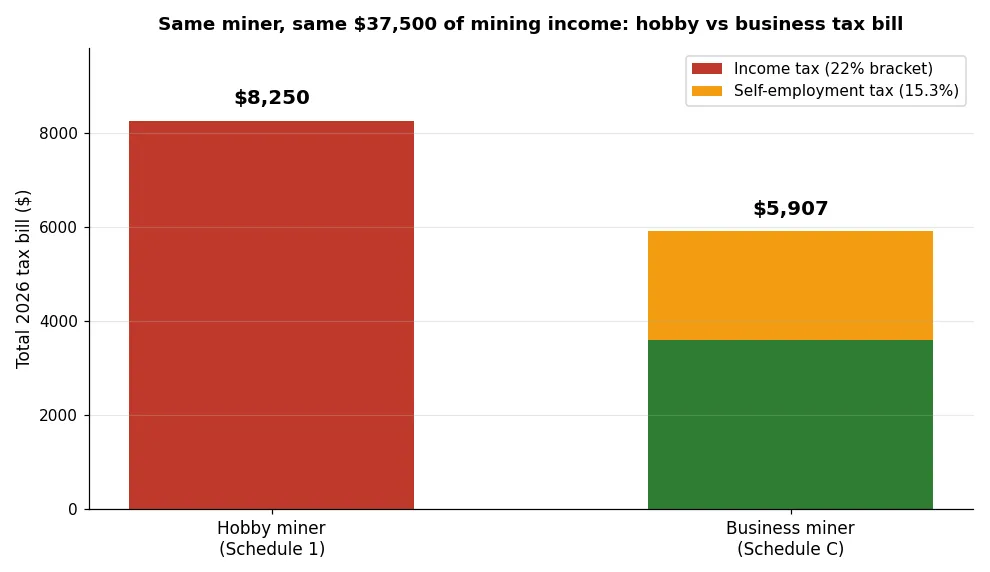
As a hobby miner, Sam reports $37,500 of income and deducts nothing. At a 22% marginal rate, his tax bill is $8,250.
No self-employment tax applies.
As a business miner, Sam deducts the full $21,150 and reports $16,350 of net income. His income tax is $3,597, and his self-employment tax is $2,310.
His total bill is $5,907.
The business route saves Sam $2,343, about 28% of his hobby tax bill. The saving comes from the deductions, and it survives the extra self-employment tax because his costs are large.
The math flips for a tiny setup. If Sam spent only $2,000 on power and fees, his business bill would be $12,826, which is $4,576 more than the hobby bill.
Business status only pays when your deductible costs are large enough to outweigh the 15.3% self-employment tax. At a 22% income tax rate, the break-even point sits near $14,700 of annual costs.
Two footnotes make the business case slightly better. Business miners also deduct half of their self-employment tax from income, and many qualify for the 20% qualified business income deduction.
Neither is in the numbers above, so the real saving is a touch larger.
What Business Miners Can Deduct
Business miners deduct the ordinary and necessary costs of running the operation. Hobby miners deduct none of these, so the list below applies only to Schedule C filers.
| Expense | What it covers |
|---|---|
| Electricity | The power your rigs actually use. A separate meter makes this easy to prove. |
| Mining hardware | ASICs and GPUs, either depreciated over years or expensed in year one. |
| Pool fees | The percentage your pool keeps from payouts. |
| Hosting and cooling | Rack space, fans, ventilation, and any hosted mining fees. |
| Internet | The share of your connection the rigs use. |
| Repairs and parts | Replacement fans, power supplies, and cables. |
| Software | Mining software, monitoring tools, and tax software. |
| Home office | The part of your home used only for mining, if it qualifies. |
Section 179 and 100% Bonus Depreciation in 2026
Hardware is usually the biggest single cost, and 2026 is a good year to buy it. The One Big Beautiful Bill Act, signed on July 4, 2025, restored 100% bonus depreciation for qualifying property acquired after January 19, 2025, and made it permanent.
That means a business miner can write off the full cost of new ASICs in the year they go into service, instead of spreading the deduction over several years. Section 179 offers a similar result, with a 2026 limit of $2,560,000 and a phase-out starting at $4,090,000 of equipment purchases.
Section 179 cannot exceed your business income for the year, while bonus depreciation can. Bonus depreciation can even create a loss.
Either way, keep the receipt and record the date the hardware went into service.
One caution: states do not always follow the federal rules. California, for example, disallows federal bonus depreciation.
Check your state before you count on the full write-off.
Self-Employment Tax: The 15.3% Surprise
Self-employment tax catches many new business miners off guard. It is separate from income tax, and it applies on top of it.
The rate is 15.3% of your net earnings: 12.4% for Social Security and 2.9% for Medicare. It applies to 92.35% of your net profit, not the full amount, and only once your net earnings reach $400 for the year.
The Social Security piece stops at the annual wage base. For 2026 that base is $184,500, according to the Social Security Administration, up from $176,100 in 2025.
The Medicare piece has no cap.
High earners pay a little more. A 0.9% Additional Medicare Tax applies to self-employment income above $200,000 for single filers and $250,000 for joint filers.
And remember, half of your self-employment tax is deductible from your income, which softens the blow.
Pay it during the year, not next April. Business miners who expect to owe $1,000 or more must make quarterly estimated payments.
Miss them and the IRS adds interest and penalties.
Congress may change these rules. A Senate proposal that would ease crypto tax burdens for crypto users is still working through Congress, and none of its changes are law yet.
Form 1099-DA and Your Mining Income
Form 1099-DA is the new IRS form for digital asset sales, and it causes a lot of confusion among miners. Here is what it does and does not do.
Brokers began reporting 2025 digital asset sales on Form 1099-DA in early 2026. Those first forms showed gross proceeds only, with no cost basis.
For 2026 transactions, brokers must also report cost basis for covered assets acquired on or after January 1, 2026.
Mining income is not on the form. Form 1099-DA reports sales and trades through a broker, not the coins you earned by mining.
Your mining income still goes on Schedule 1 or Schedule C, whether or not any form arrives.
The coins you later sell through an exchange are on the form, though. If you sell mined Bitcoin on Coinbase or Kraken, the sale proceeds appear on your 1099-DA.
Your cost basis is the value you reported as income when you mined the coins, so keep that record.
A mining pool may send a Form 1099-MISC for payouts instead. Either way, a missing form never means missing tax.
The IRS expects you to report the income with or without paperwork.
These rules are for US taxpayers. Miners in other countries face different rules.
Here is how the UK taxes Bitcoin, and here is how Australia taxes Bitcoin.
Record-Keeping: The Habit That Saves You
Mining taxes are a record-keeping problem more than a math problem. The IRS wants a number for every payout, and only your records can supply it.
For every payout, note the date, the amount of Bitcoin, the dollar value that day, and the pool or block it came from. For every sale, note the date, the amount sold, the proceeds, and the basis of the coins you sold.
A spreadsheet works fine, and crypto tax software can pull pool and exchange data automatically. Whichever you use, export a backup.
Exchanges close accounts and pools shut down, and your records should not vanish with them.
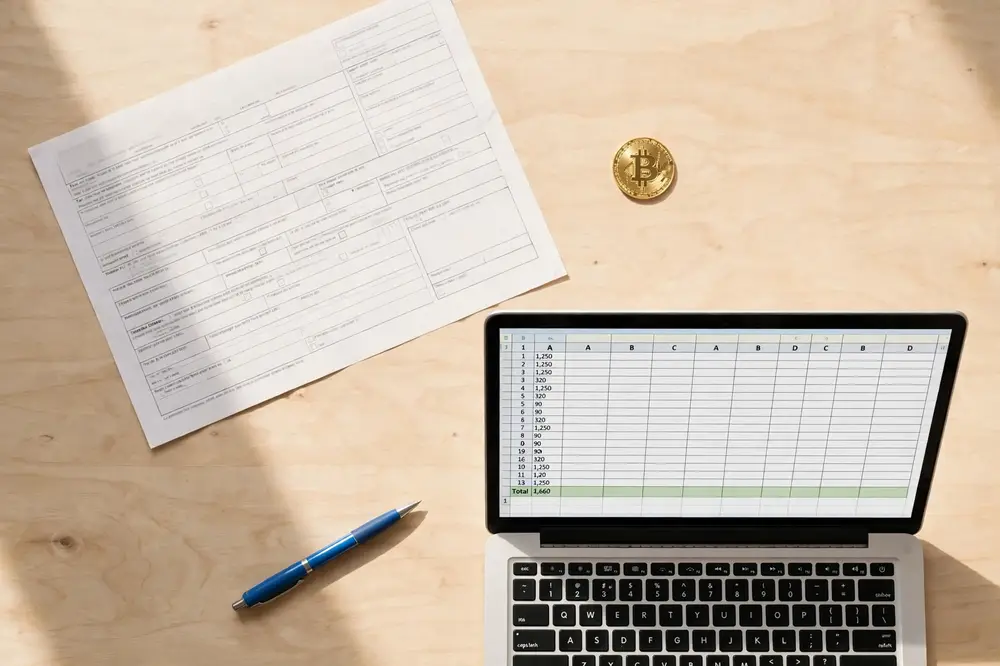
Keep receipts for every deductible cost: power bills, hardware invoices, hosting contracts, and pool fee statements. Keep them for at least three years after you file, and six if you want a safety margin.
Common Mistakes Bitcoin Miners Make
The same errors show up every tax season. Most of them are easy to avoid once you know they exist.
- Waiting to sell before reporting income. The tax hits when the coins arrive, not when you cash out.
- Forgetting the second tax event. Selling mined coins without reporting the gain is the most common underpayment.
- Deducting costs as a hobby miner. Since 2018, hobby expenses are not deductible, no matter how large the power bill.
- Using the sale price as the cost basis. Your basis is the value on the day you mined the coins, not the day you sold them.
- Ignoring estimated payments. Business miners who wait until April often owe interest on top of the tax.
- Trusting the 1099-DA to tell the whole story. It reports sales, not mining income, and it may not know your basis.
Frequently Asked Questions
Miners ask the same questions every tax season. Here are short answers to the six we hear most.
Do I pay tax on Bitcoin I mine but never sell?
Yes. The fair market value of mined Bitcoin counts as ordinary income on the day you receive it, even if you hold the coins for years.
You only avoid the second tax, capital gains, by not selling.
Is Bitcoin mining a hobby or a business?
It depends on how you run it. The IRS weighs nine factors, including profit motive, regularity, and businesslike records.
A profit in three out of five years creates a presumption that it is a business.
Can I deduct electricity costs for mining?
Yes, if mining is a business reported on Schedule C. Hobby miners cannot deduct electricity or any other mining cost.
What tax form do I use for mining income?
Hobby miners report mining income as other income on Schedule 1. Business miners report it on Schedule C and pay self-employment tax on the net profit.
Does Form 1099-DA report my mining income?
No. Form 1099-DA reports sales of digital assets through a broker.
Mining income is ordinary income that you report yourself, on Schedule 1 or Schedule C.
How much is the self-employment tax for miners in 2026?
It is 15.3% of 92.35% of net earnings, once net earnings reach $400. The Social Security portion applies only up to the 2026 wage base of $184,500.
Sources
- IRS Notice 2014-21, Virtual Currency Guidance
- Social Security Administration, Contribution and Benefit Base
- IRS, About Form 1099-DA, Digital Asset Proceeds From Broker Transactions
This article is for general information only. It is not tax advice.
Tax rules change, and your situation depends on your income, your state, and how you run your mining. Talk to a qualified tax professional before you file.