



Bitcoin capital gains tax comes down to one simple subtraction. You take what you received when you sold, subtract what you paid, and the difference is your gain or loss.
This guide shows you how to calculate Bitcoin capital gains tax step by step. It uses three worked examples on the same $20,000 buy, so you can see how the method you pick changes the tax you owe.

Key takeaways
- Your gain equals sale proceeds minus cost basis minus fees. That is the whole formula.
- The IRS treats Bitcoin as property, not currency. Every sale, swap or spend can trigger tax.
- Three methods (FIFO, HIFO and specific identification) can give three different tax bills on the same sale. In our worked example, the gap is $720.
- For 2026, long-term gains are taxed at 0%, 15% or 20%. Short-term gains use your ordinary income rate, up to 37%.
- Form 1099-DA now reports cost basis for 2026 sales. Your broker sends the IRS both sides of the calculation.
This article explains US tax rules for education only. It is not tax advice.
- What Counts as a Taxable Event?
- The Formula in One Line
- How to Calculate Bitcoin Capital Gains Tax in 5 Steps
- Step 1: List every purchase lot
- Step 2: Pick your cost basis method
- Step 3: Work out the gain or loss
- Step 4: Split short-term from long-term
- Step 5: Apply the rate and report it
- Worked Examples: The Same $20,000 Buy, Three Different Tax Bills
- Example 1: FIFO (First In, First Out)
- Example 2: HIFO (Highest In, First Out)
- Example 3: Specific Identification
- FIFO vs HIFO vs Specific Identification
- Short-Term vs Long-Term: The 2026 Rates
- What Changed in 2026: Form 1099-DA
- What About Losses?
- Common Mistakes That Cost Real Money
- Frequently Asked Questions
- How do I calculate Bitcoin capital gains tax?
- What is the difference between FIFO and HIFO?
- Do I pay tax if I only hold Bitcoin and never sell?
- What is Form 1099-DA?
- Can I offset Bitcoin losses against my other income?
- Does the wash sale rule apply to Bitcoin?
- Sources
What Counts as a Taxable Event?
Not every Bitcoin move triggers tax. Buying Bitcoin with dollars and holding it does not create a taxable event, and moving coins between wallets you own does not either.
Tax applies when you dispose of Bitcoin. The table below covers the common cases.
| Event | Taxable? | Why |
|---|---|---|
| Sell Bitcoin for dollars | Yes | You disposed of property at a price |
| Swap Bitcoin for another crypto | Yes | A crypto-to-crypto trade is still a sale |
| Spend Bitcoin on goods or services | Yes | Paying with Bitcoin counts as a sale |
| Receive Bitcoin as pay or a reward | Yes | It is ordinary income at fair market value |
| Buy Bitcoin and hold it | No | No disposal happened |
| Move Bitcoin between your own wallets | No | You still own the same coins |
| Give Bitcoin as a gift | No for the giver | The recipient takes over your cost basis |
Everyday spending trips people up most. Each coffee you buy with a Bitcoin debit card is a separate disposal, and each one needs its own gain calculation.
The Formula in One Line
Capital gain equals sale proceeds minus cost basis minus fees. A negative result is a capital loss.

Cost basis means what you paid for the coins, including the purchase price and any fees you paid to buy them. Sale proceeds mean what you received, minus any fees you paid to sell.
Here is the formula with a quick example. You buy 0.1 BTC for $6,000 and pay a $25 fee, so your basis is $6,025.
You later sell that 0.1 BTC for $7,500 and pay a $25 fee, so your proceeds are $7,475. Your gain is $7,475 minus $6,025, which is $1,450.
How to Calculate Bitcoin Capital Gains Tax in 5 Steps
Follow these five steps for every sale. They work the same whether you made one trade or one thousand.
Step 1: List every purchase lot
Write down each buy as its own lot: date, amount of Bitcoin, price paid and fees. Your exchange history has all of this, so export it before you start.
Keep lots separate by wallet or account. Since January 1, 2025, the IRS requires cost basis tracking per wallet, not pooled across all your wallets.
Step 2: Pick your cost basis method
Choose FIFO, HIFO or specific identification before you calculate. The method decides which lots count as sold, and that choice changes your gain.
FIFO is the IRS default if you do not identify specific coins. HIFO and specific identification need records that show exactly which coins you sold.
Step 3: Work out the gain or loss
Subtract the basis of the coins sold from the proceeds you received. Do this for each sale, one at a time, and keep the results in a simple list.
A sale at a loss still counts. Losses matter because they can offset your gains, as the losses section below explains.
Step 4: Split short-term from long-term
Coins held for one year or less produce short-term gains. Coins held for more than one year produce long-term gains.
The split matters because the rates differ a lot. Short-term gains use your ordinary income rate, while long-term gains get the lower 0%, 15% or 20% rates.
Step 5: Apply the rate and report it
Multiply each gain by its rate to get the tax owed. Report each sale on Form 8949, which totals onto Schedule D of your tax return.
Your broker now helps with this step. Form 1099-DA reports your sales to the IRS, and for 2026 sales it also reports cost basis for covered assets.
Worked Examples: The Same $20,000 Buy, Three Different Tax Bills
Most guides show one example and stop. This section runs three methods on the same real numbers, so you can see the difference in dollars.
Imagine you spent $20,000 on Bitcoin in three lots. Lot 1 is 0.2 BTC bought in January 2024 at $40,000 per coin, costing $8,000.
Lot 2 is 0.1 BTC bought in June 2024 at $60,000 per coin, costing $6,000. Lot 3 is 0.08 BTC bought in February 2025 at $75,000 per coin, costing $6,000.
In November 2026 you sell 0.2 BTC at $76,000 per coin. You receive $15,200.
All three lots have been held for more than one year, so the 15% long-term rate applies in every example below.
Example 1: FIFO (First In, First Out)
FIFO sells the oldest coins first. You sell the full 0.2 BTC from Lot 1, which cost $8,000.
Your gain is $15,200 minus $8,000, which is $7,200. At the 15% long-term rate, the tax is $1,080.
Example 2: HIFO (Highest In, First Out)
HIFO sells the most expensive coins first. You sell the 0.08 BTC from Lot 3 (basis $6,000), then 0.1 BTC from Lot 2 (basis $6,000), then 0.02 BTC from Lot 1 (basis $800).
Your total basis is $12,800. Your gain is $15,200 minus $12,800, which is $2,400.
At the 15% long-term rate, the tax is $360.
Example 3: Specific Identification
Specific identification lets you name the exact coins you sell. You choose 0.1 BTC from Lot 2 (basis $6,000) and 0.1 BTC from Lot 1 (basis $4,000).
Your total basis is $10,000. Your gain is $15,200 minus $10,000, which is $5,200.
At the 15% long-term rate, the tax is $780.
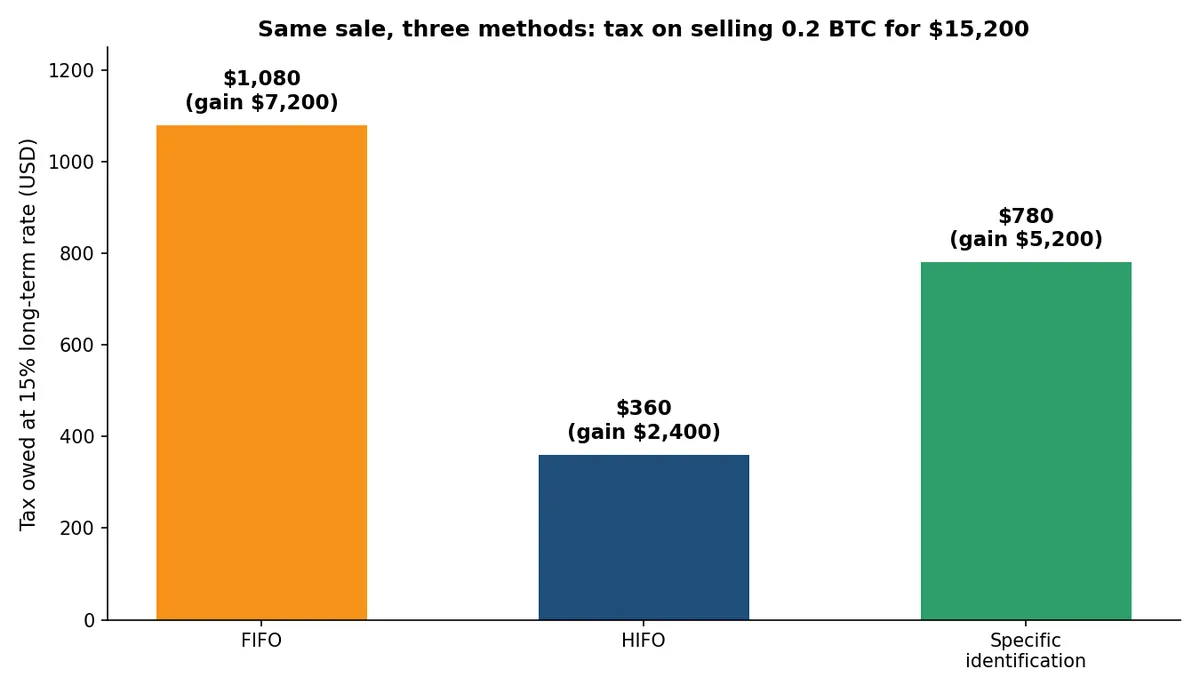
The same sale produces three different tax bills: $1,080, $360 and $780. FIFO costs $720 more than HIFO here, which is why the method you choose deserves real thought.
FIFO vs HIFO vs Specific Identification
Each method suits a different situation. The table below sums up the trade-offs.
| Method | How it works | Best when | Watch out for |
|---|---|---|---|
| FIFO | Sells the oldest coins first | You want the simplest option | It often creates the biggest gain in a rising market |
| HIFO | Sells the highest-cost coins first | You want the smallest gain this year | It needs exact records of every lot |
| Specific identification | You name the exact coins sold | You want full control over the outcome | You must identify the coins before the sale, with proof |
HIFO is not a separate IRS rule. You achieve it through specific identification by picking your highest-cost lots.
One warning applies to all three methods. You cannot change your method after the sale to get a better result, so decide before you sell, not at tax time.
Short-Term vs Long-Term: The 2026 Rates
How long you held the coins decides your rate. The holding period starts the day after you buy and includes the day you sell.
| Holding period | Tax treatment | 2026 rate |
|---|---|---|
| One year or less | Short-term | Ordinary income rate, 10% to 37% |
| More than one year | Long-term, 0% bracket | 0% up to $49,450 single, $98,900 married filing jointly |
| More than one year | Long-term, 15% bracket | 15% up to $545,500 single, $613,700 married filing jointly |
| More than one year | Long-term, 20% bracket | 20% above those thresholds |
High earners can owe an extra 3.8% Net Investment Income Tax. It applies once modified income passes $200,000 for single filers or $250,000 for married couples filing jointly.
The gap between short-term and long-term treatment is wide. Holding for just over a year instead of just under it can cut your rate from 22% or more down to 15% or even 0%.
Rates outside the US differ sharply. Our Bitcoin Tax Guide compares the rules country by country, including places where long-term gains are tax-free.
What Changed in 2026: Form 1099-DA
2026 is the first year brokers report both sides of your gain. Form 1099-DA started with gross proceeds for transactions from January 1, 2025, and cost basis reporting began for transactions from January 1, 2026.
Your exchange sends the form to you and to the IRS. For 2026 sales of covered assets, which are coins bought after 2025 and held in the same broker account, the form carries the proceeds and the basis.
The form does not cover everything. Coins bought before 2026, coins moved in from another wallet, and coins on non-custodial platforms can arrive with no basis on the form.
That gap is your job to fill. Keep your own records for every lot, because the IRS still expects the correct gain even when the form shows a blank basis.
Decentralised exchanges and self-custody wallets do not file 1099-DA at all. If you sell Bitcoin on a P2P platform or swap on a DEX, no broker reports the trade, but the tax still applies.
What About Losses?
Losses are not wasted. Capital losses first offset capital gains dollar for dollar, and any leftover net loss can offset up to $3,000 of other income per year ($1,500 if married filing separately).
Larger losses carry forward to future years. A $9,000 net loss, for example, offsets $3,000 this year and carries $6,000 into the next two years.
The wash sale rule does not currently apply to crypto you hold directly. That rule blocks loss deductions for stocks repurchased within 30 days, but Congress has not extended it to Bitcoin, so selling at a loss and buying back is allowed under current law.
Do not let the tax tail wag the dog. Harvesting a loss only helps if you actually wanted to sell, and the rules can change, so check the law in the year you file.
Common Mistakes That Cost Real Money
Most Bitcoin tax errors come from missing records, not bad math. The five mistakes below show up again and again.
First, people forget that swaps are taxable. Trading Bitcoin for another coin feels like no money changed hands, but the IRS treats it as a sale at fair market value.
Second, people ignore small spends. Every time you convert Bitcoin to gift cards or pay a merchant, that is a disposal with its own gain or loss.
Third, people pool basis across wallets. Since January 1, 2025, basis is tracked per wallet or account, and mixing wallets can overstate or understate your gain.
Fourth, people copy the number from Form 1099-DA without checking it. The form can miss basis for older or transferred coins, and the wrong basis means the wrong tax.
Fifth, people treat Bitcoin as currency. The IRS has classified it as property since Notice 2014-21, and that single fact is why Bitcoin counts as property for tax purposes.
A final practical note: the way you buy affects the records you keep. Our payment methods hub compares every way to pay for Bitcoin, and cleaner purchase records make every calculation above easier.
Frequently Asked Questions
These are the questions readers ask most about Bitcoin capital gains tax. The answers use the same numbers as the worked examples above.
How do I calculate Bitcoin capital gains tax?
Subtract your cost basis and any selling fees from the sale proceeds. The result is your capital gain or loss, and you multiply the gain by your rate (short-term or long-term) to get the tax owed.
What is the difference between FIFO and HIFO?
FIFO sells your oldest coins first, while HIFO sells your highest-cost coins first. On the same $15,200 sale in this guide, FIFO produced a $7,200 gain and $1,080 of tax, while HIFO produced a $2,400 gain and $360 of tax.
Do I pay tax if I only hold Bitcoin and never sell?
No. Buying and holding Bitcoin creates no tax, because tax applies only when you sell, swap, spend or otherwise dispose of the coins.
What is Form 1099-DA?
Form 1099-DA is the IRS form brokers use to report your crypto sales. It reported gross proceeds for transactions from January 1, 2025, and it also reports cost basis for covered assets sold from January 1, 2026.
Can I offset Bitcoin losses against my other income?
Yes, up to a limit. Losses first offset your capital gains, and any leftover net loss can offset up to $3,000 of other income per year ($1,500 if married filing separately), with the rest carried forward.
Does the wash sale rule apply to Bitcoin?
No, not under current law. The wash sale rule blocks loss deductions for stocks repurchased within 30 days, but it does not apply to crypto you hold directly, so you can sell at a loss and buy back.
Sources
- IRS, Digital Assets
- IRS, Instructions for Form 1099-DA (2026)
- IRS, Revenue Procedure 2024-28 (per-wallet cost basis)
This guide is general information, not tax advice. Tax rules change, and your situation may differ, so confirm the current rules with a qualified tax professional before you file.