



You can buy Bitcoin with a wire transfer, but the wire only moves your dollars. It does not buy the Bitcoin.
The purchase happens later, after the money lands in your exchange account. The price you pay is the live price at that moment, not the price you saw when you sent the wire.

This guide explains how to buy Bitcoin with wire transfer from start to finish. It covers real 2026 fees from Coinbase, Kraken, Gemini, Bitstamp, and CEX.IO, a worked example at today’s live Bitcoin price, and a comparison table that shows when a wire beats ACH and when it loses.
- Key Takeaways
- What a Wire Transfer Actually Does When You Buy Bitcoin
- The Trap Most Guides Bury: A Wire Does Not Lock the Bitcoin Price
- Wire vs ACH vs SWIFT: The Comparison Table
- How Much a Wire Transfer Costs in 2026
- How to Buy Bitcoin With Wire Transfer: Step by Step
- Step 1: Pick an Exchange That Accepts Wires
- Step 2: Create Your Account and Verify Your Identity
- Step 3: Get the Exchange’s Wire Instructions
- Step 4: Send the Wire From Your Bank
- Step 5: Wait for the Deposit to Clear
- Step 6: Buy Bitcoin at the Live Price
- Step 7: Move Your Bitcoin to Your Own Wallet
- Domestic vs International Wires: What Changes
- The Sender-Name Rule and Other Reasons Wires Get Rejected
- When a Wire Transfer Is the Right Choice
- Common Mistakes to Avoid
- Frequently Asked Questions
- Can I buy Bitcoin directly with a wire transfer from my bank?
- How long does it take to buy Bitcoin with a wire transfer?
- How much does it cost to buy Bitcoin with a wire transfer?
- Does a wire transfer lock the Bitcoin price?
- Can I send a wire transfer from someone else’s bank account?
- Is a wire transfer or ACH better for buying Bitcoin?
- Conclusion
- Sources
Key Takeaways
- A wire transfer moves cash to an exchange. You buy Bitcoin only after the cash arrives, at the live price then.
- Domestic wires usually land the same business day. International SWIFT wires take 1 to 5 business days.
- Bank outgoing wire fees run $15 to $35 domestic and $25 to $50 international. Exchanges add $0 to $25 on their side.
- Kraken and Gemini charge nothing for domestic wire deposits. Coinbase charges $10 per incoming wire.
- Wires suit large orders best. A $30 bank fee is 6% of a $500 buy but only 0.06% of a $50,000 buy.
- The sender name must match your exchange account name, or the deposit can be rejected.
What a Wire Transfer Actually Does When You Buy Bitcoin
A wire transfer is a bank-to-bank payment. Your bank sends dollars to the exchange’s bank account, and the exchange credits your account balance once the money arrives.
No Bitcoin changes hands during the wire itself. The exchange holds your dollars as a balance, and you place a separate buy order for Bitcoin after the deposit clears.
This two-step shape matters because the two steps happen at different times. A domestic wire sent before your bank’s cutoff usually lands the same business day.
An international SWIFT wire can take 1 to 5 business days, and weekends add more delay. Two common wire types exist: a domestic wire, called a Fedwire in the United States, which moves dollars between US banks, and an international wire, which runs over the SWIFT network.

An international wire often passes through one or more intermediary banks that each take a fee and add time. If you live in Europe and pay in euros, you probably do not need a wire at all.
A SEPA transfer is cheaper and often faster, and our guide to buying Bitcoin with SEPA covers that route in detail.
The Trap Most Guides Bury: A Wire Does Not Lock the Bitcoin Price
Here is the fact most wire transfer guides skip. Sending the wire does not lock in a Bitcoin price.
Your dollars travel, the price moves, and you buy at whatever the market shows when the money arrives. Some services make this explicit.
Crypto Dispensers, a US wire-to-Bitcoin service, states it plainly on its site: the price is not locked when you send the wire, and you approve the final price after your funds arrive and the review is complete.
Bitcoin moves fast enough for this to matter. On November 5, 2026, Bitcoin traded near $80,400, up about 3% in 24 hours, after dipping toward $75,700 the day before.
A wire sent during that swing would have bought a different amount of Bitcoin depending on which hour the funds landed. That is the risk you accept with every wire-funded buy.
A Worked Example at Today’s Live Price
Take a $10,000 domestic wire to Coinbase. Your bank charges $30 to send it, and Coinbase charges $10 to receive it.
That leaves $9,960 to spend. At $80,400 per Bitcoin, $9,960 buys about 0.1239 BTC.
That math assumes the price holds still while your money travels, and it rarely does. If Bitcoin rises 3% to $82,812 before your deposit clears, the same $9,960 buys about 0.1203 BTC instead.
You end up with roughly 0.0036 BTC less for the same dollars. If Bitcoin falls 3% to $77,988, the same money buys about 0.1277 BTC, and the delay works in your favor.
Nobody can predict which way it goes. The honest point is simpler: a wire transfer is a funding method, not a price.
If you need a fixed price, a wire is the wrong tool, because the price is set at the buy, not at the send.
How the Flat Fee Scales With Order Size
Wire fees are flat, so they punish small orders and nearly vanish on large ones. The table below uses a $30 bank fee plus a $10 exchange fee, a typical $40 total, and shows what that costs as a share of the order.
| Wire amount | Total wire fees | Fee as a share of the order |
|---|---|---|
| $500 | $40 | 8.0% |
| $1,000 | $40 | 4.0% |
| $5,000 | $40 | 0.8% |
| $10,000 | $40 | 0.4% |
| $50,000 | $40 | 0.08% |
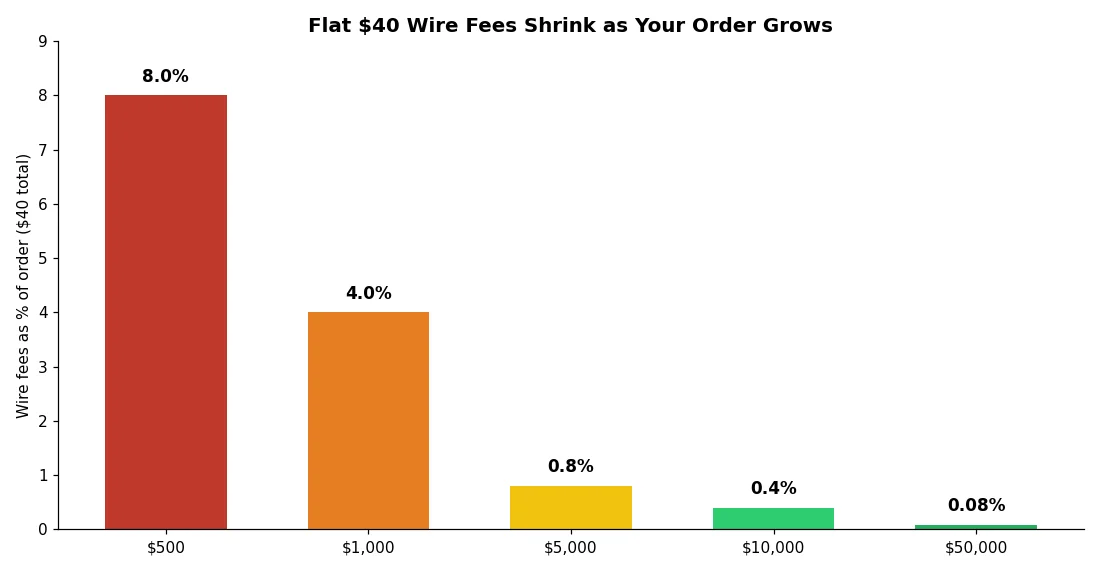
The math explains why guides call wires a large-order tool. On a $500 buy, fees eat 8% before you own a single satoshi.
On a $50,000 buy, the same $40 is a rounding error. Size is what decides whether a wire is cheap or costly.
Wire vs ACH vs SWIFT: The Comparison Table
US buyers usually choose between a wire and an ACH transfer. International buyers usually choose between a wire and SEPA.
The table below compares the three rails on the points that decide real purchases. It uses the fee schedules each exchange published in 2026.
| Factor | Domestic wire (Fedwire) | ACH transfer | International wire (SWIFT) |
|---|---|---|---|
| Typical speed | Same business day | 1 to 3 business days | 1 to 5 business days |
| Bank fee | $15 to $35 per wire | Free | $25 to $50, plus intermediary fees |
| Exchange deposit fee | $0 to $10 | Free | $0 to 0.05% of the amount |
| Withdrawal hold | None on most exchanges | Up to 7 days on Kraken and Coinbase | None on most exchanges |
| Reversible | No | Yes, for a short window | No |
| Best for | Large or urgent orders | Small, regular buys | Cross-border large orders |
| Price locked at send | No | No | No |
ACH wins on cost for everyday buys, because it is free and the exchange charges nothing to receive it. The catch is the hold: on Kraken and Coinbase, Bitcoin bought with ACH funds often cannot leave the exchange for up to 7 days.
A wire wins on speed and freedom. The money arrives the same day, and because wires cannot be reversed, exchanges usually let you withdraw your Bitcoin right away.
That trade-off is the whole decision in one line: pay the wire fee when speed or immediate withdrawal matters, and use ACH when it does not. Our guide to buying Bitcoin with ACH walks through the cheaper route step by step, including the hold rules.
How Much a Wire Transfer Costs in 2026
The total cost has three parts: your bank’s outgoing fee, the exchange’s deposit fee, and the trading fee when you buy. Most guides quote only one part, so buyers get surprised at the end.
Learning how to buy Bitcoin with wire transfer means adding all three parts before you judge the price. The sections below break each part down with real 2026 numbers.
Your Bank’s Outgoing Wire Fee
US banks typically charge $15 to $35 for a domestic outgoing wire. International wires cost $25 to $50 at the sending bank, before intermediary fees.
Bank of America charges $30 for a domestic wire sent before its 5 PM ET cutoff, and $45 for an international wire in US dollars. PNC charges $25 for a self-service domestic wire and $50 for an agent-assisted one.
International wires add intermediary banks. Each intermediary can take $15 to $30 before passing the money on, and your bank may also add an exchange-rate markup of 1% to 4% if you send in a foreign currency.
Ask your bank for the full fee schedule before you send a large wire, because the headline fee is rarely the final number.
Exchange Deposit Fees in 2026
The table below lists the wire deposit terms we verified from each exchange’s published fee schedule in November 2026. Fees change, so treat the funding screen inside your account as the final word.
| Exchange | Domestic wire deposit | International wire deposit | Typical arrival |
|---|---|---|---|
| Kraken | Free | Free (SWIFT via Customers Bank) | 0 to 1 business day |
| Gemini | Free, no deposit limit | Varies by region | Same day if received before 3 PM ET |
| Coinbase | $10 per incoming wire | $10 per incoming wire | Same business day |
| Bitstamp | Not offered for US dollars | 0.05% fee, $7.50 minimum, $50 minimum deposit | 2 to 5 business days |
| CEX.IO | $25 fee, $1,000 minimum | Varies by region | Same business day |
The Trading Fee on Top
Deposit fees are only part of the bill. You also pay a trading fee when you convert dollars to Bitcoin.
On Kraken Pro, entry-level fees are 0.40% maker and 0.80% taker after the July 2026 fee change. On Coinbase Advanced, US fees are 0.50% maker and 0.90% taker after the September 16, 2026 restructure.
Use the advanced trading screen, not the simple buy button. The simple buy screen adds a spread of roughly 1.5% to 3% on top of the fee, which costs far more than the wire itself on any order over a few hundred dollars.
How to Buy Bitcoin With Wire Transfer: Step by Step
Follow the steps in order. The two steps people skip, verifying the account name and copying the reference exactly, cause most failed or delayed deposits.
Step 1: Pick an Exchange That Accepts Wires
Choose a regulated exchange that lists wire deposits for your country and currency. Kraken and Gemini suit US buyers because domestic wires are free on both.
Coinbase works too, but it adds a $10 incoming wire fee. Check that the exchange serves your state or country before you verify your identity.
Kraken, for example, does not serve New York or Maine residents. A quick check now saves a wasted signup.
Step 2: Create Your Account and Verify Your Identity
Sign up with your legal name and complete identity verification. Regulated exchanges must verify who you are before they accept a wire, and the name on your exchange account must match the name on your bank account.
Verification usually takes minutes with a government ID and a selfie, but it can take a day if manual review is needed. Do this step before you send any money, not after.
Step 3: Get the Exchange’s Wire Instructions
Open the funding or deposit page, choose your currency, and select wire transfer. The exchange shows its receiving bank name, account number, routing or SWIFT code, and a payment reference unique to your account.
Copy these details exactly. The reference is how the exchange matches your wire to your account, and a missing or wrong reference can delay your deposit by days.
Step 4: Send the Wire From Your Bank
Log in to your online banking or visit a branch and enter the exchange’s details. Send the wire from a bank account in your own name, in the same currency the exchange expects.
Send domestic wires before your bank’s daily cutoff to land the same day. Bank of America’s cutoff is 5 PM ET, and other banks set similar cutoffs in the late afternoon.
A wire sent after the cutoff waits until the next business day. Plan around that if you are buying on a deadline.
Step 5: Wait for the Deposit to Clear
Domestic wires usually credit the same business day. Kraken lists its Fedwire deposits at 0 to 1 business day, and Gemini credits wires received before 3 PM ET the same day.
International SWIFT wires take 1 to 5 business days, and Bitstamp lists 2 to 5 business days for its international wire deposits. Keep your bank receipt until the money shows in your exchange account.
The receipt proves the send date and amount if anything goes missing in transit. Do not delete it until the deposit clears.
Step 6: Buy Bitcoin at the Live Price
Once the dollars appear in your exchange balance, open the advanced trading screen and place your buy order. A market order buys at the current price right away.
A limit order buys only if the price drops to the level you set. Check the fee preview before you confirm.
The screen shows the trading fee and the exact amount of Bitcoin you will receive, so there are no surprises after the click.
Step 7: Move Your Bitcoin to Your Own Wallet
Bitcoin held on an exchange belongs to the exchange’s wallet, not yours. For long-term holding, withdraw it to a wallet you control, where you hold the private keys.
Our guide to getting a Bitcoin wallet explains the setup, and our list of the best Bitcoin wallets for beginners compares the safest options.
Send a small test amount first, confirm it arrives, then move the rest. A test costs a few cents and catches a wrong address before it costs everything.
Domestic vs International Wires: What Changes
A domestic wire stays inside one country’s banking system, so it is fast and cheap. A US Fedwire sent before the cutoff usually settles the same business day, and the only fees are your bank’s outgoing charge and the exchange’s deposit fee, if any.
An international wire crosses borders over SWIFT, and every border adds time and cost. Intermediary banks sit between your bank and the exchange’s bank, each one checking the payment, running compliance screening, and taking a fee.
Total transit runs 1 to 5 business days, and the amount that arrives can be less than the amount you sent. Currency adds another layer.
If you send dollars to an exchange that banks in euros, someone converts the money, and the exchange rate markup can cost 1% to 4%. Send in the currency the exchange expects, and ask your bank whether an intermediary fee applies before you send.
Europeans have a better option for euro payments. SEPA transfers cost 0 to 1 euro at most banks, and SEPA Instant settles in under 10 seconds.
Since October 2025, SEPA Instant has been mandatory for all EU banks, so a euro wire to a crypto exchange rarely makes sense anymore.
The Sender-Name Rule and Other Reasons Wires Get Rejected
Exchanges accept wires only from a bank account in your own name. CEX.IO states this plainly: it accepts deposits only from an account in your name, and a joint account works only if the sender details match your exchange profile.
A wire from a friend, a family member, or a business account will be rejected or held for review. The payment reference matters just as much.
The exchange gives you a unique reference code, and your wire must carry it exactly. A missing reference means the exchange cannot match the money to your account, so the deposit sits uncredited while support sorts it out.
Wires also fail on small details. A wrong digit in the account number sends the money to the wrong place.
A wire sent in the wrong currency gets converted at a poor rate or bounced back. A first wire to a new payee can trigger your bank’s fraud review, which adds a day while the bank calls to confirm.
If a wire goes missing, contact the exchange’s support team with your bank receipt, the send date, the exact amount, and the reference code. Banks can trace a wire through the SWIFT network, but the trace takes days, so patience and paperwork are part of the process.
When a Wire Transfer Is the Right Choice
A wire makes sense in three situations. The first is a large order, where the flat fee shrinks to a fraction of a percent.
The second is an urgent order, where same-day settlement beats a 1 to 3 day ACH wait. The third is a first large deposit, where you want the money available to withdraw right away instead of locked behind a 7-day ACH hold.
A wire is the wrong choice for small or frequent buys. A $30 bank fee on a $200 weekly purchase eats 15% of every order, and an ACH transfer does the same job for free.
It is also the wrong choice if you need a fixed price, because the price is set when you buy, not when you send. If you have no bank account at all, a cash-based route such as buying Bitcoin with Western Union works differently and may fit better.
Pros and Cons at a Glance
| Pros | Cons |
|---|---|
| Same-day settlement for domestic wires | Flat $15 to $35 bank fee, plus exchange fees |
| No withdrawal hold on most exchanges | Price is not locked while funds travel |
| High limits, suited to large orders | International wires take 1 to 5 days |
| Nearly irreversible, so exchanges trust it | Irreversible, so a wrong detail is costly |
| Works for large amounts ACH cannot handle | Sender name must match exactly |
Common Mistakes to Avoid
The most expensive mistake is sending a wire to buy at a price you saw an hour ago. The market moves while the money travels, and the buy happens at the live price.
Accept that before you send, or pick a faster funding method. The second mistake is using the simple buy button instead of the advanced trading screen.
The spread on the simple screen can cost 1.5% to 3%, which dwarfs the wire fee on any order over a few hundred dollars. The third mistake is skipping the reference code.
Without it, the exchange cannot credit your deposit automatically, and your money can sit in limbo for days while support matches it by hand. The fourth mistake is wiring from the wrong account.
A wire from a spouse, a parent, or a business account will be rejected because the sender name does not match your exchange account. Always send from an account in your own name.
The fifth mistake is leaving Bitcoin on the exchange forever. Exchanges get hacked, freeze accounts, and go bankrupt.
A personal wallet costs nothing to set up and removes that risk entirely. Move your coins off the exchange once the purchase clears.
Frequently Asked Questions
These are the questions new buyers ask most about wire transfers. Each answer uses the 2026 fees and timing verified in this guide.
Can I buy Bitcoin directly with a wire transfer from my bank?
Not directly. A wire transfer moves dollars from your bank to an exchange account, and you then buy Bitcoin on the exchange with that balance at the live price.
How long does it take to buy Bitcoin with a wire transfer?
A domestic wire usually lands the same business day if you send it before your bank’s cutoff, often around 5 PM ET. An international SWIFT wire takes 1 to 5 business days.
How much does it cost to buy Bitcoin with a wire transfer?
Your bank charges $15 to $35 for a domestic wire and $25 to $50 for an international one. Exchanges charge $0 to $25 on their side, and you also pay a trading fee of roughly 0.4% to 0.9% when you buy.
Does a wire transfer lock the Bitcoin price?
No, a wire transfer does not lock the Bitcoin price. You buy at the live market price when your deposit clears and you place the order.
Can I send a wire transfer from someone else’s bank account?
No, exchanges accept wires only from a bank account in your own name. The sender name must match your exchange account name, and a wire from another person will be rejected or held for review.
Is a wire transfer or ACH better for buying Bitcoin?
ACH is better for small, regular buys because it is free, but Bitcoin bought with ACH funds often cannot be withdrawn for up to 7 days. A wire transfer is better for large or urgent orders because it settles the same day and usually carries no withdrawal hold.
Conclusion
A wire transfer is the fastest honest way to move serious money into Bitcoin. It settles the same day, it carries no withdrawal hold, and its flat fee fades to nothing on a large order.
It has one real weakness, and it is the one most guides hide. The wire moves your dollars, not your price.
You buy at the live price when the money lands, so a $10,000 wire sent at $80,400 can buy more or less Bitcoin depending on where the market sits hours later. Now you know how to buy Bitcoin with wire transfer without falling for that trap.
Use a wire when the order is large, the timing matters, or you want your Bitcoin withdrawable right away. Use ACH when the order is small and you can wait.
Either way, buy on the advanced trading screen, copy the reference exactly, send from your own account, and move your Bitcoin to a wallet you control when the purchase is done. For the full picture of every way to pay, see our complete payment methods hub, which compares all the funding routes side by side.
If your bank offers a cheaper rail for your country, such as SEPA in Europe, that route usually beats a wire on both cost and speed. Pick the rail that fits the order, not the one you used last time.
Sources
- Kraken Support: Cash deposit options (Fedwire, SWIFT, SEPA)
- Coinbase Help: Fees, including the $10 wire deposit and $25 wire withdrawal fees
- Gemini: Fee schedule, including free domestic wire deposits
- Bitstamp: Fee schedule, including international wire deposit terms
- CEX.IO: Buy Bitcoin with a bank account, including domestic wire terms