



Hyperliquid price prediction 2026 2030 starts with a simple picture. HYPE trades near $89 on October 31, 2026, after hitting about $98 on September 23, 2026, and our base case puts HYPE near $95 to $130 in 2027 and $150 to $220 by 2030 if trading activity holds up.
That base case is not a promise. HYPE faces a large token unlock on November 6, 2026, and that single event can drag the price lower even if the exchange keeps growing.

Key Takeaways
- HYPE trades near $89 on October 31, 2026, about 9 percent below its September 2026 high near $98.
- Hyperliquid still leads onchain perpetual trading with $7.71 billion in open interest, about 58 percent of the tracked market.
- A core contributor unlock of about 9.92 million HYPE lands on November 6, 2026, worth roughly $880 million at $89.
- Protocol burns have removed 49.87 million HYPE so far, but the monthly burn pace runs far below the monthly unlock size.
- Published analyst forecasts for 2030 range from about $125 to $220 on average, with one high case at $360.
Hyperliquid Price Prediction 2026 2030: The Short Answer
Our short answer splits into three paths. The bear path sees HYPE fall back toward $55 to $85 by 2030 if open interest slips and rivals keep taking volume.
- Key Takeaways
- Hyperliquid Price Prediction 2026 2030: The Short Answer
- Where HYPE Stands on October 31, 2026
- Why Traders Still Pay Attention to Hyperliquid
- The November 6 Unlock Versus the Burn
- What Analysts Actually Forecast for HYPE
- Our Hyperliquid Price Prediction Scenarios
- Risks That Could Pull HYPE Lower
- Common Mistakes HYPE Traders Make
- Frequently Asked Questions
- What is the Hyperliquid price prediction for 2026 to 2030?
- Is HYPE a good investment?
- What happens on the November 6, 2026 unlock?
- Why did HYPE fall from $98?
- What could push HYPE above $200?
- Conclusion
The base path sees HYPE reach $150 to $220 by 2030. The bull path sees $250 to $360, but only if Hyperliquid keeps its liquidity lead and regulated US access actually launches.
We built those paths from live October 31 data, not from hope. We used open interest, trading volume, fee revenue, burns, and the unlock calendar as the inputs.
What our scenarios assume
The base path assumes Hyperliquid keeps roughly half of onchain perpetual open interest. It also assumes fee revenue keeps funding buybacks, even at a slower pace than the 2026 peak.
The bull path needs one extra trigger. It needs the ICE backed US perpetual market to win approval and bring new traders to Hyperliquid based markets.

Where HYPE Stands on October 31, 2026
HYPE changed hands near $89 on October 31, 2026, across several price trackers. CoinStats showed $89.84, OKX showed $88.80, and DefiLlama showed $89.68 at nearby readings.
That cluster matters because it stops us from cherry picking one print. A price near $89 sits about 9 percent below the all time high near $98, and it sits well above the late October low near $77.
Market value tells the same story of a large cap token. Market capitalisation sits near $21 billion to $22 billion, and HYPE ranks around 9 to 11 by market value depending on the tracker.
Circulating supply sits near 239 million to 253 million HYPE. Maximum supply caps at 1 billion HYPE, so most of the supply still sits locked or reserved for future emissions.
| Snapshot, October 31, 2026 | Figure |
|---|---|
| Price | Near $89 |
| All time high | About $98 on September 23, 2026 |
| Market capitalisation | About $21 billion to $22 billion |
| Circulating supply | About 239 million to 253 million HYPE |
| Maximum supply | 1 billion HYPE |
| Onchain perp open interest | $7.71 billion, about 58 percent share |
| 30 day perp volume | About $226 billion |
Short term traders watch $85 to $87 as near support. They watch $95.20 and then the $98 high as the next resistance levels.
The ICE news that changed the mood
Intercontinental Exchange agreed on October 29, 2026, to take a minority stake in tradeXYZ. That firm plans to design Hyperliquid based perpetual markets for US customers.
The deal still needs regulatory approval, and the CFTC has set no timeline. Traders should treat this as a real catalyst with an uncertain date, not as a done deal.
Stanley Druckenmiller also invested in tradeXYZ, according to recent coverage. That name draws professional attention, but it does not guarantee approval or volume.
Why Traders Still Pay Attention to Hyperliquid
Hyperliquid runs its own Layer 1 blockchain. One part, HyperCore, runs a fully onchain order book, and another part, HyperEVM, runs smart contracts.
Traders like that setup for one reason: depth. Deep books let large orders fill with less slippage, and slippage often costs more than the headline fee.
Hyperliquid launched in 2023 and took no venture funding, according to its public history. Its founder Jeff Yan worked in high frequency trading before he built the exchange.
The HYPE token launched on November 29, 2024, with about 31 percent of supply airdropped to roughly 94,000 early users. That launch still shapes how many holders watch unlocks today.
Perp volume versus open interest
Volume can mislead you, and open interest tells a steadier story. Volume jumps when incentives pay traders to churn, while open interest shows money that actually stays in positions.
DeFi analyst Patrick Scott made that point on October 29, 2026. He noted Hyperliquid still holds about 62 percent of perp DEX open interest in his read, even after rivals grabbed volume spikes.
Castle Labs put the October 30 open interest share at 58 percent, with $7.71 billion on Hyperliquid. The two reads differ a little, but both point to the same lead.
Hyperliquid traded $21.52 billion in perps in 24 hours on October 30, about 52 percent of tracked onchain perp volume. Binance futures traded $116.04 billion in the same window, so Hyperliquid reached about 19 percent of Binance volume.
That gap to Binance still matters for a Bitcoin price prediction for 2026 style reality check. HYPE can grow fast without beating the largest centralised exchange outright.
The November 6 Unlock Versus the Burn
Here is the tug of war at the heart of this forecast. Burns shrink supply slowly, while unlocks release supply in large monthly chunks.
Tokenomist lists the next unlock for November 6, 2026, at 9,916,667 HYPE for core contributors. At $89, that tranche carries a headline value near $880 million.
Cumulative burns reached 49.87 million HYPE by late October, about 4.99 percent of maximum supply. The Assistance Fund buys HYPE with fee revenue and burns those tokens.
One day of burns ran at 19,700 HYPE on October 28. That pace points to roughly 591,000 HYPE burned per month, far below a 9.92 million unlock.
Our exclusive scoreboard below puts those forces side by side. No other forecast roundup we checked on October 31 combined all five live inputs in one table.
| HYPE tug of war, October 31, 2026 | Number | What it means |
|---|---|---|
| Monthly burn pace | About 591,000 HYPE | Slow, steady supply shrink |
| November 6 unlock | About 9.92 million HYPE | About 16.8 times the monthly burn pace |
| Cumulative burns | 49.87 million HYPE | About 4.99 percent of max supply |
| Open interest share | About 58 percent | Liquidity lead, stickier than volume |
| Cumulative protocol revenue | Over $1.38 billion | Fees fund the buyback engine |
The unlock headline overstates the instant selling risk. Past team distributions sometimes ran much smaller than the schedule, and trackers disagree on exact amounts.
Traders still sold ahead of November 6 in late October. That early selling explains part of the slide from $98 toward $77 before the late month rebound.
Why an unlock is not the same as a sale
An unlock releases tokens to their owners. It does not force those owners to sell on the same day.
Core contributors built the project, and many hold for years. Some will sell to cover taxes or costs, but a headline unlock value never equals instant market supply.
Watch actual claims and exchange inflows after November 6. Those onchain moves tell you more than the calendar date alone.
What Analysts Actually Forecast for HYPE
Published forecasts disagree, and that disagreement is useful. It shows how wide the range of honest outcomes really is.
CoinStats put the 2026 range at $68 to $105, with an average of $87. It put the 2030 range at $110 to $360, with an average of $220.
CryptoNews forecast an average near $84.21 for 2026 and $97.31 for 2027. It saw HYPE reaching as high as $162.29 by 2030.
CoinCodex forecast $74.73 by the end of 2026 and $147.79 by 2030. Its model updates daily, so its numbers move with the market.
BTCC summarised several services at $100 to $185 for 2030, with an average near $125. CoinDCX put December 2026 at $108 and 2030 at $192.
Read those forecasts as a fan, not as a single target. The fan widens every year because small changes in volume, fees, and unlock behaviour compound.
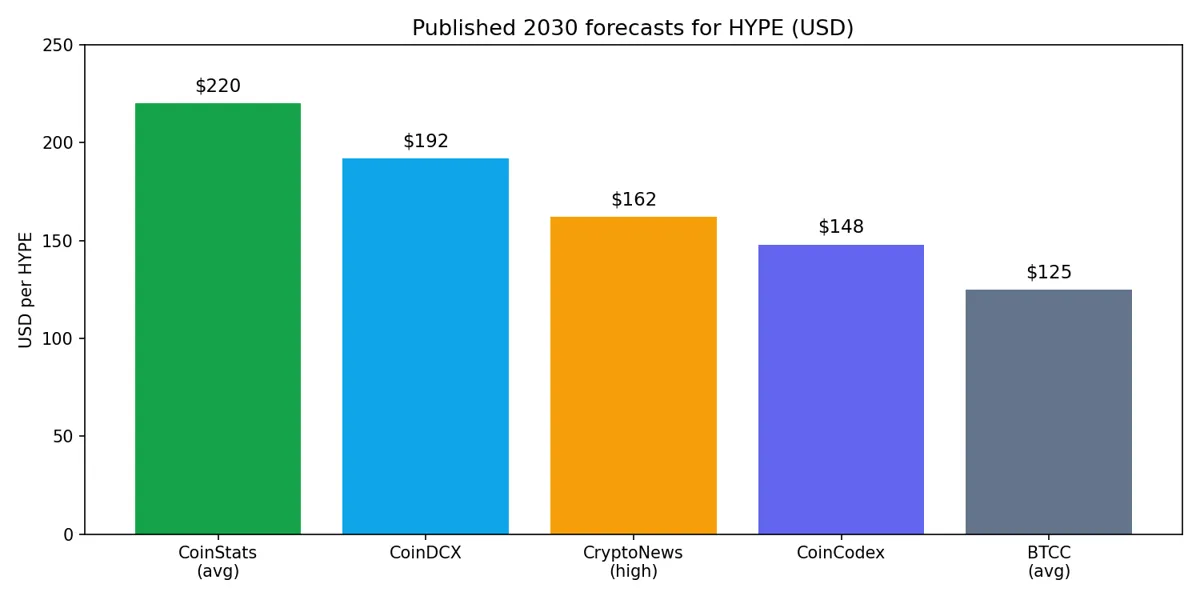
Our chart above uses only those published figures. It adds no new analyst quote and it hides no low forecast to make the picture prettier.
Compare this range with other altcoin forecasts on this site. Our Zcash price prediction for 2026 to 2030 and our Uniswap price prediction use the same scenario method, and both show wide fans for the same reason.
Our Hyperliquid Price Prediction Scenarios
We now turn published forecasts and live data into our own scenarios. We label them clearly as scenarios, not as guarantees.
The base case assumes Hyperliquid keeps its open interest lead. It also assumes HyperEVM keeps growing past 100 protocols and $2 billion in total value locked.
The bear case assumes Aster, Lighter, and Variational keep eating volume. It also assumes the November unlocks repeat each month and weigh on price through 2027.
The bull case assumes regulated US access launches and Hyperliquid based markets attract institutional flow. It also assumes USDH, the stablecoin backed by reserves held with BlackRock and Superstate, gains real liquidity.
| Year | Bear case | Base case | Bull case |
|---|---|---|---|
| End of 2026 | $60 to $75 | $85 to $105 | $105 to $120 |
| 2027 | $55 to $80 | $95 to $130 | $130 to $180 |
| 2028 | $50 to $85 | $110 to $160 | $160 to $230 |
| 2030 | $55 to $85 | $150 to $220 | $250 to $360 |
Notice how the bear case stays flat for years. That flat line reflects unlock supply and rival pressure, not a collapse in the exchange itself.
Notice how the bull case needs new demand, not just time. Time alone does not lift a token when new supply arrives every month.
The base case in plain words
Picture a trader who uses Hyperliquid every week. She cares about fills, fees, and markets, and she stays because the book stays deep.
Now picture thousands of traders like her. Their fees fund buybacks, buybacks shrink supply, and a smaller supply meets steady demand.
That loop can lift HYPE from $89 toward $150 to $220 by 2030. It works slowly, and it breaks if traders leave for a cheaper venue.
What would break the base case
Three breaks matter most. First, open interest falls sharply for two quarters in a row.
Second, USDH fails to gain liquidity over the next year. Third, the ICE backed US market stalls in regulatory review for years.
Any one break alone hurts the base case. Two breaks together push HYPE toward the bear path.
Risks That Could Pull HYPE Lower
Competition sits at the top of the risk list. Aster briefly took a large volume share in 2025, and Lighter and edgeX posted triple digit activity gains in recent weeks.
Regulation sits close behind. Hyperliquid, Lighter, Aster, Variational, and Paradex all exclude US residents in their terms today, so US access depends on a new regulated venue.
Concentration risk also matters. HYPE ties closely to one exchange, so an outage, a hack, or a fee change hits the token directly.
Market risk wraps all of it. A broad crypto downturn pulls even strong tokens lower, and HYPE already fell from $98 to near $77 in October before it rebounded.
For context on how US venues handle leverage, read our piece on perpetual futures trading in the US. For venue choice, compare our guide to the best crypto exchanges for day trading.
Common Mistakes HYPE Traders Make
Many traders treat the November 6 unlock as a certain crash. They sell early, miss a rebound, and then chase the price back up.
Other traders treat burns as a price floor. Burns help, but a 591,000 monthly burn cannot absorb a 9.92 million monthly unlock on its own.
Some traders copy a single analyst target as a plan. They buy at $89, wait for $220, and panic when the price drops to $70 first.
Smart traders set levels instead. They watch $85 support, $98 resistance, and open interest share, and they size positions so one unlock cannot wipe them out.
Long term holders should also compare HYPE with the wider market. Our Bitcoin price prediction for 2030 shows how Bitcoin cycles still drive most altcoin moves.
Frequently Asked Questions
Readers ask the same five questions about HYPE. Here are direct answers, with no hype and no promises.
What is the Hyperliquid price prediction for 2026 to 2030?
Our base case puts HYPE at $85 to $105 by the end of 2026, $95 to $130 in 2027, $110 to $160 in 2028, and $150 to $220 by 2030. Published analyst forecasts for 2030 range from about $125 to $220 on average, with a high case at $360.
Is HYPE a good investment?
HYPE suits traders who understand leverage, unlocks, and exchange risk, and it does not suit anyone who needs stable value. This article gives information only, not financial advice, and you should research the risks before you buy any amount.
What happens on the November 6, 2026 unlock?
About 9.92 million HYPE become available to core contributors on November 6, 2026, according to Tokenomist. An unlock releases tokens to owners, and it does not force those owners to sell them on that day.
Why did HYPE fall from $98?
HYPE hit about $98 on September 23, 2026, then slid toward $77 in late October as traders sold ahead of the November unlock and rivals grabbed volume. It rebounded toward $89 by October 31, helped by the ICE and tradeXYZ news.
What could push HYPE above $200?
HYPE needs sustained open interest leadership, growing fee revenue, and a regulated US market that actually launches. A bull case to $250 to $360 by 2030 needs all three, not just one good quarter.
Conclusion
HYPE stands at a crossroads on October 31, 2026. It holds the liquidity lead, it earns real fees, and it burns tokens, yet it faces a large unlock in six days.
Our base case still leans positive to 2030, at $150 to $220. That case needs traders to stay, fees to keep flowing, and unlock selling to stay orderly.
If you follow HYPE, watch three numbers each week. Watch open interest share, watch fee revenue, and watch exchange inflows after November 6.
Those three numbers will tell you sooner than any price target whether the base case still holds. For a rival perp venue angle, see our coverage of the dYdX ETP for institutional investors.
Disclaimer: This article is for information only. It is not financial advice, and crypto prices can move fast in either direction.