
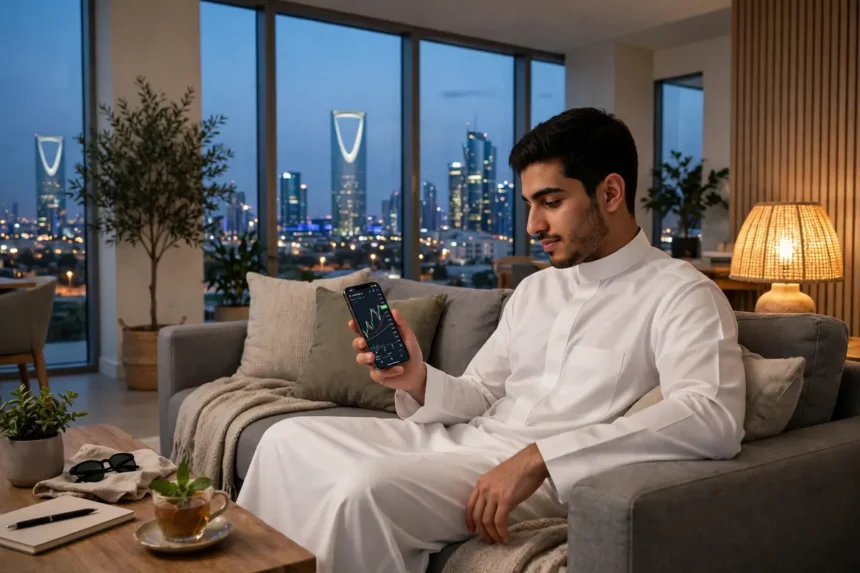
Yes, you can buy Bitcoin in Saudi Arabia as a beginner in 2026. The catch is simple: no Saudi bank and no licensed local exchange will process the purchase for you, so most buyers go through P2P escrow with stc pay or a bank transfer.
That matters because the moment you try a card or a direct bank deposit to a foreign exchange, your payment can bounce. The bank is not being difficult; it is following SAMA rules that forbid it from touching crypto.

Here is what Saudis actually do: they buy USDT from a riyal seller on a big P2P marketplace, then swap that USDT for Bitcoin on the same platform. A 1,000 SAR test buy takes about an hour, and this guide walks you through every step.
- The One Thing That Changes Everything in Saudi Arabia
- Is Bitcoin Legal in Saudi Arabia? The Honest Answer
- 5 Real Ways to Buy Bitcoin in Saudi Arabia in 2026
- 1. Binance P2P with stc pay or bank transfer
- 2. Bybit P2P with stc pay
- 3. OKX P2P
- 4. Rain, the Bahrain-licensed broker
- 5. Bitget P2P
- The Grey-Zone Decoder: Which Route Fits You
- Your First Buy, Step by Step
- What You Need Before You Start
- What a 1,000 SAR Buy Really Costs
- Is Bitcoin Halal? The Honest Answer
- Taxes and Zakat: The Money Rules
- Scams That Target Saudi Buyers
- Mistakes Almost Every Beginner Makes
- Frequently Asked Questions
- Is it legal to buy Bitcoin in Saudi Arabia?
- Can I use my Saudi bank card to buy Bitcoin?
- Which exchange is best for beginners in Saudi Arabia?
- How much money do I need to start?
- Is Bitcoin halal in Saudi Arabia?
- Do I pay tax on Bitcoin profits in Saudi Arabia?
- Your Next Step
Key takeaways
- Owning Bitcoin is not a crime in Saudi Arabia, but no local bank will process a crypto purchase.
- P2P escrow with stc pay or a local bank transfer is the realistic route for beginners.
- Start with a small test buy of 100 to 500 SAR before sending bigger money.
- Spot buying only: no leverage, no futures, no interest products, especially if the halal question matters to you.
- Move anything you plan to keep for months into a wallet you control.
The One Thing That Changes Everything in Saudi Arabia
Saudi banks cannot deal in cryptocurrencies unless SAMA gives them special approval. No bank holds that approval for retail customers, so your mada card or bank transfer to an exchange can simply be declined.
This is not a ban on you. A Standing Committee statement from August 2018 said virtual currencies are not approved and no party is licensed to deal in them, but it set no penalty for individuals who buy and hold, so understand this grey zone before you send a single riyal.
Is Bitcoin Legal in Saudi Arabia? The Honest Answer
Owning and trading Bitcoin is not criminalized for individuals in Saudi Arabia. You can buy, hold, sell, and store it without breaking a named law, and an estimated 3 to 5 million people in the Kingdom do exactly that.
But Bitcoin is not legal tender, no domestic exchange holds a Saudi license, and you cannot pay for goods with crypto or open a crypto account at any local bank. The Gulf handles this differently in each country, so compare the stricter setup in our Kuwait guide and the banking wall in our Qatar guide to see the contrast.

5 Real Ways to Buy Bitcoin in Saudi Arabia in 2026
These are the routes actual buyers use, ranked from most beginner-friendly to most specialized. Every one of them works around the banking wall in a different way.
Do not hunt for a secret “Saudi-licensed” exchange. None exists in October 2026, and any site claiming to be one is lying to you.
1. Binance P2P with stc pay or bank transfer
Binance P2P lets you buy USDT directly from another person, while Binance holds the coins in escrow until your riyals arrive. Filter sellers by stc pay or your bank, and pick someone with a completion rate above 95 percent.
Once the USDT lands in your account, you place a spot order for Bitcoin at a 0.10 percent trading fee. The P2P step itself usually adds no platform fee, but sellers bake a small markup into their rate, so compare two or three sellers before you commit.
2. Bybit P2P with stc pay
Bybit works the same way and is popular with Gulf buyers for its clean P2P screen and fast escrow release. Verification with your National ID or Iqama typically takes minutes, and P2P sellers here often accept stc pay transfers.
Buy USDT first, then use the BTC/USDT spot market. This two-step flow is the cheapest dependable route for a beginner, because you skip the spread hidden inside “express buy” buttons.
3. OKX P2P
OKX is another large exchange with an active SAR P2P market, and its spot fees run 0.08 percent maker and 0.10 percent taker. The routine is identical: verify, buy USDT from an escrowed seller, swap to Bitcoin.
OKX suits you if you plan to trade a little more often and want lower fees on the spot side. For a one-time buy, the difference against Binance or Bybit is a few riyals at most.
4. Rain, the Bahrain-licensed broker
Rain is a Gulf-based broker licensed by Bahrain’s central bank, and it accepts bank transfers from the region with a 0.5 percent fee plus a spread. It feels more like a normal financial app than a crypto casino.
The license is Bahraini, not Saudi, so it does not remove the grey zone, but some buyers prefer a regulated regional company over pure P2P. The true cost runs higher than the big P2P routes, so check the chart below before you decide.
5. Bitget P2P
Bitget accepts Saudi residents and runs a standard P2P desk with bank and card funding paths. It works fine, and its spot fee sits at 0.10 percent like most competitors.
Be careful with the card route: your Saudi bank can still decline the charge. If the card fails, fall back to P2P bank transfer instead of trying a second card.
The Grey-Zone Decoder: Which Route Fits You
No other guide scores the Saudi routes this way, so here is the honest version: the real question is not “which exchange is best” but “how do your riyals get there without tripping the banking wall.”
Read your row, then pick one route and stick with it for your first three buys. Platform-hopping is how beginners make mistakes.
| Route | How riyals move | Bank-friction risk | True extra cost | Best for |
|---|---|---|---|---|
| Binance P2P | stc pay or bank transfer to a seller; escrow holds USDT | Low: person-to-person transfers clear normally | Seller markup 1-3% | Most beginners |
| Bybit P2P | stc pay or bank transfer to a seller; escrow holds USDT | Low | Seller markup 1-3% | Clean app lovers |
| OKX P2P | Same P2P escrow flow | Low | Seller markup plus 0.10% spot | Fee hunters |
| Rain | Bank transfer to a licensed broker | Medium: bank sees a transfer to a company | 0.5% plus spread | Trust-first buyers |
| Bitget card | mada or Visa charge | High: banks routinely decline crypto charges | Card fee plus possible decline | Nobody, as plan A |
Your First Buy, Step by Step
This is the exact flow I would walk a friend through tonight. It uses Bybit and stc pay, and the whole thing takes about an hour the first time.
Do it on your phone with good light, because the selfie check is the step that fails most often in dim rooms.

- Create your account and select Saudi Arabia as your country of residence. Use your real name exactly as it appears on your ID.
- Verify your identity before sending money. Upload your National ID or Iqama, complete the selfie check, and turn on two-factor authentication.
- Open the P2P market, choose Buy and USDT, and filter payment methods by stc pay. Pick a seller with 95 percent or higher completion and hundreds of past orders.
- Enter your amount, say 300 SAR for the test. Send exactly that amount from your own stc pay account, leave the transfer reference blank, and tap “Transferred, notify seller.”
- Wait for the seller to release the USDT from escrow. Never confirm receipt before the coins show in your wallet.
- Go to the spot market, open BTC/USDT, and place a limit order. Set the maximum price you will pay and let it fill.
- Withdraw the Bitcoin to your own wallet if you plan to keep it for months. Read how to store Bitcoin safely before the amount gets serious.
What You Need Before You Start
Keep three things ready and the process runs smooth: your National ID or Iqama (residents can also use a passport on most platforms), a bank or stc pay account in your own name, and an authenticator app for two-factor codes. Platforms match the payer name and freeze mismatched transfers, and the app beats SMS codes because a SIM swap attack can steal text messages.
If Bitcoin itself is still new to you, read what Bitcoin actually is first and come back.
What a 1,000 SAR Buy Really Costs
Let me do the math for you, because “fees” sound abstract until you see riyals. Bitcoin traded around $81,600 on October 23, 2026, which is about 306,000 SAR per coin at the 3.75 peg.
Your 1,000 SAR becomes roughly $266.67, which buys about 0.00327 BTC, or 327,000 satoshis. A 2 percent P2P markup costs you 20 SAR, and the 0.10 percent spot fee costs about 1 SAR.

Is Bitcoin Halal? The Honest Answer
This question matters to almost every Saudi buyer, so let me give you the real picture instead of a yes or no. Scholars genuinely disagree, and anyone who pretends otherwise is selling you something.
Malaysia’s Shariah Advisory Council ruled in 2020 that regulated digital assets can be permissible property, and Indonesia’s MUI allows crypto as a commodity. Egypt’s Dar al-Ifta (2017) and Turkey’s Diyanet (2017) rule it haram, and AAOIFI has still issued no crypto standard as of October 2026.
The halal checklist: run every buy through this
- Buy on the spot market only. You pay, you own the coins, settlement is immediate.
- Never use margin, leverage, or futures. Borrowed trading introduces riba and gharar under every major position.
- Skip interest-bearing “earn” products and staking yields. Fixed returns on deposits fail the riba test.
- Avoid tokens tied to gambling, alcohol, or other haram activity. Bitcoin itself is a neutral payment network.
- Pay zakat: crypto you hold is zakatable at 2.5 percent of market value on your zakat date.
Taxes and Zakat: The Money Rules
Here is the good news: Saudi Arabia has no personal income tax and no capital gains tax, so your Bitcoin profits face no individual tax bill. Keep records anyway, because rules evolve and the CMA is reportedly building a crypto framework expected in late 2026.
If you are a business owner, different rules apply, including corporate tax and zakat on business assets. As a Muslim investor, your holdings carry a 2.5 percent zakat obligation regardless of the tax situation, and our Malaysia guide walks through another Muslim-majority country’s version of this setup.
Scams That Target Saudi Buyers
Scammers love grey zones, because confused buyers make easy targets. The most common P2P scam is the fake proof of payment: a seller sends you a fabricated transfer screenshot and pressures you to release coins before the riyals actually arrive.
Never release crypto from escrow until the money shows in your own account. A screenshot proves nothing, and if the payer’s name differs from the seller’s name, keep the coins in escrow and open a dispute immediately.
Mistakes Almost Every Beginner Makes
Skipping the small test buy is the classic one. One wrong digit in an account number sends your money on a long holiday, and a 300 SAR test costs you almost nothing.
Chasing the cheapest P2P rate is the other. A rate far below the rest of the list is bait, not a bargain, so pick merchants with long histories even when the rate looks slightly worse.
Frequently Asked Questions
These are the questions every Saudi beginner asks me, with straight answers and no hedging.
Is it legal to buy Bitcoin in Saudi Arabia?
Owning and trading Bitcoin is not criminalized for individuals, but no exchange is licensed in Saudi Arabia and banks cannot process crypto purchases without SAMA approval. You are buying in a grey zone, so use reputable platforms and keep records.
Can I use my Saudi bank card to buy Bitcoin?
Usually not, because banks follow SAMA guidance and routinely decline card charges to crypto exchanges. The working route is P2P escrow with stc pay or a bank transfer to another person, not to the exchange.
Which exchange is best for beginners in Saudi Arabia?
Binance P2P and Bybit P2P are the most beginner-friendly routes, because stc pay sellers are plentiful and escrow protects both sides. Rain suits buyers who prefer a licensed Gulf broker and accept higher costs.
How much money do I need to start?
Very little: Bitcoin divides into 100 million satoshis, so a 100 to 500 SAR test buy gets you started. Treat that first buy as paid training, not an investment.
Is Bitcoin halal in Saudi Arabia?
Scholars disagree: Malaysia’s Shariah council permits regulated digital assets as property, while Egypt’s and Turkey’s religious authorities prohibit crypto. Most permissive scholars allow spot buying with no leverage and no interest products, so consult a scholar you trust for a personal ruling.
Do I pay tax on Bitcoin profits in Saudi Arabia?
No personal income or capital gains tax applies to individual crypto gains in Saudi Arabia. Muslim investors still owe 2.5 percent zakat on their holdings, and businesses face separate corporate rules.

Your Next Step
You now know more than most people who already own Bitcoin in the Kingdom. The grey zone is real, but it is navigable: one verified account, one small P2P test buy, one wallet you control.
Do the verification today while the steps are fresh, and make that first small buy this week. Then compare your notes with our roundup of all the country guides to see how Saudi Arabia stacks up against the rest of the world.