



Here is the short answer first. You buy Bitcoin in Japan on an exchange that sits on the Financial Services Agency register, you fund it with a yen bank transfer, and you place the order on the exchange order book, not on the simple buy screen.
That last choice is the one most guides skip, and it is the one that costs beginners the most money. This guide is part of our series on how to buy Bitcoin around the world, and it shows you how to check the register yourself, what a 100,000 yen buy really costs on each screen, and how the tax works today versus the new law that has passed but has not started yet.

Key takeaways
- Buying and holding Bitcoin is legal in Japan, but only FSA registered exchanges may serve residents, and accounts are for people who live in Japan.
- Japan had 28 registered crypto exchange operators in early 2026, including bitFlyer, Coincheck, bitbank, GMO Coin, SBI VC Trade, and Binance Japan. Check the name on the FSA register before you send any yen.
- On a 100,000 yen buy, an order book fee runs from a small rebate to about 150 yen. The simple buy screen charges no visible fee, but its price gap can cost you thousands of yen on the same buy.
- Today your gain is still miscellaneous income, taxed at your normal rate, up to 55 percent with local tax. A new flat rate of 20.315 percent has been passed into law, but it has not started yet, so do not file under it.
- You need a photo ID and your My Number details to open an account, and you should move large holdings to your own wallet once you own them.
Is Bitcoin Legal in Japan?
Yes. Japan was one of the first big countries to write crypto rules into law, and residents have bought Bitcoin on licensed exchanges since 2017.
- Is Bitcoin Legal in Japan?
- Which Exchanges Can You Actually Use?
- What You Need Before You Start
- Step by Step: How to Buy Bitcoin in Japan
- Step 1: Open and verify your account
- Step 2: Deposit yen
- Step 3: Choose the order book, not the simple screen
- Step 4: Place the order and check the total
- Step 5: Move large amounts to your own wallet
- The True Cost of a 100,000 Yen Buy
- Deposits, Withdrawals, and Yen Fees
- How Japan Taxes Bitcoin: Two Systems, Kept Honest
- Common Mistakes and Scam Warnings
- FAQs
- Conclusion: Your First Buy, Done Right
Bitcoin is not legal tender in Japan, so no shop has to accept it. The law treats it as an asset you can own and trade, and the rules around who may sell it to you are strict.
The register check you do before anything else
Every exchange that serves Japan residents must register with the Financial Services Agency, which everyone calls the FSA. The FSA keeps a public list of registered crypto asset exchange service providers, and you can search it for free.
Do this check yourself, every time. Type the exchange name into the FSA list, confirm the legal company name matches the app you downloaded, and walk away if the name is not there, because unregistered platforms have no duty to protect your yen.
Which Exchanges Can You Actually Use?
The names beginners meet most often are bitFlyer, Coincheck, bitbank, GMO Coin, SBI VC Trade, and Binance Japan. All of them appeared on the register in our fresh check for this guide, alongside names like Rakuten Wallet and BITPoint.

Registered exchanges must keep your money apart from their own money. They must also hold at least 95 percent of customer crypto in cold wallets.
That rule came out of the Mt. Gox collapse in Tokyo in 2014. It is why the register matters more than any app store rating.
If you are comparing countries while you learn, our guide on how to buy Bitcoin in Italy shows a register check under the European MiCA rules. The habit is the same in both places: verify the licence first, then look at fees.
What You Need Before You Start
You need to live in Japan, be old enough under the exchange terms, and prove who you are. Tourists cannot open these accounts, and neither can residents of Japan who try to sign up with an address abroad.
Most exchanges run the whole check inside the app with a phone camera. Have these items ready before you start, and the signup takes minutes instead of days.
Your ID and My Number checklist
You will show a photo ID such as a My Number card, a driver licence, or a residence card if you are a foreign resident. The app asks you to photograph the front and back and take a selfie so it can match your face.
You also give your My Number, the 12 digit tax number, along with your name, address in Japan, and date of birth. Exchanges collect it because they report to the tax office, so type it exactly as it appears on your card.
Step by Step: How to Buy Bitcoin in Japan
The steps below work the same at every big registered exchange, with small name changes. Read them once in full before you move any money.
Go slowly on your first buy. A small test deposit teaches you the screens with almost no risk.
Step 1: Open and verify your account
Download the official app or open the official site you found through the FSA register, then create your account with your email and a strong password. Turn on two factor authentication right away, before you deposit anything.
Finish the identity check with your ID and My Number details from the checklist above. Most apps approve a clean application the same day, though a blurry photo can send you back to the start.
Step 2: Deposit yen
Send yen from a bank account in your own name, because exchanges reject deposits from other people. A normal bank transfer is the cheapest route and it is free at the exchange end on most platforms, though your bank may charge its own small fee.
Coincheck and bitFlyer also offer Quick Deposit through internet banking and deposits at convenience stores. Those routes land faster, but convenience store and quick routes can carry a fee, so check the fee screen before you tap confirm.
Step 3: Choose the order book, not the simple screen
Every big app gives you two doors. The simple Buy or Sell screen, often called the sales office, sells to you at the exchange price with a gap built in, and the next section shows you what that gap costs.
The exchange screen, called Lightning at bitFlyer, is a real order book where you trade with other users and pay a small stated fee. Open that screen, pick the BTC/JPY pair, and choose a limit order if you want to set your own price.
Step 4: Place the order and check the total
Type the yen amount, look at the Bitcoin amount and the fee on the confirm screen, and only then place the order. On October 19, 2026, one Bitcoin traded near 13.0 million yen, so 100,000 yen bought about 0.0077 BTC before costs.
Your Bitcoin appears in the app once the order fills. A limit order below the market price may wait or never fill, and that is normal, not a fault.
Step 5: Move large amounts to your own wallet
An exchange account is a fine place to buy, but it is not the safest place to store a large amount for years. If the platform fails, your claim sits in a queue with everyone else.
Learn the basics from our guide to the best Bitcoin wallets for beginners, then practise a small withdrawal first. Our walkthrough on how to store Bitcoin safely covers the backup steps that protect you if a phone or laptop dies.
The True Cost of a 100,000 Yen Buy
Here is the part no other Japan guide we found actually works out. Fees on the order book are tiny and public, while the simple screen hides its cost inside the price, so we put both in one table from the live fee schedules we checked on October 19, 2026.
A maker is a person whose limit order waits in the book, and a taker is a person whose order fills at once. A negative maker fee means the exchange pays you a small rebate, which still surprises most beginners.
| Route for a 100,000 yen buy | Stated fee | Cost in yen |
|---|---|---|
| GMO Coin order book, maker | -0.01 percent rebate | You gain about 10 yen |
| bitbank order book, maker | -0.02 percent rebate | You gain about 20 yen |
| Coincheck order book, major pairs | 0 percent | 0 yen |
| GMO Coin order book, taker | 0.05 percent | 50 yen |
| bitbank order book, taker | 0.12 percent | 120 yen |
| bitFlyer Lightning, taker, low volume tier | 0.15 percent | 150 yen |
| Simple Buy screen, if its price sits 3 percent above the order book price | No stated fee, cost hides in the price | About 3,000 yen |
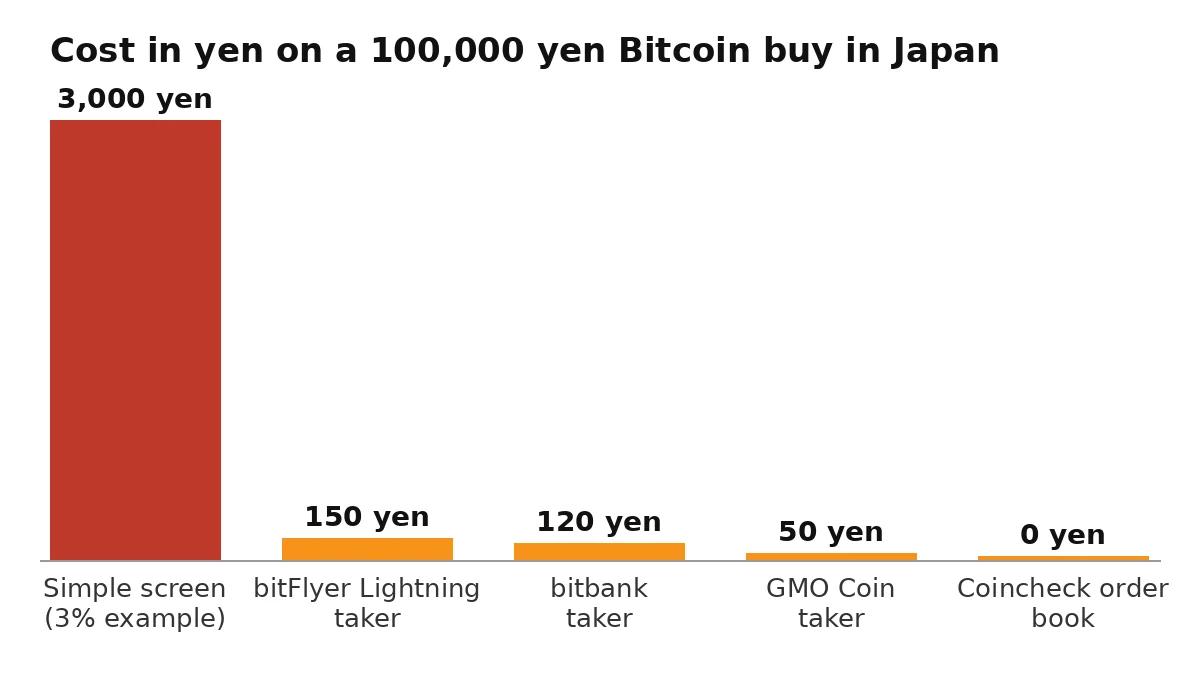
The last row is a worked example, not a quote, because the gap on the simple screen moves all day. You can measure it yourself in ten seconds: compare the buy price on the simple screen with the price on the order book screen in the same app, at the same moment.
The lesson is plain. The exchange logo changes your cost by about 100 yen, but the screen you pick can change it by thousands, so learn the order book screen in your first week.
If you are new to what Bitcoin itself is, start with what Bitcoin is and how it works before you trade often.
Deposits, Withdrawals, and Yen Fees
Getting yen in is usually free at the exchange end by bank transfer, and getting yen out is where small fixed fees appear. At bitbank, a yen withdrawal costs 550 yen below 30,000 yen and 770 yen at or above that amount, from the fee schedule we checked.
GMO Coin stands out here, with free standard yen withdrawals and free crypto transfers out, and a 400 yen fee only on large yen withdrawals. Sending your Bitcoin to your own wallet costs a network based fee at most exchanges, so check that fee before you withdraw a small amount.
Compare that with our guide on how to buy Bitcoin in the Philippines, where wallet apps set the cost, or the one on how to buy Bitcoin in India, where a tax is cut from every buy. Japan charges no tax at the moment you buy, which makes the screen choice your main cost.
How Japan Taxes Bitcoin: Two Systems, Kept Honest
This is where many guides mislead you right now, because Japan has two systems on paper and only one of them applies to a sale you make today. We state both, in order, so you file under the right one.
Keep records of every buy and sell from day one. Your exchange history helps, but it may not cover coins you moved to your own wallet and back.
The system that applies today
Today, a gain on a sale counts as miscellaneous income and joins your salary and other income on your tax return. Your total rate depends on your income band, and with the 10 percent local inhabitant tax on top, the top rate can reach 55 percent.
Worked example: you buy for 100,000 yen and sell for 150,000 yen, a gain of 50,000 yen. If your marginal band puts you at 20 percent national tax plus 10 percent local tax, you pay about 15,000 yen on that gain, and a higher band pays more.
Under the current system you cannot carry a loss forward to a later year. You can only set a crypto loss against other miscellaneous income in the same year, which is a real limit for active traders.
The new law that has passed but has not started
Japan has now passed the reform, not just proposed it. The tax change was enacted on March 31, 2026, and the linked law that moves crypto under the Financial Instruments and Exchange Act was passed in 2026 as well.
When it starts, gains on specified crypto assets sold through a registered operator get separate taxation at 20.315 percent, made of 15 percent national tax, the reconstruction surtax, and 5 percent local tax. On that same 50,000 yen gain, the bill would be about 10,158 yen, and losses could be carried forward for three years.
Here is the catch you must not miss: the start date is January 1 of the year after the linked law begins, and expert commentary points to January 1, 2028. Until that date arrives, a sale today still files as miscellaneous income, and trades on overseas or peer to peer platforms stay outside the new flat rate even after it starts.
Common Mistakes and Scam Warnings
The costliest errors in Japan are boring ones: the wrong screen, the wrong platform, and the wrong tax year. Each one is easy to avoid once you have seen it named.
Watch for these traps in your first month.
Mistakes that cost real money
Buying only on the simple screen for a year can quietly cost you more than every other fee in this guide added together. Check the gap once, and you will never unsee it.
Sending yen to an unregistered platform that a social media post praised is the second trap. If the name is not on the FSA register, your money has no local protection, and the FSA keeps adding names to its warning list of unregistered operators.
The third trap is tax. People hear about the 20 percent rate in the news and file under it early, or they forget that selling one coin to buy another is still a taxable sale under the current rules.
FAQs
Is it legal to buy Bitcoin in Japan?
Yes. Residents can buy, hold, and sell Bitcoin legally, but only on exchanges registered with the Financial Services Agency, and Bitcoin is not legal tender.
Do I need a My Number to open an exchange account in Japan?
Yes. Registered exchanges ask for a photo ID and your My Number details during signup, along with your name, address in Japan, and date of birth.
How much Bitcoin does 100,000 yen buy?
At a price near 13.0 million yen per Bitcoin on October 19, 2026, 100,000 yen buys about 0.0077 BTC before fees and price gaps.
Why does the simple buy screen cost more than the order book?
The simple screen charges no stated fee, but it builds a price gap into the quote. On a 100,000 yen buy, a 3 percent gap costs about 3,000 yen, while an order book fee costs between a small rebate and about 150 yen.
How is Bitcoin taxed in Japan right now?
Right now, gains count as miscellaneous income at your normal rate, up to 55 percent with local tax. A flat rate of 20.315 percent has been passed into law, but it has not started yet, so you cannot file under it today.
Can a foreigner open a crypto account in Japan?
A foreigner who lives in Japan can open one with a residence card and a Japanese address. People who do not live in Japan cannot open these resident only accounts.
Conclusion: Your First Buy, Done Right
You now know how to buy Bitcoin in Japan the careful way. Check the FSA register, verify your account with your ID and My Number, fund it by bank transfer, and buy on the order book screen where the fee is about 100 yen, not thousands.
Start small, keep your records for the current tax system, and move larger holdings to your own wallet. When you feel ready, browse the rest of our country guides from the hub and compare how each country handles the same first buy.






