



Strive priced its strive sats preferred bitcoin deal on October 15, and the headline number hides the real story. The company sold 7,000,000 SATS shares at $90 each for about $630 million in gross proceeds, and that sale creates a fixed dividend bill that the company must pay in cash whether Bitcoin rises or falls.
Most coverage stopped at the $630 million raise and the 15 percent rate. This guide adds up the full bill from Strive’s own SEC filings, shows the reserve the company built to cover it, and tests the plan against the $66,000 Bitcoin price in its own investor deck.

Key takeaways
- Strive priced 7,000,000 SATS shares at $90 on October 15, upsized from 5,000,000 shares, for about $630 million gross before fees and expenses.
- SATS pays 15 percent a year on a $100 stated amount, so the priced deal adds $105 million a year in dividends on our calculation.
- Add the existing SATA bill of about $182.4 million, and the combined bill reaches about $287.4 million a year on the October 9 SATA base.
- The investor deck for the smaller $500 million version showed a $386 million dividend reserve and a stress case at $66,000 Bitcoin.
- Strive held 35,595 BTC on October 13 after two buys in eight days, and it reported no debt and $310.3 million in cash on October 9.
What Strive Actually Sold in the SATS Deal
Strive trades on Nasdaq as ASST, and it runs a Bitcoin treasury strategy beside its asset management business. The company launched SATS on October 13 as a 15.00% Series A Perpetual SATS Preferred Stock with a $100 stated amount per share.
Investors bought more than the company first offered, so Strive upsized the deal two days later. The pricing release on October 15 set 7,000,000 shares at a public price of $90 per share, with settlement scheduled for October 20.
Why the $90 Price and the $100 Amount Both Matter
The dividend uses the $100 stated amount, not the $90 sale price. A buyer who paid $90 still earns the dividend on $100, which equals $15 per share for a full year.
That gap also explains why some reports call this a $700 million deal. Seven million shares times $100 gives $700 million of stated amount, while seven million shares times the $90 price gives the $630 million the company actually raises before costs.
Where SATS Sits in the Line
SATS ranks junior to SATA, the existing Variable Rate Series A Perpetual Preferred Stock, and senior to the common stock. SATA holders get paid first, and SATS holders get paid before common holders see a dividend.

SATA pays a variable rate that the board currently sets at 13 percent, and the deck describes SATA as built for price stability. SATS pays a fixed 15 percent with no target trading range, and the deck describes it as built for income stability.
The Dividend Bill Nobody Added Up
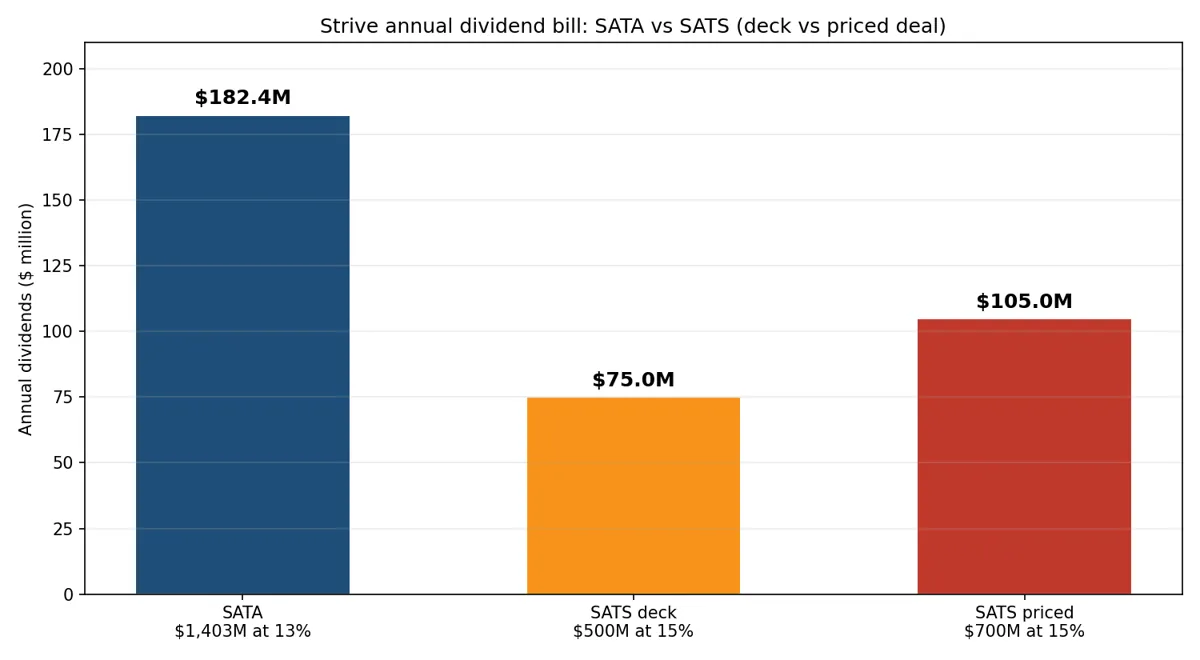
Here is the part the launch headlines missed, and it is the exclusive core of this article. We rebuilt the yearly bill twice, first with the deck’s own $500 million illustration and then with the priced deal that investors actually bought.
Both versions use one simple rule that any reader can check. You multiply the stated amount by the dividend rate, and you get the cash the company owes for a full year if the board declares the dividends in full.
| Preferred stock | Stated amount | Rate | Yearly bill |
|---|---|---|---|
| SATA, existing, October 9 base | $1,403 million | 13 percent | About $182.4 million |
| SATS, deck illustration | $500 million | 15 percent | $75 million |
| SATS and SATA, deck total | $1,903 million | Mixed | $257.4 million, as the deck states |
| SATS, priced deal | $700 million | 15 percent | $105 million, our calculation |
| SATS priced plus SATA, our total | $2,103 million | Mixed | About $287.4 million, our calculation |
What the Upsize Changed
The upsized deal adds $30 million a year to the bill in the deck illustration. The deck total sat at $257.4 million, and our priced total sits at about $287.4 million on the same October 9 SATA base.
That equals about $23.9 million in dividends for every month of a full year. Bitcoin does not need to fall for that bill to matter, because the bill stays fixed while the asset behind it moves every day.
When the Payments Start
Regular dividend dates fall on each business day, and the first payment date is November 9, 2026. The deck illustration showed a first payment of $0.9305 per share for the first short period, then $1.25 per share for each full month.
Dividends accumulate even if the board does not declare them on a given day, because SATS is cumulative. Unpaid amounts keep building, and the company cannot pay common dividends while SATS dividends remain unpaid.
The Reserve and the Stress Test in Their Own Slides
Strive knew a fixed bill needs a cash cushion, so it built a dividend reserve into the deal from day one. At closing, the company will add $22.50 per SATS share to its existing reserve, using cash and securities it already holds.
That $22.50 equals 18 months of SATS dividends on one share. For the priced 7,000,000 shares, the addition reaches $157.5 million on our calculation, up from $112.5 million in the $500 million illustration.

The $386 Million Reserve in the Deck
The deck modeled the smaller $500 million raise, and it showed a combined dividend reserve of $386 million against $257 million a year of dividends. The company counted 378 business days of dividends in that reserve, or about 1.5 years.
The same slides counted 3,490 business days of dividends covered by all assets, or about 13.8 years at about $1.0 million a day. Readers should treat those counts as the company’s own illustrative math, not as a promise about future payments.
What Happens at $66,000 Bitcoin
The deck then cut Bitcoin to $66,000, which it calls the 200-week average, and it assumed no new capital and no recovery. In that stress case, assets still covered 2,884 business days of dividends, or about 11 years.
Bitcoin alone covered 2,506 business days in that same stress case. The deck also showed break-even prices of $31,800 for SATA today, $24,800 for SATA with SATS, and $38,200 for SATA and SATS together, all down from $82,500.
What the Money Buys at the Live Price
The priced raise brings in about $630 million before underwriting discounts and expenses. If the company sets aside the $157.5 million reserve addition first, about $472.5 million remains before those costs for general purposes, including Bitcoin.
Bitcoin traded near $82,516 on October 19 in live market data. At that price, $472.5 million buys about 5,700 BTC on our simple calculation, before any fees change the final count.
How the Deck Saw the Same Question
The deck used its smaller raise and a $82,500 price, and it showed $387.5 million buying about 4,697 BTC after the reserve. That math lifted pro forma holdings from 32,773 BTC to 37,470 BTC in the illustration.
Reality already moved past that base before the SATS sale settles. Strive bought more Bitcoin on October 12 and 13, so any new SATS-funded buy would start from 35,595 BTC, not from the deck’s 32,773 BTC.
Why Bitcoin Per Share Still Decides the Story
A bigger stack alone does not prove a better deal for common holders. Readers who track Strategy’s Bitcoin holdings and its slowing weekly buying know the share count and the preferred stack matter as much as the coin count.
Strive says it targets an amplification ratio above 60 percent while Bitcoin stays below $100,000. That ratio divides preferred equity and debt by the value of the Bitcoin held, and SATS gives the company a new tool to hold that ratio up.
The Two Buys That Set This Up
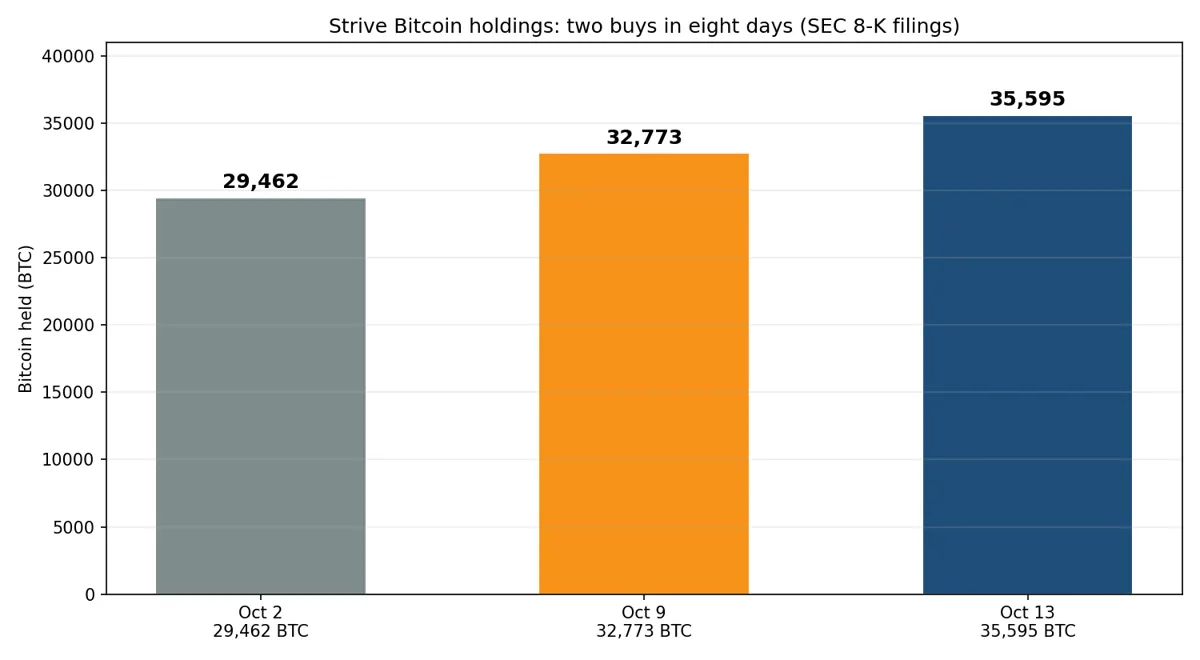
Strive bought 3,311 BTC between October 5 and October 9 at an average price of about $84,500, including fees and expenses. The October 13 Form 8-K lifted total holdings to 32,773 BTC, up from 29,462 BTC a week earlier.
CEO Matt Cole reported $208 million in warrant exercises during that week on X. The same filing reported $310.3 million in cash and cash equivalents, no consolidated debt, and 505,000 shares of Strategy’s STRC preferred stock valued at $50.3 million.
The Second Buy Nobody Should Miss
A second Form 8-K on October 14 added 2,822 BTC bought on October 12 and 13 at an average price of about $83,266. That buy cost about $235 million and lifted holdings to 35,595 BTC.
The same update reported warrant exercises for 13,674,703 Class A shares and about $369.2 million in expected gross proceeds. No traditional warrants from the PIPE financing remained outstanding after October 13.
The SATA Protection That Became Binding
Strive also amended the SATA terms in a filing dated October 12. The amendment makes the $100 minimum issuance price for future SATA sales a binding restriction, not just a stated policy.
That rule protects existing holders from cheap new SATA sales below $100. It also sits beside the fact that Strategy bought back its own STRC preferred for $192 million this month, which shows how actively treasury firms now manage these preferred stacks.
Risks, Mistakes, and What to Watch Next
The first mistake is to read 15 percent as a Bitcoin return. SATS pays a cash dividend on a stated amount, and Bitcoin itself pays no dividend at all.
The second mistake is to treat the reserve as a guarantee. The reserve covers about 18 months of SATS dividends at closing, and a long bear market can outlast any fixed cushion.
The Honest Risk List
Bitcoin fell from above $114,000 to near $83,000 while Strive grew its treasury assets, and the deck itself charts that fall. A deeper drop would cut asset coverage, even if the break-even levels in the slides still look distant.
Other treasury firms show the other side of this trade in plain numbers. Capital B booked a large treasury loss without selling a coin, and American Bitcoin grew its holdings to 8,300 BTC by a very different route.
Three Dates That Matter Now
Settlement comes first, on October 20, and it confirms whether the priced deal closes as planned. The first dividend payment follows on November 9, and it shows the daily payment system working in practice.
The next weekly holdings filing matters most for Bitcoin buyers. It will show how much of the SATS money became Bitcoin, at what average price, and how readers who follow our Bitcoin price prediction for 2026 should judge the timing.
Frequently Asked Questions
What is SATS stock?
SATS is Strive’s 15.00% Series A Perpetual SATS Preferred Stock. It is a cumulative perpetual preferred stock that ranks junior to SATA and senior to Strive’s common stock.
How much did Strive raise in the SATS deal?
Strive priced 7,000,000 SATS shares at $90 per share on October 15, 2026. The company estimates gross proceeds of about $630 million before underwriting discounts and expenses, with settlement scheduled for October 20, 2026.
How big is Strive’s yearly dividend bill after SATS?
Our calculation puts the combined bill at about $287.4 million a year. That total adds about $182.4 million for SATA on the October 9 base to $105 million for SATS at 15 percent on $700 million of stated amount.
How much Bitcoin does Strive hold?
Strive held 35,595 BTC after buying 2,822 BTC on October 12 and 13, 2026. The earlier October 13 filing had reported 32,773 BTC as of October 9, 2026.
What happens to SATS dividends if Bitcoin falls to $66,000?
Strive’s investor deck models that stress case with no new capital and no recovery. In that illustration, assets still cover 2,884 business days of SATA and SATS dividends, or about 11 years.
The Bottom Line
SATS gives Strive about $630 million of new buying power, and it gives income investors a fixed 15 percent claim that sits ahead of common holders. Anyone new to the asset should start with what Bitcoin is and how it works before judging any treasury stock built on top of it.
The trade is now easy to state in one line. Strive gains speed to buy Bitcoin near $82,500, and it accepts a cash bill of about $287 million a year that it must service in good markets and bad ones alike.






