



Dogecoin trades near $0.085 on October 13, 2026, down about 2.8 percent in a day and about 89 percent below its $0.74 high from May 2021. Our base case keeps DOGE between $0.08 and $0.13 for the rest of 2026, then between $0.11 and $0.18 by 2030.
The bull case reaches $0.28 to $0.45 by 2030. The bear case stalls between $0.05 and $0.09.

None of these paths gets DOGE to $1 by 2030, and the math below shows why $1 needs far more money than most fans expect.
- Dogecoin Price Today: Where Things Stand in October 2026
- Dogecoin Price Prediction 2026-2030: The Year by Year Table
- The Supply Problem: 5.26 Billion New Coins Every Year
- Payments, Tipping, and the DogeOS Test
- Dogecoin ETFs: Real Access, Tiny Money So Far
- Social Hype Cycles: The Driver Nobody Can Schedule
- Common Mistakes DOGE Buyers Make
- Frequently Asked Questions
- Conclusion
Bitcoin still sets the weather for coins like DOGE. Our Bitcoin price prediction for 2026 with year end targets explains why a strong Bitcoin year lifts meme coins, and why a weak one hits them first and hardest.
Key takeaways
- DOGE traded near $0.085 on October 13, with a market value near $13.3 billion and a rank near 12 among crypto assets.
- Base case: $0.08 to $0.13 in late 2026, $0.09 to $0.15 in 2027, and $0.11 to $0.18 in 2030.
- Bull case: $0.28 to $0.45 by 2030, which needs a market value near $50 billion to $80 billion.
- Dogecoin adds about 5.26 billion new coins every year, so price gains must beat steady new supply.
- US Dogecoin ETF assets stay tiny, near $16 million in September, and Bitwise closes its BWOW fund on October 14.
- Support sits near $0.080 to $0.081. Resistance starts near $0.085 to $0.090, then $0.10.
Dogecoin Price Today: Where Things Stand in October 2026
Start with the price in front of us. Market feeds on October 13 put DOGE between $0.0846 and $0.0851, with a day range near $0.080 to $0.088.
Sellers held control that day, and DOGE sat below its main moving averages.
Supply sits near 156 billion coins. At $0.085, that gives a market value near $13.3 billion.

A year ago DOGE traded near $0.22, so holders have lived through a fall of more than 60 percent in twelve months.
The levels traders are watching now
Support sits near $0.080 to $0.081, the zone price tested on October 13. Below that, traders cite $0.078 and then $0.074.
A daily close below $0.083 after a bounce would keep sellers in charge.
Resistance starts near $0.085 to $0.087, where the short term averages sit. Above that zone sits $0.089 to $0.091, then $0.094 to $0.095, and then the round $0.10 level.
DOGE must reclaim $0.09 with real volume before any bigger target matters.
Why the fall from the high matters
DOGE set its all time high near $0.74 in May 2021, during a wave of celebrity posts and retail hype. At $0.085, it trades about 89 percent below that peak.
That gap leaves room to recover, but it also warns how far hype prices can fall.
New buyers often ask about the basics before they chase a forecast. Our guide on how to buy Dogecoin in 2026 covers the wallet and exchange steps in plain words, so the forecast below sits on solid ground.

Dogecoin Price Prediction 2026-2030: The Year by Year Table
The table below uses published forecast ranges that convert market value into price, checked against the price and supply data above. Bear, base, and bull are three different futures.
They are scenarios with conditions attached, not promises.
Read the base column as the path where Bitcoin avoids a deep bear market, DOGE keeps its spot as the default meme coin, and payment use grows slowly. Change any one of those, and the path changes with it.
| Year | Bear case | Base case | Bull case | What has to go right |
|---|---|---|---|---|
| 2026 | $0.055 to $0.080 | $0.080 to $0.125 | $0.150 to $0.220 | Hold $0.080, reclaim $0.09 and $0.10 |
| 2027 | $0.045 to $0.090 | $0.090 to $0.150 | $0.180 to $0.280 | ETF flows grow, Bitcoin cycle helps |
| 2028 | $0.050 to $0.100 | $0.100 to $0.180 | $0.220 to $0.350 | Halving year liquidity lifts altcoins |
| 2029 | $0.040 to $0.090 | $0.090 to $0.170 | $0.200 to $0.380 | Payment use widens, supply growth slows in percent terms |
| 2030 | $0.050 to $0.090 | $0.110 to $0.180 | $0.280 to $0.450 | Market value near $50 billion to $80 billion |
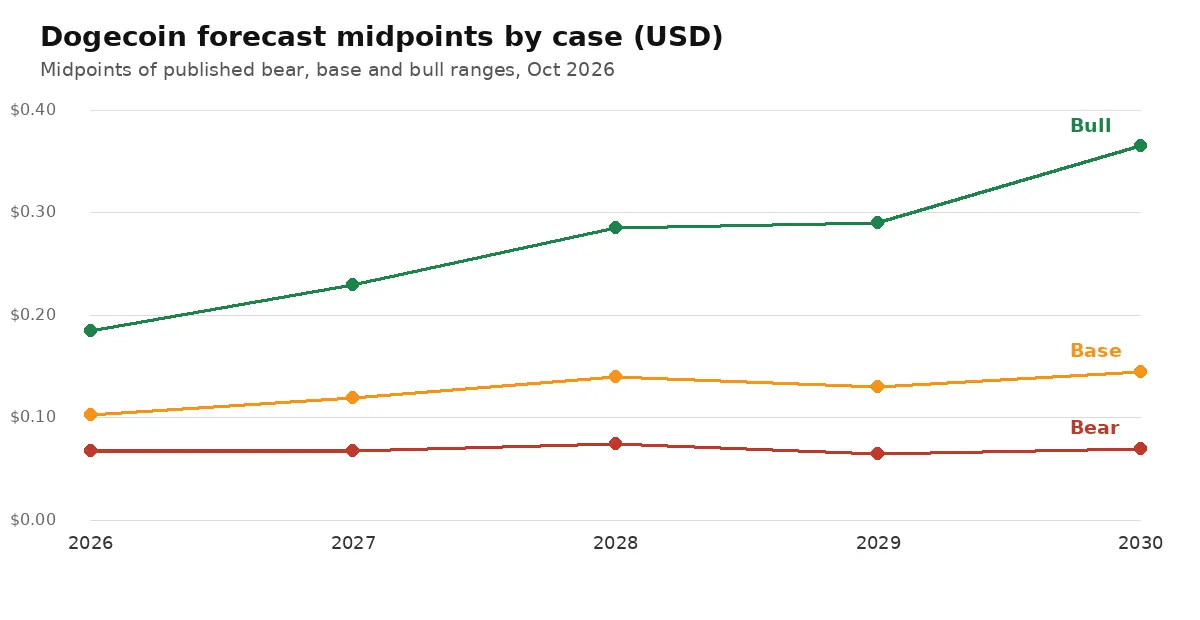
The chart below plots the middle of each range. The three paths stay close in 2026 and 2027, then split by 2030.
That split is honest, because small yearly gaps grow large over five years.
Why published forecasts disagree so much
Other forecasters land in very different places. A Finder expert panel in 2026 put DOGE at $0.20 at the end of 2026 and $0.45 in 2030.
CoinCodex put it near $0.09 at the end of 2026 and near $0.11 in 2030, while Coinbase models sat near $0.10 in 2030.
The gap comes from one choice: how much new demand each model assumes. Bullish models assume a fresh retail wave and real payment growth.
Cautious models assume demand stays flat while supply grows. Ask which story the data supports today, not which number feels best.
Can DOGE reach $1 by 2030?
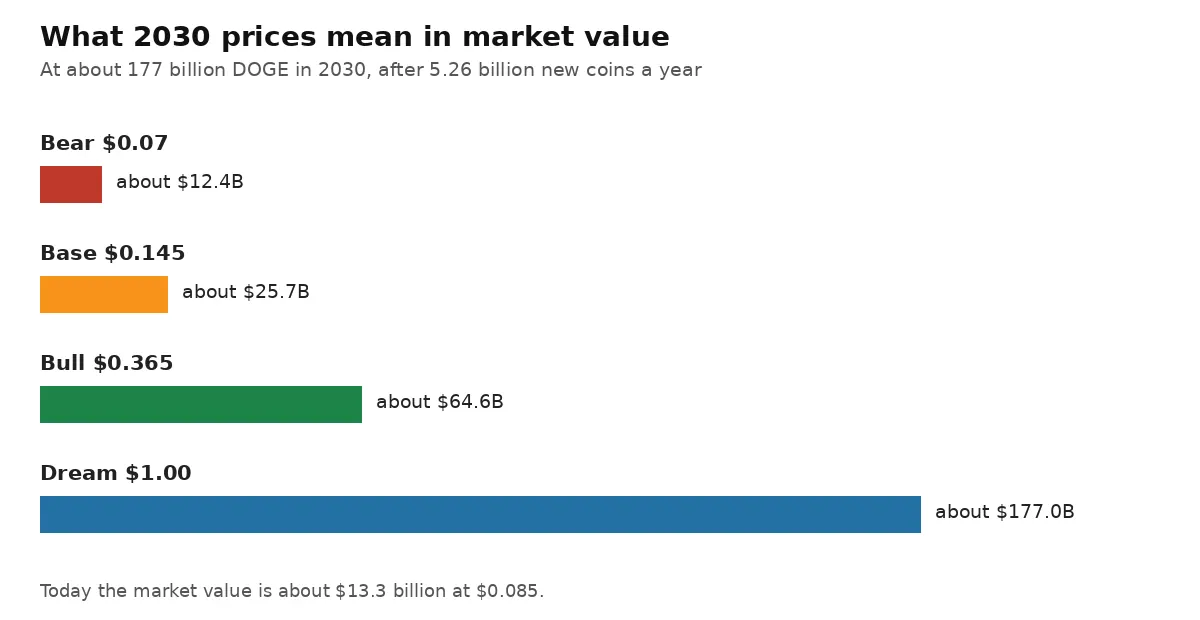
Do the supply math first. With about 177 billion coins in 2030, a $1 price needs a market value near $177 billion.
That is more than 13 times the value on October 13, and it would put a meme coin among the largest crypto assets in the world.
Our bull case stops at $0.45 for a reason. Even $0.45 needs a market value near $80 billion, close to DOGE at its 2021 peak mood.
$1 is not impossible in a wild cycle, but no careful base or bull case should promise it by 2030.
The Supply Problem: 5.26 Billion New Coins Every Year
Dogecoin pays miners 10,000 DOGE per block, and blocks arrive about once a minute. That adds near 5.26 billion new coins each year, with no cap and no end date.
At $0.085, the market must absorb roughly $450 million of new supply a year just to stand still.
The rate does fall in percent terms as supply grows. New coins equal about 3.4 percent of supply near 154 billion coins, and they would equal about 2.6 percent near 200 billion coins.
The pressure eases over time, but it never stops.
How DOGE supply compares with Bitcoin and Ethereum
Bitcoin caps supply at 21 million coins, and its new supply halves every four years. Ethereum burns part of its fees, so its supply can even shrink in busy periods.
DOGE has neither brake, which is why demand growth matters more for DOGE than for either rival.
That contrast shapes long term forecasts for every large coin. Our Ethereum price prediction 2026 2030 with bear, base and bull cases shows how a burn model supports a very different price path.
Payments, Tipping, and the DogeOS Test
DOGE began as a joke, but people do use it to tip creators and pay some shops. Fees stay low, blocks stay fast at about one minute, and the coin is easy for a new user to grasp.
That simple payment story is the strongest real use case DOGE has.
Use alone does not set the price, though. Most tipping volume is small, and a user can buy DOGE, send it, and sell it in minutes.
Price rises only when more people hold the coin than sell it, day after day.
What DogeOS could change, and what it cannot
DogeOS opened a public testnet on September 30, 2026. Developers can test payment, trading, and lending apps that sit above the main Dogecoin chain.
The testnet gives builders real tools, but it has no mainnet date yet.
Treat DogeOS as a bonus, not a base case. If its apps draw real users after a mainnet launch, demand could grow in a new way.
Until then, it changes the story around DOGE more than the cash that flows into it.
Dogecoin ETFs: Real Access, Tiny Money So Far
The first US Dogecoin ETF, the REX Osprey fund with ticker DOJE, launched on September 18, 2025, with a 1.5 percent fee. Our early report on the first Dogecoin ETF launch by REX Shares covered the hopes around that debut.
A year later, the money tells a calmer story.
Total assets across US Dogecoin ETFs reached only about $16.2 million in mid September 2026, after three weeks of inflows near $3.5 million. Grayscale GDOG held about $13.87 million of that total.
In the same week, US spot Bitcoin ETFs drew about $2.39 billion, more than 800 times the Dogecoin total.
Why the Bitwise fund closure matters
Bitwise will close its BWOW Dogecoin ETF, with the last trading day on October 14, 2026. The fund held only about $722,000 to $801,000, so its sale of coins is too small to move the price.
The signal matters more than the sale, because a major issuer found too little demand to keep the fund open.
Two US spot Dogecoin funds remain after the closure. If their assets grow from millions into hundreds of millions, our base case gets stronger.
If assets stay tiny through 2027, the ETF driver in bullish forecasts loses its force.
Social Hype Cycles: The Driver Nobody Can Schedule
DOGE moves hardest when social attention spikes. A celebrity post, a viral video, or a payment tease from a big platform can double the price in days.
Those spikes built the 2021 high, and they also faded fast once attention moved on.
Nobody can date the next spike. A forecast that needs one every year is a hope, not a plan.
Our cases assume at most brief hype lifts inside the ranges, with Bitcoin direction doing the heavy lifting.
How DOGE compares with XRP and Cardano in 2030 forecasts
Payment linked rivals face the same Bitcoin weather, but they sell clearer utility stories to funds. Our XRP price prediction 2026 to 2030 and our Cardano price prediction 2026 2030 both lean on legal and network milestones that DOGE does not have.
That does not make DOGE a bad hold for fans. It means its forecast rests more on mood and community size than on cash flow or fees.
Price your risk with that fact in front of you.
Common Mistakes DOGE Buyers Make
The first mistake is treating $1 as a near term target because the coin looks cheap. A low unit price means nothing when supply sits near 156 billion coins.
Market value, not unit price, tells you how big the asset already is.
The second mistake is buying a hype spike at its peak. DOGE often gives back half a spike within weeks.
A calmer entry during quiet weeks has served buyers better than chasing green candles.
Risk rules that fit a meme coin
Keep any DOGE position small enough that a 50 percent fall does not hurt your wider plans. Meme coins can fall that far without any bad news at all.
Never borrow to buy DOGE, and never hold money you need this year in it.
Our guide to buying altcoins the right way, with categories and steps gives a simple frame for sizing altcoin bets. It helps you place DOGE in the high risk bucket where it belongs.
Frequently Asked Questions
What is the Dogecoin price prediction for 2030?
Our base case puts DOGE between $0.11 and $0.18 in 2030. The bull case reaches $0.28 to $0.45, and the bear case stays between $0.05 and $0.09.
Can Dogecoin reach $1 by 2030?
A $1 price in 2030 needs a market value near $177 billion, more than 13 times the value in October 2026. No careful base or bull case in this article promises $1 by 2030.
What price did Dogecoin trade at in October 2026?
DOGE traded near $0.085 on October 13, 2026. It sat about 89 percent below its $0.74 high from May 2021.
How many new Dogecoin are created each year?
Miners add about 5.26 billion new DOGE each year. The coin has no supply cap, so new supply never stops.
Are Dogecoin ETFs a big price driver?
Not yet, because US Dogecoin ETF assets were only about $16.2 million in September 2026. Bitwise also closes its BWOW fund on October 14, 2026, after weak demand.
Conclusion
Dogecoin enters late 2026 near $0.085, with strong support near $0.080 and a hard ceiling near $0.09 to $0.10. Our base case sees slow growth to $0.11 to $0.18 by 2030.
The bull case needs a market value near $80 billion to reach $0.45.
Your next step is simple. Watch the $0.09 reclaim, track ETF assets each month, and size any position for meme coin risk.
If those three checks improve together, the base case can move up. If they fade, the bear case is already written.