



If you are asking whether Bitcoin mining is still profitable in 2026, here is the honest answer in one sentence: it is profitable only if your electricity costs less than about ten cents per kilowatt-hour and your hardware beats 16 joules per terahash.
Everyone else is paying to mine. This is not a guess. The network numbers from the first days of October 2026 make the math brutally clear, and in this guide I will show you the exact calculation, machine by machine, so you can decide for yourself before you spend a single dollar on hardware.

Bitcoin itself is still going strong. The price is sitting near $84,500 at the start of October 2026, up from a summer dip below $58,000. But a rising price does not save a bad mining setup. To understand why, you first need to understand what Bitcoin is at the network level: a system where miners compete for a fixed pool of rewards, and the competition only gets tougher.
- Key takeaways
- Why Bitcoin mining in 2026 is a math problem, not a belief
- The real numbers right now (October 2026)
- The honest math: one Antminer S21 Pro, three electricity bills
- Which machines are alive in 2026, and which are dead
- The costs the calculators never mention
- Five mistakes that turn mining into a donation
- When home mining still makes sense
- Frequently asked questions
- Is Bitcoin mining still profitable in 2026?
- How much can one ASIC miner earn per month?
- Is it too late to start mining Bitcoin?
- Can I mine Bitcoin on my phone or laptop?
- What happens to mining profits after the 2028 halving?
- Is mining better than just buying Bitcoin?
- The bottom line
Key takeaways
- Is Bitcoin mining still profitable in 2026? Yes for industrial miners and lucky home miners with cheap power. No for most people paying normal residential rates.
- The break-even line for a current-generation ASIC is roughly $0.10 to $0.11 per kWh of electricity. The US residential average in 2026 is $0.18 per kWh.
- An Antminer S21 Pro (234 TH/s) earns about $9.24 a day in gross revenue at current difficulty. At average US power prices, it loses nearly $6 a day.
- Hardware from before 2024, like the S19 series, is effectively dead for home mining at any normal power rate.
- Difficulty hit a record 132.76 trillion in September 2026 and keeps rising. Your share of the rewards shrinks every month your costs stay the same.
Why Bitcoin mining in 2026 is a math problem, not a belief
People talk about mining like it is a lottery ticket or a passive income dream. It is neither. Mining is a factory business. Money comes in on one side (block rewards), money goes out on the other side (electricity), and the owner of the cheapest input wins.
The revenue side is decided by three things: the Bitcoin price, the network difficulty, and the fixed block subsidy of 3.125 BTC per block. Miners do not control any of them. The cost side is decided by two things: your hardware efficiency and your electricity rate. You control both.
That is why the same machine can be a money printer for a miner in Texas with 5-cent power and a money bonfire for a miner in California paying 33 cents. Before we go further, if you are new to the mechanics, read our guide on how Bitcoin mining works. The rest of this article is the money half of that story.
The real numbers right now (October 2026)
Here is the state of the network as I write this, with sources you can check yourself:

- Bitcoin price: around $84,500 to $86,500 in early October 2026, after a 43% Q3 rally that brought BTC back from a $58,000 low.
- Network difficulty: 132.76 trillion, a record set at the September 19 retarget, with another upward adjustment projected for October 3. Competition has never been higher.
- Hashprice: about $39.49 per petahash per second per day, per Hashrate Index. This single number combines price, difficulty, and fees. It is the most honest revenue figure in mining.
- Block subsidy: 3.125 BTC. Transaction fees add barely anything, roughly under 1% of miner revenue right now.
- Production cost: JPMorgan estimates it costs large miners about $85,000 to produce one Bitcoin. Notice how close that is to the current price. The industry is running on thin margins.
Difficulty matters more than most beginners think. Every 2,016 blocks, roughly every two weeks, the network retunes difficulty so blocks arrive every ten minutes. More machines joining means higher difficulty, which means your machine’s slice of the fixed reward pie gets smaller. Look at the trend since September:
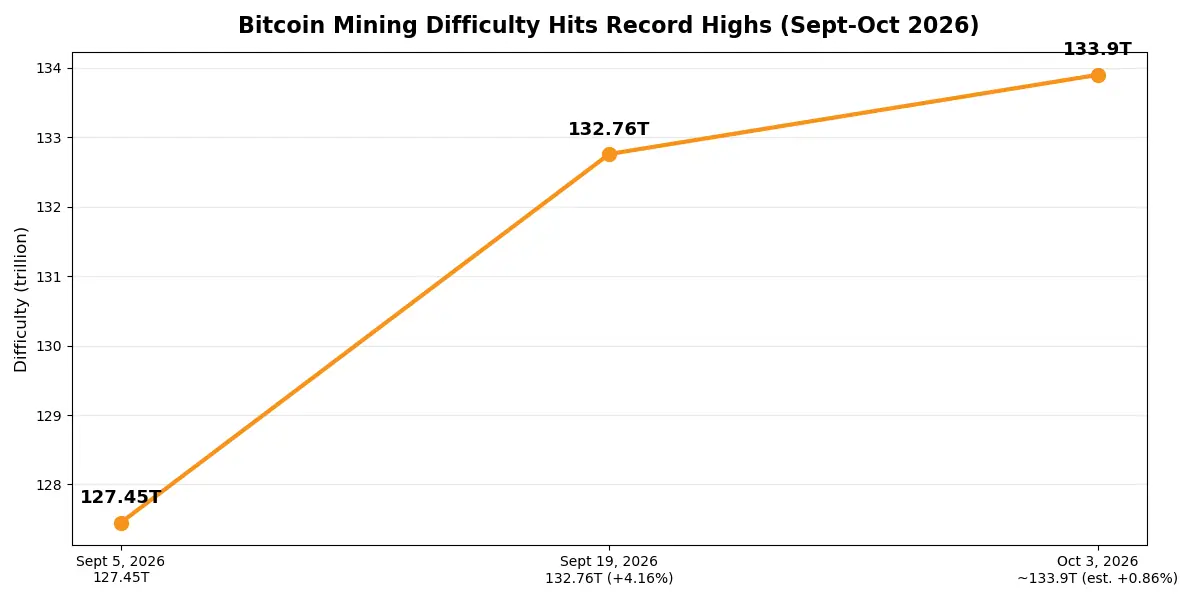
September’s 4.16% jump cut every miner’s expected production by about 4% overnight. That is the treadmill you are running on. For context on where the price side of the equation might go, see what analysts expect Bitcoin to do through the rest of 2026.
The honest math: one Antminer S21 Pro, three electricity bills
The Antminer S21 Pro is the workhorse of 2026. It pushes 234 terahashes per second, draws 3,510 watts, and runs at 15 joules per terahash. Street price for a new unit sits between about $2,000 and $3,100. Let me run the full calculation step by step.
Step 1: daily revenue. The machine has 0.234 petahashes. At $39.49 per petahash per day, gross revenue is 0.234 x $39.49 = $9.24 per day. In Bitcoin terms, that is about 0.000109 BTC a day, or 0.00328 BTC a month, worth roughly $277 at current prices.
Step 2: daily electricity use. 3.51 kilowatts running 24 hours = 84.24 kWh per day. That is like running two and a half electric space heaters nonstop.
Step 3: subtract power cost. This is where everything is decided:
| Electricity rate | Daily power cost | Daily net (before pool fees) | Monthly net |
|---|---|---|---|
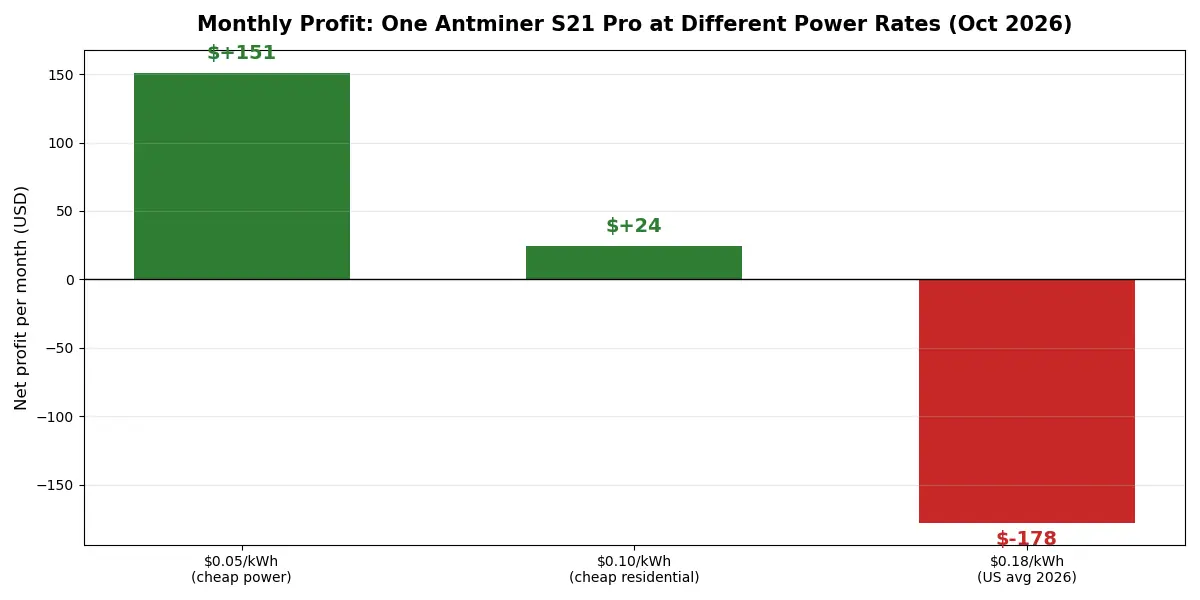
| $0.05/kWh (cheap industrial/hosted) | $4.21 | +$5.03 | +$151 |
| $0.10/kWh (cheap residential) | $8.42 | +$0.82 | +$25 |
| $0.18/kWh (US average 2026, EIA) | $15.16 | -$5.92 | -$178 |
Read that table again. At the average American residential rate, this brand-new, top-tier machine loses $178 a month. You would literally be paying money for the privilege of mining. At 10 cents, you make $25 a month, meaning your $2,000 to $3,100 machine needs 7 to 10 years to pay for itself. Only at 5 cents does the picture look healthy: about $151 a month, a payback of roughly 20 months on a $3,000 machine.
And that payback assumes difficulty never rises. It always rises.
Here is the uncomfortable comparison most mining sellers hope you never make. Take that same $3,000 and buy Bitcoin directly at $84,500. You get 0.0355 BTC today, instantly. Mine with it at 5-cent power for 20 months and you net roughly the same amount of Bitcoin, after dealing with noise, heat, and a machine slowly becoming obsolete. If difficulty keeps climbing, and it has been, the buyer beats the miner. Mining is not magic. It is buying Bitcoin with extra steps and extra risk.
Which machines are alive in 2026, and which are dead
Efficiency is measured in joules per terahash. Lower is better. Here is the honest lineup, using the same October 2026 hashprice for all of them:
| Machine | Hashrate / power | Efficiency | Break-even power rate | Verdict |
|---|---|---|---|---|
| Antminer S23 Hydro | 580 TH/s, 5,510W | 9.5 J/TH | ~$0.17/kWh | Best margins, but needs hydro setup and high voltage |
| Antminer S21 XP | 270 TH/s, 3,645W | 13.5 J/TH | ~$0.12/kWh | Solid for cheap residential power |
| Antminer S21 Pro | 234 TH/s, 3,510W | 15 J/TH | ~$0.11/kWh | Workhorse, profitable only under ~10 cents |
| Antminer S19 Pro | 110 TH/s, 3,250W | 29.5 J/TH | ~$0.055/kWh | Dead for home use at any normal rate |
The S19 Pro was the king of 2021. In 2026 it earns $4.34 a day and burns 78 kWh doing it. Unless your power is under 5.5 cents, it loses money every hour it runs. This is why the used market is full of cheap S19s. They are not bargains. They are retired athletes being sold as racehorses.
The costs the calculators never mention
Online calculators give you revenue minus electricity and call it profit. Here is what they leave out, and it matters:
Noise. An air-cooled ASIC runs at 75 to 76 decibels, roughly a vacuum cleaner that never turns off. Your neighbors will hear it through the wall. Your family will hear it through the door. Immersion cooling fixes this but costs thousands more.
Heat. 3.5 kilowatts of heat, 24 hours a day, is two space heaters in July. In winter it is free heating, which is genuinely nice. In summer you are paying for air conditioning on top of the miner.
Power setup. These machines need 220 to 240 volt circuits. A standard US wall outlet is 120 volts. You may need an electrician before you mine a single satoshi.
Pool fees and downtime. Pools take 1 to 2%. Real uptime is never 100%: firmware updates, reboots, internet outages, and thermal shutdowns shave off another 2 to 5%. Knock at least 5% off any calculator number.
Difficulty growth. This is the silent killer. Your machine earns a fixed share of a shrinking slice. Models that assume flat difficulty are fantasy. Historically, difficulty has trended up year after year as more efficient machines join the network.
Hardware depreciation. ASICs lose value fast. A $3,000 machine today might fetch half that in 18 months as newer models arrive. If you never reach payback, the hardware is a sunk cost, not an investment.
The 2028 halving. In about April 2028, the block subsidy drops from 3.125 BTC to 1.5625 BTC. That is roughly 18 months away. Any machine you buy today will see its revenue cut in half unless the Bitcoin price doubles to compensate. Read our breakdown of the 2028 Bitcoin halving to understand why hardware cycles are planned around this event, and check the bull and bear cases for the Bitcoin price to see what kind of price action miners are hoping for.
Five mistakes that turn mining into a donation
After watching beginners enter this space for years, the same errors repeat:
1. Buying old hardware because it is cheap. A used S19 for $500 looks like a steal until it eats $10 of electricity a day to make $4.34. The purchase price is the smallest number in mining.
2. Forgetting the electrician. Budget for 240V wiring, breakers, and ventilation. For many homes this adds $500 to $2,000 before the machine even powers on.
3. Mining at average residential rates. The EIA projects the 2026 US residential average at 18.2 cents per kWh. At that rate, no air-cooled home miner makes money. Check your actual bill, including delivery charges, not just the generation rate.
4. Ignoring the halving countdown. Buying a machine with a 20-month payback when the subsidy halves in 18 months is betting that the price doubles on schedule. Sometimes it does. It is not a plan.
5. Selling the mined coins immediately at a loss. If your all-in cost to mine a Bitcoin is above the market price, every coin you sell locks in a loss. Some miners hold through the cycle, betting the price rises. That turns mining into a leveraged long on Bitcoin, which is a strategy, but be honest with yourself that this is what you are doing.
When home mining still makes sense
This is not a doom piece. Mining can work at home, but only in specific situations:
- Genuinely cheap power: off-peak tariffs, solar surplus, or rural rates under 7 cents per kWh.
- Heat reuse: if the miner replaces your winter heating, its waste heat has real value. This is the most honest use case in cold climates.
- Lottery mining: tiny, quiet miners like the BitAxe will almost certainly never win a block, but they cost little, sip power, and give you a real, tiny chance at the full 3.125 BTC reward. Fun money, not income.
- Supporting the network: some people mine to learn, to support decentralization, or to earn Bitcoin without going through an exchange. Those are valid reasons, just not profit reasons.
For an honest look at gentler on-ramps, our piece on greener ways to mine crypto in 2026 covers options that do not involve a roaring 3.5 kW box in your garage.
A miner shares 3.5 years of real results: halving impact, difficulty, and honest S19/S21 profitability numbers.
Frequently asked questions
Short answers to the questions every beginner asks:
Is Bitcoin mining still profitable in 2026?
It is profitable only with electricity under about $0.10 per kWh and hardware better than 16 J/TH. Industrial miners with power under $0.05 per kWh do fine. Most home miners on residential rates lose money. The honest test: is Bitcoin mining still profitable in 2026 for YOUR power bill? Run the math above with your actual rate before buying anything.
How much can one ASIC miner earn per month?
An Antminer S21 Pro grosses about $277 a month in Bitcoin at October 2026 difficulty and prices. After electricity at 5 cents per kWh, you keep about $151. At 10 cents you keep about $25. At the US average of 18 cents, you lose about $178 a month. These are snapshots, not promises: difficulty and price move constantly.
Is it too late to start mining Bitcoin?
It is not too late, but the bar is higher than ever. Record difficulty of 132.76 trillion means you need the newest hardware and cheap power just to break even. The 2028 halving will raise the bar again. Latecomers with expensive power are the ones who lose.
Can I mine Bitcoin on my phone or laptop?
No. Bitcoin mining requires specialized ASIC hardware. Phones and laptops cannot compete with machines doing hundreds of trillions of hashes per second. So-called mining apps on phones are simulations or cloud contracts, not real mining.
What happens to mining profits after the 2028 halving?
The block reward drops from 3.125 to 1.5625 BTC, cutting miner revenue roughly in half unless the price doubles or fees surge. Historically, halvings have been followed by price rallies, but nothing is guaranteed. Plan any hardware purchase around this date.
Is mining better than just buying Bitcoin?
For most people, buying wins. Three thousand dollars buys you about 0.0355 BTC instantly at current prices. Mining that much with one machine at cheap power takes roughly 20 months, and you absorb hardware risk, difficulty growth, and operational hassle along the way. Mining only beats buying if your power is very cheap and you hold the coins through a price rise.
The bottom line
So, is Bitcoin mining still profitable in 2026? The honest math says: for industrial miners with cheap power, yes. For a homeowner with an average electric bill, no. The break-even line sits around ten cents per kilowatt-hour, and most of the developed world pays more than that.
This is not a reason to hate mining. It is a reason to respect it. Mining secures the network, and the miners who survive are the disciplined ones who treat it as a business: cheap power, current hardware, realistic projections, and an exit plan before the halving.
If you decide to proceed, do one thing first: take your machine’s hashrate, multiply by the current hashprice, subtract your real power cost, and then cut the result by 10% for fees and downtime. If that number is still positive, you have a business. If it is not, you have a very loud, very hot donation to the Bitcoin network. And once those coins land, learn how to keep them with our guide to storing Bitcoin safely.